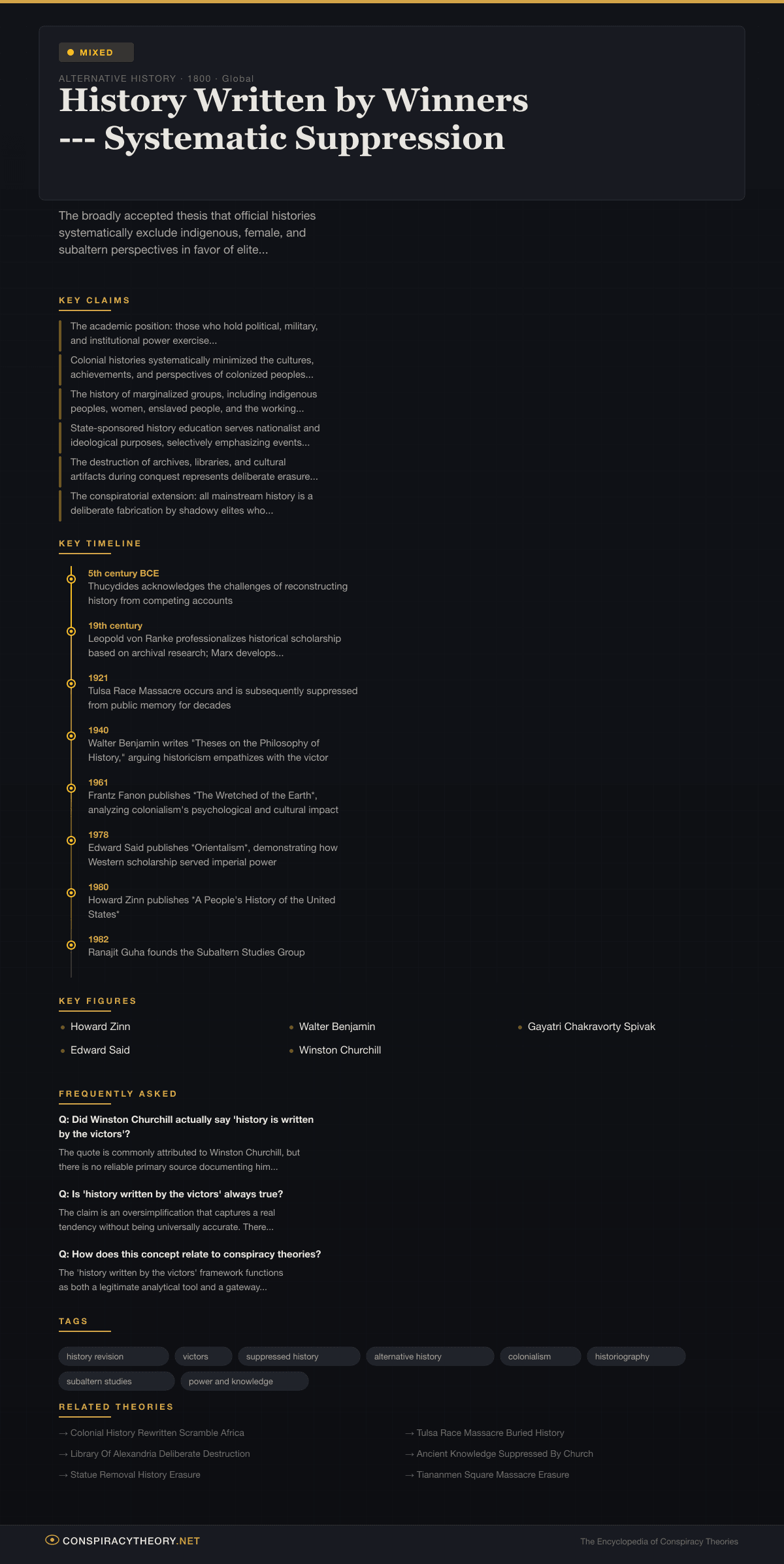
History Written by Winners --- Systematic Suppression

Overview
The proposition that “history is written by the victors” encompasses a range of claims from the academically mainstream to the conspiratorially extreme. At its most defensible, it describes the well-documented phenomenon by which those who hold political, military, economic, and institutional power exercise disproportionate influence over which historical narratives are preserved, taught, and disseminated. At its most extreme, it asserts that the entirety of mainstream historical knowledge is a fabrication serving elite interests, and that the true history of humanity has been systematically suppressed.
The academic version of this thesis has been articulated by scholars across multiple disciplines and intellectual traditions. Howard Zinn’s A People’s History of the United States (1980) presented American history from the perspective of workers, minorities, women, and the colonized. Walter Benjamin’s “Theses on the Philosophy of History” (1940) argued that historicism inevitably empathizes with the victor. Edward Said’s Orientalism (1978) demonstrated how Western scholarship constructed knowledge about the East that served imperial interests. The Subaltern Studies Group, inspired by Antonio Gramsci and led by scholars like Ranajit Guha and Gayatri Spivak, examined how colonial and elite historiography erased the perspectives and agency of subordinate populations.
The theory carries a “mixed” status because the academic observation about power’s influence on historical narrative is well-supported and widely accepted, while the conspiratorial extension that all mainstream history is deliberate fabrication is an overstatement that collapses important distinctions between bias, omission, and fabrication.
Origins & History
The recognition that power influences historical narrative is as old as historiography itself. Thucydides, writing in the 5th century BCE, acknowledged the challenges of reconstructing events from competing and self-interested accounts. However, the systematic analysis of how power structures shape historical knowledge is primarily a product of the Enlightenment and its aftermath.
The 19th century saw the professionalization of historical scholarship under the influence of Leopold von Ranke, who advocated for history based on primary sources and archival research, pursued “as it actually happened” (wie es eigentlich gewesen). While Ranke’s methodology represented an advance in rigor, critics later noted that his emphasis on diplomatic and political history, drawn primarily from state archives, inherently privileged the perspectives of states and their leaders while marginalizing the experiences of ordinary people, women, colonized populations, and other groups who left fewer state-recognized archival records.
Karl Marx’s materialist conception of history, developed in the mid-19th century, provided an influential framework for understanding how economic structures shape not only material conditions but also the ideas, narratives, and cultural productions of a society. Marx’s concept of ideology as a system of ideas serving dominant class interests became foundational for subsequent analyses of how power operates through knowledge production, including historical knowledge.
In the 20th century, the critique of victor’s history took on new urgency in the context of colonialism and its aftermath. The Indian Subaltern Studies Group, founded by Ranajit Guha in 1982, examined how British colonial historiography had erased the agency of Indian peasants and workers, presenting colonial rule as either benevolent modernization or a contest between Indian elites, with the masses appearing only as objects of policy or passive followers. Guha’s work showed that peasant rebellions, resistance movements, and alternative social formations had their own internal logic and historical significance that colonial and nationalist historiography alike had obscured.
Edward Said’s Orientalism (1978) demonstrated how Western academic, literary, and artistic representations of the “Orient” constituted a system of knowledge that justified and enabled imperial domination. Said showed that scholarly knowledge was not neutral but was embedded in power relations, and that the production of knowledge about colonized peoples was inseparable from the exercise of power over them.
Howard Zinn’s A People’s History of the United States (1980) brought the critique of elite historiography to a mass American audience. Zinn’s narrative, which began with Columbus’s arrival from the perspective of the Arawak people rather than the European explorers, explicitly challenged the patriotic consensus that dominated American history education. The book has sold over two million copies and remains one of the most widely read works of American historiography, though it has also been criticized by professional historians for its own selectivity and interpretive biases.
The concept entered conspiracy theory discourse through a different pathway. For conspiracy theorists, “history is written by the victors” functions not as a call for more rigorous and inclusive historiography but as a blanket dismissal of all established historical narratives. This version of the argument holds that mainstream history is not merely biased or incomplete but is fundamentally fabricated, and that the true history of humanity has been deliberately suppressed by powerful forces ranging from governments and churches to secret societies and shadowy global elites.
Key Claims
- The academic position: those who hold political, military, and institutional power exercise disproportionate influence over which historical narratives are preserved, taught, and disseminated
- Colonial histories systematically minimized the cultures, achievements, and perspectives of colonized peoples while presenting colonialism as civilizing mission
- The history of marginalized groups, including indigenous peoples, women, enslaved people, and the working class, has been systematically underrepresented in mainstream historical education
- State-sponsored history education serves nationalist and ideological purposes, selectively emphasizing events and figures that support dominant political narratives
- The destruction of archives, libraries, and cultural artifacts during conquest represents deliberate erasure of alternative historical records
- The conspiratorial extension: all mainstream history is a deliberate fabrication by shadowy elites who have suppressed humanity’s “true” history
- Alternative historical narratives are dismissed or suppressed not because they lack evidence but because they threaten powerful interests
- Modern media, education systems, and academic institutions continue to serve as gatekeepers for establishment historical narratives
Evidence
The evidence supporting the general thesis that power influences historical narrative is extensive and well-documented across multiple academic disciplines.
Concrete examples of historical suppression are numerous and verifiable. The Tulsa Race Massacre of 1921, in which a white mob destroyed the prosperous Black community of Greenwood, Oklahoma, killing an estimated 100-300 people, was systematically excluded from Oklahoma history textbooks and public memory for decades. The massacre’s history was recovered primarily through the work of Black historians and journalists, and Oklahoma did not include it in state educational curriculum until the 21st century.
The Belgian Congo’s history under King Leopold II, which involved forced labor, mutilation, and the deaths of millions of Congolese people, was systematically downplayed in Belgian education and public memory until relatively recently. Adam Hochschild’s King Leopold’s Ghost (1998) brought this history to widespread public attention in the English-speaking world.
The Armenian Genocide of 1915, in which the Ottoman government systematically killed approximately 1.5 million Armenians, was denied by successive Turkish governments for over a century, with diplomatic pressure applied to prevent international recognition. This represents an ongoing case of state-sponsored historical suppression.
In Japan, the content of history textbooks regarding World War II atrocities, including the Nanjing Massacre and the comfort women system, has been a persistent point of controversy, with conservative forces pressing for narratives that minimize Japanese responsibility.
In the United States, the history of indigenous peoples, the full scope of slavery’s brutality, and the extent of racial violence during the Jim Crow era were systematically underrepresented in mainstream education for generations, a deficiency that ongoing curriculum reforms continue to address.
However, the evidence also shows that the “victors write history” thesis is not absolute. The Confederate “Lost Cause” narrative, constructed by the losers of the American Civil War, dominated Southern and to some extent national historiography for a century. The historical traditions of Judaism, maintained through centuries of persecution and diaspora, demonstrate that defeated and marginalized peoples can preserve detailed historical accounts. The global spread of anti-colonial nationalist histories during the 20th century shows that alternative narratives can eventually challenge and displace imperial ones.
Debunking / Verification
The “mixed” status reflects the distinction between the well-supported academic observation and its conspiratorial overextension.
The academic thesis that power influences historical narrative is confirmed by extensive scholarship and concrete examples. No serious historian disputes that colonial, nationalist, and institutional biases have shaped historical knowledge, or that the recovery of marginalized perspectives is important scholarly and ethical work.
However, the conspiratorial version, which holds that all mainstream history is deliberate fabrication, fails on several grounds. Modern historiography is a global enterprise conducted by hundreds of thousands of scholars across diverse national, ideological, and institutional contexts. A coordinated suppression of “true history” would require a conspiracy of implausible scope. Furthermore, the very scholars who have done the most to recover suppressed historical narratives, from Zinn to Said to the Subaltern Studies Group, have worked within mainstream academic institutions using standard scholarly methods, demonstrating that the system is capable of self-correction.
The conspiratorial version also tends toward unfalsifiability: if mainstream history is dismissed as victor’s propaganda, any alternative narrative, regardless of its evidentiary basis, can claim legitimacy simply by being alternative. This reasoning is used to support claims ranging from the genuinely suppressed (the Tulsa Massacre) to the demonstrably false (Tartarian empire conspiracy theories), treating all challenges to consensus history as equivalent.
Cultural Impact
The “history written by the victors” framework has had enormous influence across academic, educational, political, and popular culture.
In academia, the critique of victor’s history has produced transformative scholarship. Social history, cultural history, women’s history, labor history, postcolonial studies, and subaltern studies have all expanded the range of perspectives represented in historical scholarship. The discipline of history is significantly more diverse in its subjects, methods, and practitioners than it was a half-century ago, in substantial part because of the analytical framework that the “victors” critique provided.
In education, debates about whose history gets taught have become among the most politically charged issues in contemporary culture. Controversies over textbook content in the United States, Japan, Turkey, and many other countries reflect the ongoing practical significance of questions about historical narrative and power. The American debates over Critical Race Theory in education are, at their core, arguments about whether the historical narratives taught in schools adequately represent the experiences of marginalized communities.
In popular culture, the aphorism “history is written by the victors” has become one of the most frequently cited quotations in discussions of knowledge and power. It appears in films, television shows, video games, and social media discourse, functioning as a shorthand for skepticism about official narratives.
Within conspiracy theory communities, the framework serves as a foundational justification for rejecting mainstream accounts of virtually any historical event. This application, while drawing on a legitimate scholarly insight, extends it far beyond what the evidence supports and often serves to legitimate unfounded claims by associating them with the genuine scholarly project of recovering suppressed histories.
Timeline
- 5th century BCE — Thucydides acknowledges the challenges of reconstructing history from competing accounts
- 19th century — Leopold von Ranke professionalizes historical scholarship based on archival research; Marx develops materialist conception of history
- 1921 — Tulsa Race Massacre occurs and is subsequently suppressed from public memory for decades
- 1940 — Walter Benjamin writes “Theses on the Philosophy of History,” arguing historicism empathizes with the victor
- 1961 — Frantz Fanon publishes The Wretched of the Earth, analyzing colonialism’s psychological and cultural impact
- 1978 — Edward Said publishes Orientalism, demonstrating how Western scholarship served imperial power
- 1980 — Howard Zinn publishes A People’s History of the United States
- 1982 — Ranajit Guha founds the Subaltern Studies Group
- 1988 — Gayatri Spivak publishes “Can the Subaltern Speak?”
- 1998 — Adam Hochschild publishes King Leopold’s Ghost, bringing Belgian Congo atrocities to public attention
- 2001 — Tulsa Race Massacre Commission publishes findings; public recognition begins
- 2019-present — Debates over Critical Race Theory in American education intensify, centering on whose historical narratives should be taught
- 2020s — Social media amplifies both legitimate historical recovery projects and conspiratorial applications of the “victors write history” framework
Sources & Further Reading
- Zinn, Howard. A People’s History of the United States. Harper & Row, 1980.
- Said, Edward W. Orientalism. Pantheon Books, 1978.
- Benjamin, Walter. “Theses on the Philosophy of History.” 1940. In Illuminations, edited by Hannah Arendt.
- Guha, Ranajit, ed. Subaltern Studies (multi-volume series). Oxford University Press India, 1982-present.
- Spivak, Gayatri Chakravorty. “Can the Subaltern Speak?” In Marxism and the Interpretation of Culture, edited by Cary Nelson and Lawrence Grossberg, 1988.
- Hochschild, Adam. King Leopold’s Ghost. Houghton Mifflin, 1998.
- Fanon, Frantz. The Wretched of the Earth. Grove Press, 1961.
- Trouillot, Michel-Rolph. Silencing the Past: Power and the Production of History. Beacon Press, 1995.
![Photograph taken in Heidelberg, April 1964,[1] by Jeremy J. Shapiro at the Max Weber-Soziologentag. Horkheimer is front left, Adorno front right, and Habermas is in the background, right, running his hand through his hair. Siegfried Landshut is in the background left. — related to History Written by Winners --- Systematic Suppression](/images/theories/victor-history-winners-suppression/body.jpg)
Frequently Asked Questions
Did Winston Churchill actually say 'history is written by the victors'?
Is 'history written by the victors' always true?
How does this concept relate to conspiracy theories?
Infographic
Share this visual summary. Right-click to save.