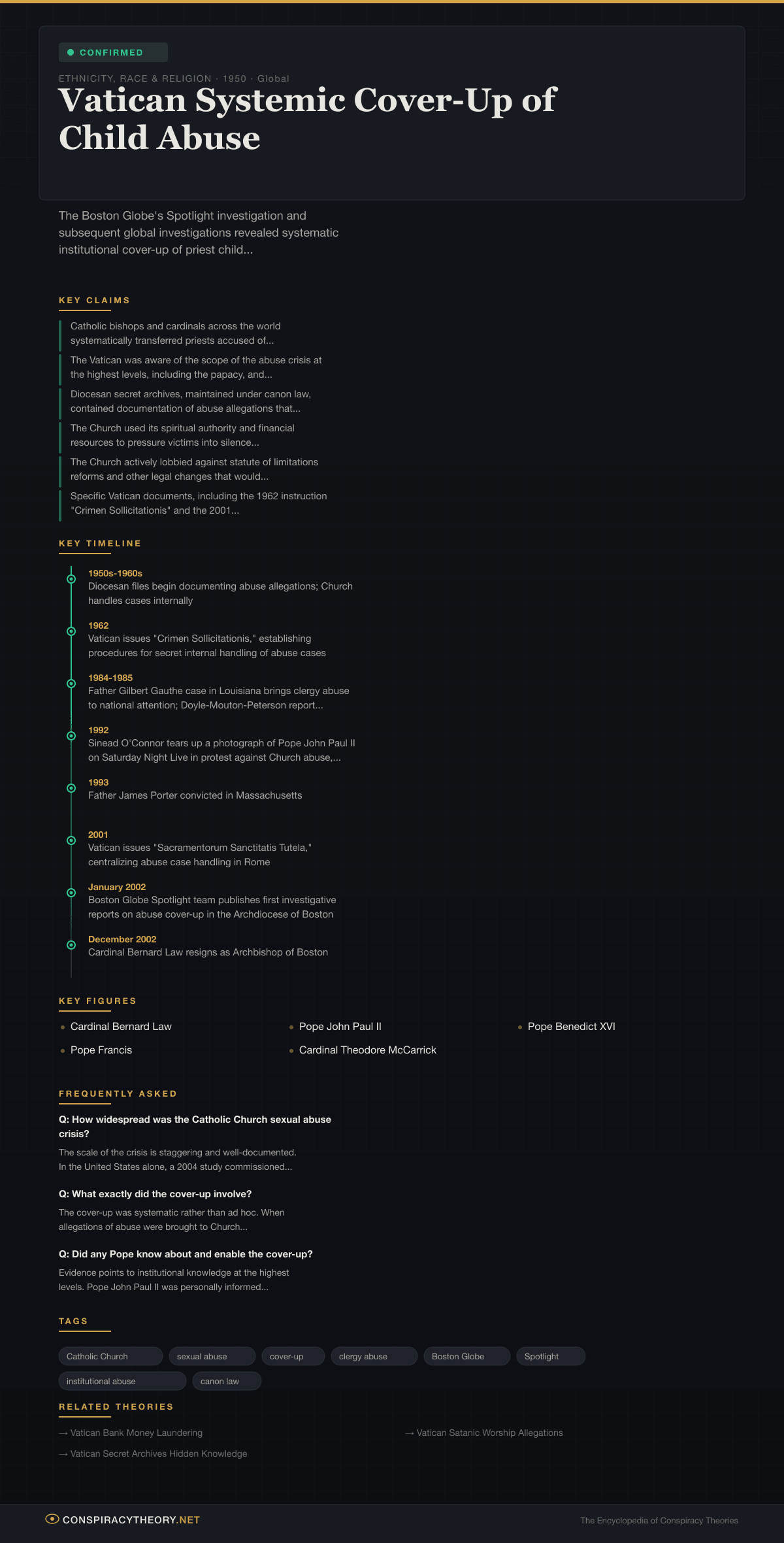
Vatican Systemic Cover-Up of Child Abuse

Overview
The systematic cover-up of child sexual abuse within the Catholic Church is among the most extensively documented institutional conspiracies in modern history. What was long dismissed as anti-Catholic prejudice, isolated incidents, or the exaggerations of disgruntled individuals has been conclusively established through criminal investigations, grand jury reports, government commissions, and the Church’s own internal documents as a global pattern of institutional behavior spanning at least six decades and virtually every country where the Catholic Church operates.
The conspiracy was not a conspiracy in the popular sense of a secret plot hatched by a small group. Rather, it was a systematic institutional response pattern in which Church authorities at every level, from parish priests to cardinals to popes, prioritized the protection of the institution’s reputation over the safety of children. Accused priests were transferred rather than reported to police. Victims were pressured into silence through spiritual authority and legal settlements with non-disclosure agreements. Secret files documented abuse allegations that were never shared with law enforcement. And the Church actively lobbied against legal reforms that would have facilitated prosecution of abusers and institutional accountability.
The theory carries a “confirmed” status because its central claims have been verified through government investigations and judicial proceedings in the United States, Ireland, Australia, Germany, France, the Netherlands, Belgium, Chile, and numerous other countries, often using the Church’s own internal documents as evidence.
Origins & History
While instances of clergy sexual abuse undoubtedly extend much further into history, the documented crisis as understood today begins in the mid-20th century. The earliest systematic record-keeping of abuse cases within the Church appears to date from the 1950s, when dioceses began maintaining files on priests accused of inappropriate behavior with minors. These files, which were kept in diocesan “secret archives” as permitted under canon law, documented a pattern of abuse that Church authorities were aware of but chose to manage internally.
The first major public exposure of the crisis came in 1984-1985 with the case of Father Gilbert Gauthe in Lafayette, Louisiana, who was convicted of molesting dozens of children. The case attracted significant media attention, and attorney F. Ray Mouton, hired by the diocese, co-authored a confidential report with Father Thomas Doyle and psychiatrist Michael Peterson warning Church leaders that the abuse crisis was far larger than any individual case and would result in catastrophic legal and public relations consequences if not addressed systematically. The report was presented to the US Conference of Catholic Bishops but largely ignored.
Throughout the 1990s, individual cases continued to surface in the media, and settlements with victims accumulated into the hundreds of millions of dollars. Father James Porter in Massachusetts was convicted in 1993 of abusing 28 children. Father John Geoghan in Boston was accused of abusing over 130 children over three decades while being transferred between parishes by Cardinal Bernard Law.
The watershed moment came in January 2002, when the Boston Globe’s investigative team, known as the Spotlight team, published a series of articles documenting that Cardinal Law and the Archdiocese of Boston had systematically transferred known abuser priests between parishes for decades, allowing them continued access to children. The reporting, based in part on sealed court documents that the Globe had successfully fought to unseal, revealed that the archdiocese had known about and concealed abuse by dozens of priests, including Geoghan, Paul Shanley, and many others.
The Spotlight investigation triggered a global reckoning. Investigations, lawsuits, and media exposures followed in rapid succession across countries. In Ireland, the Ferns Report (2005), the Ryan Report (2009), and the Murphy Report (2009) documented decades of abuse in Catholic institutions including industrial schools, Magdalene laundries, and diocesan parishes. The Ryan Report found that physical and sexual abuse was “endemic” in Catholic-run institutions for children.
In the United States, the John Jay Report, commissioned by the US Conference of Catholic Bishops and published in 2004, found that 4,392 priests had been credibly accused of abusing 10,667 minors between 1950 and 2002 — approximately 4% of all priests active during that period. In 2018, a Pennsylvania grand jury report documented over 1,000 victims and 300 predator priests across six dioceses over 70 years, and noted that the actual numbers were likely higher because records had been destroyed and victims had died or remained silent.
Australia’s Royal Commission into Institutional Responses to Child Sexual Abuse (2013-2017) was one of the most comprehensive investigations ever conducted, spanning five years, taking testimony from thousands of survivors, and examining institutions including but not limited to the Catholic Church. The Commission found that 7% of all Catholic priests active between 1950 and 2010 had been accused of abuse, with some religious orders having accusation rates exceeding 20%.
In France, the Sauve Commission (2021) estimated that 330,000 children had been sexually abused within the French Catholic Church since 1950, with 216,000 victims of priests and religious brothers and the remainder abused by lay staff. In Germany, a 2018 study commissioned by the German Bishops’ Conference documented at least 3,677 victims of 1,670 priests between 1946 and 2014.
Key Claims
- Catholic bishops and cardinals across the world systematically transferred priests accused of sexually abusing children to new parishes without warning communities, enabling continued abuse
- The Vatican was aware of the scope of the abuse crisis at the highest levels, including the papacy, and chose institutional protection over child safety
- Diocesan secret archives, maintained under canon law, contained documentation of abuse allegations that were deliberately withheld from law enforcement
- The Church used its spiritual authority and financial resources to pressure victims into silence through confidentiality agreements and settlements with non-disclosure clauses
- The Church actively lobbied against statute of limitations reforms and other legal changes that would have facilitated prosecution of abusers and institutional accountability
- Specific Vatican documents, including the 1962 instruction “Crimen Sollicitationis” and the 2001 “Sacramentorum Sanctitatis Tutela,” established procedures that prioritized internal Church handling of abuse cases over reporting to civil authorities
- The crisis was global in scope, spanning virtually every country where the Catholic Church operates, indicating a systemic institutional pattern rather than isolated local failures
- The total number of victims worldwide is likely in the hundreds of thousands, with many cases never reported due to shame, institutional pressure, or the deaths of victims
Evidence
The evidence for the systemic cover-up is overwhelming and comes from diverse, independent sources across multiple countries and decades.
Court documents unsealed through litigation have provided primary evidence of institutional knowledge and concealment. In the Boston archdiocese, documents showed Cardinal Law personally receiving reports of abuse by specific priests and authorizing their transfer to new parishes. Similar documentation has been produced in litigation against dioceses across the United States, Ireland, and Australia.
Grand jury reports in the United States have provided detailed institutional analysis. The 2018 Pennsylvania grand jury report is particularly significant for its scope (six dioceses, 70 years) and its documentation of the institutional response pattern: “receive a complaint, investigate internally, fail to report, assign the accused to another parish, repeat.”
Government commissions in Ireland and Australia produced thousands of pages of findings based on witness testimony, institutional records, and expert analysis. The Australian Royal Commission alone published 17 volumes of findings. These reports documented not only individual abuse but the systematic institutional mechanisms that enabled it.
The Church’s own internal documents have served as some of the most damning evidence. The 1962 instruction “Crimen Sollicitationis” established procedures for handling abuse cases within the Church that imposed secrecy under threat of excommunication. While defenders argue this document addressed solicitation in confession rather than all forms of abuse, critics note that it established a template of internal, secret handling that was applied broadly.
The case of Cardinal Theodore McCarrick, who was laicized (defrocked) in 2019 after decades of abuse allegations, demonstrated that cover-up extended to the highest levels of Church hierarchy. A Vatican investigation found that successive popes and cardinals had received information about McCarrick’s behavior but failed to act, with McCarrick continuing to be promoted to archbishop and cardinal despite credible allegations.
Debunking / Verification
This theory is classified as confirmed. The central claims — that the Catholic Church systematically covered up child sexual abuse, that this pattern was global in scope, that Church leaders at the highest levels were aware and complicit, and that institutional mechanisms prioritized secrecy over child protection — have been established beyond reasonable doubt through criminal investigations, grand jury reports, government commissions, and court proceedings in multiple countries.
No serious institutional or academic challenge exists to the documented findings. The Catholic Church itself, under Pope Francis, has acknowledged the reality of systemic abuse and cover-up. Francis has compared the cover-up to “a sacrilege” and has implemented reforms including mandatory reporting requirements, the creation of the Pontifical Commission for the Protection of Minors, and the defrocking of senior clerics including Cardinal McCarrick.
However, critics argue that reforms have been insufficient. The Pontifical Commission has faced internal resistance, and several members have resigned in frustration. Mandatory reporting requirements remain inconsistently implemented across dioceses. And the fundamental tension between canon law’s internal handling of matters and civil law’s requirement for external reporting has not been fully resolved.
The question of whether the crisis has ended or merely evolved remains debated. New cases continue to emerge, particularly in countries where investigations are more recent, and some advocates argue that the institutional culture that enabled the cover-up has not been fundamentally changed.
Cultural Impact
The Catholic Church sexual abuse crisis has had incalculable impact on the Church itself, on legal and institutional reform, and on public discourse about institutional accountability and the protection of children.
Church attendance and Catholic identification have declined measurably in countries most affected by the revelations, with surveys showing a direct connection between awareness of the abuse crisis and disaffiliation from the Church. The financial impact has also been enormous: dioceses across the United States have paid over $4 billion in settlements and legal costs, with several filing for bankruptcy protection.
The crisis transformed the legal landscape for institutional child abuse. Statute of limitations reforms, “window” legislation allowing older cases to be filed, and mandatory reporting laws have been enacted or strengthened in numerous jurisdictions, often over the active opposition of Church lobbyists. These legal changes have had implications far beyond the Catholic Church, enabling accountability for abuse in other institutions including public schools, youth organizations, and other religious denominations.
The Spotlight team’s reporting was dramatized in the 2015 film Spotlight, directed by Tom McCarthy, which won the Academy Award for Best Picture. The film is widely credited with further elevating public awareness of both the abuse crisis and the importance of investigative journalism.
The crisis has fundamentally altered the relationship between religious authority and public trust. The revelation that an institution claiming moral authority had systematically enabled the abuse of children damaged not only the Catholic Church but the broader credibility of religious institutions as arbiters of ethical behavior.
Timeline
- 1950s-1960s — Diocesan files begin documenting abuse allegations; Church handles cases internally
- 1962 — Vatican issues “Crimen Sollicitationis,” establishing procedures for secret internal handling of abuse cases
- 1984-1985 — Father Gilbert Gauthe case in Louisiana brings clergy abuse to national attention; Doyle-Mouton-Peterson report warns Church leaders of systemic crisis
- 1992 — Sinead O’Connor tears up a photograph of Pope John Paul II on Saturday Night Live in protest against Church abuse, is widely condemned
- 1993 — Father James Porter convicted in Massachusetts
- 2001 — Vatican issues “Sacramentorum Sanctitatis Tutela,” centralizing abuse case handling in Rome
- January 2002 — Boston Globe Spotlight team publishes first investigative reports on abuse cover-up in the Archdiocese of Boston
- December 2002 — Cardinal Bernard Law resigns as Archbishop of Boston
- 2004 — John Jay Report finds 4,392 priests credibly accused of abusing 10,667 minors in the US (1950-2002)
- 2005 — Ireland’s Ferns Report documents decades of abuse in the Diocese of Ferns
- 2009 — Ireland’s Ryan Report finds abuse “endemic” in Catholic institutions; Murphy Report documents Dublin archdiocese cover-up
- 2013 — Pope Francis establishes the Pontifical Commission for the Protection of Minors
- 2013-2017 — Australia’s Royal Commission conducts five-year investigation, finding 7% of Catholic priests accused of abuse
- 2018 — Pennsylvania grand jury documents over 1,000 victims and 300 predator priests across six dioceses; Cardinal McCarrick resigns over abuse allegations
- 2019 — McCarrick laicized; Pope Francis hosts unprecedented Vatican summit on abuse prevention
- 2021 — France’s Sauve Commission estimates 330,000 child victims in the French Catholic Church since 1950
- 2022 — Germany’s Munich archdiocesan report implicates former Pope Benedict XVI in mishandling abuse cases
Sources & Further Reading
- Investigative Staff of the Boston Globe. Betrayal: The Crisis in the Catholic Church. Little, Brown, 2002.
- John Jay College of Criminal Justice. “The Nature and Scope of Sexual Abuse of Minors by Catholic Priests and Deacons in the United States 1950-2002.” USCCB, 2004.
- Pennsylvania Office of the Attorney General. “40th Statewide Investigating Grand Jury Report.” 2018.
- Royal Commission into Institutional Responses to Child Sexual Abuse. Final Report, 17 volumes. Commonwealth of Australia, 2017.
- Commission on Sexual Abuse in the Catholic Church in France (Sauve Commission). “Sexual Violence in the Catholic Church in France 1950-2020.” October 2021.
- McCarthy, Tom, dir. Spotlight. Open Road Films, 2015.
- Berry, Jason. Lead Us Not into Temptation: Catholic Priests and the Sexual Abuse of Children. Doubleday, 1992.
- Doyle, Thomas P. et al. “The Problem of Sexual Molestation by Roman Catholic Clergy.” Confidential report, 1985.

Frequently Asked Questions
How widespread was the Catholic Church sexual abuse crisis?
What exactly did the cover-up involve?
Did any Pope know about and enable the cover-up?
Infographic
Share this visual summary. Right-click to save.