USAID Shutdown Conspiracy
Overview
On a Friday afternoon in early February 2025 — the kind of timing governments reserve for news they’d rather you not think too hard about — the Trump administration detonated a bomb inside one of the most consequential and least understood agencies in the federal government. The United States Agency for International Development, the sprawling apparatus that distributes American foreign aid across more than 100 countries, was effectively shut down. Not defunded by Congress. Not reformed through legislation. Just… gutted, with the speed and surgical precision of a hostile corporate takeover.
Elon Musk’s DOGE operatives swept into USAID headquarters at the Ronald Reagan Building in Washington, gaining access to internal systems, financial databases, and communications. Secretary of State Marco Rubio issued a directive folding USAID’s functions under the State Department — a bureaucratic annexation that career diplomats warned would cripple America’s humanitarian operations worldwide. Roughly 10,000 employees received letters placing them on administrative leave. Contracts worth billions were frozen. Programs feeding children in sub-Saharan Africa, treating HIV patients across the developing world, and distributing vaccines in conflict zones went dark — some within hours.
The reaction was immediate and, predictably, split along fault lines that made the whole thing feel less like a policy debate and more like a Rorschach test for the American psyche. Conservatives celebrated the demolition of what they’d long called a globalist slush fund — a money pit funneling taxpayer dollars to left-wing NGOs, “woke” programs, and shadowy regime change operations. Liberals recoiled at what they saw as the deliberate sabotage of American soft power, a gift to authoritarian regimes who’d been itching to fill the vacuum.
Both sides, it turns out, had receipts. And that’s what makes the USAID story one of the most complicated conspiracy narratives of 2025 — because the agency’s actual history is strange enough that almost everyone’s paranoia has at least a toehold in fact.
The Agency They Came to Kill
A Brief History of USAID
USAID was born in 1961 when President John F. Kennedy signed the Foreign Assistance Act, consolidating America’s scattered foreign aid programs into a single agency. The logic was Cold War arithmetic: the Soviet Union was courting the developing world with promises of modernization and ideology. America needed to compete. USAID would be the tip of that spear — building roads, training farmers, funding schools, and distributing food, all while making the case that alignment with Washington was better than alignment with Moscow.
From the start, the agency existed in an awkward liminal space between altruism and strategy. Its founding mandate spoke of reducing poverty and promoting democratic governance. Its actual operations were shaped by the geopolitical priorities of whoever occupied the Oval Office. During the Cold War, USAID money flowed to anti-communist allies regardless of their human rights records. Programs in Guatemala, Vietnam, Indonesia, and Chile served development objectives that happened to dovetail neatly with CIA objectives — and sometimes, the line between the two organizations wasn’t a line at all.
This is not conspiracy theory. This is the declassified historical record. USAID’s Office of Public Safety trained foreign police forces in counterinsurgency techniques during the 1960s and ’70s — programs that, in countries like Brazil and Uruguay, amounted to training death squads. The Church Committee hearings of 1975 revealed that USAID programs had been used as cover for CIA operations in multiple countries. The agency’s academic research programs, particularly in Southeast Asia, were sometimes fronts for intelligence gathering.
By the time the Cold War ended, USAID had undergone several waves of reform meant to create firewalls between development work and intelligence activities. The modern agency — with roughly 10,000 employees and an annual budget of around $40 billion — operated independently from the CIA, with its own administrator, its own mission, and its own sprawling network of implementing partners: NGOs, contractors, and multilateral organizations that did the on-the-ground work of delivering American aid.
But the Cold War stain never fully washed out. And for critics, it never would.
What USAID Actually Did
By 2025, USAID’s portfolio was staggeringly broad. The agency was the primary implementer of PEPFAR — the President’s Emergency Plan for AIDS Relief, a George W. Bush-era program that had provided antiretroviral treatment to more than 20 million people in sub-Saharan Africa and is widely credited with saving more lives than any other U.S. government program in history. USAID ran food security programs in over 50 countries. It distributed vaccines. It trained election monitors. It funded independent media and civil society organizations in authoritarian states. It responded to earthquakes, famines, and refugee crises.
It also funded programs that, depending on your politics, were either vital investments in democratic governance or transparent efforts to push American ideology on sovereign nations. USAID money supported civil society organizations in countries like Georgia, Ukraine, and Venezuela — groups that were, in some cases, part of protest movements that toppled governments. The agency funded “media literacy” and “counter-disinformation” programs that critics saw as censorship by proxy. It supported gender equality initiatives, LGBTQ+ rights programs, and reproductive health services in regions where those priorities were culturally and politically explosive.
This was the agency the Trump administration came to kill. And the question of why depends entirely on who you ask.
The Right-Wing Case: Draining the Globalist Swamp
The Slush Fund Narrative
For years before the 2025 shutdown, a detailed critique of USAID had been building in conservative media and think tanks. The core argument was straightforward: USAID had become a massive, unaccountable funnel for taxpayer money, with billions flowing to left-leaning NGOs that used development aid as cover for advancing a progressive political agenda.
The Heritage Foundation — whose Project 2025 blueprint explicitly called for restructuring or eliminating USAID — published analyses arguing that the agency’s implementing partners constituted an “NGO-industrial complex.” Groups like the International Rescue Committee, Mercy Corps, and various United Nations agencies received billions in USAID contracts, and Heritage researchers argued these organizations pushed climate policy, gender ideology, and “diversity, equity, and inclusion” frameworks that had nothing to do with feeding the hungry or treating the sick.
Musk amplified this narrative on X (formerly Twitter), posting screenshots of USAID contracts and asking his 200-million-plus followers whether taxpayers should be funding, say, a program teaching “climate-resilient agriculture” in Bangladesh or a “media literacy” initiative in Moldova. The posts generated millions of engagements and crystallized a narrative: USAID wasn’t about helping people. It was about laundering ideological priorities through the veneer of humanitarianism.
The CIA Front Theory
A more radical version of the right-wing critique went further: USAID wasn’t just wasteful, it was a CIA front — a continuation of Cold War intelligence operations dressed up in the language of development. This theory, which had been circulating in libertarian and paleoconservative circles for decades, gained mainstream traction in 2025.
Proponents pointed to USAID’s documented Cold War history, its operations in countries where the U.S. had strategic interests, and the revolving door between USAID, the State Department, and the intelligence community. They highlighted USAID’s “transition initiatives” programs — short-term, flexible funding mechanisms used in countries experiencing political upheaval — as evidence that the agency was in the regime change business.
The theory found particularly fertile ground in discussions about Ukraine. USAID had spent billions in Ukraine since the 1990s, funding civil society groups, media organizations, and governance reforms. For those who believed the 2014 Maidan Revolution was a Western-orchestrated coup — a view shared by Moscow and a growing segment of the American right — USAID’s Ukraine portfolio was Exhibit A.
Senator Rand Paul, a longtime critic of foreign aid, gave the theory legitimacy by stating publicly that USAID had “become an arm of the political establishment” and that its shutdown was overdue. Tucker Carlson, now hosting a subscription media empire, produced a multi-episode series arguing that USAID was the civilian wing of America’s “forever wars.”
The “Color Revolution” Connection
The most detailed version of this conspiracy theory centered on USAID’s alleged role in orchestrating “color revolutions” — the wave of popular uprisings in post-Soviet states and the Middle East that toppled authoritarian governments between 2003 and 2014. The Rose Revolution in Georgia. The Orange Revolution in Ukraine. The Arab Spring across North Africa and the Middle East.
USAID had, without question, funded civil society organizations in all these countries before and during the uprisings. The agency provided grants to election monitoring groups, opposition media outlets, and pro-democracy NGOs. Whether this constituted “support for democratic development” or “regime change operations” depended entirely on your perspective — and, often, on whether the government being toppled was one you liked.
The conspiracy theory elevated this documented reality into something more sweeping: USAID was part of a coordinated apparatus — alongside the National Endowment for Democracy, the Open Society Foundations (cue the George Soros conspiracy theories), and various intelligence agencies — that destabilized sovereign nations to install governments friendly to Western interests. The 2025 shutdown, in this framing, was the long-overdue amputation of a cancerous limb of the deep state.
The Left-Wing Case: Sabotage by Design
The Authoritarian Benefit Theory
On the other side of the political divide, a mirror-image conspiracy theory took shape with equal speed and conviction. The USAID shutdown, liberals and progressives argued, was not about reducing waste or fighting corruption. It was a deliberate act of sabotage designed to weaken America’s global influence, punish countries that didn’t bend to Trump’s will, and benefit the authoritarian governments the administration was cozying up to.
This theory rested on a geopolitical observation: the countries most harmed by the USAID shutdown were the same countries Russia, China, and Saudi Arabia were trying to pull into their respective orbits. When American food aid stopped flowing in the Horn of Africa, China was ready with its own aid packages — strings attached. When USAID-funded democracy programs went dark in Central Asia, Moscow’s influence expanded unopposed. When reproductive health funding was cut across sub-Saharan Africa, the void was filled by Chinese-built clinics whose staff pointedly declined to discuss human rights.
Critics pointed to Trump’s well-documented admiration for Vladimir Putin, his transactional relationships with Mohammed bin Salman, and his hostility toward international institutions. They connected the USAID dismantlement to a broader pattern: withdrawing from climate agreements, threatening to leave NATO, cutting contributions to the United Nations, pulling out of the World Health Organization. The through-line, they argued, was the systematic destruction of the post-World War II international order — the very architecture that USAID had been built to maintain.
Former USAID administrator Samantha Power — who had served under Biden and was a prominent critic of the shutdown — described it as “unilateral diplomatic disarmament.” Retired military and intelligence officials, including several Trump-era appointees, warned publicly that the shutdown would create vacuums that adversaries would fill.
The PEPFAR Hostage Theory
Perhaps the most emotionally charged element of the left-wing conspiracy narrative centered on PEPFAR. The program, launched by George W. Bush in 2003, was providing life-saving antiretroviral treatment to approximately 20 million people across sub-Saharan Africa, the Caribbean, and Southeast Asia. It was, by any objective measure, one of the most successful humanitarian programs in history — and it was administered almost entirely through USAID.
When the aid freeze hit, PEPFAR shipments stopped. Clinics in Mozambique, Zambia, and Kenya reported running out of antiretroviral drugs within weeks. Medical professionals warned that interruptions in treatment don’t just cause suffering — they breed drug-resistant strains of HIV, potentially setting back decades of progress.
For critics, the administration’s willingness to let PEPFAR go dark revealed the true nature of the shutdown: it was never about efficiency or waste reduction. You don’t dismantle the most successful public health program in modern history because you’re worried about “woke” spending. The PEPFAR disruption, they argued, was either callous indifference to African lives, deliberate cruelty designed to generate leverage, or both.
The administration pushed back, insisting PEPFAR would continue under State Department management. But the practical reality — thousands of contracts frozen, supply chains disrupted, implementing partners unable to pay staff — made the reassurance ring hollow. Advocacy groups reported that clinics in multiple countries had begun rationing medication within the first month.
The Global Gag Rule on Steroids
Woven through the shutdown was a long-running fight over reproductive rights. Since the Reagan era, Republican administrations have implemented the “Mexico City Policy” — informally known as the “global gag rule” — which bars U.S. foreign aid from going to organizations that provide or promote abortion, even with non-U.S. funds. Democratic administrations rescind it. Republican administrations reinstate it. The cycle repeats.
But the 2025 version went further than any previous iteration. The Trump administration didn’t just reinstate the gag rule — it used the USAID restructuring to embed anti-abortion provisions deep into the aid apparatus in ways that would be difficult for a future administration to reverse. Organizations that had received USAID funding for decades were told their contracts were being “reviewed” for compliance with the expanded policy. Many simply had their funding cut.
For reproductive rights advocates, this was the real agenda behind the USAID shutdown: not fiscal responsibility, but the weaponization of foreign aid to impose a domestic social agenda on the global health system. The shutdown provided political cover for what was, in practice, the most aggressive expansion of the global gag rule in history.
What Actually Happened: The Timeline
January 2025
Within days of inauguration, the administration signaled its intentions. An executive order froze new USAID spending pending a “90-day review.” DOGE teams received authorization to access USAID financial systems. Secretary of State Rubio began laying the groundwork for absorbing USAID into the State Department, appointing political loyalists to key oversight positions within the agency.
February 2025
The situation accelerated rapidly. On February 1, DOGE operatives arrived at USAID headquarters and began accessing contracts databases, personnel records, and program documentation. Within days, Musk was posting on X about specific contracts he found objectionable — a pattern that career officials said compromised ongoing programs in conflict zones by revealing sensitive operational details.
On February 7, approximately 2,200 USAID employees received letters placing them on paid administrative leave. By the end of the month, the number had swelled to more than 6,000 — the vast majority of the agency’s workforce. Those who remained were largely political appointees and a skeleton crew maintaining legally mandated functions.
Rubio formally placed USAID under State Department authority on February 14, ordering the agency’s senior leadership to report to State Department officials. USAID Administrator — a position that had historically been Senate-confirmed and carried cabinet-level authority — was effectively downgraded to a subordinate role.
March–April 2025
Legal challenges mounted. A federal judge issued a temporary restraining order blocking the termination of certain USAID contracts, ruling that the administration likely lacked the statutory authority to unilaterally dismantle an agency created by Congress. The administration appealed, arguing that the president’s constitutional authority over foreign affairs gave him broad discretion to reorganize aid delivery.
Meanwhile, on the ground, the consequences were becoming impossible to ignore. The World Food Programme reported critical shortfalls in 14 countries where USAID had been a primary funder. Health organizations documented treatment interruptions for HIV, tuberculosis, and malaria patients. A measles outbreak in the Democratic Republic of the Congo — where USAID had been funding a vaccination campaign — killed more than 200 children in a single province.
Congressional Republicans were divided. Defense hawks, including some who had served in military and intelligence roles, warned that the shutdown was creating power vacuums. Fiscal conservatives cheered the spending cuts. The Republican Study Committee released a report arguing that USAID’s functions could be performed more efficiently by the private sector and faith-based organizations.
The Courts Weigh In
Throughout the spring and summer of 2025, the legal battle over USAID’s shutdown became one of several fronts in a broader constitutional confrontation between the administration and the judiciary. Federal courts in multiple jurisdictions issued conflicting rulings on the legality of the restructuring, with some judges finding that Congress — not the president — held the authority to create and dissolve federal agencies, and others granting the administration broad deference on foreign policy matters.
The administration’s response to adverse court rulings followed a pattern that became familiar across multiple policy areas: slow-walking compliance, appealing every unfavorable decision, and continuing to restructure operations even as judges ordered them to stop. USAID employees who were ordered reinstated by courts found, in many cases, that their positions had been eliminated, their programs defunded, and their system access revoked.
The Evidence, Weighed Honestly
What the Right Gets Right
USAID was not, by any stretch, a flawlessly run organization. Government Accountability Office reports spanning decades documented waste, fraud, and mismanagement across the agency’s portfolio. Contracts worth hundreds of millions went to implementing partners with limited oversight. Programs operated for years without meaningful evaluation of their effectiveness. The “beltway bandit” phenomenon — a revolving door between USAID and the Washington-based contractors it funded — was real and well-documented.
The charge that USAID funding sometimes served political rather than humanitarian objectives is also rooted in fact. The agency’s “democracy promotion” programs did, in practice, support organizations and movements aligned with U.S. foreign policy goals. The line between “supporting civil society” and “supporting opposition movements” was genuinely blurry in places like Ukraine, Georgia, Venezuela, and Belarus. The Cold War history of CIA-USAID overlap is not conspiracy theory — it’s the conclusion of congressional investigations and declassified documents.
And the accusation that the NGO ecosystem around USAID had become self-perpetuating and resistant to reform? Also not baseless. Large international NGOs depended on USAID contracts for significant portions of their revenue. They lobbied to maintain funding. They hired former USAID officials. They advocated for the continuation of programs that sustained their organizations. This doesn’t make them evil, but it does make them an interest group — something the “USAID is pure altruism” framing conveniently ignores.
What the Left Gets Right
The manner of the shutdown — chaotic, legally dubious, seemingly designed for maximum disruption — is very difficult to reconcile with a good-faith reform effort. If the goal were genuinely to reduce waste and improve efficiency, the logical approach would be a methodical review: identify underperforming programs, audit questionable contracts, reform procurement processes, and wind down ineffective initiatives while maintaining critical operations. That’s what Congress does when it’s serious about oversight. That’s what the GAO recommends. That’s what prior administrations of both parties did when they identified problems at USAID.
What the Trump administration did instead — sending DOGE teams to rip through databases, mass-firing career employees, freezing all contracts simultaneously, and posting sensitive operational details on social media — looked less like reform and more like demolition. The collateral damage to programs like PEPFAR, which had bipartisan support and a track record of saving millions of lives, suggested that efficiency was not the primary objective.
The geopolitical consequences were also hard to dismiss. American adversaries openly celebrated the USAID shutdown. Russian state media ran segments praising the decision. Chinese diplomats in Africa moved aggressively to fill the aid vacuum. The shutdown provided a windfall to the very governments the American right claimed to oppose — a paradox that conspiracy theorists on both sides struggled to explain.
The Uncomfortable Middle Ground
The most honest reading of the USAID shutdown lands somewhere that neither side’s conspiracy theory can comfortably accommodate. USAID was simultaneously an agency that saved millions of lives and an agency with a genuinely troubled history of political manipulation. It was both a vehicle for extraordinary humanitarian good and a tool of geopolitical influence that sometimes served American interests rather than the interests of the people it claimed to help. The agency needed reform. What it got was annihilation.
The conspiracy theories flourish in the gap between these two realities. The right-wing narrative collapses USAID’s entire modern portfolio into its Cold War sins, treating programs that distribute antiretroviral drugs as morally equivalent to programs that trained foreign death squads. The left-wing narrative treats any criticism of USAID as a stalking horse for authoritarianism, unable to grapple with the legitimate questions about accountability, effectiveness, and mission creep that had dogged the agency for decades.
The Bigger Picture
The USAID shutdown didn’t happen in isolation. It was part of a broader pattern of institutional dismantlement by the second Trump administration, which targeted the Consumer Financial Protection Bureau, the Department of Education, the Environmental Protection Agency, and dozens of other federal agencies. The ideological framework — articulated most explicitly in Project 2025 — held that the federal bureaucracy had become a self-perpetuating deep state that operated independently of democratic accountability and needed to be broken.
USAID was, in some ways, the perfect target for this project. It operated largely overseas, making its beneficiaries invisible to American voters. Its work was technical and complex, making it easy to caricature. Its history provided ammunition for critics from multiple directions. And its constituency — the global poor, foreign governments, and international NGOs — had no political power in Washington.
The conspiracy theories surrounding the shutdown are, ultimately, competing stories about what America is for. Is foreign aid a moral obligation, a strategic investment, a tool of imperialism, or a waste of money? The answer, historically, has been “all of the above, depending on the program” — but that’s too nuanced to fit on a bumper sticker, and it’s certainly too nuanced for the polarized landscape of 2025 American politics.
What’s left, in the wake of the shutdown, is a humanitarian catastrophe measured in treatment interruptions, meals not delivered, and vaccines not administered — alongside a genuine and unresolved debate about what American foreign aid should look like, who it should serve, and who gets to decide.
Timeline
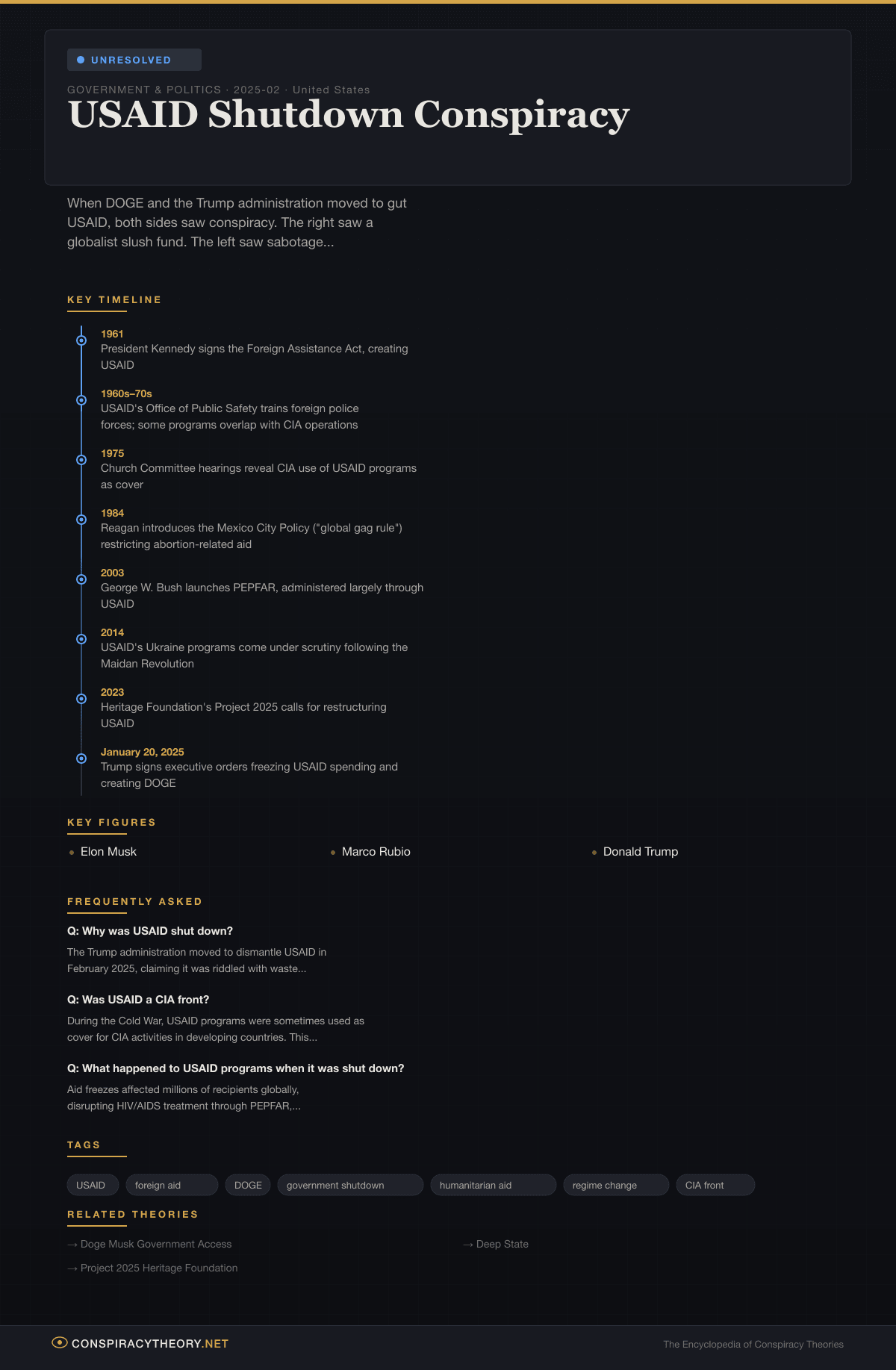
- 1961 — President Kennedy signs the Foreign Assistance Act, creating USAID
- 1960s–70s — USAID’s Office of Public Safety trains foreign police forces; some programs overlap with CIA operations
- 1975 — Church Committee hearings reveal CIA use of USAID programs as cover
- 1984 — Reagan introduces the Mexico City Policy (“global gag rule”) restricting abortion-related aid
- 2003 — George W. Bush launches PEPFAR, administered largely through USAID
- 2014 — USAID’s Ukraine programs come under scrutiny following the Maidan Revolution
- 2023 — Heritage Foundation’s Project 2025 calls for restructuring USAID
- January 20, 2025 — Trump signs executive orders freezing USAID spending and creating DOGE
- February 1, 2025 — DOGE operatives access USAID headquarters and internal systems
- February 7, 2025 — First wave of USAID employees placed on administrative leave
- February 14, 2025 — Secretary Rubio formally places USAID under State Department control
- February–March 2025 — Federal courts issue temporary restraining orders on aid freezes
- March–April 2025 — PEPFAR treatment interruptions documented across sub-Saharan Africa
- 2025 (ongoing) — Legal battles continue over the administration’s authority to dismantle a congressionally created agency
Sources & Further Reading
- Foreign Assistance Act of 1961 (Public Law 87-195)
- Church Committee Final Report, Book I: Foreign and Military Intelligence (1976)
- Government Accountability Office reports on USAID waste and oversight (multiple years)
- Heritage Foundation, “Mandate for Leadership: The Conservative Promise” (Project 2025)
- PEPFAR annual reports and country operational plans
- National Security Archive, George Washington University — declassified USAID-CIA documents
- Congressional Research Service, “USAID: Overview and Issues for Congress” (2024)
- Federal court filings: Global Health Council v. Trump, AFGE v. Department of State (2025)
Related Theories
- DOGE: Elon Musk’s Government Access — the broader story of DOGE’s infiltration of federal agencies
- The Deep State — the theory that a permanent bureaucracy operates independently of elected officials
- Project 2025 — the Heritage Foundation blueprint that called for USAID’s restructuring
- George Soros Conspiracy — overlapping narratives about NGOs and “color revolutions”
- Iran Regime Change Conspiracy — USAID’s role in U.S. regime change debates
Frequently Asked Questions
Why was USAID shut down?
Was USAID a CIA front?
What happened to USAID programs when it was shut down?

Infographic
Share this visual summary. Right-click to save.