Unification Church (Moonies)

Overview
The Unification Church — formally the Holy Spirit Association for the Unification of World Christianity, now operating as the Family Federation for World Peace and Unification — is a South Korean religious movement founded by Sun Myung Moon in 1954. Its members have been colloquially known as “Moonies” since the 1960s, a term the church considers pejorative. What makes the Unification Church a fixture of conspiracy research is not speculation but documented fact: the organization served as a front for Korean intelligence operations targeting the United States Congress, owned a newspaper in Washington, D.C. that functioned as a mouthpiece for the American right, extracted staggering sums from its members through systematic financial pressure, and cultivated relationships with political leaders across multiple continents.
The church’s conspiratorial dimensions are classified as confirmed. The Koreagate scandal of the late 1970s, congressional investigations, Moon’s own federal tax fraud conviction, and the post-assassination investigation in Japan have all produced documentary evidence of the church’s role in intelligence operations, political influence campaigns, and financial exploitation. This is not a case where suspicion outpaces proof. The record is extensive and, in many respects, the church’s own leadership has acknowledged key facts — though they frame them differently than investigators do.
The story of the Unification Church sits at a peculiar intersection of Cold War intelligence, religious fanaticism, media manipulation, and political corruption. It spans seven decades and three continents, and its consequences were still unfolding in 2022, when a lone gunman killed the former Prime Minister of Japan over grievances rooted in his mother’s involvement with Moon’s organization.
Sun Myung Moon
Sun Myung Moon was born Mun Yong-myeong in 1920 in what is now North Korea. His early biography is heavily mythologized by the church: according to official accounts, Jesus Christ appeared to Moon on a mountainside in 1935 and asked him to complete the work of salvation that the crucifixion had left unfinished. Moon spent the following decades developing a syncretic theology — drawing on Christianity, Korean shamanism, and anti-communism — that positioned him as the Messiah, a figure he publicly identified himself as beginning in the 1990s.
After establishing the Unification Church in Seoul in 1954, Moon built a religious empire with extraordinary speed. The church expanded into Japan in the late 1950s and into the United States in the 1960s, eventually establishing a global presence spanning over 100 countries. But the Unification Church was never merely a religious organization. Moon built an interlocking network of businesses, media companies, political organizations, and cultural institutions that operated in tandem with the church’s spiritual mission. His business interests included arms manufacturing (Tongil Group produced parts for the Korean military), commercial fishing, automobile components, and media properties. By the 1980s, Moon’s financial empire was estimated to be worth billions of dollars.
Moon’s political ideology was rooted in militant anti-communism, which made him a natural ally of Cold War-era intelligence services — and of right-wing political movements worldwide. He cultivated relationships with authoritarian leaders across Latin America and Asia, with the American conservative movement, and, most consequentially, with the Korean Central Intelligence Agency.
Moon died in 2012 at age 92. His widow, Hak Ja Han, assumed leadership of the church and continues to lead it. The organization has since fractured, with two of Moon’s sons — Hyung Jin “Sean” Moon and Kook Jin “Justin” Moon — splitting off to form a splinter group, Sanctuary Church, notable for its gun-centered theology and ceremonies featuring AR-15 rifles.
The CIA and Koreagate
The most thoroughly documented conspiratorial dimension of the Unification Church is its relationship with the Korean Central Intelligence Agency (KCIA). The KCIA was established in 1961 by South Korean dictator Park Chung-hee, and from its earliest years, the agency cultivated the Unification Church as an instrument of political influence abroad.
The connection was not subtle. The KCIA helped finance the church’s international expansion, and Moon’s organization returned the favor by conducting influence operations on behalf of the South Korean government — particularly in the United States, where maintaining congressional support for American military aid to South Korea was a strategic priority. The church organized rallies, lobbied lawmakers, and provided financial support to politicians sympathetic to South Korean interests.
This arrangement exploded into public view in the late 1970s during the “Koreagate” scandal. In 1977, the U.S. House of Representatives launched an investigation into South Korean influence operations targeting Congress. The investigation, led by the House Ethics Committee and a special subcommittee chaired by Representative Donald Fraser, found that the South Korean government had orchestrated a systematic campaign to buy influence in Congress through businessman Park Tong-sun — and that the Unification Church had played a parallel role in this effort.
The Fraser Committee’s 1978 report, formally titled “Investigation of Korean-American Relations,” concluded that the KCIA had “attempted to use the Unification Church as a political tool” and that Moon’s organization had engaged in lobbying, intelligence gathering, and the channeling of funds to U.S. political figures. The investigation documented meetings between Moon and KCIA directors, financial transfers between the South Korean government and church entities, and the church’s role in organizing support for the Park Chung-hee regime among American lawmakers.
Moon himself was never charged in connection with Koreagate. However, in 1982, a federal grand jury in New York indicted him on charges of tax fraud and conspiracy to obstruct justice. Moon was convicted and sentenced to eighteen months in federal prison, of which he served thirteen. The case centered on $162,000 in unreported income — relatively modest sums — but prosecutors argued the money represented a fraction of a much larger pattern of financial irregularity. Moon’s supporters, including some prominent civil liberties advocates, argued the prosecution was politically motivated and represented religious persecution. The conviction stood on appeal.
The Washington Times
In 1982 — the same year Moon was convicted of tax fraud — the Unification Church founded the Washington Times, a daily newspaper in the nation’s capital explicitly designed to counter what Moon and his allies perceived as the liberal bias of the Washington Post. The paper was not a vanity project or a money-making enterprise. Moon reportedly poured over $1 billion into the newspaper over the decades, subsidizing its losses year after year. The Washington Times was an influence operation dressed up as journalism.
The paper became a fixture of conservative Washington. President Ronald Reagan reportedly read it daily and once called it his “favorite newspaper.” It provided a platform for conservative columnists, broke stories favorable to Republican administrations, and editorially championed hawkish foreign policy, supply-side economics, and social conservatism. For decades, the Times served as a credibility-laundering operation — its existence as a “real” newspaper in Washington gave the Unification Church a veneer of mainstream legitimacy that its theology and recruitment practices could never have earned on their own.
The arrangement was straightforward: Moon’s tax-exempt religious organization bankrolled a newspaper that amplified the political views of his allies, who in turn provided the church with access and protection. The Times gave Moon something money alone could not buy — a seat at the table in Washington. Conservative politicians who might never attend a Unification Church event were happy to appear at Washington Times functions, and the line between the two was intentionally blurred.
The newspaper also served as a vehicle for Moon’s broader media ambitions. The church acquired United Press International (UPI) in 2000, and Moon’s media network eventually spanned television, digital media, and print across multiple countries.
Mass Weddings
The Unification Church’s mass wedding ceremonies — known internally as “Blessing” ceremonies — are among the most recognizable images associated with the organization. Beginning in the 1960s and escalating dramatically in the 1980s and 1990s, Moon presided over ceremonies in which thousands of couples were married simultaneously, often in sports stadiums. The scale grew over time: 2,075 couples in 1982 at Madison Square Garden, 6,000 couples in 1988 in South Korea, 30,000 couples in 1997, and 360,000 couples (many participating via satellite link) in 1995.
For many couples, the partner was selected by Moon himself. Members submitted photographs and biographical information, and Moon matched them — sometimes across racial and national lines, consistent with his theological emphasis on breaking down ethnic barriers. Couples frequently met for the first time at the ceremony or only days before. The theological justification was rooted in Moon’s claim to be the “True Parent” of humanity: because the biblical Fall had corrupted all human lineage, only Moon possessed the spiritual authority to create “sinless” marriages and families.
The mass weddings served multiple functions simultaneously. Theologically, they were the church’s central sacrament. Organizationally, they were a powerful mechanism of control. A member who has surrendered the choice of a life partner to the church leader — and whose spouse is also a devoted member — is far more deeply bound to the organization than one who merely attends services. Children born from these “blessed” marriages were considered spiritually distinct, creating a second generation with even deeper ties to the movement.
The ceremonies also functioned as spectacular media events, generating worldwide press coverage and reinforcing Moon’s image as a figure of global spiritual authority. Whether the ceremonies were genuine religious observance, organizational control tactics, or publicity stunts is not an either/or question. They were all three at once.
Financial Exploitation
The Unification Church’s financial practices have been the subject of investigation, litigation, and legislative action in multiple countries. The pattern is consistent: members are pressured to make extraordinary financial sacrifices, with the proceeds flowing upward to the church’s central leadership.
In Japan — the church’s wealthiest national base — the exploitation was systematic and extreme. Japanese members were pressured to purchase spiritual goods, including marble vases, miniature pagodas, and ginseng products, at enormously inflated prices. The church used a practice known as “spiritual sales” (reikan shoho), in which members or their families were told that purchasing expensive items was necessary to remove ancestral curses or achieve spiritual purification. Japanese courts have ruled against the church in dozens of cases involving these practices, with total damages awarded exceeding $100 million.
The scale of financial extraction from Japan was staggering. According to investigations by Japanese media and government agencies, the Unification Church extracted an estimated $6 billion from Japanese members between the 1960s and the 2010s. Much of this money was transferred to church headquarters in South Korea and to Moon’s international operations. Former members have described being pressured to sell homes, take out loans, and exhaust retirement savings.
In the United States, the church operated a system of communal living and labor in which members worked long hours selling flowers, candles, and other goods on street corners and at public venues, with proceeds going to the church. Former members described conditions that amounted to unpaid labor, with the church controlling members’ housing, diet, social contacts, and finances.
The Abe Assassination
On July 8, 2022, former Japanese Prime Minister Shinzo Abe was shot and killed while delivering a campaign speech in Nara, Japan. The assassin, Tetsuya Yamagami, used a homemade firearm — a detail that attracted intense attention in a country where gun violence is almost nonexistent. But it was Yamagami’s motive that transformed the assassination from a shocking crime into a political earthquake.
Yamagami told investigators that he had intended to kill a senior leader of the Unification Church but had been unable to get close to one. He targeted Abe instead because of the former prime minister’s public association with the organization. In September 2021, Abe had appeared via video at a rally organized by a Unification Church affiliate, the Universal Peace Federation, praising Moon’s widow Hak Ja Han and the organization’s work. For Yamagami, this was the final provocation.
Yamagami’s grievance was personal and devastating. His mother had joined the Unification Church in the 1990s and, over the following years, had donated approximately 100 million yen (roughly $700,000) to the organization. The donations bankrupted the family. Yamagami’s father had died by suicide when Yamagami was a child, and the family’s financial ruin — directly attributable to the church’s extraction of his mother’s assets — shattered whatever remained of his upbringing. He grew up in poverty, abandoned his plans for higher education, and spent years in the Japan Maritime Self-Defense Force before drifting through a series of low-wage jobs.
The assassination forced a reckoning in Japanese politics that the church’s decades of financial predation had never managed to trigger on its own.
Japanese Political Ties
The post-assassination investigation revealed the depth of the Unification Church’s penetration of Japanese politics — specifically, its deep and longstanding relationship with the ruling Liberal Democratic Party (LDP).
Within weeks of Abe’s death, the LDP conducted an internal survey that found approximately half of its lawmakers had some form of connection to the Unification Church or its affiliated organizations. The connections ranged from attending church events, to accepting organizational support during elections (the church could mobilize volunteer canvassers and voters), to sending congratulatory messages to church functions, to accepting political donations through affiliated entities. Some lawmakers had deeper ties: they had attended church conferences, appeared at recruitment events, or maintained ongoing relationships with church leaders.
The relationship between the LDP and the Unification Church dated back decades. Moon’s militant anti-communism aligned naturally with the LDP’s Cold War-era positioning, and the church offered something valuable to politicians: a disciplined, mobilizable base of supporters who could provide campaign labor and votes in a political system where individual-level voter mobilization matters enormously. In return, the church received political protection — or at minimum, political indifference to its predatory financial practices.
Former Prime Minister Nobusuke Kishi — Abe’s grandfather — was among the first senior LDP figures to cultivate ties with Moon’s organization in the 1960s. The relationship passed through generations of the Japanese political establishment, becoming so routine that many lawmakers treated it as unremarkable.
The post-assassination revelations triggered a public backlash that the LDP could not contain. Prime Minister Fumio Kishida ordered all cabinet members to sever ties with the church and announced that the government would seek a court order to strip the Unification Church of its legal status as a religious corporation in Japan — a move without precedent for a major religious organization. In October 2023, the Japanese government formally requested the dissolution of the church’s religious corporation status, a legal proceeding that, if successful, would strip the organization of its tax-exempt privileges and legal protections in Japan.
The Abe assassination accomplished through violence what decades of lawsuits, journalism, and victim advocacy had failed to achieve: it made the Unification Church’s political relationships politically toxic.
Timeline
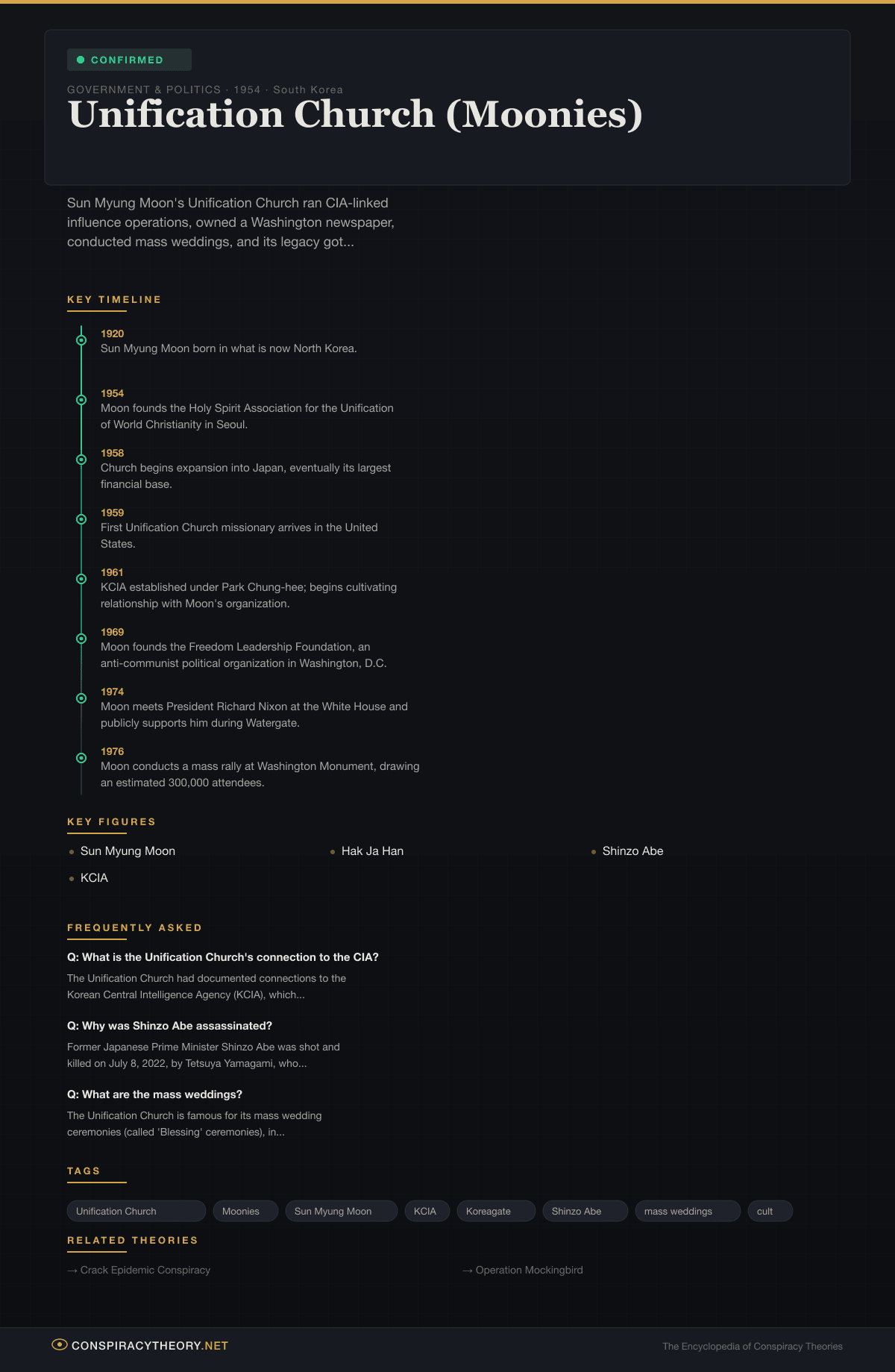
- 1920 — Sun Myung Moon born in what is now North Korea.
- 1954 — Moon founds the Holy Spirit Association for the Unification of World Christianity in Seoul.
- 1958 — Church begins expansion into Japan, eventually its largest financial base.
- 1959 — First Unification Church missionary arrives in the United States.
- 1961 — KCIA established under Park Chung-hee; begins cultivating relationship with Moon’s organization.
- 1969 — Moon founds the Freedom Leadership Foundation, an anti-communist political organization in Washington, D.C.
- 1974 — Moon meets President Richard Nixon at the White House and publicly supports him during Watergate.
- 1976 — Moon conducts a mass rally at Washington Monument, drawing an estimated 300,000 attendees.
- 1977 — U.S. House of Representatives launches investigation into Korean influence operations (Koreagate).
- 1978 — Fraser Committee report documents KCIA-Unification Church connections.
- 1982 — Moon convicted of tax fraud; Washington Times founded.
- 1984 — Moon reports to federal prison in Danbury, Connecticut; serves thirteen months.
- 1988 — Mass wedding ceremony for 6,000 couples in South Korea.
- 1995 — Mass wedding for 360,000 couples, many via satellite.
- 1997 — Mass wedding for 30,000 couples.
- 2000 — Church acquires United Press International (UPI).
- 2009 — Moon’s organization renamed Family Federation for World Peace and Unification.
- 2012 — Sun Myung Moon dies at age 92; Hak Ja Han assumes leadership.
- 2015 — Hyung Jin “Sean” Moon breaks from the main church, founds Sanctuary Church.
- 2021 — Shinzo Abe appears via video at Universal Peace Federation rally, praising Hak Ja Han.
- 2022 — Shinzo Abe assassinated on July 8. Investigations reveal extent of LDP-church ties.
- 2023 — Japanese government requests dissolution of the church’s religious corporation status.
Sources & Further Reading
- U.S. House of Representatives, Subcommittee on International Organizations. Investigation of Korean-American Relations (Fraser Committee Report). October 31, 1978.
- Kaplan, David E., and Alec Dubro. Yakuza: Japan’s Criminal Underworld. University of California Press, 2003.
- Bromley, David G., and Anson D. Shupe. “Moonies” in America: Cult, Church, and Crusade. Sage Publications, 1979.
- Introvigne, Massimo. The Unification Church. Signature Books, 2000.
- Hong, Nansook. In the Shadow of the Moons: My Life in the Reverend Sun Myung Moon’s Family. Little, Brown, 1998.
- Shorrock, Tim. “The Untold Story of Korea’s Church-State Nexus.” The Nation, 2022.
- Adelstein, Jake. “The Unification Church, the Abe Assassination, and Japan’s Political Reckoning.” The Daily Beast, 2022.
- Asahi Shimbun Investigative Team. Reporting on Unification Church financial practices and LDP ties, 2022-2023.
- National Network of Lawyers Against Spiritual Sales (Japan). Case records and financial analysis of church extraction practices.
- Rich, Frank. “The Church of Sun Myung Moon.” New York Times, various dates.
- U.S. v. Sun Myung Moon, 718 F.2d 1210 (2d Cir. 1983). Federal appellate decision affirming Moon’s tax fraud conviction.
Related Theories
- CIA Drug Trafficking — Another confirmed case of intelligence agencies using non-state organizations for covert operations.
- Project Mockingbird — CIA influence over media outlets parallels Moon’s use of the Washington Times as a political tool.
- Koreagate — The broader South Korean influence operation in which the Unification Church played a central role.

Frequently Asked Questions
What is the Unification Church's connection to the CIA?
Why was Shinzo Abe assassinated?
What are the mass weddings?
Infographic
Share this visual summary. Right-click to save.