Tupac Shakur Faked His Death
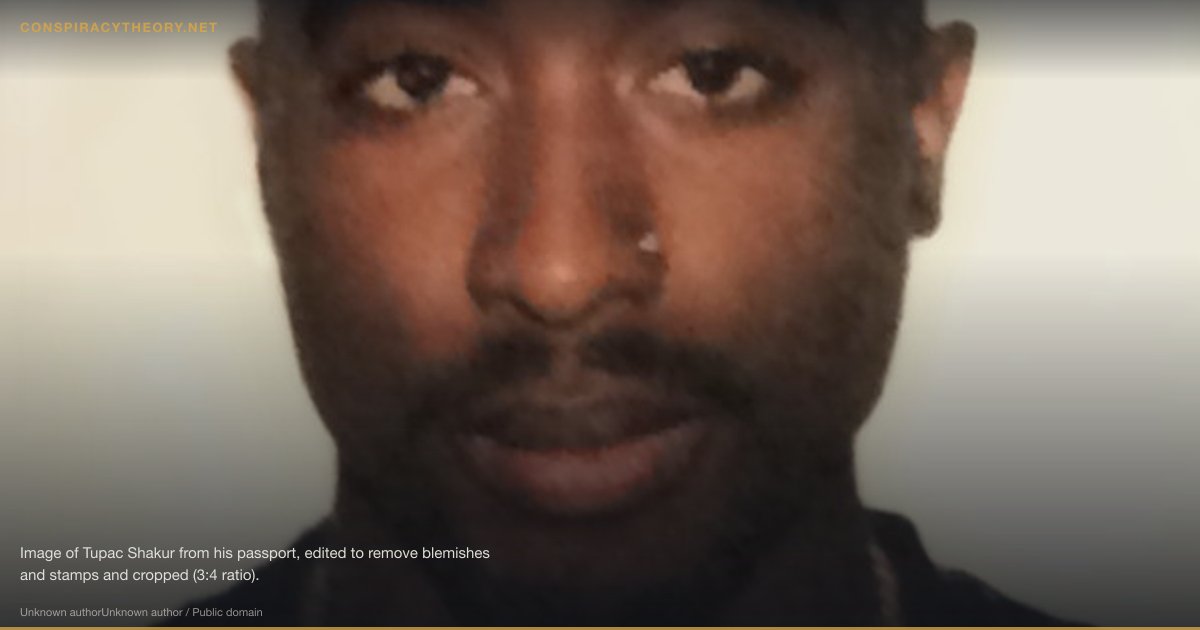
Overview
The conspiracy theory that Tupac Amaru Shakur faked his death on September 13, 1996, and is living in hiding — most commonly said to be in Cuba, New Zealand, or a remote location in the American Southwest — is one of the most persistent and widely circulated celebrity death conspiracies of the modern era. Emerging almost immediately after his fatal shooting in Las Vegas, the theory has endured for three decades, sustained by a combination of circumstantial oddities, the rapper’s own artistic mythology, and the deep emotional connection millions of fans feel to his legacy.
Proponents of the theory point to a constellation of alleged clues: the adoption of the alias “Makaveli” shortly before his death, referencing a political philosopher associated with strategic deception; the rapid cremation of his remains with no public funeral; the staggering volume of posthumous music releases; reported sightings in Cuba, where his stepmother Assata Shakur has lived in political exile since the 1980s; and a series of numerological patterns that believers find embedded in his album titles, lyrics, and the circumstances of his death.
The theory is classified as debunked. Tupac Shakur’s shooting was witnessed by multiple people including Suge Knight, who was driving the car and was himself wounded. His six-day hospitalization at University Medical Center in Las Vegas was documented by medical staff, law enforcement, and family members. His death was confirmed by attending physicians, and a death certificate was issued by the Clark County Coroner. The “evidence” cited by conspiracy theorists consists of coincidences, misattributions, and the common human reluctance to accept the sudden death of a cultural icon.
Origins & History
The Shooting
On the evening of September 7, 1996, Tupac Shakur attended the Mike Tyson vs. Bruce Seldon boxing match at the MGM Grand in Las Vegas. After the fight, Tupac and members of his entourage were involved in an altercation in the MGM Grand lobby with Orlando Anderson, a reported member of the Southside Compton Crips. The confrontation was captured on the casino’s security cameras.
Later that evening, Tupac was riding in the passenger seat of a black BMW 750iL sedan driven by Death Row Records CEO Marion “Suge” Knight. At approximately 11:15 PM, while the car was stopped at a red light at the intersection of Flamingo Road and Koval Lane, a white Cadillac pulled alongside. An occupant of the Cadillac fired multiple rounds into the BMW. Tupac was struck four times — twice in the chest, once in the arm, and once in the thigh. One round struck his right lung. Suge Knight was grazed by a bullet fragment.
Tupac was rushed to University Medical Center, where he underwent emergency surgery including the removal of his right lung. He was placed in a medically induced coma. Despite multiple surgical interventions over the following days, Tupac died of internal bleeding and respiratory failure on September 13, 1996, at 4:03 PM. He was 25 years old.
The Cremation and Immediate Aftermath
Tupac’s body was cremated the following day, September 14, 1996. There was no public funeral or open-casket viewing. Members of his group, the Outlawz, later stated in interviews that they mixed some of his ashes with marijuana and smoked them as a tribute — a claim they said was inspired by Tupac’s own wishes expressed in his music.
The speed of the cremation and the absence of a public memorial became the first pillars of the conspiracy theory. Fans accustomed to the elaborate public funerals of other celebrities found the private, rapid disposition of Tupac’s remains suspicious. Within weeks of his death, rumors began circulating that the cremation was a cover — that there was no body to display because Tupac had staged his own disappearance.
The Makaveli Album
On November 5, 1996 — less than two months after his death — Death Row Records released The Don Killuminati: The 7 Day Theory, credited to “Makaveli.” The album’s existence became a central piece of the conspiracy narrative. Its cover art depicted Tupac on a cross in a crucifixion pose, which believers interpreted as symbolizing resurrection. The album title’s references to both the Illuminati (inverted as “Killuminati”) and the number seven were dissected endlessly for hidden meanings.
The name “Makaveli” itself became the theory’s most cited piece of evidence. Tupac had begun reading the works of Niccolò Machiavelli during his imprisonment at Clinton Correctional Facility in 1995, and adopted the name as an artistic persona. Conspiracy theorists seized on the claim that Machiavelli had advocated faking one’s own death as a strategy for defeating enemies — a claim that, while widely repeated, represents a significant distortion of Machiavelli’s actual writings.
Growth Through the Internet Era
The Tupac-is-alive theory was one of the first major conspiracy theories to be incubated and amplified by the early internet. GeoCities fan pages, Usenet groups, and early web forums dedicated to the theory proliferated in the late 1990s. Sites like “2PacAlive.com” and “TupacFakedHisDeath.com” catalogued purported evidence and attracted millions of visitors.
The theory received periodic boosts from mainstream media coverage. Television specials, magazine articles, and later YouTube documentaries exploring the question kept it in public consciousness. Each new posthumous album release — and there have been many — reignited speculation that Tupac was secretly alive and recording new material.
Key Claims
- The Machiavelli strategy: Tupac adopted the name “Makaveli” to signal that he was following Machiavelli’s supposed advice to fake one’s death to gain tactical advantage over enemies
- Rapid cremation: The body was cremated the day after death with no public viewing, supposedly to prevent anyone from verifying the identity of the deceased
- Posthumous music volume: The sheer number of posthumous releases — over seven studio albums and numerous compilations — suggests Tupac is still recording, not that he was simply prolific during his lifetime
- Cuba exile: Tupac is living in Cuba under the protection of the Cuban government, in proximity to his stepmother Assata Shakur (Joanne Chesimard), a former Black Liberation Army member granted political asylum by Fidel Castro in 1984
- The number 7: Tupac was shot on September 7, survived for 7 days, died at age 25 (2+5=7), and his album was titled The 7 Day Theory — all pointing to a numerological code
- “R U Still Down?”: The title of the 1997 posthumous album is interpreted as a direct message from Tupac to fans asking if they still support him
- Suge Knight’s comments: Suge Knight has made ambiguous statements in interviews that conspiracy theorists interpret as hints that Tupac is alive, including a 2012 interview where he referenced Tupac in the present tense
- Lyrical predictions: Multiple Tupac songs contain lyrics about faking death, being resurrected, or living in exile, which believers interpret as literal plans rather than artistic expression
- Photo and video sightings: Blurry photographs and videos allegedly showing Tupac in Cuba, Somalia, New Zealand, and various American cities have circulated online for decades
Evidence & Debunking
The Medical Record
Tupac’s shooting, hospitalization, and death are documented through extensive medical records. He was treated at University Medical Center by multiple physicians and nurses over a six-day period. His mother, Afeni Shakur, was at his bedside and authorized the cessation of life support. The attending physicians’ statements, hospital records, and the Clark County Coroner’s report all consistently document his death from gunshot wounds and subsequent organ failure.
The Machiavelli Misattribution
The cornerstone of the conspiracy — that Machiavelli advocated faking one’s death — does not withstand scrutiny. Machiavelli’s major works, The Prince (1532) and Discourses on Livy (1531), discuss political strategy, deception, and the exercise of power at length. While Machiavelli endorses various forms of political cunning, scholars of Renaissance political philosophy note that he does not specifically recommend or discuss faking one’s own death as a strategic tactic. The claim appears to have originated within the conspiracy theory community itself and been retroactively attributed to Machiavelli. Tupac’s genuine interest in Machiavelli was intellectual and thematic — he was drawn to ideas about power, survival, and navigating hostile systems, themes deeply relevant to his own life and music.
The Posthumous Releases Explained
Tupac was an extraordinarily prolific recording artist. During his career, he was known for marathon studio sessions, frequently recording three or more songs per day. At the time of his death, he had amassed a vault of hundreds of unreleased tracks — estimates range from 200 to over 400 songs in various stages of completion. Death Row Records, and later Amaru Entertainment (the label established by his mother Afeni Shakur), drew on this archive for posthumous releases. Many of these tracks were remixed, had new beats added, or featured new guest verses from other artists. The existence of extensive posthumous catalogs is common among prolific artists who die young — similar archives existed for Jimi Hendrix, Jeff Buckley, and others.
The Cremation
While the rapid cremation surprised fans, it was consistent with the wishes of Tupac’s family, particularly his mother Afeni Shakur. The decision was private and personal. Notably, rapid cremation or burial is not uncommon following violent deaths, particularly when families wish to avoid the spectacle of a highly publicized funeral. Afeni Shakur, a former Black Panther Party member, was known for her desire to protect her son’s dignity and legacy from exploitation.
The Cuba Sightings
The Cuba theory draws its plausibility from a real connection: Tupac’s stepmother, Assata Shakur (born Joanne Chesimard), has lived in Cuba since 1984 after escaping from a New Jersey prison where she was serving a life sentence for the 1973 killing of a New Jersey state trooper. She was granted political asylum by the Cuban government. Conspiracy theorists reason that this existing connection and safe harbor could facilitate Tupac’s disappearance to the island.
However, the theory collapses under practical scrutiny. Cuba, while politically independent from the United States, is not hermetically sealed. Thousands of journalists, tourists, academics, and diplomats visit annually. No credible journalist, researcher, or visitor has ever produced verified evidence of Tupac’s presence. The photographs and videos purported to show Tupac in Cuba are uniformly low-quality images of unidentified individuals, none of which have survived any serious attempt at verification. Additionally, hiding one of the most recognizable faces in global popular culture on an island regularly visited by Americans and international media would present extraordinary logistical challenges.
The Numerology
The numerological arguments — centered on the number 7 — exemplify the pattern-seeking behavior common to conspiracy thinking. When examining any death with sufficient determination to find patterns, numbers can be made to align. Tupac was shot on September 7, but he died on September 13 (not a multiple of 7). He was 25, but only yields 7 through addition of digits — a technique that can produce virtually any target number from any starting figure. The album title The 7 Day Theory refers to the seven days it took to record the album, a fact confirmed by multiple people involved in its production.
Suge Knight’s Statements
Suge Knight has made numerous contradictory statements about Tupac’s death over the years, including suggestions that Tupac might be alive and claims about who ordered the shooting. Knight is a convicted felon with a documented history of manipulation, intimidation, and self-serving public statements. He was present in the car during the shooting and was himself injured. His ambiguous comments are widely understood as attempts to maintain relevance and generate media attention rather than genuine disclosures.
Cultural Impact
The Blueprint for Hip-Hop Conspiracy Culture
The Tupac-is-alive theory established the template for conspiracy thinking within hip-hop culture. It preceded and influenced similar theories about The Notorious B.I.G., Ol’ Dirty Bastard, and later artists. The theory intersected with broader hip-hop conspiracy narratives about the Illuminati’s alleged control of the music industry, secret societies, and the idea that artists who become “too powerful” or “too conscious” are targeted for elimination — or must fake their deaths to escape.
Tupac’s Posthumous Legacy
Paradoxically, the conspiracy theory has both enhanced and complicated Tupac’s cultural legacy. On one hand, it has kept his name in continuous circulation, contributing to his status as perhaps the most discussed figure in hip-hop history. On the other hand, it has sometimes overshadowed serious engagement with his music, poetry, and social commentary. Tupac was a complex artist who addressed systemic racism, poverty, police brutality, and the contradictions of street life with unusual depth. The conspiracy narrative risks reducing him to a mystery to be solved rather than an artist to be understood.
The Hologram and Digital Resurrection
At the 2012 Coachella Valley Music and Arts Festival, a digital projection of Tupac — widely described as a “hologram” though technically a Pepper’s ghost illusion — performed alongside Snoop Dogg and Dr. Dre. The event was a cultural sensation and briefly reignited alive-theory speculation, with some believers arguing it was actually Tupac performing live behind a screen. The hologram incident illustrated the intense desire among fans to experience Tupac as a living presence and the blurred line between technological reproduction and conspiracy thinking.
Internet-Era Conspiracy Archetype
The Tupac theory is frequently cited by researchers studying how conspiracy theories propagate online. It emerged at the dawn of the consumer internet and has evolved through every subsequent platform — from Usenet to web forums to YouTube to social media to TikTok. Each new platform brought a new generation of believers and a new wave of “evidence” videos and analysis. It serves as a case study in how emotional attachment, pattern recognition, and platform algorithms combine to sustain unfounded beliefs across decades.
Timeline
- June 16, 1971 — Tupac Amaru Shakur born in East Harlem, New York
- February 1995 — Tupac sentenced to prison; reads Machiavelli and other political philosophers during incarceration
- October 1995 — Released on bail pending appeal, with Suge Knight posting $1.4 million bond; signs with Death Row Records
- February 1996 — Releases All Eyez on Me, a double album that becomes one of the bestselling hip-hop records of all time
- August 1996 — Records The Don Killuminati: The 7 Day Theory in seven days under the name Makaveli
- September 7, 1996 — Shot four times in a drive-by shooting on the Las Vegas Strip after the Tyson-Seldon fight at MGM Grand
- September 13, 1996 — Dies at University Medical Center, Las Vegas, at age 25
- September 14, 1996 — Body cremated; no public funeral held
- November 5, 1996 — The Don Killuminati: The 7 Day Theory released posthumously under the name Makaveli; conspiracy theories intensify
- November 1997 — R U Still Down? (Remember Me) released, the first of many posthumous compilations
- 1997-2004 — Multiple posthumous albums released including Until the End of Time (2001) and Loyal to the Game (2004)
- 2002 — Nick Broomfield’s documentary Biggie & Tupac examines the circumstances of both rappers’ deaths
- 2003 — Tupac: Resurrection documentary released; nominated for Academy Award
- 2012 — Tupac “hologram” performs at Coachella, reigniting conspiracy speculation
- 2015 — Suge Knight makes ambiguous statements in interview about Tupac’s fate; makes national news
- 2017 — Tupac inducted into the Rock and Roll Hall of Fame
- 2017 — Biopic All Eyez on Me released theatrically
- September 2023 — Las Vegas Metropolitan Police arrest Duane “Keffe D” Davis and charge him with murder in connection with the 1996 shooting
- 2024 — Keffe D Davis trial proceedings bring renewed attention to the factual circumstances of the shooting
Sources & Further Reading
- Hoye, Jacob, and Karolyn Ali, eds. Tupac: Resurrection, 1971-1996. Atria Books, 2003.
- Scott, Cathy. The Killing of Tupac Shakur. Huntington Press, 1997.
- Sullivan, Randall. LAbyrinth: A Detective Investigates the Murders of Tupac Shakur and Notorious B.I.G. Atlantic Monthly Press, 2002.
- Guy, Jasmine. Afeni Shakur: Evolution of a Revolutionary. Atria Books, 2004.
- Westhoff, Ben. Original Gangstas: The Untold Story of Dr. Dre, Eazy-E, Ice Cube, Tupac Shakur, and the Birth of West Coast Rap. Hachette Books, 2016.
- Davis, Duane “Keffe D” Keith, and Don Charles. Compton Street Legend. CreateSpace, 2019.
- Kading, Greg. Murder Rap: The Untold Story of the Biggie Smalls & Tupac Shakur Murder Investigations. One Time Publishing, 2011.
- Dyson, Michael Eric. Holler If You Hear Me: Searching for Tupac Shakur. Basic Civitas Books, 2001.

Frequently Asked Questions
Is Tupac Shakur really dead?
Why do people think Tupac faked his death?
What is the Machiavelli connection to Tupac's death conspiracy?

Infographic
Share this visual summary. Right-click to save.
