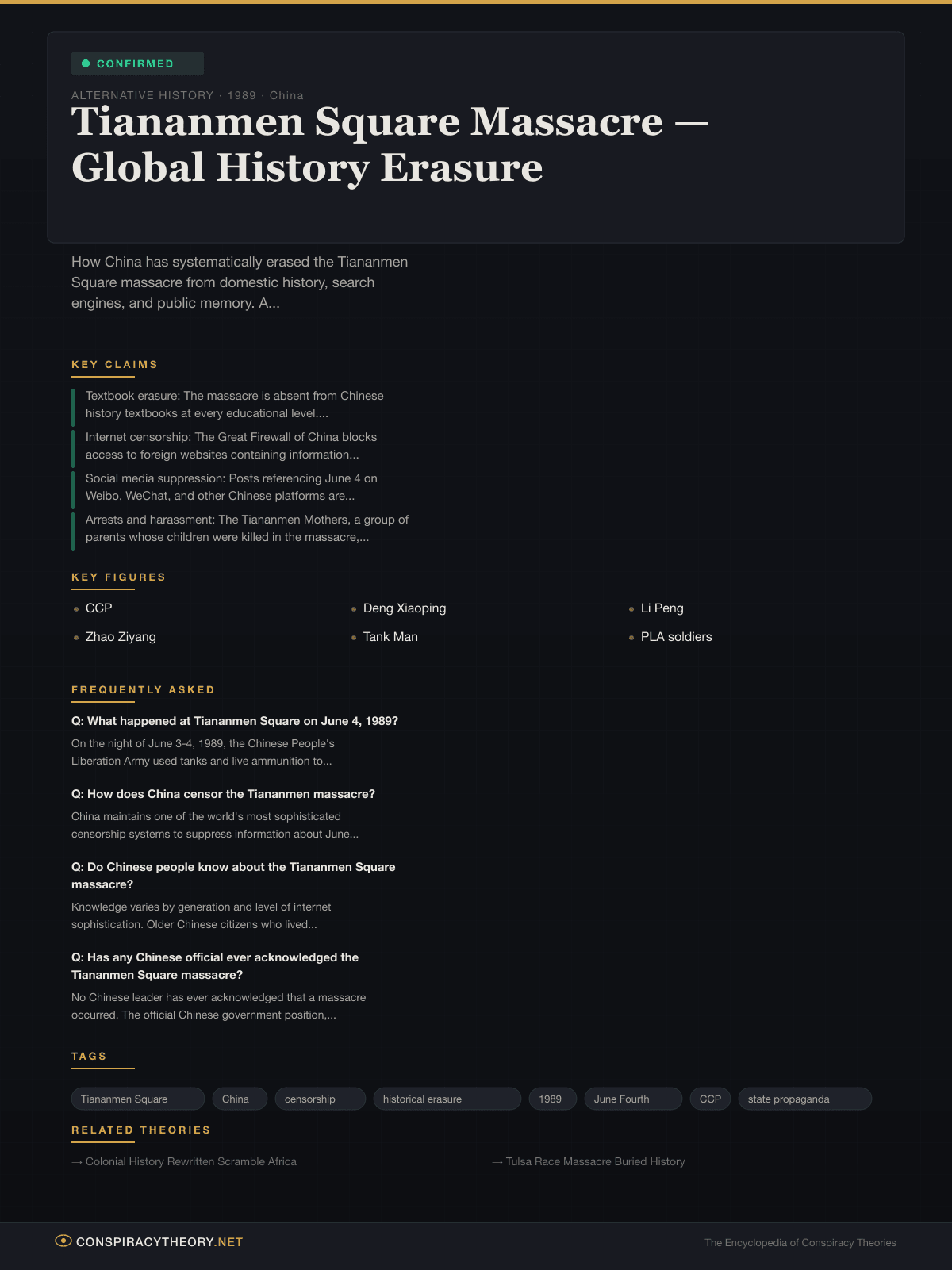
Tiananmen Square Massacre — Global History Erasure

Overview
On the morning of June 5, 1989, a young man in a white shirt carrying shopping bags stepped in front of a column of tanks on Chang’an Avenue in Beijing. The lead tank tried to go around him. He moved to block it. The tank stopped. The man climbed onto the turret, apparently said something to the crew, then climbed down and resumed his position. Eventually, two figures ran into the frame and pulled him away. The entire encounter lasted a few minutes. The photograph, taken from a hotel balcony by AP photographer Jeff Widener, became one of the most reproduced images of the 20th century, an icon of individual defiance against state power recognized instantly around the world.
Except in China, where it does not exist.
The Chinese Communist Party’s erasure of the Tiananmen Square massacre is not a conspiracy theory in the conventional sense — it is a confirmed, ongoing, state-sponsored campaign of historical suppression, documented by journalists, human rights organizations, and the Chinese government’s own censorship apparatus. What makes it relevant to this encyclopedia is not the question of whether the erasure is happening (it demonstrably is) but the sheer scale and sophistication of the operation, and the uncomfortable questions it raises about how effectively a modern state can rewrite history.
This article is classified as confirmed. The massacre happened. The censorship is ongoing. Both are documented beyond any reasonable dispute.
Origins & History
The 1989 Democracy Movement
The Tiananmen protests did not begin as a demand for revolution. They began with flowers.
On April 15, 1989, Hu Yaobang, the former General Secretary of the Chinese Communist Party, died of a heart attack. Hu had been a relatively liberal figure within the CCP, sympathetic to intellectual freedom and political reform. He had been forced to resign in 1987 after being blamed for student protests, and his death became a rallying point for reformists. Students began gathering in Tiananmen Square to lay wreaths and mourn Hu, and the mourning gatherings quickly evolved into something larger.
By late April, the protests had grown to include hundreds of thousands of participants — students, workers, intellectuals, and ordinary citizens — calling for democratic reform, freedom of the press, accountability for official corruption, and dialogue with the government. The movement spread to cities across China, including Shanghai, Chengdu, Wuhan, and Xi’an. At its peak, an estimated one million people occupied Tiananmen Square and surrounding streets in Beijing.
The government was divided. General Secretary Zhao Ziyang favored dialogue with the protesters and visited the square on May 19, famously telling the students through a megaphone, “We came too late.” Premier Li Peng and paramount leader Deng Xiaoping favored a hard-line response. Zhao was overruled. Martial law was declared on May 20.
The Massacre
On the night of June 3-4, 1989, the People’s Liberation Army moved into Beijing with tanks and armored personnel carriers. Troops advanced from multiple directions toward Tiananmen Square, meeting resistance from citizens who had erected barricades on major roads. Soldiers fired live ammunition into crowds of civilians on the streets surrounding the square. The worst violence occurred not in the square itself but on the approaches to it, particularly along Chang’an Avenue and Muxidi.
The death toll remains one of the most contested figures in modern history. The Chinese Red Cross initially reported 2,600 deaths, then retracted the figure under government pressure. A 2017 declassified British diplomatic cable from Sir Alan Donald, the UK Ambassador to China, estimated the death toll at 10,000, citing a source with connections to the Chinese State Council. Nicholas Kristof, then the New York Times Beijing bureau chief, estimated 400 to 800 civilians killed. The Chinese government has acknowledged only about 200 dead, characterizing them as a mix of soldiers and “rioters.” Amnesty International and other human rights organizations have estimated between several hundred and several thousand deaths. The true figure may never be known.
Thousands were arrested in the weeks following the crackdown. Some were executed. Others received lengthy prison sentences. The student movement’s most prominent leaders — including Wang Dan, Wu’er Kaixi, and Chai Ling — either fled the country through clandestine networks (Operation Yellowbird smuggled hundreds of dissidents through Hong Kong) or were imprisoned.
Zhao Ziyang, who had opposed the military crackdown, was stripped of all his positions and placed under house arrest, where he remained until his death in 2005 — a 15-year internal exile with no formal charges and no trial.
The Erasure Begins
The censorship campaign began immediately. Within days of the massacre, the Chinese government’s official narrative was established: there had been no massacre. What had occurred was the suppression of a “counter-revolutionary riot” that threatened the stability of the Chinese state. The military had acted with restraint against violent provocateurs. The students had been manipulated by a small number of agitators with foreign backing. Order had been restored. The topic was closed.
This narrative was enforced through every channel of state power. Textbooks were revised. News archives were restricted. The phrase “June Fourth” became unspeakable in public discourse. The anniversary became a day of heightened security and surveillance rather than commemoration.
Key Claims
The “conspiracy” in the Tiananmen erasure case is not a contested theory but a documented state operation with specific, verifiable components:
- Textbook erasure: The massacre is absent from Chinese history textbooks at every educational level. Students educated entirely within the Chinese system may complete their education without encountering any reference to the 1989 protests or the military crackdown
- Internet censorship: The Great Firewall of China blocks access to foreign websites containing information about Tiananmen. Domestic search engines return no results for queries related to the massacre. Even oblique references — “May 35th,” certain number sequences, candle emojis on June 4 — are algorithmically detected and removed
- Social media suppression: Posts referencing June 4 on Weibo, WeChat, and other Chinese platforms are deleted, often within minutes of posting. Users who persist face account suspension or police visits. Around the anniversary, censorship intensifies to the point that even sharing images of empty squares or making numerical references (6/4, 89, 64) can trigger deletion
- Arrests and harassment: The Tiananmen Mothers, a group of parents whose children were killed in the massacre, have been subjected to decades of surveillance, harassment, and periodic detention. Their founder, Ding Zilin, whose 17-year-old son was shot and killed on June 3, 1989, has been under near-continuous surveillance since she began documenting victims
- International pressure: China has pressured foreign governments and institutions to avoid referencing Tiananmen. The Chinese government has objected to Tiananmen-related exhibits, memorials, and academic conferences abroad
Evidence
The Censorship Apparatus
The evidence for systematic erasure is overwhelming and comes from multiple independent sources:
Academic research: Multiple studies have documented the scope of Tiananmen censorship. A 2013 study by researchers at Harvard (Gary King, Jennifer Pan, and Margaret Roberts) analyzed millions of Chinese social media posts and found that censorship was most aggressive around collective action and protest topics, with Tiananmen references among the most consistently suppressed content. The researchers estimated that the Chinese government employs hundreds of thousands of people in censorship-related work.
Journalist investigations: Louisa Lim, a former BBC and NPR correspondent in China, conducted an experiment for her 2014 book The People’s Republic of Amnesia. She showed the Tank Man photograph to 100 students at four Beijing universities. The vast majority did not recognize it. Those who did typically had access to VPNs or had spent time abroad. The experiment, while informal, illustrated the practical effectiveness of three decades of censorship.
Digital forensics: The Citizen Lab at the University of Toronto has documented extensive keyword filtering on Chinese social media platforms, including exhaustive lists of Tiananmen-related terms that trigger automatic censorship. The filtering extends beyond obvious terms to include creative circumlocutions, numerical codes, and visual memes that Chinese internet users have developed to discuss the topic indirectly.
Diplomatic cables: Declassified documents from multiple Western governments provide contemporaneous accounts of the massacre that contradict the Chinese government’s narrative. The 2017 release of Sir Alan Donald’s cable, with its detailed description of military operations and its 10,000-death estimate, generated significant international attention.
Survivor testimony: Hundreds of Tiananmen survivors have provided testimony to journalists, researchers, and human rights organizations over the decades. Their accounts are broadly consistent and corroborate photographic and video evidence recorded by foreign journalists who were present.
What China Claims
The Chinese government’s position, on the rare occasions it addresses the topic at all, has been consistent since 1989: the military action was necessary to prevent chaos and maintain stability, the subsequent decades of economic growth vindicate the decision, and the topic is a closed matter of internal Chinese affairs. In 2019, Chinese Defense Minister Wei Fenghe stated at the Shangri-La Dialogue that the crackdown was “the correct policy” and that “the government was decisive in stopping the turbulence.”
The government has never provided a comprehensive account of the events, never released casualty figures, never allowed independent investigation, and never permitted public commemoration within mainland China.
Cultural Impact
Hong Kong’s Vigil — and Its End
For three decades, the one place in China where the Tiananmen massacre was publicly commemorated was Hong Kong. Under the “one country, two systems” framework, Hong Kong maintained freedoms of assembly and expression that did not exist on the mainland. Every year on June 4, tens of thousands of people gathered in Victoria Park for a candlelight vigil organized by the Hong Kong Alliance in Support of Patriotic Democratic Movements of China.
The vigil was banned in 2020 and 2021, ostensibly due to COVID-19 public health measures. In 2021, the Hong Kong Alliance was forced to disband under pressure from the national security law imposed in 2020. Its leaders, including Lee Cheuk-yan and Albert Ho, were arrested and prosecuted. The Tiananmen Museum in Hong Kong, operated by the Alliance, was closed. The Pillar of Shame — a sculpture by Danish artist Jens Galschiot commemorating the massacre, which had stood at the University of Hong Kong since 1997 — was removed in December 2021.
The suppression of Hong Kong’s Tiananmen vigil represented the effective completion of China’s domestic erasure campaign. By 2022, there was no place within Chinese sovereign territory where the massacre could be publicly commemorated.
International Memory
Outside China, the Tiananmen massacre remains widely known and regularly referenced in media, academia, and diplomatic discourse. The Tank Man image is one of the most iconic photographs in history, regularly featured in lists of the most important images of the 20th century. The anniversary is marked annually by international media coverage, academic conferences, and protests at Chinese embassies and consulates worldwide.
However, the effectiveness of China’s domestic censorship has raised troubling questions about the limits of historical memory in an age of digital information control. If a state with sufficient resources and political will can effectively erase a major historical event from the consciousness of an entire generation of its citizens — despite the existence of abundant documentation in the rest of the world — what does that imply about the durability of historical knowledge more generally?
The “China Model” of Censorship
The Tiananmen erasure has become a reference point for discussions of state censorship worldwide. Researchers and journalists frequently cite it as the most comprehensive example of historical memory suppression in the digital age. The techniques developed by China to censor Tiananmen — keyword filtering, algorithmic content detection, social media monitoring, and the employment of massive numbers of human censors — have been studied, and in some cases replicated, by other authoritarian governments.
In Popular Culture
The Tiananmen massacre and its suppression have been the subject of extensive creative and journalistic work outside China, including the documentary The Gate of Heavenly Peace (1995) by Carma Hinton and Richard Gordon, the film Summer Palace (2006) by Lou Ye (who was banned from filmmaking in China for five years as a result), and the novel Beijing Coma (2008) by Ma Jian. Louisa Lim’s The People’s Republic of Amnesia (2014) and Rowena Xiaoqing He’s Tiananmen Exiles (2014) are among the most important English-language non-fiction works on the topic.
Within China, the massacre is referenced obliquely and at considerable personal risk. Artists and writers who have alluded to June Fourth have faced censorship, detention, and career destruction. Ai Weiwei, the internationally prominent Chinese artist and dissident, has referenced Tiananmen in multiple works and was detained by Chinese authorities for 81 days in 2011.
Timeline
| Date | Event |
|---|---|
| April 15, 1989 | Hu Yaobang dies; mourning gatherings begin in Tiananmen Square |
| April 26, 1989 | People’s Daily editorial condemns protests as “turmoil” (dongluan) |
| May 13, 1989 | Students begin hunger strike; protests swell to over one million participants in Beijing |
| May 19, 1989 | Zhao Ziyang visits square; tells students “We came too late” |
| May 20, 1989 | Martial law declared in Beijing |
| June 3-4, 1989 | PLA troops and tanks move into Beijing; soldiers fire on civilians; hundreds to thousands killed |
| June 5, 1989 | ”Tank Man” stands before column of tanks on Chang’an Avenue; photographed by Jeff Widener and others |
| June 1989 onward | Mass arrests; student leaders imprisoned or smuggled out of China (Operation Yellowbird) |
| 1989-1990 | Chinese government establishes official narrative; textbook revisions begin; censorship apparatus expanded |
| 1990 | First candlelight vigil held in Hong Kong’s Victoria Park |
| 2005 | Zhao Ziyang dies under house arrest after 15 years of internal exile |
| 2013 | Harvard study documents scope of Chinese social media censorship, with Tiananmen as primary example |
| 2014 | Louisa Lim publishes The People’s Republic of Amnesia, documenting the effectiveness of censorship on Chinese students |
| 2017 | Declassified British diplomatic cable estimates 10,000 killed |
| 2019 | Defense Minister Wei Fenghe calls the crackdown “the correct policy” |
| 2020-2021 | Hong Kong Tiananmen vigils banned; organizers arrested; Tiananmen Museum closed |
| 2021 | Pillar of Shame sculpture removed from University of Hong Kong |
| 2024-present | 35th anniversary passes with no public commemoration within Chinese territory |
Sources & Further Reading
- Lim, Louisa. The People’s Republic of Amnesia: Tiananmen Revisited. Oxford University Press, 2014
- Brook, Timothy. Quelling the People: The Military Suppression of the Beijing Democracy Movement. Stanford University Press, 1998
- King, Gary, Jennifer Pan, and Margaret Roberts. “How Censorship in China Allows Government Criticism but Silences Collective Expression.” American Political Science Review 107, no. 2 (2013): 326-343
- Hinton, Carma, and Richard Gordon. The Gate of Heavenly Peace. Documentary, 1995
- He, Rowena Xiaoqing. Tiananmen Exiles: Voices of the Struggle for Democracy in China. Palgrave Macmillan, 2014
- Kristof, Nicholas D. “A Reassessment of How Many Died in the Military Crackdown in Beijing.” The New York Times, June 21, 1989
- Amnesty International. “China: The Massacre of June 1989 and Its Aftermath.” 1990
- Zhao, Ziyang. Prisoner of the State: The Secret Journal of Premier Zhao Ziyang. Simon & Schuster, 2009
- Citizen Lab. “Censored Contagion: How Information on the Coronavirus Is Managed on Chinese Social Media.” University of Toronto, 2020
- Ma, Jian. Beijing Coma. Translated by Flora Drew. Chatto & Windus, 2008
Related Theories
- Tulsa Race Massacre — Suppressed for 75 Years — Another confirmed case of historical event suppression
- Colonial History Rewritten — State-sponsored historical revision in post-colonial contexts

Frequently Asked Questions
What happened at Tiananmen Square on June 4, 1989?
How does China censor the Tiananmen massacre?
Do Chinese people know about the Tiananmen Square massacre?
Has any Chinese official ever acknowledged the Tiananmen Square massacre?
Infographic
Share this visual summary. Right-click to save.