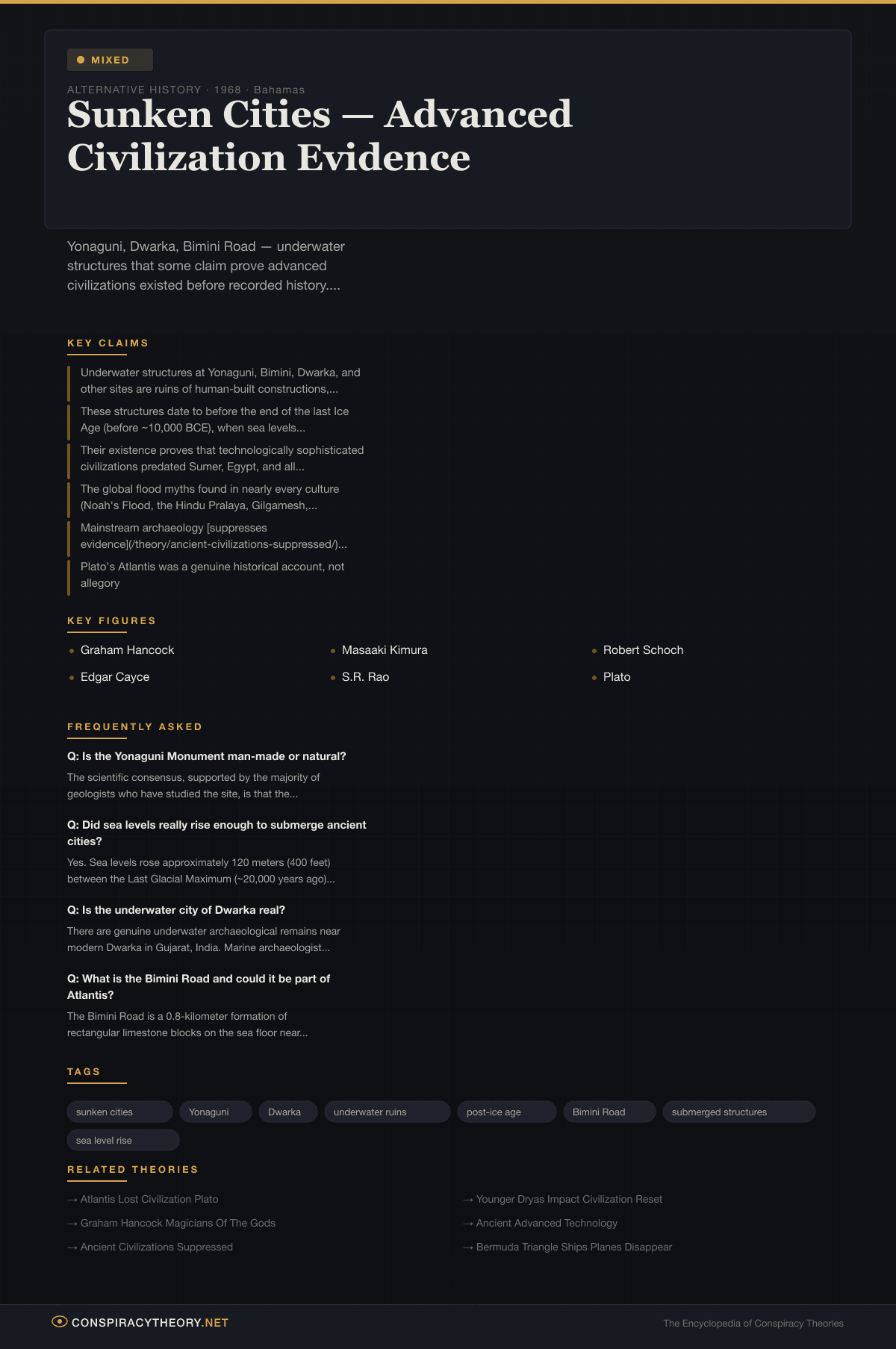
Sunken Cities — Advanced Civilization Evidence
Overview
There is a seductive premise at the heart of the sunken cities theory, and it starts with an indisputable fact: during the last Ice Age, sea levels were roughly 120 meters (400 feet) lower than today. Vast stretches of what is now ocean floor were dry, habitable land. The Persian Gulf was a river valley. Britain was connected to continental Europe. Indonesia was a single landmass. Australia was joined to New Guinea. And between roughly 20,000 and 6,000 years ago, all of that land was swallowed by rising seas.
Here’s the question that fuels an entire genre of alternative history: What if someone was living there? Not just scattered hunter-gatherers, but an organized, technologically sophisticated civilization? And what if the underwater structures that divers have discovered off the coasts of Japan, India, Cuba, the Bahamas, and the Mediterranean are the ruins of that civilization — proof that history began thousands of years before Sumer and Egypt, and that a catastrophic flood (preserved in mythology worldwide) wiped the slate almost clean?
It’s a hell of a story. And some parts of it are better supported than others.
This article examines the major underwater sites cited as evidence of pre-historical advanced civilizations, separating what is genuinely underwater archaeology from what is geological misidentification, wishful thinking, and a deeply human desire to believe we’ve lost more than we remember.
Origins & History
Plato Started It
Every sunken civilization theory eventually traces back to one source: Plato’s dialogues Timaeus and Critias (c. 360 BCE), in which the philosopher describes Atlantis — a powerful island civilization that sank beneath the ocean “in a single day and night of misfortune” approximately 9,000 years before Plato’s time. Whether Plato intended Atlantis as history, allegory, or philosophical thought experiment has been debated for over two millennia, but the image of a drowned civilization proved irresistible.
The Atlantis template established the narrative structure that all subsequent sunken city theories follow: an advanced civilization, a catastrophic flood, submersion, and fragmentary survival in myth. Every underwater rock formation discovered since has been measured against this template.
Edgar Cayce and the Bimini Prophecy
The modern search for sunken civilizations was turbocharged by Edgar Cayce, the American psychic known as the “Sleeping Prophet.” In 1938, during one of his trance readings, Cayce predicted that “a portion of the temple” of Atlantis would be discovered near Bimini in the Bahamas in “1968 or 1969.”
When underwater photographer J. Manson Valentine discovered a formation of large, roughly rectangular limestone blocks on the sea floor near North Bimini in September 1968 — right on Cayce’s schedule — the alternative history community erupted. The “Bimini Road,” as it became known, seemed to fulfill the prophecy perfectly. That it could be explained by natural geological processes was, for true believers, irrelevant. The prophecy had been fulfilled.
The Yonaguni Discovery
In 1986, diving instructor Kihachiro Aratake discovered a massive terraced stone formation off the coast of Yonaguni, the westernmost island of Japan’s Ryukyu archipelago. The structure — roughly 50 meters long, 20 meters wide, and 25 meters tall — features what appear to be flat terraces, sharp edges, right-angle steps, and even what some observers describe as carved channels and a triangular pool.
Masaaki Kimura, a marine geologist at the University of the Ryukyus, became the site’s most prominent advocate, arguing that the monument was at least partially man-made and could date to 10,000 years ago — a time when the site would have been above sea level due to lower ocean levels. Kimura’s claims received extensive media coverage, particularly after Graham Hancock featured Yonaguni prominently in his 1998 book Underworld: The Mysterious Origins of Civilization.
Graham Hancock and the Lost Civilization Thesis
No figure is more central to the modern sunken cities theory than Graham Hancock, the British journalist turned alternative history author. Hancock’s 2002 book Underworld was the result of years of diving at underwater sites around the world — Yonaguni, Dwarka, Malta, and others — and argued that a sophisticated civilization existed during the Ice Age and was destroyed by the flooding that accompanied deglaciation.
Hancock’s thesis connects to his broader Younger Dryas impact theory: a comet or asteroid impact approximately 12,800 years ago triggered catastrophic flooding, rising seas, and the destruction of an advanced but now-forgotten civilization. The survivors, in Hancock’s telling, became the “magicians of the gods” who brought agricultural knowledge and construction techniques to the historically documented civilizations of Egypt, Mesopotamia, and the Indus Valley.
The appeal of Hancock’s narrative is considerable. It’s well-written, it draws on real science (the Younger Dryas climate event is well-documented), and it addresses a genuine gap in the archaeological record (the transition from hunter-gatherer to agricultural societies happened with striking speed in several places simultaneously). Its weakness is that it extends far beyond what the evidence supports.
Key Claims
Proponents of the sunken cities hypothesis make several interlinked claims:
- Underwater structures at Yonaguni, Bimini, Dwarka, and other sites are ruins of human-built constructions, not natural geological formations
- These structures date to before the end of the last Ice Age (before ~10,000 BCE), when sea levels were significantly lower
- Their existence proves that technologically sophisticated civilizations predated Sumer, Egypt, and all other historically documented civilizations by thousands of years
- The global flood myths found in nearly every culture (Noah’s Flood, the Hindu Pralaya, Gilgamesh, Deucalion, Mayan flood stories) are cultural memories of the real rising seas that destroyed this civilization
- Mainstream archaeology suppresses evidence of these pre-historical civilizations because it would overturn established timelines
- Plato’s Atlantis was a genuine historical account, not allegory
Evidence
Site-by-Site Analysis
Yonaguni Monument (Japan)
What proponents claim: A man-made stepped pyramid or terraced monument dating to at least 10,000 years ago, when the site was above water. Kimura identifies features he interprets as a road, walls, a star-shaped platform, and carved faces.
What the geology says: The formation is composed of Miocene-era sandstone and mudstone that naturally fractures along bedding planes and joint sets, creating step-like terraces and right-angle features. Geologist Robert Schoch of Boston University — who is generally sympathetic to alternative chronologies (he famously argued the Sphinx is older than conventionally dated) — visited Yonaguni and concluded that the monument is “primarily, if not entirely, natural.” The stone type in the region regularly forms these patterns above water too; the submarine examples just happen to look more dramatic because underwater erosion enhances the angular features.
No tools, pottery, inscriptions, or any other human artifacts have been recovered from the Yonaguni Monument. For a supposedly man-made structure that would have required years of work by an organized society, the complete absence of associated material culture is a significant problem.
Status: Almost certainly natural. Kimura’s interpretation has not gained acceptance in the broader geological or archaeological community.
Bimini Road (Bahamas)
What proponents claim: A man-made road, wall, or foundation — possibly part of Atlantis, fulfilling Edgar Cayce’s 1938 prediction. The formation’s rectangular blocks and linear arrangement suggest human construction.
What the geology says: Multiple geological studies, including work by Eugene Shinn of the U.S. Geological Survey, have conclusively identified the Bimini Road as naturally occurring beachrock. Beachrock forms when calcium carbonate cements beach sand and shell fragments in the intertidal zone. When this rock is exposed to wave action, it fractures along predictable lines into rectangular blocks — a well-documented geological process observed on beaches worldwide.
Core samples taken from the blocks show that the grain layers are continuous across block boundaries — meaning the blocks were once a single slab that fractured in place, not individual blocks that were placed by builders. Radiocarbon dating of the rock and the shells within it yields ages of approximately 2,000-3,000 years — far too young for an Ice Age civilization and consistent with natural beachrock formation.
Status: Debunked. Natural beachrock formation.
Dwarka (India)
What proponents claim: The mythological city of Dwarka — home of the Hindu god Krishna — has been found underwater off the coast of Gujarat. The ruins date to 9,000 BCE or earlier, proving that Indian civilization is far older than mainstream historians acknowledge.
What the archaeology actually shows: This is the most nuanced of the three major sites, because there genuinely are underwater archaeological remains near Dwarka. Marine archaeologist S.R. Rao of the National Institute of Oceanography conducted extensive surveys beginning in the 1980s and documented stone anchors, pottery fragments, and structural remnants on the sea floor.
However, dating of these materials places them around 1500 BCE — consistent with a historical trading port of the late Bronze Age, not a pre-Ice Age metropolis. The site is archaeologically significant as evidence of ancient Indian maritime activity, but the jump from “Bronze Age port” to “pre-10,000 BCE advanced civilization” is not supported by the evidence Rao or any subsequent researcher has published.
Additional claims about a “9,500-year-old city” in the Gulf of Cambay, announced by India’s National Institute of Ocean Technology in 2001, remain controversial. The supposed artifacts were dredged, not excavated in situ, making their context (and therefore their dating) unreliable. Several geologists have argued the “artifacts” are natural rock formations.
Status: Mixed. Real underwater archaeology exists at Dwarka, but it dates to the historical period (~1500 BCE), not to a pre-Ice Age civilization.
Other Cited Sites
Pavlopetri (Greece): A genuinely sunken Bronze Age city off the coast of southern Laconia, dated to approximately 2800 BCE. It’s real underwater archaeology — streets, buildings, tombs — but dates to the well-documented historical period, not to a lost pre-Ice Age civilization. Proponents sometimes cite it as proof of concept without noting the dating.
Cuba’s Underwater Structures: In 2001, a Canadian exploration company reported sonar images suggesting structures at 600-750 meters depth off western Cuba. At such depth, the site would have been above water only during the Pleistocene, hundreds of thousands of years ago. No follow-up investigation has confirmed the initial claims, and the sonar resolution was insufficient to distinguish geological formations from man-made structures.
Heracleion/Thonis (Egypt): A genuine sunken ancient Egyptian port city discovered in Abu Qir Bay. Extraordinary real archaeology — but dating to the 8th century BCE, well within historical periods.
Debunking / Verification
This theory receives a “mixed” status because it entangles two very different claims:
The legitimate claim: Sea levels were dramatically lower during the Ice Age, and human settlements that existed on now-submerged coastlines are undoubtedly out there. Marine archaeology is a young field, and there is much more to discover underwater. Some genuine underwater archaeological sites (Pavlopetri, Heracleion, Dwarka’s Bronze Age port) demonstrate that the ocean has swallowed real human habitation. It is entirely reasonable to expect more such discoveries.
The unsupported claim: The specific formations most frequently cited as evidence — Yonaguni, Bimini Road — have been studied by geologists and found to be natural. The broader claim that an advanced, globe-spanning civilization existed before ~10,000 BCE and was destroyed by flooding lacks supporting evidence. No pre-Ice Age writing systems, metal tools, pottery traditions, or other material culture markers of an “advanced” civilization have been found at any underwater site.
The theory’s fundamental problem is the gap between “sea levels rose and coastlines were submerged” (true) and “an advanced civilization comparable to Egypt or Sumer existed there” (undemonstrated). Coastal hunter-gatherer settlements were certainly flooded. A technologically sophisticated civilization with cities, writing, and monumental architecture — which would leave abundant, unmistakable material evidence even after millennia underwater — has not been found.
The flood myth argument is more interesting than proponents sometimes realize but less conclusive than they claim. Global flood myths likely reflect real experiences of rising seas and catastrophic flooding at the end of the Ice Age. This does not require a single unified civilization to explain — many separate coastal cultures would have independently experienced and mythologized the same global phenomenon.
Cultural Impact
Rewriting Human History (In the Bookstore, at Least)
The sunken cities theory has become a publishing and media juggernaut. Graham Hancock’s books have sold millions of copies worldwide. His Netflix series Ancient Apocalypse (2022) reached the platform’s top 10 in multiple countries, sparking furious debates between alternative history enthusiasts and professional archaeologists. The Society for American Archaeology took the unusual step of writing an open letter criticizing the show’s claims.
This cultural impact is significant because it shapes public perception of archaeology. Surveys consistently show that substantial portions of the public believe in lost ancient civilizations — a belief nurtured by decades of books, documentaries, and now streaming content that present speculation as evidence and frame mainstream science as a hostile establishment.
The “Suppressed History” Narrative
Sunken city theories feed into the broader suppressed ancient civilizations narrative — the idea that mainstream academia knows (or suspects) that human history is far older and more complex than publicly acknowledged but suppresses this knowledge to protect established careers, funding structures, and ideological commitments. This narrative is seductive because academia is sometimes slow to accept new evidence and does have institutional biases. But there is a vast difference between institutional conservatism and active suppression of evidence.
Marine Archaeology’s Catch-22
Legitimate marine archaeologists face a frustrating double bind. Their field genuinely deserves more funding and attention — underwater sites are threatened by climate change, development, and trawling. But the public enthusiasm generated by lost civilization theories can distort research priorities and attract the wrong kind of attention. Archaeologists who work underwater spend considerable time explaining what they haven’t found (pre-Ice Age civilizations) rather than what they have (fascinating evidence of coastal adaptation, maritime trade, and environmental change).
In Popular Culture
- Graham Hancock’s Underworld: The Mysterious Origins of Civilization (2002) — the definitive popular treatment
- Ancient Apocalypse (Netflix, 2022-2024) — Hancock’s streaming series that reignited the debate
- The Yonaguni Monument features in the anime Nadia: The Secret of Blue Water and the video game Tomb Raider: Underworld
- James Cameron’s interest in underwater exploration has intersected with lost civilization theories in multiple documentaries
- The Bimini Road is a fixture of Bermuda Triangle lore and Atlantis-hunting documentaries
- Disney’s Atlantis: The Lost Empire (2001) drew on the sunken civilization genre
- The video game Assassin’s Creed Odyssey features explorable underwater ruins inspired by real Mediterranean sites
- Aquaman (2018) presents Atlantis as a technologically advanced sunken civilization
Key Figures
Graham Hancock — Former Economist journalist turned alternative history author. His books Fingerprints of the Gods (1995), Underworld (2002), and Magicians of the Gods (2015) form the core texts of the modern lost civilization movement. His Netflix series brought these ideas to their largest-ever audience.
Masaaki Kimura — Marine geologist at the University of the Ryukyus who has argued since the late 1990s that the Yonaguni Monument is at least partially man-made. His claims have not gained acceptance in the broader geological community.
Robert Schoch — Boston University geologist known for arguing that the Sphinx is older than conventionally dated. Despite his alternative sympathies, Schoch concluded that the Yonaguni Monument is most likely natural.
S.R. Rao (1922-2013) — Indian marine archaeologist who conducted pioneering underwater surveys at Dwarka. His documented discoveries of Bronze Age maritime remains are genuine archaeological achievements, though they have been overextended by lost civilization proponents.
Edgar Cayce (1877-1945) — American psychic whose 1938 prediction of Atlantean ruins near Bimini directly shaped the interpretation of the Bimini Road discovery 30 years later.
Plato (c. 428-348 BCE) — The philosopher whose Atlantis dialogues created the conceptual template for every sunken civilization theory that followed.
Timeline
| Date | Event |
|---|---|
| ~360 BCE | Plato writes of Atlantis in Timaeus and Critias |
| 1938 | Edgar Cayce predicts Atlantis will be found near Bimini in 1968-1969 |
| 1968 | J. Manson Valentine discovers the Bimini Road |
| 1980s | S.R. Rao begins underwater archaeological surveys at Dwarka |
| 1986 | Kihachiro Aratake discovers the Yonaguni Monument |
| 1997 | Masaaki Kimura begins publishing claims that Yonaguni is man-made |
| 1998 | Graham Hancock features Yonaguni in Underworld research |
| 1999 | Robert Schoch visits Yonaguni; concludes it is likely natural |
| 2001 | Sonar images of alleged structures off Cuba announced; Gulf of Cambay claims emerge |
| 2002 | Hancock publishes Underworld: The Mysterious Origins of Civilization |
| 2000s | Heracleion (Thonis) excavations reveal genuine sunken Egyptian port |
| 2015 | Hancock publishes Magicians of the Gods, extending the lost civilization thesis |
| 2022 | Ancient Apocalypse debuts on Netflix; Society for American Archaeology responds |
| 2024 | Ancient Apocalypse Season 2 continues the series |
Sources & Further Reading
- Hancock, Graham. Underworld: The Mysterious Origins of Civilization. Crown, 2002. (Primary source for the theory; not endorsement.)
- Schoch, Robert M. Voices of the Rocks. Harmony Books, 1999.
- Shinn, Eugene A. “Geology and the Origin of the Bimini Road.” Compass of Sigma Gamma Epsilon, 1978.
- Kimura, Masaaki. “Ancient Ruins Found Underwater at Yonaguni, Japan.” 21st Century Science & Technology, 2004.
- Rao, S.R. The Lost City of Dvaraka. National Institute of Oceanography, 1999.
- Flemming, Nicholas C. Cities in the Sea. New English Library, 1971.
- Bailey, Geoffrey, and Nicholas Flemming. “Archaeology of the Continental Shelf: Marine Resources, Submerged Landscapes and Underwater Archaeology.” World Archaeology, 2008.
- Society for American Archaeology. “Open Letter Regarding Netflix’s Ancient Apocalypse.” November 2022.
- Fagan, Brian. The Long Summer: How Climate Changed Civilization. Basic Books, 2004.
Related Theories
- Atlantis — The original lost sunken civilization from Plato’s dialogues
- Younger Dryas Impact Theory — The catastrophe theory often invoked to explain the destruction of the alleged civilization
- Graham Hancock’s Lost Civilization — The most prominent modern articulation of the advanced pre-historical civilization thesis
- Ancient Advanced Technology — Broader claims about lost prehistoric technological capabilities
- Suppressed Ancient Civilizations — The meta-conspiracy that mainstream academia hides evidence of pre-historical societies
- Bermuda Triangle — The Bimini Road is geographically located within the Bermuda Triangle, and the two theories often overlap
Frequently Asked Questions
Is the Yonaguni Monument man-made or natural?
Did sea levels really rise enough to submerge ancient cities?
Is the underwater city of Dwarka real?
What is the Bimini Road and could it be part of Atlantis?
Infographic
Share this visual summary. Right-click to save.