The Single Bullet / Magic Bullet Theory
Overview
Of all the arguments in the JFK assassination debate — and there are enough to fill a library — none has generated more heat, more ridicule, and more genuine scientific dispute than the single bullet theory. Proposed by junior Warren Commission counsel Arlen Specter in 1964, it holds that a single 6.5mm Mannlicher-Carcano bullet accomplished one of the most remarkable feats in the history of ballistics: it struck President Kennedy in the upper back, transited his neck, exited his throat, paused (according to the timing analysis of the Zapruder film) for approximately 1.6 seconds, then struck Governor John Connally in the back, shattered a rib, exited his chest, plunged through his right wrist, shattered the radius bone, and lodged itself in his left thigh. It was then recovered on a stretcher at Parkland Hospital in a condition so nearly pristine that critics promptly dubbed it the “magic bullet.”
The name stuck, and it stuck for a reason. Commission Exhibit 399 — the bullet in question — looks like it was fired into a cotton bale, not through two human bodies and multiple bones. It weighs 158.6 grains, having lost only 2.4 grains of its original mass. Test bullets fired through a single human wrist emerged more deformed than CE 399 allegedly emerged after its seven-wound journey.
The single bullet theory is not merely an interesting forensic puzzle. It is the load-bearing wall of the lone-assassin conclusion. If CE 399 did not cause all of the wounds attributed to it, then more than three shots were fired in Dealey Plaza. Since the Warren Commission determined that Oswald’s bolt-action rifle could fire at most three rounds in the available time — and one of those rounds missed the car entirely — additional shots mean additional shooters. If the magic bullet didn’t happen, the assassination was a conspiracy. It is really that simple.
Origins & History
The Problem the Theory Solved
The single bullet theory was born of necessity, not elegance. When the Warren Commission began its work in December 1963, it faced a fundamental timing problem created by the Zapruder film — the 26.6-second, 486-frame home movie that Abraham Zapruder shot from a concrete pedestal overlooking the motorcade.
The film showed that the interval between the first shot to hit Kennedy (approximately frame 223-225) and the fatal head shot (frame 313) was roughly 4.8 seconds. FBI firearms experts had determined that Oswald’s Mannlicher-Carcano rifle required a minimum of 2.3 seconds between shots to operate the bolt action, re-aim, and fire — meaning a maximum of three shots could be fired in the available time window.
The problem was Governor Connally. Connally was seated directly in front of Kennedy in the presidential limousine, on a jump seat. He was wounded in the back, chest, wrist, and thigh. If Connally’s wounds were caused by a separate bullet from Kennedy’s wounds, then at least four shots had been fired (one missing, one hitting Kennedy in the back/throat, one hitting Connally, and one hitting Kennedy in the head). Four shots were impossible from a single bolt-action rifle in the available time.
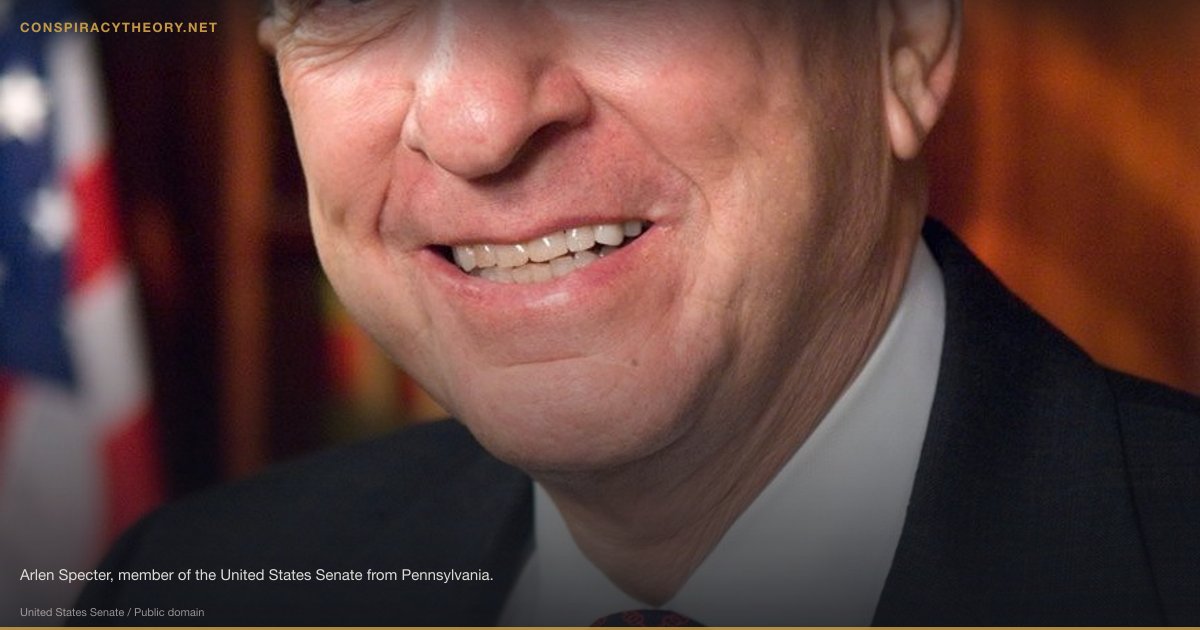
Junior counsel Arlen Specter — a young Philadelphia prosecutor who would later become a US Senator — proposed the solution: one bullet caused all seven wounds to both men. It was the only way to keep the shot count at three and preserve the lone-gunman conclusion.
Commission Exhibit 399
The bullet at the center of the theory was reportedly discovered by Parkland Hospital senior engineer Darrell Tomlinson on a stretcher in a hallway near the emergency room on the afternoon of November 22, 1963. The bullet was a 6.5mm Western Cartridge Company round, consistent with ammunition used in the Mannlicher-Carcano rifle attributed to Oswald.
CE 399 was remarkably intact. Its copper jacket was slightly flattened on one side and its base was marginally distorted, but it bore none of the fragmentation, deformation, or material loss that ballistics experts would expect from a bullet that had struck two human bodies, shattered a rib, shattered a wrist bone, and lodged in a thigh. The bullet appeared, as numerous observers noted, to have been fired through something soft.
This condition was not a minor problem for the theory — it was the central problem. When Warren Commission skeptics coined the term “magic bullet,” they were not merely being sarcastic. They were identifying a genuine forensic anomaly that has never been convincingly resolved.
Connally’s Objection
Governor Connally himself never accepted the single bullet theory. He maintained until his death in 1993 that he was struck by a separate bullet, and his account was supported by his wife Nellie, who was sitting beside him. In testimony before the Warren Commission and in subsequent interviews, Connally described hearing the first shot, beginning to turn to look at the President, and then being struck by a separate bullet from behind.
Connally’s testimony was significant because the Zapruder film shows him reacting to his wounds approximately 1.6 seconds after Kennedy’s first visible reaction — a delay that, in the single bullet theory, is attributed to a “delayed reaction” on Connally’s part. Critics argue this delay is more consistent with two separate bullets.
Key Claims
Arguments Against the Single Bullet Theory
- The bullet’s condition is impossible: CE 399 is too pristine to have caused the extensive bone and tissue damage attributed to it. Test bullets fired through cadaver wrists alone emerged more deformed than CE 399
- The trajectory requires a “magic” path: For the bullet to have struck both Kennedy and Connally as described, it would have had to change direction multiple times — entering Kennedy’s back on a downward trajectory, exiting his throat on a level or slightly upward trajectory, then re-entering Connally’s back on a downward trajectory. Critics argue this path violates basic physics
- Connally’s testimony contradicts the theory: The governor, an experienced hunter and marksman, was certain he was hit by a separate bullet. His wife’s testimony corroborated his account
- The timing gap: The approximately 1.6-second delay between Kennedy’s and Connally’s visible reactions in the Zapruder film is more consistent with two shots than with a “delayed reaction” to a single bullet
- Fragment evidence: More bullet fragments were recovered from Connally’s wrist and chest than CE 399 appears to have lost, raising the possibility that the fragments came from a different bullet entirely
- The stretcher chain of custody: The stretcher on which CE 399 was found may not have been Connally’s stretcher. Tomlinson was not certain which stretcher the bullet came from, and the chain of custody was imprecise
Arguments Supporting the Single Bullet Theory
- The alignment works: When the relative positions of Kennedy and Connally in the limousine are properly reconstructed — with Connally seated on a jump seat that was lower and inboard of Kennedy’s position — the trajectory of a single bullet from the sixth floor of the Texas School Book Depository through both men is physically possible. Computer-aided reconstructions by Dale Myers and others have demonstrated this
- Wound ballistics research: Studies of full metal jacket bullets similar to CE 399 have shown that such bullets can pass through soft tissue and bone while remaining relatively intact, particularly if they are traveling at a velocity that has been reduced by passing through a first target
- The Zapruder film timing: Some analysts argue that Kennedy and Connally react simultaneously, not sequentially, and that the apparent delay is an artifact of film interpretation
- Neutron activation analysis: In 1977, Dr. Vincent Guinn conducted neutron activation analysis on CE 399 and the fragments recovered from Connally’s wrist, concluding that they shared the same metallic composition, consistent with coming from the same bullet. However, subsequent reanalysis by researchers at Texas A&M challenged Guinn’s methodology and conclusions
- No viable alternative: If the single bullet theory is rejected, the alternative requires a second gunman who fired a bullet that was never recovered, from a position that has never been identified, using a weapon that was never found
Evidence
The Forensic Debate
The single bullet theory is ultimately a forensic question, and the forensic evidence is genuinely ambiguous.
The autopsy: The military autopsy conducted at Bethesda Naval Hospital on the night of November 22 was, by wide consensus, inadequate. The pathologists were not forensic specialists, did not dissect the neck wound, and failed to track the bullet’s path through Kennedy’s body. The autopsy photographs and X-rays were not available to the Warren Commission during its investigation, and the original autopsy notes were burned by the lead pathologist, Dr. James Humes.
The Dale Myers reconstruction: In 2003, animator and researcher Dale Myers published a computer-generated reconstruction of the shooting that placed Kennedy and Connally in their documented positions in the limousine and traced a bullet trajectory from the sixth floor window. His reconstruction showed that a single bullet could have traversed both men along a straight line, with no “magic” direction changes required. The key insight was that Connally’s jump seat was positioned significantly inboard of Kennedy, meaning the bullet did not need to change direction — it just continued in a straight line through bodies that were offset from each other.
The Lattimer experiments: Dr. John Lattimer, a urologist and ballistics researcher, conducted shooting tests using Mannlicher-Carcano ammunition and gelatin blocks simulating human tissue. He found that full metal jacket bullets could pass through simulated neck tissue and bone while remaining relatively intact, supporting the plausibility of CE 399’s condition. However, other researchers who conducted similar tests obtained bullets that were significantly more deformed.
The neutron activation analysis controversy: Guinn’s 1977 analysis concluded that CE 399 and the Connally wrist fragments were metallic matches. In 2006, researchers Cliff Spiegelman and William Tobin reanalyzed the data and concluded that Guinn’s methodology was flawed and that the metallic composition of Mannlicher-Carcano bullets was insufficiently unique to allow reliable matching. Their finding undermined one of the strongest pieces of scientific evidence supporting the theory.
Debunking / Verification
The single bullet theory remains unresolved because the evidence is genuinely contradictory. The computer-aided trajectory analysis supports the physical plausibility of the bullet path. The condition of CE 399 argues against it. The Zapruder film timing is ambiguous. Connally’s testimony contradicts it. The autopsy was too flawed to be definitive.
The 1979 House Select Committee on Assassinations accepted the single bullet theory as a valid explanation but concluded, based on acoustic evidence (later disputed), that Kennedy was “probably assassinated as a result of a conspiracy” involving a second gunman who fired from the grassy knoll. This awkward conclusion — accepting the single bullet theory while simultaneously finding evidence of a conspiracy — illustrates the fundamental difficulty of resolving the forensic questions.
Modern ballistics science has not settled the debate. Both supporters and critics of the theory can cite experimental results that support their positions. The destruction of key evidence — the autopsy notes, the failure to dissect the neck wound, the inadequate chain of custody for CE 399 — means that some questions are now permanently unanswerable.
Cultural Impact
The single bullet theory has become one of the most famous forensic disputes in history and a permanent fixture of American popular culture.
The term “magic bullet” has entered the English language as a synonym for any explanation that seems too convenient or too implausible to be true. It is used in contexts far removed from the JFK assassination, applied to everything from pharmaceutical claims to economic theories.
The theory was dramatized memorably in Oliver Stone’s 1991 film JFK, in which Kevin Costner’s Jim Garrison delivers a courtroom demonstration of the bullet’s alleged path that remains one of the most iconic scenes in political cinema. Stone’s depiction, while criticized by supporters of the Warren Commission, brought the forensic arguments to a mass audience and crystallized public skepticism about the official narrative.
The single bullet theory has also driven significant advances in forensic science and ballistics research. The debate has produced sophisticated computer modeling, neutron activation analysis, wound ballistics experiments, and photographic enhancement techniques that have applications far beyond the JFK case.
In political terms, the theory is often cited as an example of how official investigations can reach conclusions that strain public credulity, contributing to the broader erosion of institutional trust that has characterized American political culture since the 1960s. The phrase “you believe in the magic bullet?” has become shorthand for questioning whether someone accepts government explanations at face value.
Key Figures
- Arlen Specter — Junior Warren Commission counsel who devised the single bullet theory; later became a US Senator from Pennsylvania
- John Connally — Texas Governor wounded in the assassination; rejected the single bullet theory until his death in 1993
- Nellie Connally — The governor’s wife, seated beside him; corroborated his account of being hit by a separate bullet
- Gerald Ford — Warren Commission member who, according to declassified documents, requested that the Commission’s description of the bullet entry point be moved upward in the report to better support the single bullet trajectory
- Dr. James Humes — Lead autopsy pathologist at Bethesda Naval Hospital; burned his original autopsy notes
- Dale Myers — Computer animator whose reconstruction supported the single bullet trajectory
- Dr. Vincent Guinn — Chemist whose neutron activation analysis supported the theory (later challenged)
- Dr. Cyril Wecht — Forensic pathologist and the most prominent scientific critic of the single bullet theory
Timeline
| Date | Event |
|---|---|
| November 22, 1963 | President Kennedy and Governor Connally shot in Dallas |
| November 22, 1963 | CE 399 found on stretcher at Parkland Hospital |
| November 22, 1963 | Autopsy conducted at Bethesda Naval Hospital |
| November 29, 1963 | Warren Commission established |
| 1964 | Arlen Specter develops the single bullet theory during Commission investigation |
| September 24, 1964 | Warren Commission report published, incorporating the single bullet theory |
| 1966 | Edward Jay Epstein’s Inquest challenges the single bullet theory |
| 1966 | Mark Lane’s Rush to Judgment popularizes “magic bullet” critique |
| 1967 | Josiah Thompson’s Six Seconds in Dallas presents detailed forensic challenge |
| 1969 | Dr. Cyril Wecht begins public critique of the single bullet theory |
| 1977 | Dr. Vincent Guinn conducts neutron activation analysis supporting the theory |
| 1979 | House Select Committee on Assassinations accepts the single bullet theory but finds probable conspiracy |
| 1991 | Oliver Stone’s JFK dramatizes the “magic bullet” argument for mass audience |
| 1993 | Governor Connally dies, never having accepted the single bullet theory |
| 2003 | Dale Myers publishes computer reconstruction supporting the trajectory |
| 2006 | Spiegelman and Tobin challenge Guinn’s neutron activation analysis |
| 2013 | Discovery Channel cold case investigation produces mixed results |
| 2023 | Additional Warren Commission documents declassified |
Sources & Further Reading
- Warren Commission. “Report of the President’s Commission on the Assassination of President Kennedy.” US Government Printing Office, 1964
- Thompson, Josiah. Six Seconds in Dallas: A Micro-Study of the Kennedy Assassination. Bernard Geis Associates, 1967
- Epstein, Edward Jay. Inquest: The Warren Commission and the Establishment of Truth. Viking, 1966
- Wecht, Cyril. Cause of Death: A Leading Forensic Expert Sets the Record Straight. Dutton, 1993
- Myers, Dale K. With Malice: Lee Harvey Oswald and the Murder of Officer J.D. Tippit. Oak Cliff Press, 1998
- Guinn, Vincent P. “JFK Assassination: Bullet Analyses.” Analytical Chemistry 51, no. 4 (1979)
- Spiegelman, Cliff, et al. “Chemical and Forensic Analysis of JFK Assassination Bullet Lots.” Annals of Applied Statistics 1, no. 2 (2007)
- Lattimer, John K. Kennedy and Lincoln: Medical and Ballistic Comparisons of Their Assassinations. Harcourt Brace Jovanovich, 1980
- Lane, Mark. Rush to Judgment: A Critique of the Warren Commission. Holt, Rinehart and Winston, 1966
- Bugliosi, Vincent. Reclaiming History: The Assassination of President John F. Kennedy. W.W. Norton, 2007
Related Theories
- JFK Assassination — The broader conspiracy surrounding the Kennedy assassination
- JFK Grassy Knoll — Evidence for a second shooter from the grassy knoll
- Oswald as Patsy — The theory that Oswald was set up to take the blame

Frequently Asked Questions
What is the magic bullet theory?
Has the magic bullet theory been proven or disproven?
Why does the single bullet theory matter?

Infographic
Share this visual summary. Right-click to save.
