Shadow Government / Continuity of Government
Overview
On the morning of March 1, 2002, Americans picking up the Washington Post encountered a remarkable story. Under the headline “Shadow Government Is at Work in Secret,” the paper reported that since September 11, approximately 75 to 150 senior government officials had been living and working in two classified underground bunkers outside Washington, rotating in and out on 90-day shifts, as part of a “shadow government” designed to ensure the survival of executive branch functions in the event of a catastrophic attack on the capital.
The story was not a conspiracy theory. It was sourced to senior Bush administration officials speaking on background. The shadow government was real. It had been activated on September 11 and had been operating continuously for six months. And it raised a question that has haunted American political discourse for decades: if the government maintains secret, parallel governing structures designed to operate outside normal constitutional processes during emergencies, who decides when the emergency begins, who decides when it ends, and what happens to democracy in the meantime?
The shadow government conspiracy theory exists on a spectrum. At one end is the documented reality: the United States has maintained Continuity of Government (COG) programs since the Eisenhower administration, involving classified facilities, emergency powers, designated survivors, and plans for maintaining government operations during catastrophic events. These programs are real, expensive, and extensively planned. At the other end is the conspiracy theory: that these programs have been co-opted by a permanent, unelected power structure that operates alongside — or instead of — elected government during peacetime, making decisions that shape policy without democratic accountability or oversight.
The distance between these two endpoints is shorter than most people are comfortable admitting.
Origins & History
The Atomic Age and Presidential Succession
The shadow government concept originated in the most rational of contexts: the fear that a Soviet nuclear strike on Washington, D.C., could decapitate the American government. In the late 1940s and early 1950s, as the Soviet Union developed its nuclear arsenal and intercontinental delivery systems, American military planners confronted a scenario in which the president, vice president, cabinet, congressional leadership, and the Supreme Court could all be killed simultaneously by a single nuclear weapon.
The response was Continuity of Government planning. Under Presidents Truman and Eisenhower, the federal government began constructing a network of classified facilities designed to house a functioning government in the aftermath of nuclear attack. The most significant of these included:
Mount Weather (officially the “High Point Special Facility”): A massive underground complex in the Blue Ridge Mountains of Virginia, approximately 48 miles from Washington. Constructed in the 1950s, Mount Weather was designed to serve as an alternate seat of government, complete with offices, dormitories, a hospital, a crematorium, communication facilities, a television and radio broadcast studio, and sufficient supplies to support hundreds of government officials for extended periods.
The Greenbrier Bunker: Built beneath the Greenbrier resort hotel in White Sulphur Springs, West Virginia, this facility was designed to house the entire U.S. Congress — 535 members plus staff — in the event of nuclear war. The bunker, codenamed “Project Greek Island,” operated under cover as a resort expansion from 1958 until 1992, when its existence was revealed by the Washington Post.
Raven Rock Mountain Complex (Site R): A massive underground Pentagon located near the Maryland-Pennsylvania border, designed to serve as an alternate military command center. This facility remains operational and has been expanded multiple times since its construction in the 1950s.
These were not conspiracy theories. They were engineering projects, funded by Congress (often through classified budget lines), constructed by contractors, and maintained by military and civilian personnel. Their existence was classified but their purpose was straightforward: to ensure that the government could survive and function after a nuclear attack.
The Reagan Expansion
The most significant and politically consequential expansion of COG planning occurred during the Reagan administration. In 1981, President Reagan signed a series of classified National Security Decision Directives (NSDDs) that dramatically expanded and reorganized the COG apparatus. The program, which operated under various codenames including “Doomsday” and involved billions of dollars in classified spending, went far beyond the Eisenhower-era plans for surviving nuclear attack.
The Reagan-era COG program had several notable features that later fueled conspiracy theories:
Private citizen participation: The program included private citizens — individuals who held no elected or appointed government office — who participated in regular exercises simulating the assumption of emergency governmental powers. These participants were organized into teams that would, in the event of a national emergency, form a standby government ready to take over executive functions.
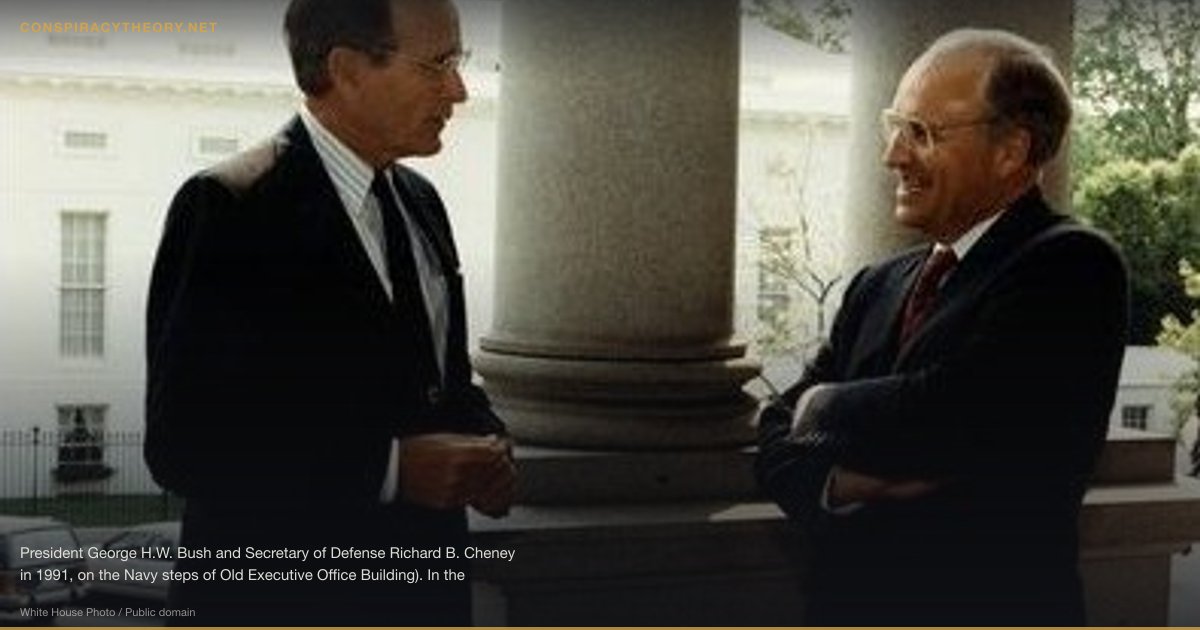
Two of the most prominent private-citizen participants were Dick Cheney, then a Republican congressman from Wyoming, and Donald Rumsfeld, then a private-sector CEO with no government position. Both men participated in COG exercises throughout the 1980s and into the 1990s, spending weekends at classified locations practicing the assumption of emergency executive authority. Both would later hold senior government positions — Cheney as Secretary of Defense under George H.W. Bush and Vice President under George W. Bush, Rumsfeld as Secretary of Defense under both Gerald Ford and George W. Bush — from which they directly influenced COG policy.
Expanded scope: The Reagan-era program broadened the definition of “emergency” beyond nuclear attack to include other catastrophic scenarios, including terrorist attacks, natural disasters, and civil unrest. This expansion meant that COG plans could potentially be activated in a wider range of circumstances, raising questions about the boundaries of emergency power.
Oliver North’s role: Lieutenant Colonel Oliver North, best known for his role in the Iran-Contra affair, was involved in the development of COG plans during the 1980s. During the Iran-Contra hearings in 1987, Representative Jack Brooks of Texas attempted to question North about his involvement in plans for “the suspension of the American Constitution,” but committee chairman Senator Daniel Inouye cut Brooks off, stating that the matter was “highly sensitive and classified.” This exchange, broadcast on national television, became one of the most cited pieces of evidence in shadow government conspiracy theories.
The Iran-Contra Connection and Rex 84
The shadow government narrative gained significant traction from the connection between COG planning and the Iran-Contra affair. Oliver North, who was simultaneously involved in the secret sale of arms to Iran, the funding of Nicaraguan Contras, and the development of COG emergency plans, represented a nexus of covert operations that seemed to confirm the worst suspicions of government critics.
The Rex 84 exercise (Readiness Exercise 1984), which planned for the detention of hundreds of thousands of undocumented immigrants during a national emergency, was developed under the same administrative umbrella as the COG programs. The connection between continuity of government planning and the potential detention of civilians fueled fears that COG plans could be used not merely to preserve government in the aftermath of an attack but to impose authoritarian control on the civilian population.
September 11 and the Activation
The September 11, 2001, terrorist attacks represented the first real-world activation of COG plans. Within minutes of the attacks, Vice President Dick Cheney — the same man who had spent the 1980s practicing for exactly this scenario — was moved to the Presidential Emergency Operations Center (PEOC) beneath the White House. Other senior officials were dispersed to classified locations. The COG apparatus, designed for nuclear war, was applied to a terrorist attack.
What happened next remains partially classified. The Washington Post reported in March 2002 that the shadow government had been operating continuously since 9/11, with senior officials rotating through classified facilities. The specific authorities exercised during this period, the decisions made, and the legal framework under which they operated have never been fully disclosed.
Several post-9/11 developments raised additional concerns:
Presidential emergency orders: President Bush signed a series of classified executive directives related to COG and emergency powers, the full contents of which have not been made public. National Security Presidential Directive 51 (NSPD-51), signed in 2007, outlined “Continuity of Government” plans but contained classified annexes that not even members of Congress were allowed to review, despite their explicit requests.
The Cheney-Addington theory of executive power: Vice President Cheney, drawing on his decades of COG experience, advocated an expansive theory of executive power during national emergencies that included warrantless surveillance, enhanced interrogation techniques, and the indefinite detention of suspected terrorists. Whether and how these positions were influenced by Cheney’s long immersion in COG planning remains a subject of debate.
Key Claims
Shadow government conspiracy theories advance several claims of varying credibility:
- A permanent, unelected governing apparatus exists alongside the elected government, ready to assume power during declared emergencies (partially confirmed by COG documentation)
- COG plans include provisions for suspending constitutional rights, including habeas corpus, freedom of assembly, and due process (plausible based on Rex 84 and related exercises, but full details remain classified)
- Private citizens participated in government exercises practicing the assumption of executive power, including individuals who later held senior government positions (confirmed by investigative reporting on Cheney and Rumsfeld’s participation)
- The scope of “emergency” has been deliberately broadened beyond nuclear attack to include scenarios that could justify domestic martial law (partially confirmed by the expansion of COG definitions during the Reagan and post-9/11 eras)
- Congressional oversight of COG programs is inadequate, with even members of Congress denied access to classified COG documents (confirmed by multiple members of Congress)
- The shadow government was activated on 9/11 and may have remained partially activated for years afterward (partially confirmed by the 2002 Washington Post reporting)
- COG programs represent a mechanism for coup — a pre-built infrastructure for seizing power that could be activated by any president willing to declare a sufficiently broad emergency
Evidence
What Is Documented
The evidentiary basis for shadow government concerns is more substantial than for most conspiracy theories:
Physical infrastructure: The existence of Mount Weather, the Greenbrier bunker, Raven Rock, and other classified facilities is confirmed and documented. These are real places with real functions, built at enormous expense and maintained for decades.
COG exercises: The participation of Cheney, Rumsfeld, and other future senior officials in classified COG exercises during the 1980s has been documented by multiple journalists, including James Mann in his 2004 book Rise of the Vulcans and James Bamford in his work on the NSA.
September 11 activation: The activation of COG plans on 9/11 and the subsequent operation of a “shadow government” were reported by mainstream news organizations citing senior administration officials.
Congressional exclusion: Multiple members of Congress, including Representative Peter DeFazio of Oregon, have publicly stated that they were denied access to classified COG documents despite being members of relevant committees.
What Remains Unknown
Critical questions about the shadow government remain unanswered because the relevant information is classified:
- The full content of NSPD-51 and related classified directives
- The specific authorities exercised by the shadow government during and after 9/11
- The current scope and operational status of COG programs
- Whether COG plans include provisions for suspending constitutional protections
- The criteria for COG activation and the process for deactivation
Cultural Impact
The Normalization of Emergency Powers
The shadow government concept has contributed to a broader cultural acceptance of emergency powers as a permanent feature of American governance rather than a temporary response to crisis. The post-9/11 era saw a dramatic expansion of executive emergency authority, including the PATRIOT Act, warrantless surveillance programs, and expanded detention authority, much of it justified by the same logic of emergency preparedness that underlies COG planning.
Entertainment and Fiction
The shadow government has been a staple of American popular culture for decades. Television series including Designated Survivor (whose entire premise is based on COG protocols), 24, The West Wing, and Jericho have explored themes of continuity of government and emergency powers. Films including Olympus Has Fallen and White House Down dramatize scenarios in which shadow government infrastructure plays a role. These fictional treatments have made the concept of continuity of government familiar to a mass audience, simultaneously normalizing it and fueling anxiety about its potential misuse.
The Democratic Accountability Gap
The shadow government debate has highlighted a genuine and unresolved tension in democratic governance: how does a democracy plan for scenarios in which normal democratic processes may be suspended, without creating the infrastructure for permanent authoritarian rule? The COG programs exist because nuclear war, massive terrorism, or catastrophic natural disaster could genuinely destroy the government’s ability to function. But the same infrastructure that would preserve government in those scenarios could also be used to seize power in less extreme circumstances. No democratic theory has fully resolved this tension.
Timeline
| Date | Event |
|---|---|
| 1947 | National Security Act creates the CIA and National Security Council, expanding the classified apparatus of government |
| 1950s | Eisenhower administration begins construction of Mount Weather and other classified facilities for continuity of government |
| 1958 | Construction of the Greenbrier Congressional bunker (“Project Greek Island”) begins in West Virginia |
| 1961 | Eisenhower’s farewell address warns of the “military-industrial complex” |
| 1962 | Cuban Missile Crisis triggers the closest real-world approach to COG activation |
| 1981 | Reagan signs classified NSDDs dramatically expanding COG programs |
| 1981-1992 | Dick Cheney and Donald Rumsfeld participate in COG exercises as private citizens |
| 1984 | Rex 84 exercise plans for mass detention during national emergency |
| 1987 | Rep. Jack Brooks questions Oliver North about COG plans during Iran-Contra hearings; Sen. Inouye shuts down the questioning |
| 1992 | Greenbrier bunker exposed by Washington Post reporter Ted Gup; facility decommissioned |
| September 11, 2001 | COG plans activated for the first time; Cheney moved to underground bunker; senior officials dispersed to classified locations |
| March 1, 2002 | Washington Post reports that approximately 100 senior officials have been rotating through classified bunkers since 9/11 |
| 2007 | Bush signs NSPD-51 on continuity of government; classified annexes denied to Congress |
| 2007 | Rep. Peter DeFazio, member of Homeland Security Committee, denied access to classified COG annexes |
| 2017-2025 | Shadow government concept merges with “deep state” conspiracy theories in popular discourse |
Sources & Further Reading
- Mann, James. Rise of the Vulcans: The History of Bush’s War Cabinet. Viking, 2004
- Bamford, James. A Pretext for War: 9/11, Iraq, and the Abuse of America’s Intelligence Agencies. Doubleday, 2004
- Graff, Garrett M. Raven Rock: The Story of the U.S. Government’s Secret Plan to Save Itself — While the Rest of Us Die. Simon & Schuster, 2017
- Gup, Ted. “The Doomsday Blueprints.” Time, August 10, 1992
- Barton Gellman and Susan Schmidt. “Shadow Government Is at Work in Secret.” Washington Post, March 1, 2002
- Shorrock, Tim. Spies for Hire: The Secret World of Intelligence Outsourcing. Simon & Schuster, 2008
- Savage, Charlie. Takeover: The Return of the Imperial Presidency and the Subversion of American Democracy. Little, Brown, 2007
- National Security Presidential Directive 51 (unclassified portions). White House, May 9, 2007
- Wills, Garry. Bomb Power: The Modern Presidency and the National Security State. Penguin, 2010
- Glennon, Michael J. National Security and Double Government. Oxford University Press, 2015
Related Theories
- Deep State — The related theory of unelected bureaucrats controlling government policy
- FEMA Camps — Theories about emergency detention facilities connected to COG infrastructure
- Rex 84 — The confirmed 1984 exercise planning for mass detention during national emergency
- New World Order — The broader conspiracy framework within which shadow government theories often operate
- Trilateral Commission — Elite organization theories that overlap with shadow government claims

Frequently Asked Questions
Is there really a shadow government in the United States?
What are Continuity of Government programs?
What happened to COG programs after 9/11?
Who maintained COG programs during the 1980s and 1990s?

Infographic
Share this visual summary. Right-click to save.
