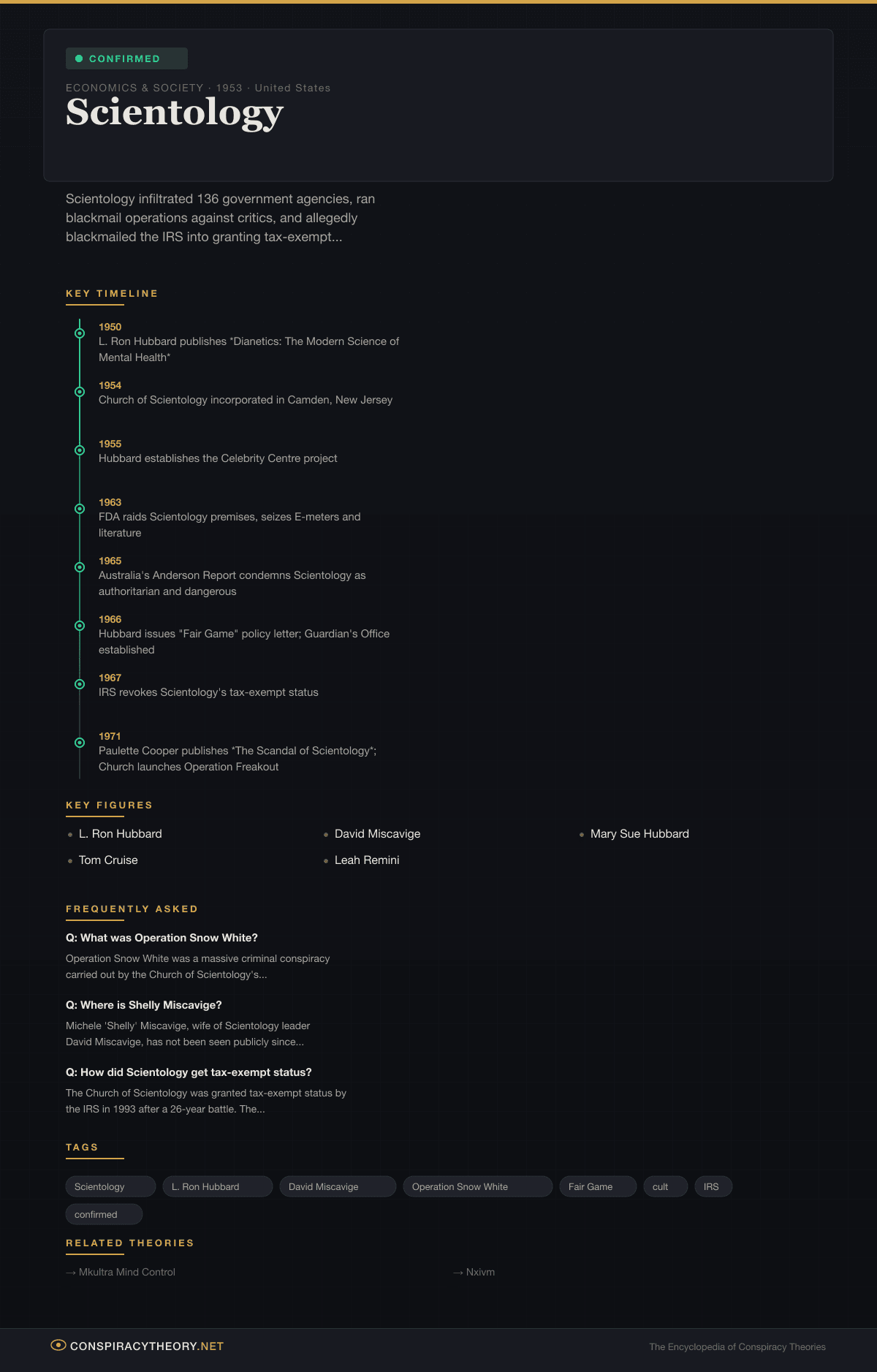
Scientology

Overview
The Church of Scientology occupies a unique position in the landscape of conspiracy theories: it is simultaneously the subject of conspiracy allegations and the perpetrator of confirmed criminal conspiracies. While many organizations accused of shadowy behavior can point to paranoia or misunderstanding, Scientology’s record includes federal convictions, court findings, and thousands of pages of documentary evidence establishing that the Church systematically infiltrated government agencies, stole classified documents, ran harassment campaigns against private citizens, and waged a decades-long war against the Internal Revenue Service that critics allege involved blackmail.
Founded in 1954 by science fiction writer L. Ron Hubbard, the Church of Scientology grew from a fringe self-help movement into a global organization claiming millions of members and holding tax-exempt status in the United States. Along the way, its leadership orchestrated what the FBI described as the single largest infiltration of the United States government in history. Eleven senior officials went to prison. The Church’s founder was named as an unindicted co-conspirator. And the organization not only survived but thrived, eventually forcing the IRS into a capitulation that remains one of the most controversial decisions in the agency’s history.
This article is classified as confirmed because the core conspiratorial activities — Operation Snow White, Operation Freakout, the Fair Game policy, and the campaign against the IRS — are established through federal court convictions, declassified government documents, sworn testimony, and investigative journalism. Ongoing allegations regarding abuses under current leader David Miscavige remain contested by the Church but are supported by extensive testimony from former senior members.
L. Ron Hubbard and the Origins
Lafayette Ronald Hubbard was a prolific pulp fiction writer who, in 1950, published Dianetics: The Modern Science of Mental Health, a self-help book positing that the human mind stores traumatic memories called “engrams” that cause physical and psychological harm. The book became a bestseller. Within four years, Hubbard had transformed his self-help system into a full religion — the Church of Scientology, incorporated in 1954 in Camden, New Jersey.
From the outset, the relationship between Scientology and government authorities was adversarial. The FDA seized copies of Hubbard’s writings and Scientology’s E-meters (devices used in the Church’s central practice of “auditing”) in 1963. The IRS revoked the Church’s tax-exempt status in 1967. The Australian state of Victoria held a Board of Inquiry that resulted in the Anderson Report of 1965, which described Scientology’s practices as authoritarian, dangerous, and based on fabricated claims.
Hubbard’s response to government scrutiny was not to reform but to institutionalize counterattack. In 1966, he issued a policy letter establishing the doctrine of “Fair Game,” which stated that people who were declared enemies of Scientology — labeled “Suppressive Persons” — could be “deprived of property or injured by any means by any Scientologist without any discipline of the Scientologist. May be tricked, sued or lied to or destroyed.” Though the Church later claimed the policy was rescinded, multiple courts found that the practice continued under different terminology.
In 1966, Hubbard also created the Guardian’s Office (GO), an internal intelligence and legal bureau tasked with protecting the Church from external threats. Under the direction of Hubbard’s wife Mary Sue, the GO would grow into what amounted to a private intelligence agency — one that would eventually commit crimes on a scale that dwarfed many actual intelligence agencies’ domestic operations.
Operation Snow White
Operation Snow White was not a conspiracy theory. It was a conspiracy — one that resulted in the largest case of domestic espionage in United States history.
Beginning in 1973, the Guardian’s Office launched a systematic campaign to infiltrate government agencies and private organizations that held files on Scientology or L. Ron Hubbard. The operation’s stated goals, drawn from Hubbard’s own directives, were to obtain and purge any government documents critical of the Church, to use the stolen information to identify and neutralize perceived enemies, and to plant Scientology operatives in positions where they could monitor and influence government actions affecting the Church.
The scope was staggering. According to FBI and court documents, the Church placed as many as 5,000 covert agents in 136 government agencies, foreign embassies, and private organizations across more than 30 countries. In the United States alone, Scientology operatives infiltrated the IRS, the Department of Justice, the FBI, the Drug Enforcement Administration, the Coast Guard, the American Medical Association, and numerous other agencies. Agents were instructed to obtain jobs — often as clerks, typists, or file handlers — that would give them access to records.
The operation was discovered in 1977 when the FBI executed simultaneous raids on Scientology offices in Los Angeles and Washington, D.C. Agents seized approximately 48,000 documents, revealing the full architecture of the infiltration campaign. The evidence showed that Scientology operatives had stolen government documents, forged IRS credentials, burglarized government offices, and wiretapped at least one IRS official.
In 1979, a federal grand jury indicted eleven senior Scientology officials, including Mary Sue Hubbard, on charges of conspiracy, theft of government property, and obstruction of justice. All eleven either pleaded guilty or were convicted at trial. Mary Sue Hubbard was sentenced to five years in prison (she served one). L. Ron Hubbard himself was named as an unindicted co-conspirator but was never prosecuted — by the time of the trial, he had gone into hiding, and he would remain out of public view until his death in 1986.
Federal prosecutors described the case as “the largest single scheme of infiltration of the United States government in history.” The sentencing judge noted that the crimes were not isolated acts but part of a systematic, well-organized campaign directed by senior Church leadership. The operation was planned from the top, executed through formal institutional channels, and carried out with the full resources of the Church.
What makes Operation Snow White particularly significant is that it was not a rogue operation. Court documents established that the campaign was initiated by L. Ron Hubbard himself, managed through the Church’s formal command structure, and executed as institutional policy. This was not a few bad actors. This was the organization.
Fair Game and Operation Freakout
If Operation Snow White demonstrated Scientology’s willingness to take on governments, the Fair Game policy showed what the Church was prepared to do to individual people.
The most thoroughly documented case is Operation Freakout, the Guardian’s Office campaign against journalist Paulette Cooper. In 1971, Cooper published The Scandal of Scientology, one of the first critical books about the organization. The Church’s response was a multi-year harassment campaign designed, in the words of internal Church documents, to have Cooper “incarcerated in a mental institution or jail, or at least to hit her so hard that she drops her attack.”
The operation included filing multiple frivolous lawsuits against Cooper, sending her anonymous threatening letters, attempting to frame her for bomb threats by stealing her stationery and mailing threats to the Church on it (she was actually indicted based on this fabricated evidence before it was uncovered), making anonymous calls to her neighbors claiming she had a venereal disease, attempting to have her committed to a psychiatric institution, and infiltrating her social circle with Scientology operatives posing as friends.
Cooper was not the only target. Court records, testimony from former members, and investigative reporting have documented similar campaigns against journalists, former members, lawyers, and government officials. The pattern was consistent: when someone criticized Scientology publicly, the Church would investigate them for personal vulnerabilities, file lawsuits to drain their resources, hire private investigators to follow them, contact their employers and associates with damaging (often fabricated) information, and publicly attack their credibility.
The Church has maintained that the Fair Game policy was officially canceled in 1968. Multiple courts have found otherwise. In the 1984 case of Wollersheim v. Church of Scientology, a California appellate court upheld a judgment against the Church, finding that it had engaged in a campaign of “fair game” harassment against former member Larry Wollersheim. The court described the Church’s conduct as “reprehensible” and noted that the policy had not been substantively changed — only the terminology.
Former senior members, including Marty Rathbun (who served as the Church’s Inspector General for Ethics) and Mike Rinder (who ran the Church’s Office of Special Affairs, the successor to the Guardian’s Office), have confirmed that aggressive operations against critics continued long after the formal policy was supposedly rescinded. Rinder, who left Scientology in 2007, has publicly stated that he personally directed harassment campaigns against perceived enemies of the Church throughout the 1990s and 2000s.
The IRS War
The Church of Scientology’s campaign to obtain tax-exempt status from the Internal Revenue Service is one of the most extraordinary confrontations between a private organization and a federal agency in American history. It lasted 26 years, involved thousands of lawsuits, and ended in a result that many tax law experts consider indefensible.
The IRS revoked Scientology’s tax-exempt status in 1967, concluding that the Church operated for the private benefit of L. Ron Hubbard and that its activities were commercial rather than religious. Scientology spent the next quarter-century fighting to get it back.
The Church’s strategy was not subtle. Over the course of the campaign, Scientology and its members filed more than 2,400 lawsuits against the IRS and individual IRS employees. The litigation was not primarily aimed at winning in court — it was designed to make the cost of denying tax exemption so high that the agency would capitulate. Former IRS officials have described the strategy as litigation-as-warfare.
But the lawsuits were only part of the campaign. According to the New York Times’ landmark 1997 investigation, Scientology hired private investigators to surveil IRS officials, dug into their personal lives and finances, and used the information to pressure them. The Church allegedly placed operatives inside the IRS itself — a continuation of the Snow White playbook — to gather intelligence on the agency’s internal deliberations.
In 1991, David Miscavige, who had by then assumed control of the Church, requested a meeting with IRS Commissioner Fred Goldberg. The meeting took place without the knowledge of the IRS Chief Counsel’s office — an extraordinary breach of protocol. Over the next two years, the IRS and Scientology negotiated a secret closing agreement.
On October 1, 1993, the IRS granted the Church of Scientology and approximately 150 related entities tax-exempt status. The closing agreement, the details of which remained secret for years, reportedly included provisions allowing Scientology to pay a fraction of the back taxes it owed.
The deal provoked outrage among tax professionals and government watchdogs. The New York Times reported that IRS officials who had worked on the Scientology case for years were stunned by the reversal and believed the agency had caved to pressure. Several former IRS officials told the newspaper that the decision was made not on the merits but because the agency was exhausted by the relentless litigation and covert pressure campaign.
The tax exemption has saved the Church of Scientology billions of dollars. It also effectively settled the question of whether Scientology is a religion for legal purposes in the United States — a question that remains open in many other countries. Germany, for instance, classifies Scientology as a commercial enterprise and has placed it under domestic intelligence surveillance.
David Miscavige’s Regime
When L. Ron Hubbard died on January 24, 1986, at his ranch in Creston, California, the Church announced that he had “discarded the body” to continue his research on higher spiritual planes. Control of Scientology passed to David Miscavige, then 25 years old, who had risen through the Church’s internal ranks with a combination of personal intensity and institutional ruthlessness.
Under Miscavige, the Church has faced a growing wave of allegations from former senior members — people who held the highest positions in the organization and left to describe what they witnessed. Their accounts, corroborated across dozens of independent testimonies, describe an organization characterized by authoritarian control, physical violence, forced labor, and the systematic destruction of families through the policy of “disconnection.”
Disconnection is the Church’s policy requiring members to cut off all contact with people declared “Suppressive Persons” — including family members who leave or criticize the Church. While the Church has publicly denied that disconnection is enforced, hundreds of former members have described being forced to choose between their families and their membership. Actress Leah Remini, who left Scientology in 2013 after more than 30 years, has described being required to disconnect from friends and family. Her subsequent television series Scientology and the Aftermath (2016-2019) featured dozens of similar accounts.
Multiple former senior executives have alleged that Miscavige personally engaged in physical violence against subordinates. These accounts come from people who held positions including Inspector General (Marty Rathbun), head of the Office of Special Affairs (Mike Rinder), executive director of the Church’s international management organization (Marc Headley), and other senior officials. They describe Miscavige punching, kicking, and choking subordinates, and confining executives to a facility called “The Hole” at Scientology’s international headquarters in Gilman Hot Springs, California — a pair of double-wide trailers where dozens of senior executives were allegedly held for months or years, forced to sleep on the floor, and subjected to physical and psychological abuse.
The Church has categorically denied all allegations of abuse and has characterized the former members making these claims as disgruntled apostates motivated by personal grievances. Miscavige has never directly responded to the allegations in an interview or deposition; the Church has successfully used legal maneuvers to prevent his deposition in multiple lawsuits, though as of late 2025, several pending cases may force him to testify.
Missing Persons: Shelly Miscavige and Others
The most prominent missing person question involves Michele “Shelly” Miscavige, David Miscavige’s wife. Shelly Miscavige was last seen in public in August 2007. Before her disappearance from public life, she had been a constant presence at Church events and at her husband’s side.
Former senior members have alleged that Shelly fell out of favor with David Miscavige after taking actions without his authorization while he was away from headquarters. According to these accounts, she was sent to the Church of Spiritual Technology (CST) compound near Lake Arrowhead, California — a remote, heavily secured facility where Hubbard’s writings are archived.
In 2013, Leah Remini filed a missing persons report with the Los Angeles Police Department. The LAPD announced that it had closed the case after making contact with Shelly Miscavige and determining that she was alive and not being held against her will. However, no journalist, former member, or independent observer has publicly confirmed seeing or speaking with Shelly Miscavige since 2007. The Church has stated that she is “working” and is entitled to her privacy.
Shelly’s case is the most visible, but it is not the only one. Former members have raised questions about the whereabouts and wellbeing of other senior Scientologists who disappeared from public view after reportedly falling out of favor with Miscavige. The Church maintains that all members are present voluntarily and free to leave.
The question of whether members at Scientology’s international base (known as “Int Base” or “Gold Base”) are truly free to leave has been the subject of extensive investigation. Former members describe a compound surrounded by razor wire (which the Church says is pointed inward for security), motion sensors, and security cameras, with members’ passports and identification held by Church officials. In 2012, the Riverside County Sheriff’s Department investigated conditions at Gold Base but concluded that the individuals they spoke with did not want to leave. Critics have argued that the investigation was inadequate and that members under institutional control cannot be expected to speak freely to police in the presence of Church handlers.
Celebrity Strategy
Scientology’s cultivation of celebrities is not a conspiracy theory — it is an explicit, documented organizational strategy. L. Ron Hubbard wrote in 1955 that “the purpose of the Celebrity Centre is to forward the expansion and application of Scientology through the celebrities of the arts, sports, management, and government.” The Church operates dedicated Celebrity Centres — ornate facilities offering special treatment to high-profile members.
The Church’s celebrity roster has included Tom Cruise, John Travolta, Kirstie Alley, Elisabeth Moss, Giovanni Ribisi, and others. Cruise’s relationship with Scientology is the most publicly significant. Former senior members have described Cruise as Miscavige’s closest personal friend and have alleged that Church staff were used to cater to Cruise’s personal needs — including, in one widely reported claim, auditioning young women as potential romantic partners for the actor. Both the Church and Cruise have denied this.
The strategic logic is straightforward: celebrity members provide legitimacy, media access, and recruitment appeal. But former members have described a darker dimension. They allege that the Church’s auditing process — in which members confess their most intimate secrets while connected to an E-meter — creates files of personal information that can be used as leverage. Critics have alleged that the Church uses these “PC folders” (preclear folders) to discourage high-profile members from leaving. The Church denies using auditing information for any purpose other than spiritual counseling.
John Travolta’s relationship with Scientology has been the subject of persistent speculation along these lines. Travolta, who joined in 1975, has been the target of tabloid rumors for decades. Former members have alleged that the Church possesses detailed files on Travolta’s private life. Whether or not this constitutes blackmail in a legal sense, the dynamic described by former insiders — an organization holding deeply personal confessions of people whose careers depend on public image — raises obvious questions about the voluntariness of continued membership.
The Conspiracy Within
What distinguishes Scientology from most subjects of conspiracy theories is the volume and quality of evidence. This is not a case built on speculation, anonymous sources, or circumstantial connections. The record includes:
- Federal criminal convictions of eleven senior officials for infiltrating government agencies and stealing documents
- Court findings in multiple jurisdictions that the Church engaged in harassment campaigns against critics
- Sworn testimony from dozens of former senior members describing abuses under the current leadership
- IRS records and investigative journalism documenting the Church’s campaign to obtain tax-exempt status through litigation and alleged coercion
- Congressional and law enforcement investigations into the Church’s labor practices, tax arrangements, and treatment of members
The Church of Scientology maintains that it is a legitimate religion, that its members participate voluntarily, that its accusers are motivated by personal grudges, and that media coverage is driven by religious bigotry. It has fought every allegation with aggressive litigation, private investigation of accusers, and public campaigns to discredit former members.
What remains unresolved is the full extent of ongoing operations. Former members describe an organization that learned from Operation Snow White not to stop conducting covert operations but to stop getting caught. The Office of Special Affairs, which replaced the Guardian’s Office after the Snow White convictions, is alleged by former members to continue surveillance, infiltration, and harassment campaigns — but with greater sophistication and legal cover. The Church denies this.
Also unresolved is the question of accountability. Despite the scale of documented abuses, no senior Church official has faced criminal prosecution since the Snow White convictions. David Miscavige has never been charged with a crime. The IRS deal remains in place. And the Church continues to enjoy the legal protections afforded to religious organizations in the United States, including exemption from many labor and employment laws.
The case of Lisa McPherson illustrates the limits of accountability. McPherson, a Scientologist, was involved in a minor car accident in Clearwater, Florida, on November 18, 1995. After exhibiting erratic behavior at the scene, she was taken to a hospital but was checked out by fellow Scientologists against medical advice. She was then held at the Church’s Fort Harrison Hotel for 17 days under a Scientology procedure called the “Introspection Rundown,” intended to handle psychotic episodes. During this period, she was reportedly denied psychiatric care, restrained, and force-fed. On December 5, 1995, she was found dead. The medical examiner initially ruled the death an accident but noted she was severely dehydrated, underweight, and covered in insect bites and bruises. Criminal charges of abuse and practicing medicine without a license were filed against the Church but were dropped in 2000 after the medical examiner changed the cause of death from “undetermined” to “accidental.” A wrongful death lawsuit was settled on undisclosed terms in 2004.
Timeline
- 1950 — L. Ron Hubbard publishes Dianetics: The Modern Science of Mental Health
- 1954 — Church of Scientology incorporated in Camden, New Jersey
- 1955 — Hubbard establishes the Celebrity Centre project
- 1963 — FDA raids Scientology premises, seizes E-meters and literature
- 1965 — Australia’s Anderson Report condemns Scientology as authoritarian and dangerous
- 1966 — Hubbard issues “Fair Game” policy letter; Guardian’s Office established
- 1967 — IRS revokes Scientology’s tax-exempt status
- 1971 — Paulette Cooper publishes The Scandal of Scientology; Church launches Operation Freakout
- 1973 — Operation Snow White begins; Church operatives infiltrate 136 government agencies
- 1977 — FBI raids Scientology offices in Los Angeles and Washington, D.C.; 48,000 documents seized
- 1979 — Eleven senior Scientology officials indicted, including Mary Sue Hubbard
- 1980 — Mary Sue Hubbard and ten others convicted or plead guilty
- 1984 — California appellate court upholds judgment against Church for “fair game” harassment in Wollersheim v. Church of Scientology
- 1986 — L. Ron Hubbard dies at his ranch in Creston, California; David Miscavige assumes control
- 1991 — Time magazine publishes “The Thriving Cult of Greed and Power”
- 1991 — Miscavige meets IRS Commissioner Fred Goldberg in unprecedented direct meeting
- 1993 — IRS grants tax-exempt status to the Church of Scientology and ~150 related entities
- 1995 — Lisa McPherson dies after 17 days of confinement at Scientology’s Fort Harrison Hotel
- 1998 — Criminal charges filed in McPherson case (later dropped in 2000)
- 2004 — McPherson wrongful death lawsuit settled on undisclosed terms
- 2005 — Tom Cruise’s couch-jumping on Oprah and public advocacy for Scientology draws intense media scrutiny
- 2007 — Shelly Miscavige last seen in public
- 2008 — Anonymous (hacktivist group) launches “Project Chanology” campaign against the Church
- 2009 — Investigative series by the St. Petersburg Times (now Tampa Bay Times) features accounts from former senior executives of physical violence by Miscavige
- 2013 — Leah Remini leaves Scientology; files missing persons report for Shelly Miscavige
- 2015 — Alex Gibney’s documentary Going Clear: Scientology and the Prison of Belief airs on HBO
- 2016-2019 — Scientology and the Aftermath airs on A&E, featuring testimonies from dozens of former members
- 2023-2025 — Multiple civil lawsuits filed against the Church and Miscavige personally; courts struggle to serve Miscavige with papers as Church claims he cannot be located
- 2025 — Danny Masterson sentenced to 30 years to life for rape; prosecutors note Scientology’s role in silencing victims
Sources & Further Reading
- Wright, Lawrence. Going Clear: Scientology, Hollywood, and the Prison of Belief. Alfred A. Knopf, 2013.
- Reitman, Janet. Inside Scientology: The Story of America’s Most Secretive Religion. Houghton Mifflin Harcourt, 2011.
- Ortega, Tony. The Unbreakable Miss Lovely: How the Church of Scientology Tried to Destroy Paulette Cooper. Silvertail Books, 2015.
- Cooper, Paulette. The Scandal of Scientology. Tower Publications, 1971.
- Headley, Marc. Blown for Good: Behind the Iron Curtain of Scientology. BFG Books, 2009.
- Gibney, Alex, dir. Going Clear: Scientology and the Prison of Belief. HBO Documentary Films, 2015.
- Remini, Leah, and Rebecca Paley. Troublemaker: Surviving Hollywood and Scientology. Ballantine Books, 2015.
- Frantz, Douglas. “Scientology’s Puzzling Journey from Tax Rebel to Tax Exempt.” The New York Times, March 9, 1997.
- Behar, Richard. “The Thriving Cult of Greed and Power.” Time, May 6, 1991.
- United States of America v. Mary Sue Hubbard et al., Criminal No. 78-401 (D.D.C. 1979).
- Anderson, Kevin Victor. Report of the Board of Enquiry into Scientology. State of Victoria, Australia, 1965.
- Childs, Joe, and Thomas C. Tobin. “The Truth Rundown” series. St. Petersburg Times, 2009.
Related Theories
- MKUltra — CIA mind control program with thematic parallels to Scientology’s auditing and behavioral control methods
- Elite Pedophile Rings — Patterns of institutional abuse, cover-up, and the exploitation of power dynamics within closed organizations
- NXIVM — Another organization that operated as a self-improvement group while engaging in coercive control, forced labor, and criminal conspiracy; leader Keith Raniere convicted in 2019

Watch: Documentaries & Videos
Related documentaries available on YouTube.
Going Clear
Frequently Asked Questions
What was Operation Snow White?
Where is Shelly Miscavige?
How did Scientology get tax-exempt status?

Infographic
Share this visual summary. Right-click to save.