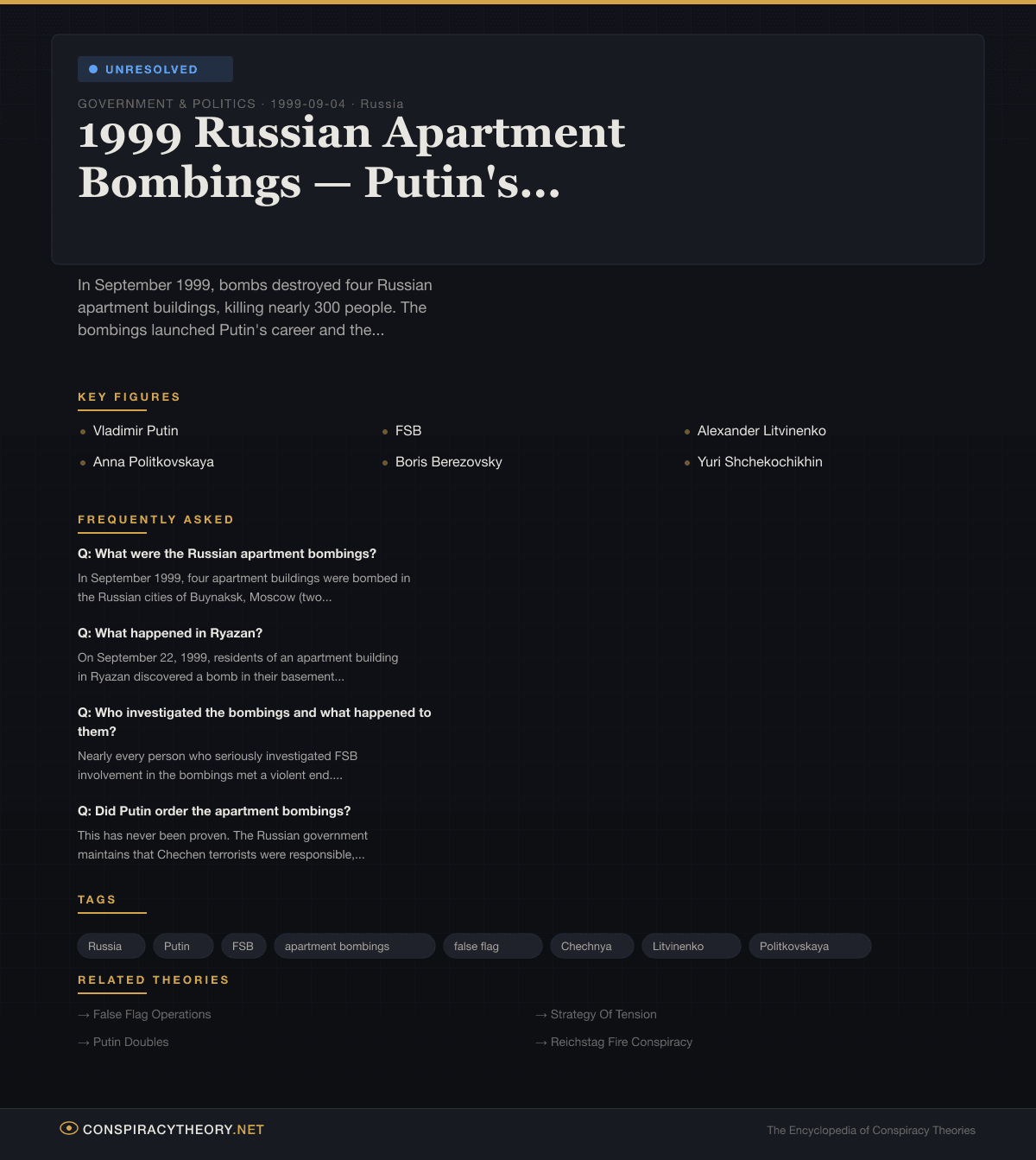
1999 Russian Apartment Bombings — Putin's False Flag

Overview
In September 1999, somebody blew up four apartment buildings in Russia, killing 293 people as they slept. The Russian government blamed Chechen terrorists. An obscure former KGB officer named Vladimir Putin, who had been prime minister for barely a month, used the bombings to launch a massive military assault on Chechnya. The war made Putin the most popular politician in Russia. Four months later, he was president.
That’s the official version. Here’s the other version:
The FSB — Russia’s domestic intelligence service, successor to the KGB — planted the bombs themselves. They murdered 293 Russian citizens to create a pretext for a war that would make their man president. And when people started investigating, the FSB murdered them too.
This is not a fringe theory promoted by conspiracy forums. It was asserted by Alexander Litvinenko, a former FSB officer, who was then poisoned with radioactive polonium in London. It was investigated by Anna Politkovskaya, Russia’s most courageous journalist, who was then shot dead in her apartment building on Putin’s birthday. It was pursued by Yuri Shchekochikhin, a Duma member and journalist, who then died of what appeared to be thallium poisoning. It was championed by Sergei Yushenkov, another Duma member, who was then shot dead outside his home.
The pattern is not subtle. Ask questions about the apartment bombings, and you die. The trail of bodies is itself the most compelling evidence that the official story cannot withstand scrutiny.
The Bombings
September 1999
The attacks came in rapid succession:
September 4, Buynaksk, Dagestan: A truck bomb destroyed a five-story apartment building housing Russian military families. 64 dead, 146 wounded. A second bomb at a nearby building was discovered and defused.
September 9, Moscow, Guryanova Street: A massive explosion at 1:00 a.m. destroyed a nine-story apartment building. 94 dead, 249 wounded. The blast was so powerful it damaged buildings hundreds of meters away.
September 13, Moscow, Kashirskoye Highway: Another middle-of-the-night explosion, this one obliterating an eight-story building. 118 dead, 200 wounded. Moscow was in a state of terror. Citizens organized night watches, patrolling the basements of their apartment buildings.
September 16, Volgodonsk: A truck bomb destroyed a nine-story building. 17 dead, 69 wounded.
In total: 293 dead, more than 1,000 wounded, four buildings reduced to rubble, and a nation paralyzed by fear.
The Political Context
The bombings occurred at a moment of maximum political opportunity for the security services. Boris Yeltsin was in his final months as president, his health failing, his popularity in single digits. Russia’s political establishment was consumed by the question of succession — who would inherit the post-Soviet state?
On August 9, 1999, Yeltsin appointed Vladimir Putin as prime minister. Putin was virtually unknown to the Russian public. He was a former KGB officer who had served as head of the FSB for a year and had no independent political base. His appointment was widely interpreted as a temporary placeholder.
Then the bombings happened. Putin’s response was instant, furious, and calculated. He vowed to “wipe out” the terrorists “in the outhouse” — a crude phrase that electrified Russian public opinion. Within days, he ordered the invasion of Chechnya, launching the Second Chechen War. His approval rating skyrocketed from single digits to over 45% in weeks. On December 31, 1999, Yeltsin resigned and appointed Putin acting president. In March 2000, Putin won the presidential election.
The apartment bombings didn’t just start a war. They made a president.
The Ryazan Incident
September 22, 1999
The single most damning piece of evidence came six days after the last bombing. On the evening of September 22, residents of an apartment building at 14/16 Novosyolov Street in Ryazan noticed two suspicious strangers carrying sacks into their basement. They called the police.
Local authorities evacuated 30,000 residents from the neighborhood. The bomb squad examined the device and reported finding three sacks of white powder connected to a detonator and timer. The local FSB tested the substance and identified it as hexogen (RDX) — the same military-grade explosive used in the Moscow and Volgodonsk bombings. The bomb squad declared the device live.
The city was in a state of emergency. Police launched a manhunt and traced the license plate of the suspects’ car to… the FSB.
Two FSB agents were detained by local police. They had been caught, apparently, in the act of planting a bomb in a residential apartment building.
The “Training Exercise”
What happened next has defined the bombing conspiracy ever since. FSB Director Nikolai Patrushev held a press conference and declared that the Ryazan incident was a “training exercise” to test the vigilance of residents. The substance in the sacks, he said, was sugar, not hexogen. The detonator was fake. It was all a drill.
The problems with this explanation:
- The local bomb squad’s tests identified the substance as hexogen, not sugar. The squad leader publicly contradicted the FSB’s claim.
- If it was a training exercise, why weren’t local authorities notified? Standard procedure for any military or security exercise requires coordination with local police and emergency services. None occurred.
- If it was sugar, why were the “trainees” using real detonators? And why did they flee the scene?
- The timing: The “exercise” occurred while Russia was experiencing the worst domestic terrorist campaign in its history — an extraordinarily dangerous time to conduct an unannounced bomb-planting drill in a residential building.
- The FSB agents were released without public identification. No formal investigation of the “exercise” was conducted.
- No other such “exercises” were known to have been conducted before or after the Ryazan incident.
The Ryazan incident is the Rosetta Stone of the apartment bombings conspiracy. If the FSB was caught planting a real bomb in Ryazan, the implication is devastating: the FSB was behind all the bombings.
The Investigators
The Dead
What sets the apartment bombings theory apart from most conspiracy theories is the body count among those who investigated it. This is not a case where theorists are ignored or marginalized. It’s a case where they’re killed.
Sergei Yushenkov (1950-2003): A liberal Duma member who co-chaired the Kovalev Commission, an independent investigation into the bombings. On April 17, 2003 — hours after officially registering his political party — he was shot dead outside his Moscow apartment. He had been collecting evidence of FSB involvement.
Yuri Shchekochikhin (1950-2003): A journalist for Novaya Gazeta and Duma member who investigated the bombings. He died on July 3, 2003, after a sudden illness with symptoms consistent with thallium poisoning — a favorite assassination method of Russian intelligence services. His medical records were classified as a state secret.
Anna Politkovskaya (1958-2006): Russia’s most prominent investigative journalist, who covered the Chechen war and investigated the bombings for Novaya Gazeta. She was shot dead in the elevator of her Moscow apartment building on October 7, 2006 — Putin’s birthday. The contract killing was eventually traced to Chechen security forces, but the identity of whoever ordered the hit remains officially unknown.
Alexander Litvinenko (1962-2006): A former FSB officer who publicly accused the FSB of orchestrating the bombings at a 1998 press conference. He fled Russia and continued his investigations from London. On November 1, 2006, he was poisoned with polonium-210, a radioactive isotope, during a meeting at a London hotel. He died on November 23. A 2016 British public inquiry concluded that his murder was “probably approved by” Putin and FSB Director Patrushev.
Boris Berezovsky (1946-2013): The oligarch who initially supported Putin but turned against him and funded investigations into the bombings from London exile. He was found dead in his bathroom in March 2013. The official ruling was suicide, but the coroner recorded an open verdict, unable to determine whether it was suicide or murder.
The pattern is not circumstantial. It is systematic. Every major investigator of FSB involvement in the apartment bombings has died violently or under suspicious circumstances. The statistical probability of this occurring by coincidence is essentially zero.
Litvinenko’s Accusations
Alexander Litvinenko is the most important witness in the apartment bombings case. As a former FSB officer, he had inside knowledge. At a November 1998 press conference — alongside several FSB colleagues — Litvinenko publicly accused the FSB of ordering him to assassinate Boris Berezovsky. He was arrested, tried, and acquitted, then fled Russia in 2000.
From London, Litvinenko co-authored Blowing Up Russia: Terror from Within (2002) with historian Yuri Felshtinsky, laying out the case for FSB involvement in the bombings. The book was banned in Russia.
Litvinenko’s deathbed statement, dictated from his hospital bed as he was dying of radiation poisoning, directly accused Putin: “You may succeed in silencing one man but the howl of protest from around the world will reverberate, Mr. Putin, in your ears for the rest of your life.”
The Official Investigation
The Convictions
Russian authorities arrested and convicted several men for the bombings — primarily ethnic Chechens and Dagestanis. The most prominent defendant, Achemez Gochiyayev, was convicted in absentia; he has never been captured and maintains his innocence, claiming he was set up by FSB agents who asked him to rent the basement spaces where the bombs were placed.
The trials were conducted in military courts, closed to the public and press. Defense attorneys were given limited access to evidence. The proceedings were widely criticized as inadequate by international observers.
The Kovalev Commission
The independent commission established by Duma member Sergei Kovalev to investigate the bombings was systematically obstructed. Its key members died (Yushenkov, Shchekochikhin). Its requests for access to evidence were denied. Its lawyer, Mikhail Trepashkin, was arrested on weapons charges — widely seen as fabricated — and imprisoned. The commission was effectively destroyed before it could issue a final report.
No independent investigation of the bombings has ever been permitted by Russian authorities. The Duma twice rejected proposals for a parliamentary investigation.
The Broader Context
Cui Bono
The apartment bombings produced precisely one political winner: Vladimir Putin. Before the bombings, he was an unknown bureaucrat. After the bombings, he was a wartime leader. The Second Chechen War — launched explicitly as a response to the bombings — gave Putin the strongman image that has defined his political identity for a quarter century.
This doesn’t prove FSB involvement. But the question “who benefits?” has rarely had a more obvious answer in the history of political violence.
The Strategy of Tension
The apartment bombings fit a well-documented pattern of false-flag attacks used by security services to justify repression and consolidate power. Italy’s Strategy of Tension in the 1960s-80s — in which Italian intelligence services and right-wing groups carried out bombings blamed on leftists — provides the closest historical parallel. Russia’s own history includes Operation Trust (the Bolsheviks’ elaborate deception operation) and numerous KGB provocations.
The Reichstag Fire of 1933 — in which the Nazis are widely believed to have burned the German parliament to create a pretext for emergency powers — is another obvious parallel. In both cases, a ruling elite in need of a crisis to consolidate power found one.
Legacy
The apartment bombings remain the original sin of the Putin era. If the FSB bombed its own citizens to create a pretext for war and manufacture a president, then the entire edifice of Putin’s Russia is built on the murder of 293 sleeping people.
The Russian government’s response to this question — not denial, not investigation, but the systematic elimination of everyone who asks it — speaks louder than any official statement.
Timeline
| Date | Event |
|---|---|
| Aug 9, 1999 | Putin appointed prime minister |
| Sept 4, 1999 | Buynaksk bombing: 64 dead |
| Sept 9, 1999 | Moscow (Guryanova Street) bombing: 94 dead |
| Sept 13, 1999 | Moscow (Kashirskoye) bombing: 118 dead |
| Sept 16, 1999 | Volgodonsk bombing: 17 dead |
| Sept 22, 1999 | Ryazan incident: FSB agents caught planting bomb, FSB claims “training exercise” |
| Sept 23, 1999 | Russia begins bombing Chechnya |
| Dec 31, 1999 | Yeltsin resigns; Putin becomes acting president |
| March 2000 | Putin elected president |
| 2002 | Litvinenko/Felshtinsky publish Blowing Up Russia |
| April 2003 | Duma member Yushenkov shot dead |
| July 2003 | Journalist Shchekochikhin dies of suspected poisoning |
| Oct 2006 | Journalist Politkovskaya shot dead |
| Nov 2006 | Litvinenko poisoned with polonium-210 in London; dies Nov 23 |
| March 2013 | Berezovsky found dead in UK |
| Jan 2016 | UK public inquiry: Litvinenko murder “probably approved by Putin” |
Sources & Further Reading
- Litvinenko, Alexander, and Yuri Felshtinsky. Blowing Up Russia: Terror from Within. SPI Books, 2002.
- Satter, David. Darkness at Dawn: The Rise of the Russian Criminal State. Yale University Press, 2003.
- Politkovskaya, Anna. Putin’s Russia: Life in a Failing Democracy. Metropolitan Books, 2005.
- Dunlop, John B. The Moscow Bombings of September 1999. ibidem Press, 2012.
- Owen, Robert. The Litvinenko Inquiry: Report into the Death of Alexander Litvinenko. UK Home Office, 2016.
- Soldatov, Andrei, and Irina Borogan. The New Nobility: The Restoration of Russia’s Security State. PublicAffairs, 2010.
Related Theories
- False Flag Operations — The broader pattern of manufactured pretexts
- Strategy of Tension — Italian parallel with intelligence-backed terrorism
- Reichstag Fire — Historical parallel of burning democracy to seize power
Frequently Asked Questions
What were the Russian apartment bombings?
What happened in Ryazan?
Who investigated the bombings and what happened to them?
Did Putin order the apartment bombings?
Infographic
Share this visual summary. Right-click to save.