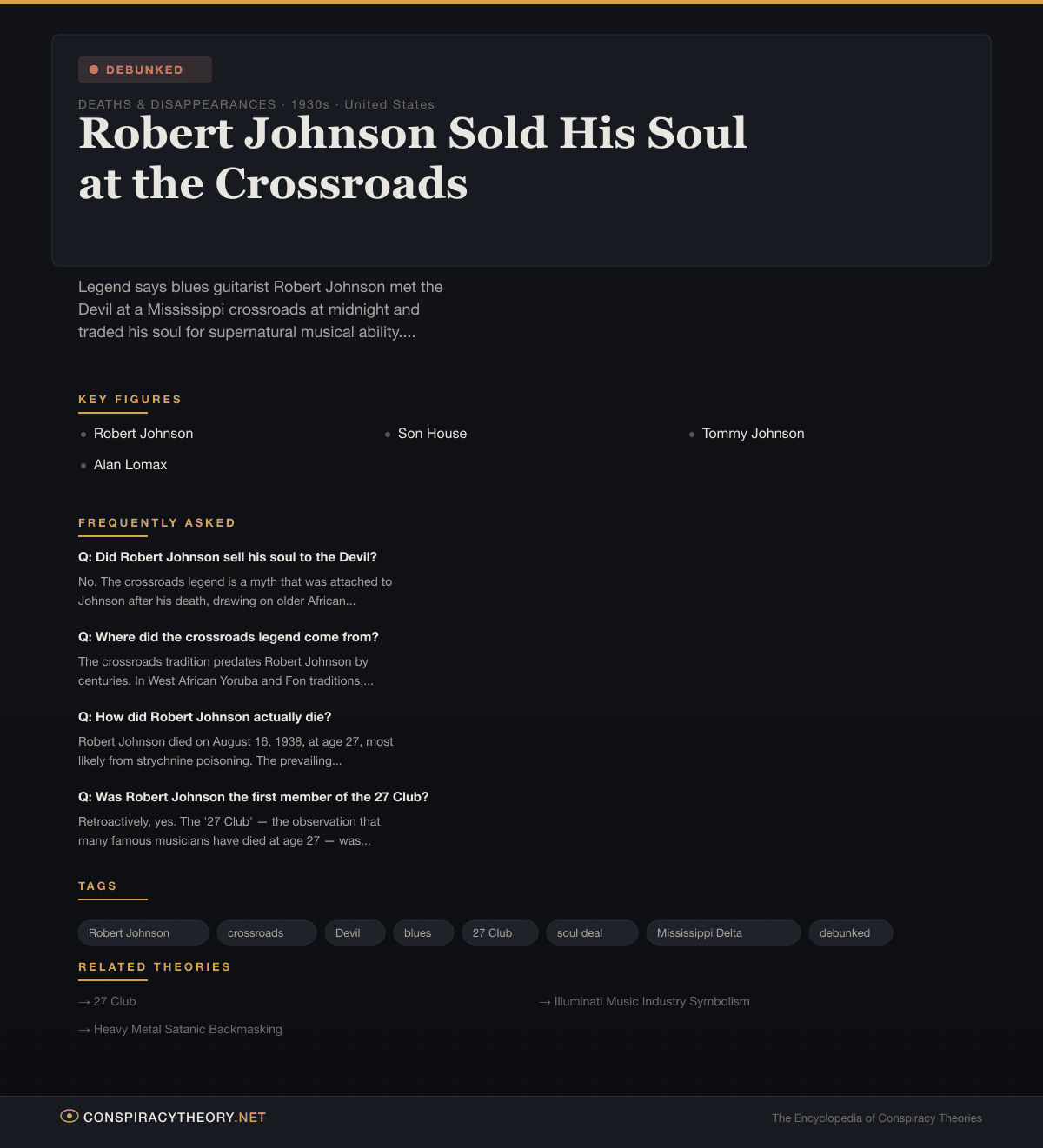
Robert Johnson Sold His Soul at the Crossroads

Overview
Sometime in the early 1930s — the date isn’t certain, because almost nothing about Robert Leroy Johnson is certain — a young Black man from the Mississippi Delta walked up to a crossroads at midnight. The Devil was waiting. They made a deal: the young man’s soul in exchange for mastery of the guitar.
The young man went home and played the blues like no one had ever heard.
Then he died at twenty-seven.
This is the story. It’s been told in documentaries, dramatized in films, referenced in thousands of songs, and cited as the origin story of rock ‘n’ roll itself. It is, along with the 27 Club, one of the most durable myths in American popular culture.
It’s also not true. Robert Johnson was a real person — a brilliant and innovative musician who revolutionized blues guitar in a body of work consisting of just 29 songs recorded over two sessions in 1936 and 1937. He died young, probably poisoned by a jealous husband. He did not sell his soul to the Devil. The crossroads legend was borrowed from an older folk tradition, attached to a different musician entirely, and transferred to Johnson because his story — the mysterious genius, the small body of work, the early death — was too good not to mythologize.
But the myth is worth understanding not despite being false but because of what it reveals: about how America processes Black artistry, about the hunger for supernatural explanations of extraordinary talent, and about how conspiracy theories can be beautiful.
The Real Robert Johnson
The Life
Robert Leroy Johnson was born on May 8, 1911, in Hazlehurst, Mississippi. His mother, Julia Dodds, had ten children by her husband Charles Dodds (who had fled Mississippi after a land dispute with white landowners) and two more by a field worker named Noah Johnson. Robert was one of the latter.
He grew up in poverty, moved between relatives, and showed early musical interest. As a teenager in Robinsonville, Mississippi, he hung around local juke joints, watching established blues musicians like Son House and Willie Brown play. By all accounts, he was enthusiastic but mediocre — Son House later described the young Johnson’s playing as terrible.
Then Johnson disappeared for a period — roughly 1930 to 1931. When he returned, he could play. And not just play — he could play in ways that stunned the established musicians who had dismissed him.
This rapid improvement is the kernel around which the crossroads legend crystallized.
The Improvement Explained
Johnson’s transformation from amateur to virtuoso has a prosaic explanation that is, in its own way, more impressive than a deal with the Devil.
During his absence from Robinsonville, Johnson went to Hazlehurst and studied under Ike Zimmerman, an established guitarist. Zimmerman was known for practicing in graveyards at night — for the quiet and privacy, not for supernatural reasons — and he taught Johnson techniques and repertoire that the Robinsonville musicians didn’t know.
Johnson was also an exceptionally fast learner with an ear for imitation. He studied records obsessively — the playing of Lonnie Johnson, Kokomo Arnold, Skip James, and others — and developed a style that synthesized multiple influences into something that sounded startlingly original. He worked at it constantly.
When he returned to Robinsonville, he was playing a different style than what the local musicians knew. To Son House and others, it sounded like a miracle. It wasn’t. It was talent combined with intense, focused practice and exposure to a wider range of influences than the Delta scene provided.
The Recordings
Johnson recorded only twice:
- November 23-27, 1936, in San Antonio, Texas (16 songs)
- June 19-20, 1937, in Dallas, Texas (13 songs)
These 29 songs — including “Cross Road Blues,” “Hellhound on My Trail,” “Love in Vain,” “Sweet Home Chicago,” and “Me and the Devil Blues” — constitute one of the most influential bodies of work in American music. They were commercially unsuccessful during Johnson’s lifetime, selling modestly and reaching only a small regional audience.
Johnson’s recordings were rediscovered in the 1960s when Columbia Records released King of the Delta Blues Singers (1961). The album influenced virtually every major rock musician of the era — Keith Richards, Eric Clapton, Bob Dylan, and the entire British blues revival drew directly from Johnson’s recordings.
The Death
Robert Johnson died on August 16, 1938, in Greenwood, Mississippi. He was 27 years old.
The most widely accepted account: Johnson was playing at a juke joint near Greenwood. He had been involved with a woman whose husband (or boyfriend) objected. The man offered Johnson an open bottle of whiskey. Another musician, Sonny Boy Williamson, warned Johnson never to drink from an open bottle. Johnson reportedly replied: “Don’t ever knock a bottle out of my hand.”
He drank the whiskey. He became violently ill. He died two or three days later, likely from strychnine poisoning.
No autopsy was performed. No death certificate was filed at the time (one was created later, listing the cause of death as “no doctor”). His death received no newspaper coverage. He was buried in a grave that was unmarked for decades — and three different sites now claim to be his burial place.
The Crossroads Legend
The Folk Tradition
The idea of meeting a supernatural being at a crossroads is ancient and global. In Greek mythology, Hecate rules the crossroads. In Yoruba religion, Eshu (or Legba in Vodou) is the trickster deity of the crossroads who mediates between the human and spirit worlds.
The West African crossroads tradition survived the Middle Passage and evolved in the American South, blending with Christian concepts of the Devil. In African American folk tradition, you could go to a crossroads at midnight and meet a dark figure who would tune your guitar (or teach you to play cards, or grant another skill) in exchange for your soul.
This tradition was widespread. It was not specific to Robert Johnson.
The Tommy Johnson Connection
The crossroads story was actually first told about Tommy Johnson (1896-1956), a Mississippi blues musician who was no relation to Robert. Tommy Johnson’s brother LeDell told researcher David Evans in the 1960s that Tommy had gone to a crossroads at midnight, met a large Black man (interpreted as the Devil), and had his guitar tuned. After that, Tommy could play anything.
The story circulated orally in the Mississippi Delta blues community. When Robert Johnson’s recordings were rediscovered in the 1960s and he became famous posthumously, the crossroads legend was transferred from Tommy to Robert — partly because Robert Johnson’s songs explicitly referenced the Devil (“Me and the Devil Blues,” “Hellhound on My Trail”) and partly because his story was simply more dramatic.
Johnson’s Role in the Myth
Johnson himself played into the mystique, though the extent to which he believed it versus cultivated it is unknowable. His songs reference the Devil, crossroads, hellhounds, and damnation with an intensity that stands out even in a genre steeped in religious imagery.
“Cross Road Blues” — the song most closely associated with the legend — is actually about trying to hitch a ride and being afraid of being caught on the road after dark as a Black man in Mississippi. The “crossroads” in the song are literal, not metaphorical. But the song’s eerie intensity and the cultural context of the crossroads tradition made the supernatural interpretation irresistible.
The Myth and Race
The Supernatural Negro
The crossroads legend participates in a long tradition of attributing extraordinary Black achievement to supernatural rather than human agency. If Robert Johnson played guitar with unprecedented brilliance, the explanation couldn’t be that he was a genius who worked incredibly hard — it had to be that he cheated. He made a deal. He had an unfair advantage. His ability wasn’t really his.
This pattern — requiring supernatural or illegal explanations for Black excellence — recurs throughout American history. It’s visible in everything from the persistent testing of Black athletes for performance-enhancing drugs to the assumption that successful Black businesses must be involved in crime.
The crossroads legend is, in this reading, a way for American culture to process Black artistry without fully crediting the artist.
The Romantic Counter-Reading
The legend also functions as romance — a story about the price of genius, the connection between art and suffering, and the idea that the greatest art requires the ultimate sacrifice. In this reading, Johnson isn’t diminished by the Devil story; he’s elevated. He becomes not just a musician but a mythic figure, a Faust of the Delta who traded eternity for immortal art.
Both readings are true simultaneously. The legend dehumanizes Johnson even as it deifies him.
The 27 Club Connection
Johnson’s death at 27 retroactively made him the first member of the 27 Club — though the concept didn’t exist during his lifetime and wasn’t articulated until the cluster of rock star deaths in 1969-1971 (Brian Jones, Jimi Hendrix, Janis Joplin, Jim Morrison).
The 27 Club mythology extended the crossroads legend into rock ‘n’ roll: these musicians, like Johnson, had burned too bright and paid the price. The Devil always collects. It’s a compelling narrative, even though statistical analysis shows that 27 is not an unusually dangerous age for musicians.
Timeline
| Date | Event |
|---|---|
| May 8, 1911 | Robert Johnson born in Hazlehurst, Mississippi |
| Late 1920s | Young Johnson plays harmonica and guitar around Robinsonville; mediocre reviews |
| c. 1930-1931 | Johnson leaves Robinsonville; studies under Ike Zimmerman |
| c. 1932 | Johnson returns to Robinsonville as transformed guitarist |
| Nov 1936 | First recording session in San Antonio (16 songs) |
| June 1937 | Second recording session in Dallas (13 songs) |
| Aug 16, 1938 | Johnson dies in Greenwood, Mississippi, likely from strychnine poisoning; age 27 |
| 1961 | Columbia Records releases King of the Delta Blues Singers; Johnson rediscovered |
| 1960s | Crossroads legend transferred from Tommy Johnson to Robert Johnson |
| 1986 | Johnson inducted into Rock and Roll Hall of Fame (inaugural class) |
| 1990 | Robert Johnson: The Complete Recordings released; sells over 1 million copies |
| 2003 | Johnson ranked #5 on Rolling Stone’s “100 Greatest Guitarists of All Time” |
Sources & Further Reading
- Wald, Elijah. Escaping the Delta: Robert Johnson and the Invention of the Blues. Amistad, 2004.
- Guralnick, Peter. Searching for Robert Johnson. Dutton, 1989.
- Schroeder, Patricia R. Robert Johnson, Mythmaking, and Contemporary American Culture. University of Illinois Press, 2004.
- Evans, David. Tommy Johnson. Studio Vista, 1971.
- Gioia, Ted. Delta Blues: The Life and Times of the Mississippi Masters Who Revolutionized American Music. W.W. Norton, 2008.
Related Theories
- 27 Club — The pattern of musicians dying at age 27
- Illuminati Music Industry — Modern versions of the “sold your soul for fame” narrative
- Satanic Backmasking — The broader connection between music and diabolism

Frequently Asked Questions
Did Robert Johnson sell his soul to the Devil?
Where did the crossroads legend come from?
How did Robert Johnson actually die?
Was Robert Johnson the first member of the 27 Club?

Infographic
Share this visual summary. Right-click to save.