QAnon Conspiracy Theory
Overview
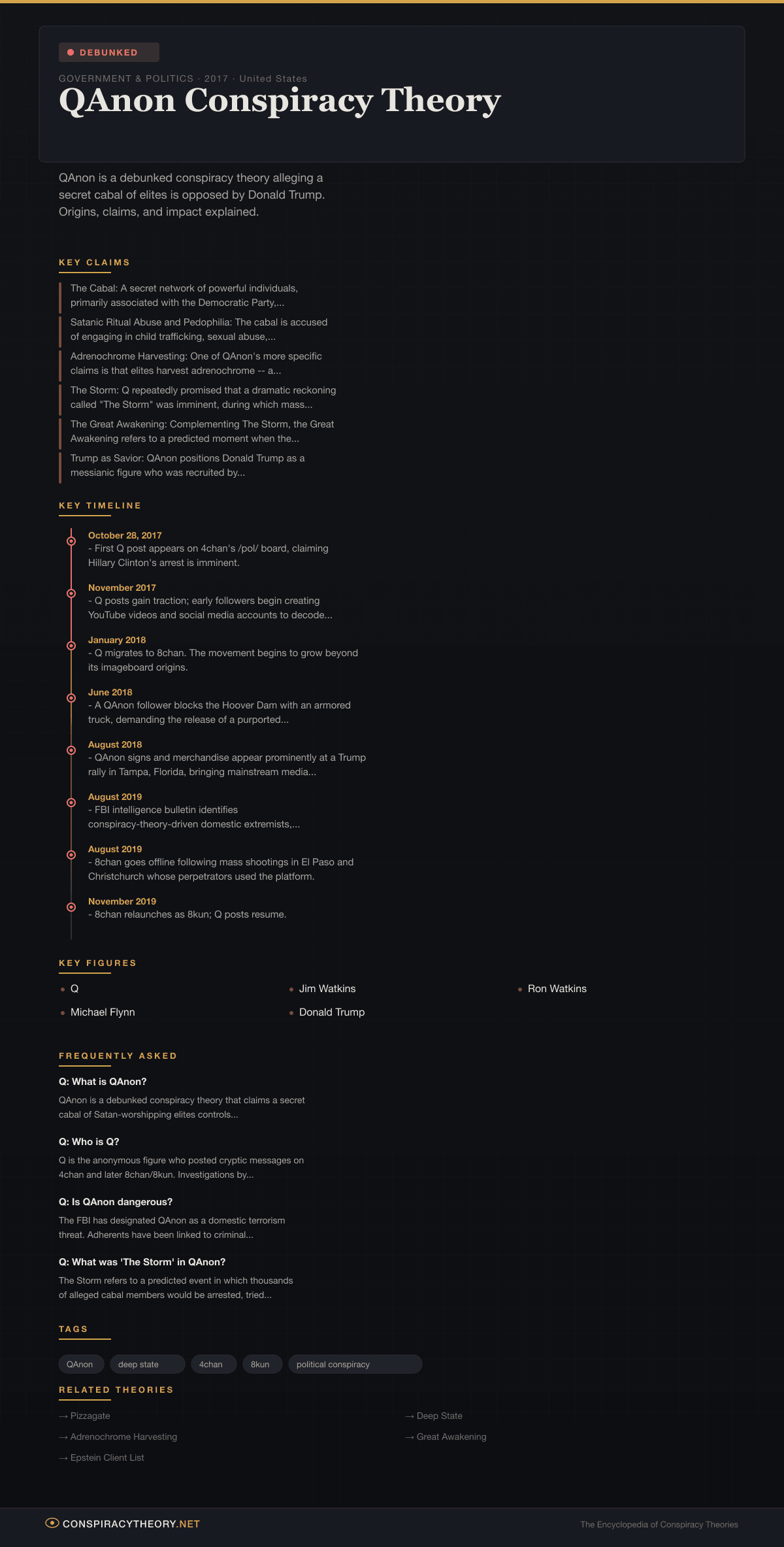
QAnon is a far-reaching conspiracy theory that emerged in late 2017 on the anonymous imageboard 4chan. At its core, the theory alleges that a secret cabal of Satan-worshipping pedophiles — composed of prominent Democratic politicians, Hollywood celebrities, and global elites — controls world governments, the media, and financial institutions. According to QAnon adherents, former U.S. President Donald Trump was recruited by military intelligence officials to dismantle this cabal, and an insider known only as “Q” has been communicating cryptic messages (called “drops” or “crumbs”) to reveal the hidden truth to the public.
The theory has been comprehensively debunked by journalists, academic researchers, law enforcement agencies, and fact-checking organizations. None of QAnon’s central predictions have come true, and the FBI has classified the movement as a domestic terrorism threat. Despite this, QAnon grew from an obscure internet subculture into a significant political and social phenomenon, influencing elections, inspiring acts of violence, and spreading to dozens of countries worldwide.
QAnon functions as what researchers describe as a “big tent” conspiracy theory — a sprawling, constantly evolving framework that absorbs and incorporates older conspiracy theories ranging from anti-Semitic blood libel tropes to anti-vaccination narratives and New World Order fears. Its decentralized, participatory structure encouraged followers to conduct their own “research” and arrive at conclusions that reinforced the overarching narrative, creating a self-sustaining ecosystem of belief.
Origins & History
The 4chan Era (October 2017)
QAnon traces its origins to October 28, 2017, when an anonymous user posted on the /pol/ (Politically Incorrect) board of 4chan under the name “Q Clearance Patriot.” The initial post claimed that Hillary Clinton’s arrest was imminent and that the National Guard had been activated in preparation. This arrest never occurred.
The pseudonym referenced “Q clearance,” a U.S. Department of Energy security classification, implying the poster had access to classified information. The account, which came to be known simply as “Q,” continued posting cryptic messages that followers called “Q drops” or “breadcrumbs.” These posts were deliberately vague and often phrased as leading questions, allowing readers to project their own interpretations onto the text — a technique that researchers have compared to cold reading methods used by psychics.
QAnon did not emerge in a vacuum. It built directly on the Pizzagate conspiracy theory of 2016, which falsely alleged that a child trafficking ring was being operated out of Comet Ping Pong, a pizza restaurant in Washington, D.C. Although Pizzagate had been thoroughly debunked — and had already inspired a violent incident in which a man fired a rifle inside the restaurant — its core narrative of elite pedophilia provided the foundation upon which QAnon was constructed.
Migration to 8chan and 8kun (2018-2019)
In late 2017 and early 2018, Q’s posting migrated from 4chan to 8chan (later rebranded as 8kun), a more permissive imageboard operated by Jim Watkins, an American businessman living in the Philippines, and administered by his son, Ron Watkins. This migration was significant for several reasons. The 8chan platform gave Q’s posts a more permanent and controlled home, and the site’s administrators played an active role in verifying the Q account’s identity through the use of “tripcodes” — unique cryptographic identifiers.
The relationship between Q and the Watkins family became a subject of intense scrutiny. Multiple independent investigations, including forensic linguistic analysis and reporting by journalists such as those at Reply All, The New York Times, and the HBO documentary series Q: Into the Storm (2021), presented substantial evidence suggesting that Ron Watkins had been posting as Q, or had at minimum taken over the account at some point during its existence. Ron Watkins denied these claims.
After the El Paso and Christchurch mass shootings in 2019, in which the perpetrators had posted manifestos on 8chan, the site was taken offline after losing its infrastructure providers. It returned in November 2019 under the name 8kun, and Q posts resumed shortly thereafter.
Growth and Mainstreaming (2019-2020)
QAnon experienced explosive growth during 2019 and 2020, driven by several converging factors. Social media algorithms on platforms including Facebook, YouTube, Instagram, and TikTok amplified QAnon content by directing users toward increasingly extreme material. The COVID-19 pandemic, which began in early 2020, created conditions of widespread fear, uncertainty, and social isolation that made people more susceptible to conspiratorial thinking. Lockdowns also meant more people were spending time online.
During this period, QAnon merged with anti-lockdown and anti-vaccination movements, wellness and alternative health communities, and existing far-right political networks. The movement’s messaging was laundered through the “Save the Children” hashtag, which co-opted genuine concerns about child exploitation to recruit new adherents who might not have otherwise engaged with QAnon content directly.
By mid-2020, QAnon adherents had run for public office in the United States. Marjorie Taylor Greene, who had expressed support for QAnon theories, won a congressional seat in Georgia in November 2020. Dozens of other QAnon-linked candidates ran for office at various levels of government.
Decline and Fragmentation (2021-Present)
The period following the January 6, 2021, breach of the U.S. Capitol marked a turning point for the QAnon movement. Major social media platforms including Facebook, Twitter, YouTube, and TikTok implemented sweeping bans on QAnon-related accounts and content. The original Q account largely ceased posting after December 2020, with only a handful of sporadic posts appearing in 2022.
The failure of QAnon’s most prominent prediction — that Donald Trump would expose the cabal and initiate mass arrests during a climactic event called “The Storm” — led some followers to abandon the movement. Others adapted their beliefs, shifting goalposts or incorporating new narratives. The movement fragmented into various splinter communities, some of which migrated to alternative platforms such as Telegram, Gab, and Truth Social.
Key Claims
QAnon is not a single, coherent theory but rather a constellation of interconnected claims. The following represent the most prominent elements:
-
The Cabal: A secret network of powerful individuals, primarily associated with the Democratic Party, Hollywood, and global financial institutions, is alleged to control world events. This group is sometimes referred to as the “Deep State” or the “Illuminati.”
-
Satanic Ritual Abuse and Pedophilia: The cabal is accused of engaging in child trafficking, sexual abuse, and ritualistic practices involving children. These claims echo centuries-old blood libel and Satanic panic narratives.
-
Adrenochrome Harvesting: One of QAnon’s more specific claims is that elites harvest adrenochrome — a chemical compound produced by the oxidation of adrenaline — from terrorized children and consume it as a life-extending drug. There is no scientific basis for this claim. Adrenochrome is a real chemical compound, but it has no youth-restoring properties and can be synthesized in a laboratory.
-
The Storm: Q repeatedly promised that a dramatic reckoning called “The Storm” was imminent, during which mass arrests of cabal members would take place, followed by military tribunals and public executions. This event was never given a firm date and has never occurred.
-
The Great Awakening: Complementing The Storm, the Great Awakening refers to a predicted moment when the general public would become aware of the cabal’s existence and the truth behind Q’s messages.
-
Trump as Savior: QAnon positions Donald Trump as a messianic figure who was recruited by military intelligence to defeat the cabal. Some QAnon adherents have incorporated explicitly religious language, casting the political conflict in terms of a spiritual battle between good and evil.
-
WWG1WGA: The motto “Where We Go One, We Go All” became a rallying cry for the movement, frequently appearing on merchandise, social media posts, and at political rallies.
-
Secret Communications: Followers believed that Trump communicated with them through coded messages, including specific hand gestures, word choices in speeches and social media posts, and even the timing of his posts relative to Q drops.
Evidence & Debunking
No credible evidence supports QAnon’s central claims. The theory has been debunked on multiple levels:
Failed Predictions: QAnon’s track record of predictions is one of consistent failure. Hillary Clinton was not arrested on the dates specified. The Storm never materialized. Mass arrests never occurred. Military tribunals were never convened against the alleged cabal. Researchers have documented hundreds of specific Q predictions that failed to come true.
Identity of Q: Multiple independent investigations have concluded that the Q account was likely operated by Ron Watkins, Jim Watkins, or both, rather than by a government insider. Forensic linguistic analysis, digital forensics, and investigative journalism have all pointed toward the Watkins family. The HBO documentary Q: Into the Storm captured a moment in which Ron Watkins appeared to inadvertently reveal his involvement before catching himself.
Adrenochrome: The claim that adrenochrome must be harvested from living children is false. Adrenochrome is a widely available chemical compound that can be easily synthesized and purchased from chemical supply companies. It has no documented life-extending properties, and no scientific research supports the claims made by QAnon adherents.
Historical Parallels: Scholars have noted that many of QAnon’s claims are recycled from much older conspiracy traditions, particularly anti-Semitic blood libel — the medieval accusation that Jews kidnapped and murdered Christian children to use their blood in religious rituals. The Protocols of the Elders of Zion, a fabricated anti-Semitic text from the early 20th century alleging a Jewish conspiracy for world domination, shares structural similarities with QAnon’s narrative of a secret elite cabal.
Institutional Assessments: The FBI identified QAnon as a potential domestic terrorism threat in a 2019 intelligence bulletin. The Department of Homeland Security, various international intelligence agencies, and academic institutions have all assessed QAnon as a baseless conspiracy theory with the potential to inspire violence.
The January 6 Connection
The breach of the U.S. Capitol on January 6, 2021, represented the most visible intersection of QAnon beliefs and real-world action. Among the thousands who entered the Capitol building that day, a significant number were identified as QAnon adherents. The most recognizable was Jacob Chansley, known as the “QAnon Shaman,” who entered the Senate chamber wearing a horned headdress and carrying a spear with an American flag attached. Chansley was sentenced to 41 months in prison for obstructing an official proceeding.
Prosecutors in January 6 cases identified QAnon beliefs as a motivating factor for many defendants. Court documents revealed that some participants believed they were participating in The Storm — the long-promised mass arrest of cabal members — and that their actions were sanctioned by the military or by Trump himself.
The events of January 6 demonstrated the real-world consequences of QAnon’s narrative framework. By casting political opponents as literally Satanic child abusers, the theory provided adherents with a moral justification for extreme action. If one genuinely believed that government officials were torturing and killing children, violent intervention could seem not only justified but morally obligatory.
In the aftermath, more than 70 individuals with documented QAnon affiliations were charged with crimes related to the Capitol breach. Their cases contributed to the broader legal and political reckoning that followed January 6.
Cultural Impact
Media and Entertainment
QAnon’s influence extended well beyond politics, permeating popular culture and media. The movement became the subject of numerous documentaries, including HBO’s Q: Into the Storm (2021), the Netflix documentary The Social Dilemma (2020), which discussed QAnon in the context of social media radicalization, and various investigative podcast series. Fictional portrayals of QAnon-like movements appeared in television shows and novels.
Social Media and Platform Policy
QAnon forced major technology companies to confront the role of their platforms in spreading conspiracy theories. Facebook removed thousands of QAnon-affiliated groups and pages in 2020. Twitter suspended more than 70,000 accounts associated with the movement following January 6. YouTube adjusted its recommendation algorithm and removed QAnon content. These actions represented some of the most sweeping content moderation decisions in the history of social media and contributed to ongoing debates about free speech, platform responsibility, and the regulation of online misinformation.
Impact on Families
One of the less discussed but deeply consequential effects of QAnon has been its impact on personal relationships. Organizations such as QAnon Casualties, a Reddit community, documented thousands of cases in which families were torn apart by a member’s radicalization. Spouses reported divorces, parents described losing contact with adult children, and children described watching parents descend into a worldview that consumed their identity. Mental health professionals noted parallels between QAnon radicalization and cult indoctrination.
Influence on Other Movements
QAnon’s framework proved remarkably adaptable and was absorbed by or merged with numerous other movements, including anti-vaccination advocacy, sovereign citizen ideology, wellness and alternative health communities, Christian nationalism, and various far-right political movements. The theory’s modular structure meant that individuals could adopt elements of the QAnon worldview without necessarily identifying as QAnon followers.
International Spread
Although QAnon originated in the United States and was centered on American politics, the movement spread to dozens of countries. This international expansion typically involved local adaptation, with adherents grafting QAnon’s narrative framework onto their own national political contexts.
Germany became one of the most significant international centers of QAnon activity. The German QAnon movement merged with the Reichsburger (Reich Citizens) movement and anti-lockdown protests. In December 2022, German authorities arrested 25 members of a group that had allegedly plotted a coup d’etat, with investigators noting the influence of QAnon ideology on the conspirators.
United Kingdom saw QAnon beliefs merge with existing conspiracy communities, particularly those focused on child exploitation scandals and anti-establishment sentiment. QAnon-influenced protesters appeared at anti-lockdown demonstrations in London.
Australia experienced a significant QAnon presence, with adherents participating in anti-lockdown protests and spreading the theory through social media. Australian researchers documented how QAnon narratives were adapted to incorporate local political figures and events.
Japan developed its own QAnon community, sometimes referred to as “JAnon,” which blended QAnon narratives with Japanese political concerns and pre-existing conspiracy traditions. QAnon-influenced groups were identified at protests and political events in Tokyo and other cities.
Brazil, France, Canada, and the Netherlands all experienced notable QAnon activity, with local communities adapting the theory’s framework to their respective political landscapes. In several countries, QAnon adherents ran for political office or participated in organized protest movements.
The international spread of QAnon demonstrated both the globalizing power of internet-based conspiracy theories and the universal appeal of narratives that cast complex political realities in terms of simple good-versus-evil frameworks.
Timeline
- October 28, 2017 — First Q post appears on 4chan’s /pol/ board, claiming Hillary Clinton’s arrest is imminent.
- November 2017 — Q posts gain traction; early followers begin creating YouTube videos and social media accounts to decode the drops.
- January 2018 — Q migrates to 8chan. The movement begins to grow beyond its imageboard origins.
- June 2018 — A QAnon follower blocks the Hoover Dam with an armored truck, demanding the release of a purported government report. He is arrested after a standoff.
- August 2018 — QAnon signs and merchandise appear prominently at a Trump rally in Tampa, Florida, bringing mainstream media attention to the movement.
- August 2019 — FBI intelligence bulletin identifies conspiracy-theory-driven domestic extremists, including QAnon adherents, as a terrorism threat.
- August 2019 — 8chan goes offline following mass shootings in El Paso and Christchurch whose perpetrators used the platform.
- November 2019 — 8chan relaunches as 8kun; Q posts resume.
- March-April 2020 — COVID-19 pandemic accelerates QAnon’s growth as lockdowns increase online activity and conspiratorial thinking.
- July 2020 — Facebook removes hundreds of QAnon-affiliated groups. Twitter suspends thousands of QAnon accounts.
- August 2020 — “Save the Children” campaign co-opts legitimate child protection concerns, drawing new followers into QAnon.
- November 2020 — Marjorie Taylor Greene, a QAnon supporter, is elected to Congress. Donald Trump loses the presidential election; QAnon communities refuse to accept the result.
- January 6, 2021 — QAnon adherents participate in the breach of the U.S. Capitol. The “QAnon Shaman” becomes one of the most recognizable figures of the event.
- January 2021 — Major social media platforms implement sweeping bans on QAnon content and accounts.
- January 20, 2021 — Joe Biden’s inauguration contradicts QAnon predictions that Trump would remain in power. Some followers experience disillusionment; others shift the narrative.
- March 2021 — HBO releases Q: Into the Storm, a documentary series investigating the identity of Q and pointing toward Ron Watkins.
- June 2022 — Q posts briefly resurface on 8kun after an 18-month hiatus, but activity remains minimal.
- December 2022 — German authorities arrest 25 suspected coup plotters influenced by QAnon and Reichsburger ideology.
- 2023-2025 — QAnon communities continue to operate in fragmented form across alternative platforms, with diminished but persistent influence on political discourse.
Sources & Further Reading
- Roose, Kevin. “What Is QAnon, the Viral Pro-Trump Conspiracy Theory?” The New York Times, updated 2021.
- Rothschild, Mike. The Storm Is Upon Us: How QAnon Became a Movement, Cult, and Conspiracy Theory of Everything. Melville House, 2021.
- LaFrance, Adrienne. “The Prophecies of Q.” The Atlantic, June 2020.
- Amarasingam, Amarnath, and Marc-Andre Argentino. “The QAnon Conspiracy Theory: A Security Threat in the Making?” CTC Sentinel, Vol. 13, Issue 7, July 2020.
- Hoback, Cullen, director. Q: Into the Storm. HBO Documentary, 2021.
- Federal Bureau of Investigation. “Anti-Government, Identity Based, and Fringe Political Conspiracy Theories Very Likely Motivate Some Domestic Extremists to Commit Criminal, Sometimes Violent Activity.” Intelligence Bulletin, May 30, 2019.
- Pew Research Center. “A Look at the Americans Who Believe There Is Some Truth to the QAnon Conspiracy Theories.” May 2021.
- Papasavva, Antonis, et al. “The Gospel According to Q: Understanding the QAnon Conspiracy from the Perspective of Canonical Information.” First Monday, Vol. 26, No. 10, 2021.
- Argentino, Marc-Andre. “QAnon and the Storm of the U.S. Capitol: The Offline Effect of Online Conspiracy Theories.” The Conversation, January 2021.
- Bloom, Mia, and Sophia Moskalenko. Pastels and Pedophiles: Inside the Mind of QAnon. Stanford University Press, 2021.
- Institute for Strategic Dialogue. “The Q Continuum: QAnon’s International Expansion.” 2021.
- Wong, Julia Carrie. “QAnon Explained: The Antisemitic Conspiracy Theory Gaining Traction Around the World.” The Guardian, August 2020.
Related Theories
- Pizzagate — The predecessor conspiracy theory about elite pedophilia centered on a Washington, D.C., pizza restaurant, which provided the foundational narrative for QAnon.
- Deep State — The theory that a hidden government within the government secretly controls policy, a core element of the QAnon worldview.
- Adrenochrome Harvesting — The claim that elites harvest a youth-restoring chemical from children, one of QAnon’s most distinctive and widely circulated sub-theories.
- The Great Awakening — The predicted moment of mass public awareness central to QAnon’s eschatological framework.
- Epstein Client List — Theories surrounding Jeffrey Epstein’s connections to powerful individuals, which QAnon adherents have incorporated into their broader cabal narrative.
Frequently Asked Questions
What is QAnon?
Who is Q?
Is QAnon dangerous?
What was 'The Storm' in QAnon?
Is QAnon still active?

Infographic
Share this visual summary. Right-click to save.