Protocols of the Elders of Zion
Overview
There is a document that has been conclusively proven to be a forgery for more than a century. It was exposed as a plagiarism in 1921. Every serious historian, every reputable institution, every credible analysis has confirmed that it is fake. It has been debunked more thoroughly and more often than perhaps any other text in history.
It has also contributed to the murder of six million people.
The Protocols of the Elders of Zion is a fabricated antisemitic text, first published in Russia around 1903, that purports to be the minutes of a secret meeting of Jewish leaders planning world domination. The “plan” described in the Protocols involves controlling banks, manipulating media, fomenting wars, and undermining Christian civilization — a grab bag of antisemitic stereotypes dressed up as a leaked strategy document.
The text was plagiarized, primarily from an 1864 French political satire that had nothing to do with Jews. It was almost certainly produced by agents of the Russian Okhrana (the tsarist secret police) as part of a campaign to blame Russia’s problems on a Jewish conspiracy. By 1921, the forgery had been publicly exposed. It should have died there.
It didn’t. Henry Ford distributed half a million copies in the United States. Hitler cited it in Mein Kampf. The Nazis used it as propaganda to justify the Holocaust. It remains in print today, sold in bookstores across the Middle East, shared on social media, and cited by antisemites worldwide. The Protocols is the most influential piece of political forgery in human history — a document that everyone knows is fake and that millions of people believe anyway.
The Forgery
The Source Material
The primary source for the Protocols was a book that had nothing to do with Jews, conspiracies, or religion. In 1864, French satirist Maurice Joly published The Dialogue in Hell Between Machiavelli and Montesquieu — a political satire attacking the authoritarian ambitions of Napoleon III. The book depicted a fictional conversation in which Machiavelli (representing Napoleon III) laid out plans for political domination.
Joly’s book was banned in France, and Joly was imprisoned for 15 months. The book then faded into obscurity — until someone in the Russian secret police realized it could be repurposed.
The forgers took Joly’s text and performed a remarkably crude substitution: wherever Joly had Machiavelli describing Napoleon III’s schemes for political control, the forgers replaced the references with “the Jews” or “the Elders of Zion.” Large passages were copied nearly word-for-word. When Philip Graves later compared the two texts, he found that roughly two-thirds of the Protocols was directly plagiarized from Joly.
A secondary source was Hermann Goedsche’s 1868 novel Biarritz, which contained a chapter depicting a fictional midnight meeting of Jewish leaders in a Prague cemetery. Goedsche’s fiction was itself derivative — but it provided the narrative framework of a secret Jewish council that the Protocols’ forgers needed.
The Okhrana Connection
The most widely accepted scholarly account traces the Protocols to the Russian Okhrana — specifically to its foreign operations based in Paris. The leading candidate for authorship is Pyotr Rachkovsky, head of the Okhrana’s foreign branch, who had a documented history of fabricating documents for political purposes. Rachkovsky operated in Paris, where Joly’s book would have been available, and had both the motive and the capability to produce the forgery.
Historian Mikhail Lepekhine identified Mathieu Golovinski, a Russian journalist and Okhrana agent living in Paris, as the probable author. Golovinski had worked for Rachkovsky and had the literary skills to transform Joly’s text into the Protocols’ pseudo-documentary format.
The motive was straightforward: the Okhrana wanted to discredit liberal and revolutionary movements in Russia by attributing them to a Jewish conspiracy. Anti-Jewish violence (pogroms) was already a tool of Russian state policy, used to redirect popular anger away from the tsarist regime. The Protocols provided an ideological framework for that violence — a pseudo-intellectual justification for hatred that could be presented as “evidence.”
Publication
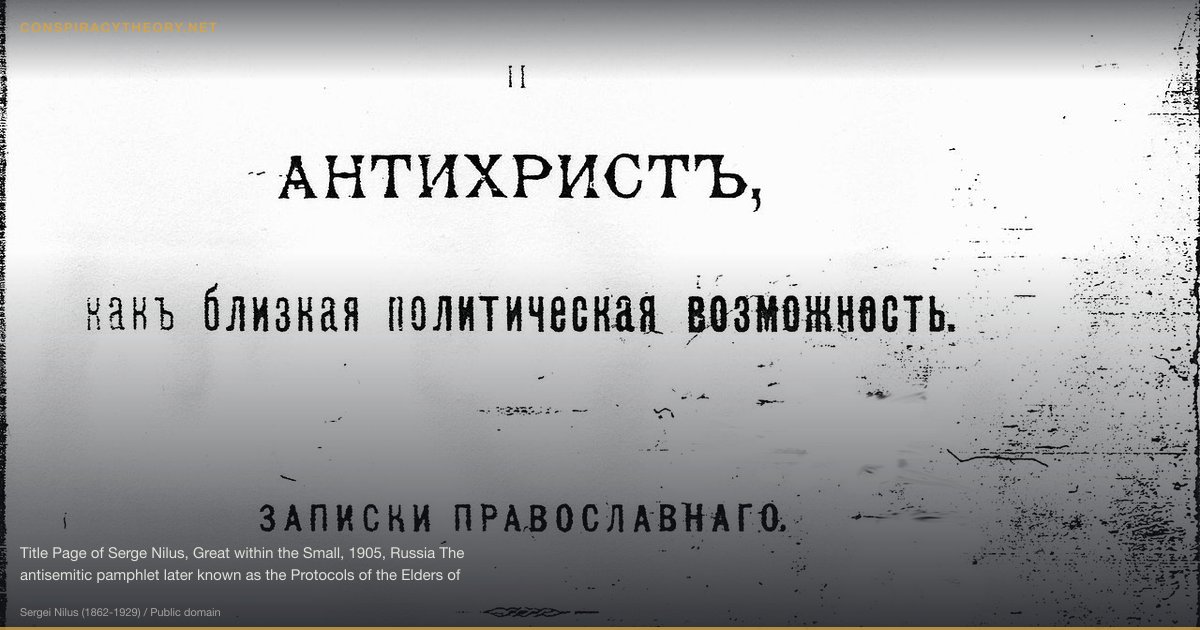
The Protocols first appeared in abbreviated form in the Russian newspaper Znamya (The Banner) in 1903, published by Pavel Krushevan — an antisemite who had also helped incite the devastating Kishinev pogrom of the same year. The full text was published in 1905 by the mystic Sergei Nilus, who appended it to his book The Great in the Small.
The timing was not coincidental. Russia was experiencing revolutionary upheaval — the Revolution of 1905 would begin that year. The Protocols served the interests of conservative, monarchist forces who wanted to blame Russia’s problems on Jews and revolutionaries rather than on the failures of the tsarist system.
The Debunking
Philip Graves (1921)
The most definitive debunking came from Philip Graves, the Constantinople correspondent for the London Times. In August 1921, Graves published a series of articles demonstrating the plagiarism from Joly’s Dialogue in Hell.
A Russian emigre had brought Graves a copy of Joly’s book, and Graves performed a systematic comparison. The parallels were overwhelming — not just in themes but in specific phrases, sentence structures, and arguments. Graves showed that the forgers had often simply copied Joly’s text with minimal changes, substituting “the Jews” for “Napoleon III” and “the Elders of Zion” for “Machiavelli.”
The Times had previously treated the Protocols with some credulity — a May 1920 editorial had raised questions about the document’s claims without endorsing them. Graves’s exposé was the paper’s correction: the Protocols were a crude forgery, assembled by plagiarizing a decades-old French satire.
Subsequent Scholarship
Every serious examination of the Protocols has confirmed Graves’s findings:
- Herman Bernstein (1935) published a comprehensive analysis tracing the forgery’s sources and transmission
- Norman Cohn (1967) wrote Warrant for Genocide, the definitive scholarly study of the Protocols and their role in inspiring the Holocaust
- Italian scholar Cesare G. De Michelis (2004) published new research on the text’s Russian origins
- A Swiss court in 1935 ruled the Protocols were “ridiculous nonsense” and forgeries
- A Russian court in 1993 found a newspaper guilty of antisemitism for publishing them as genuine
The evidence is not ambiguous. The Protocols are a forgery — plagiarized, fabricated, and conclusively debunked. This has been established beyond any reasonable doubt for more than a century.
The Spread
Henry Ford
The Protocols’ most influential promoter in the English-speaking world was Henry Ford — the automotive pioneer, one of America’s richest men, and a virulent antisemite. Beginning in May 1920, Ford’s newspaper, the Dearborn Independent, published a 91-week series titled “The International Jew: The World’s Foremost Problem,” drawing heavily on the Protocols.
Ford’s prestige gave the Protocols an audience they would never have reached through antisemitic pamphlets. The Dearborn Independent had a circulation of 700,000, and Ford distributed it through his car dealerships. “The International Jew” was reprinted as a four-volume book set and translated into multiple languages. Ford distributed approximately 500,000 copies.
Ford eventually issued a public apology in 1927 after a lawsuit and pressure from Jewish organizations. But the damage was done. His editions of “The International Jew” continued to circulate internationally — including in Germany, where they were read by a young Adolf Hitler, who kept a portrait of Ford in his office and praised him in Mein Kampf.
Nazi Germany
The Protocols became a central text of Nazi ideology. Hitler referenced them in Mein Kampf (1925), writing: “To what extent the whole existence of this people is based on a continuous lie is shown incomparably by the Protocols of the Elders of Zion.” When informed that the Protocols were a forgery, Hitler reportedly replied that their truth was evident in their conformity with reality — a circular logic that would characterize Nazi propaganda.
The Nazis made the Protocols required reading in German schools. The text was used to justify the Nuremberg Laws, the escalation of anti-Jewish persecution, and ultimately the Holocaust. Alfred Rosenberg, the Nazi party’s chief ideologist, wrote extensively about the Protocols as though they were genuine.
The connection between a forged text and industrial genocide is direct and documented. The Protocols didn’t cause the Holocaust by themselves — antisemitism had deep roots in European culture. But they provided a narrative framework, a pseudo-intellectual justification, and a mobilizing mythology that helped make genocide seem not just acceptable but necessary.
The Arab World
After World War II, as the Protocols became untouchable in most of the Western world, they found a new audience in the Middle East. The text was translated into Arabic and distributed widely, often with state support. It is sold in bookstores in several Arab countries, sometimes presented alongside legitimate political texts.
Hamas’s original 1988 charter explicitly referenced the Protocols in Article 32: “The Zionist plan is limitless. After Palestine, the Zionists aspire to expand from the Nile to the Euphrates. When they will have digested the region they overtook, they will aspire to further expansion, and so on. Their plan is embodied in the ‘Protocols of the Elders of Zion.’” (Hamas issued a revised charter in 2017 that did not include this reference.)
The Protocols’ adoption in the Middle East reflects the text’s core utility: it provides a simple explanation for complex geopolitical realities. The Israeli-Palestinian conflict, economic inequality, political instability — the Protocols offers a single cause for everything. That explanatory power, however false, is what keeps the text alive.
The Internet Era
The internet has given the Protocols their widest distribution in history. The text is freely available on countless websites, often presented without context or debunking. It circulates on social media, in encrypted messaging apps, and on conspiracy forums. Each new crisis — financial crash, pandemic, war — generates a new wave of Protocols citations from antisemitic voices claiming that current events confirm the text’s predictions.
The paradox of the internet age is that debunking is more accessible than ever, but so is the forgery itself. Anyone can read the Protocols, and anyone can read the proof that it’s fake. Whether they read the debunking depends on what they’re looking for.
Why the Forgery Works
The Unfalsifiable Framework
The Protocols’ resilience comes from its structure. The text describes a conspiracy so vast and so powerful that any evidence against it can be incorporated into it. If the Protocols are proven to be forgeries, that’s what the conspirators would do — discredit the truth. If Jews deny the conspiracy, that’s what they would do — deny it. If the world operates normally, that’s part of the plan. If the world descends into crisis, that proves the plan.
This unfalsifiable quality is the hallmark of effective conspiracy theories. The Protocols don’t require evidence because they provide a lens through which any evidence can be interpreted as confirmation.
The Emotional Logic
The Protocols succeed not because they’re convincing as a document — they’re transparently absurd, internally contradictory, and poorly written. They succeed because they confirm what antisemites already believe. The text doesn’t create hatred; it organizes and validates pre-existing hatred, giving it a narrative structure and an air of secret knowledge.
This is the pattern of all successful propaganda: it doesn’t persuade people of something new. It tells people that what they already feel is justified.
The Utility for Power
The Protocols have always served the interests of people seeking power by directing popular anger at a scapegoat. The tsarist regime used them to deflect revolutionary anger. Henry Ford used them to explain economic changes that threatened his worldview. The Nazis used them to justify genocide. Contemporary autocrats and demagogues use them (or their descendants) to explain away the failures of their own governance.
The Protocols are, ultimately, a tool — and tools persist as long as they remain useful.
Timeline
| Date | Event |
|---|---|
| 1864 | Maurice Joly publishes The Dialogue in Hell Between Machiavelli and Montesquieu |
| 1868 | Hermann Goedsche publishes Biarritz with fictional Jewish council scene |
| c. 1897-1903 | Protocols likely fabricated by Okhrana agents in Paris |
| 1903 | First publication in abbreviated form in Russian newspaper Znamya |
| 1905 | Full text published by Sergei Nilus |
| 1917 | Russian Revolution; Protocols used to blame Jews |
| 1920 | Henry Ford’s Dearborn Independent begins “The International Jew” series |
| Aug 1921 | Philip Graves exposes the plagiarism in the London Times |
| 1925 | Hitler references Protocols in Mein Kampf |
| 1927 | Ford issues public apology (distribution continues) |
| 1933 | Nazis come to power; Protocols become school curriculum |
| 1935 | Swiss court rules Protocols are “ridiculous nonsense” |
| 1938-1945 | Holocaust — Protocols used as justification for genocide |
| 1964 | U.S. Senate Judiciary Committee report: Protocols are “fabricated” |
| 1967 | Norman Cohn publishes Warrant for Genocide |
| 1988 | Hamas charter cites the Protocols |
| 1993 | Russian court rules Protocols publication constitutes antisemitism |
| 2000s-present | Protocols widely distributed on internet |
Sources & Further Reading
- Cohn, Norman. Warrant for Genocide: The Myth of the Jewish World Conspiracy and the Protocols of the Elders of Zion. Serif, 1967.
- De Michelis, Cesare G. The Non-Existent Manuscript: A Study of the Protocols of the Sages of Zion. University of Nebraska Press, 2004.
- Bronner, Stephen Eric. A Rumor about the Jews: Antisemitism, Conspiracy, and the Protocols of Zion. Oxford University Press, 2003.
- Graves, Philip. “The Truth About the Protocols: A Literary Forgery.” The Times (London), August 16-18, 1921.
- Bernstein, Herman. The Truth About “The Protocols of Zion.” KTAV Publishing House, 1935/1971.
- Joly, Maurice. The Dialogue in Hell Between Machiavelli and Montesquieu. 1864.
- United States Senate Judiciary Committee. Protocols of the Elders of Zion: A “Fabricated” Historic Document. 1964.
Related Theories
- International Jewish Conspiracy — The broader antisemitic conspiracy framework
- New World Order — Modern conspiracy theories with Protocols-derived elements
- Rothschild Banking Dynasty — Jewish banking family conspiracy theories
- Zionist Occupation Government — Modern descendant of Protocols ideology

Frequently Asked Questions
What are the Protocols of the Elders of Zion?
Who wrote the Protocols?
How were the Protocols debunked?
Are the Protocols still in circulation?

Infographic
Share this visual summary. Right-click to save.
