Pizzagate Conspiracy Theory

Overview
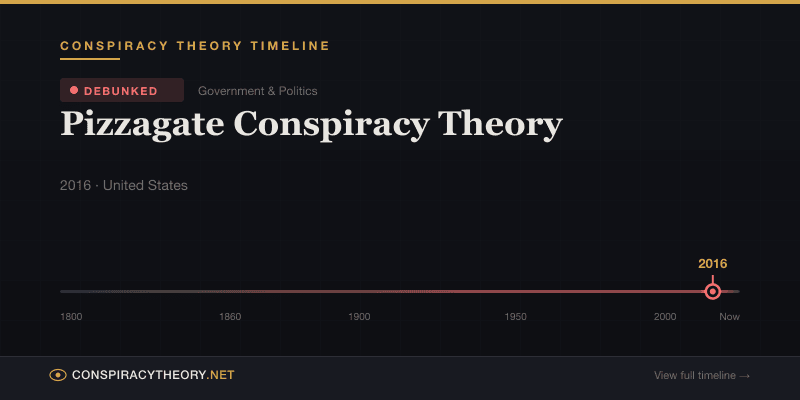
Pizzagate is a debunked conspiracy theory that emerged during the 2016 United States presidential election. The theory falsely alleged that coded messages hidden in emails belonging to John Podesta, the chairman of Hillary Clinton’s presidential campaign, revealed the existence of a child sex trafficking ring operated by high-ranking Democratic Party officials. The supposed criminal activity was claimed to be centered at Comet Ping Pong, a pizza restaurant in the Northwest Washington, DC neighborhood of Chevy Chase.
The theory originated on the anonymous imageboard 4chan in late October 2016, after WikiLeaks published a trove of Podesta’s hacked emails. Anonymous users claimed that seemingly innocuous references to food items such as “pizza,” “cheese,” and “pasta” in the emails were actually coded language for child sexual abuse. These interpretations had no basis in evidence and were constructed through unfounded pattern-matching and speculation.
Despite being thoroughly debunked by law enforcement, news organizations, and independent fact-checkers, Pizzagate had severe real-world consequences. On December 4, 2016, a man armed with an assault rifle entered Comet Ping Pong to “self-investigate” the claims, firing at least one shot before surrendering to police. The theory is widely considered a landmark case study in the dangers of online misinformation and is recognized as a direct precursor to the larger QAnon conspiracy movement.
Origins & History
The Podesta Email Leak
On October 7, 2016, exactly one month before the presidential election, WikiLeaks began publishing a cache of approximately 20,000 emails from the personal Gmail account of John Podesta. The emails had been obtained through a phishing attack that cybersecurity researchers and U.S. intelligence agencies later attributed to Russian military intelligence (GRU) operatives as part of a broader campaign to interfere in the 2016 election.
The vast majority of the emails consisted of mundane political communications, campaign logistics, and personal correspondence. However, some emails contained casual references to food and dinner plans. In one frequently cited exchange, Podesta discussed a handkerchief described as having a “map that seems pizza-related.” In others, staffers discussed ordering pizza for campaign events or attending fundraiser dinners.
The 4chan and Reddit Amplification
Within days of the WikiLeaks publication, users on 4chan’s /pol/ (politically incorrect) board began circulating claims that the food references were actually a coded pedophilia lexicon. Proponents asserted, without any evidence, that “cheese pizza” stood for “child pornography” (based on shared initials), “pasta” referred to young boys, and “sauce” referred to orgies. No law enforcement or intelligence agency has ever confirmed the existence of such a code, and linguistics and cryptography experts have dismissed the alleged cipher as baseless.
The theory quickly migrated from 4chan to Reddit, where the subreddit r/pizzagate became a central hub for organizing and disseminating claims. At its peak, the subreddit had approximately 20,000 subscribers who collaboratively constructed elaborate diagrams, maps, and connection charts linking Democratic politicians, lobbyists, and restaurant owners to alleged criminal activity. The subreddit was banned by Reddit on November 21, 2016, for violating rules against sharing personal information and harassment, though the community quickly reconstituted on the alternative platform Voat and other fringe forums.
Comet Ping Pong and James Alefantis
Comet Ping Pong, a casual pizza restaurant and music venue owned by James Alefantis, became the central target of the conspiracy theory for several reasons. Alefantis was in a relationship with David Brock, the founder of the liberal media watchdog group Media Matters for America. The restaurant had hosted Democratic fundraising events. And proponents of the theory claimed that artwork displayed in the restaurant and images posted on its social media accounts contained hidden references to child abuse.
In reality, Comet Ping Pong is a family-friendly restaurant with ping pong tables that regularly hosts live music. The artwork and social media posts cited by conspiracy theorists were typical of the eclectic aesthetic common to independent restaurants in the neighborhood. Alefantis, his employees, and their families received an onslaught of death threats and harassment as the conspiracy theory spread. The restaurant’s Yelp and Google review pages were flooded with hostile messages from people who had never visited the establishment.
Social Media Spread
The conspiracy theory was amplified through a network of social media accounts, alternative media websites, and political figures. Retired Lieutenant General Michael Flynn and his son, Michael Flynn Jr., both shared Pizzagate-related content on Twitter. Alex Jones of InfoWars devoted multiple segments to the theory on his show before later retracting his claims and apologizing. Turkish media, pro-Russian outlets, and a variety of fake news websites published stories treating the claims as credible. Research published by the Oxford Internet Institute found evidence that automated bot accounts played a significant role in amplifying the theory’s reach on Twitter during the critical weeks before the Comet Ping Pong shooting.
Key Claims
Proponents of Pizzagate made numerous specific claims, none of which have been substantiated by evidence:
- That references to food in John Podesta’s emails were coded language for child sexual abuse and trafficking
- That Comet Ping Pong pizza restaurant in Washington, DC, served as a front for a child sex trafficking operation, with children allegedly imprisoned in tunnels beneath the restaurant
- That James Alefantis, the restaurant’s owner, was a central figure in an elite pedophilia ring
- That John Podesta, Tony Podesta, Hillary Clinton, and other senior Democratic figures were participants in or facilitators of organized child sexual abuse
- That artwork in or associated with individuals connected to the restaurant contained coded pedophilic imagery
- That symbols in the restaurant’s logo and decor matched symbols associated with pedophilia as catalogued by the FBI
- That law enforcement agencies and mainstream media were complicit in covering up the alleged crimes
- That various murders and suspicious deaths were connected to efforts to conceal the trafficking ring
The Comet Ping Pong Shooting
On December 4, 2016, Edgar Maddison Welch, a 28-year-old from Salisbury, North Carolina, drove approximately 350 miles to Washington, DC, and entered Comet Ping Pong armed with a Colt AR-15 assault rifle, a .38-caliber Colt revolver, and a folding knife. Before leaving home, Welch had texted a friend asking him to watch a YouTube video about Pizzagate “with an open mind,” adding that he could not let the alleged crimes against children “go on.”
Inside the restaurant, Welch pointed his rifle at an employee, who fled along with other staff and customers. Welch then proceeded to search the restaurant, at one point shooting open a locked door that led to a computer storage closet. He found no hidden rooms, no children, and no evidence of any criminal activity. After approximately 45 minutes, Welch surrendered peacefully to police.
Welch later told investigators that he had been motivated to act after watching online videos about the conspiracy theory and that he had driven to Washington to “self-investigate” the claims. He told the New York Times that “the intel on this wasn’t 100 percent” and expressed regret for how he handled the situation.
In June 2017, Welch pleaded guilty to federal charges of interstate transport of a firearm and ammunition and assault with a dangerous weapon. He was sentenced to four years in prison. At his sentencing, Welch apologized and acknowledged that “the conspiracy theory he’d been led to believe was wholly unfounded.”
The incident drew nationwide attention to the real-world dangers of online conspiracy theories and marked one of the first widely publicized cases of what researchers would later term “stochastic terrorism” driven by internet misinformation.
Evidence & Debunking
Law Enforcement Investigations
Multiple law enforcement agencies investigated the Pizzagate claims and found no evidence to support them:
- The Metropolitan Police Department of Washington, DC investigated the allegations and found no basis for them, publicly stating that there was no evidence of criminal activity at Comet Ping Pong
- The FBI examined the claims and found no evidence of a child trafficking operation
- The DC Police conducted a thorough investigation of the restaurant and confirmed that Comet Ping Pong does not have a basement, directly refuting one of the theory’s central claims about underground tunnels and hidden rooms
Fact-Checking and Media Analysis
Every major fact-checking organization and credible news outlet that investigated the claims concluded they were false:
- The New York Times published extensive reporting debunking the theory and detailing its origins and spread through social media networks
- The Washington Post conducted on-the-ground investigations and interviews with employees, patrons, and neighbors of the restaurant
- Snopes, PolitiFact, and FactCheck.org all rated the claims as false after detailed investigations
- BBC, NPR, and other international outlets reported on the theory as a case study in misinformation
Why the Theory Was False
The foundational claims of Pizzagate fail on multiple factual grounds:
- No coded language existed. No law enforcement agency, intelligence service, or credible linguist has identified or confirmed the existence of the alleged food-related pedophilia code. The interpretation was invented by anonymous internet users and imposed retroactively onto ordinary email language.
- No basement. Comet Ping Pong does not have a basement, eliminating the central claim about hidden rooms and tunnels beneath the restaurant. (An interview in which Alefantis mentioned storing tomato sauce was misinterpreted; he was referring to another property he owned.)
- No victims. No victim of the alleged trafficking ring has ever come forward, been identified by law enforcement, or been located by any investigation.
- No physical evidence. Searches of the restaurant by both the armed intruder and law enforcement found no evidence of criminal activity, hidden chambers, or anything consistent with the conspiracy theory’s claims.
- Circular reasoning. Much of the “evidence” presented by proponents consisted of interpreting ambiguous information through the lens of a predetermined conclusion, a textbook example of confirmation bias and apophenia (the tendency to perceive meaningful connections between unrelated things).
Connection to QAnon
Pizzagate is widely recognized by researchers and journalists as the most significant direct precursor to the QAnon conspiracy theory, which emerged in October 2017 when an anonymous poster known as “Q” began publishing cryptic messages on 4chan claiming to be a high-level government insider.
QAnon absorbed and expanded the core Pizzagate narrative in several key ways:
- Elite pedophilia ring. QAnon retained Pizzagate’s central premise that powerful elites are involved in organized child sexual abuse, but expanded the alleged conspiracy from a handful of Democratic politicians to a sprawling global cabal encompassing politicians, celebrities, business leaders, and members of the so-called “deep state.”
- Satanic elements. Pizzagate proponents had alleged satanic ritual elements in the supposed abuse. QAnon amplified this into a comprehensive framework involving Satan worship, blood rituals, and the harvesting of a substance called adrenochrome from frightened children.
- Platform migration. The online communities that formed around Pizzagate, particularly after the r/pizzagate subreddit was banned, migrated to platforms like Voat, 8chan (later 8kun), and various Telegram channels. These same platforms became the primary vectors for QAnon content.
- Distrust of institutions. Both theories share a fundamental premise that mainstream media, law enforcement, and government institutions are either complicit in or actively covering up the alleged crimes, making it impossible to “disprove” the conspiracy within the logical framework of its adherents.
- “Save the children” framing. QAnon adopted and refined Pizzagate’s strategy of framing the conspiracy in terms of child protection, which made the theory emotionally compelling and difficult to oppose publicly without appearing to dismiss concerns about child welfare.
Researchers at the Harvard Shorenstein Center, the Oxford Internet Institute, and numerous other academic institutions have published studies documenting the direct lineage from Pizzagate to QAnon, tracing the migration of communities, narratives, and rhetorical strategies from one movement to the other.
Cultural Impact
Impact on Misinformation Research
Pizzagate is considered a watershed event in the study of online misinformation and radicalization. It demonstrated how conspiracy theories could be collaboratively constructed by anonymous internet users, amplified through social media algorithms and bot networks, and translate into real-world violence within a matter of weeks. The incident prompted increased academic research into the mechanics of conspiracy theory formation and spread in the digital age.
The theory’s trajectory from fringe message board speculation to mainstream awareness to an armed assault on a family restaurant became a standard case study in courses on media literacy, digital citizenship, and the sociology of misinformation. It contributed directly to platform policy changes at Reddit, Twitter, Facebook, and other social media companies regarding the moderation of conspiracy theory content and coordinated harassment campaigns.
Impact on Individuals
The human cost of Pizzagate was significant. James Alefantis and his employees at Comet Ping Pong received thousands of death threats and harassing messages. Neighboring businesses on the same block were also targeted. Alefantis was forced to hire private security and install protective infrastructure at the restaurant. Other individuals named in the conspiracy theory, including artists and musicians who had performed at the venue, were subjected to online harassment, doxing, and threats.
The restaurant itself became a symbol. In the years following the shooting, Comet Ping Pong continued to operate, and Alefantis became an advocate for legislative action against online harassment and disinformation.
Political and Media Implications
Pizzagate raised urgent questions about the responsibilities of politicians and media figures who amplify unverified claims. Michael Flynn’s sharing of Pizzagate content and Alex Jones’s extended coverage of the theory on InfoWars demonstrated how public figures with large platforms could lend perceived legitimacy to baseless claims. Jones’s later retraction and apology did not undo the damage caused by his earlier promotion of the theory.
The episode also highlighted the role of foreign state actors in amplifying divisive content within American political discourse. Research by Clemson University’s Media Forensics Hub and the Oxford Internet Institute documented the role of Russian-linked social media accounts in promoting Pizzagate content, consistent with the broader pattern of Russian information operations during the 2016 election cycle.
Legacy in Online Culture
Pizzagate fundamentally altered the landscape of online conspiracy culture. It demonstrated the speed with which participatory, crowdsourced conspiracy theories could form and escalate in the social media era. The term “Pizzagate” itself entered the cultural lexicon as shorthand for politically motivated conspiracy theories and the dangers of online radicalization. It is frequently cited alongside the later QAnon movement and the January 6, 2021 Capitol attack as evidence of the tangible real-world consequences of unchecked online misinformation.
Timeline
- October 7, 2016 — WikiLeaks begins publishing approximately 20,000 emails hacked from John Podesta’s personal Gmail account
- Late October 2016 — Anonymous users on 4chan’s /pol/ board begin claiming that food references in the Podesta emails are coded language for child sexual abuse
- Early November 2016 — The theory spreads from 4chan to Reddit, Twitter, Facebook, and YouTube; the subreddit r/pizzagate is created and rapidly grows
- November 2016 — Michael Flynn and Michael Flynn Jr. share Pizzagate-related content on social media; Alex Jones covers the theory on InfoWars
- November 21, 2016 — Reddit bans the r/pizzagate subreddit for violating rules against sharing personal information; the community migrates to Voat
- December 1, 2016 — Turkish state media promotes Pizzagate claims
- December 4, 2016 — Edgar Maddison Welch enters Comet Ping Pong armed with an AR-15 rifle and fires at least one shot while searching the restaurant; he surrenders to police after finding no evidence of the alleged crimes
- December 2016 — Major news organizations including The New York Times, The Washington Post, and BBC publish extensive debunking reports
- March 2017 — Alex Jones apologizes for promoting Pizzagate and retracts his claims about Comet Ping Pong
- June 22, 2017 — Edgar Welch is sentenced to four years in federal prison
- October 28, 2017 — The first “Q” post appears on 4chan, marking the beginning of QAnon, which incorporates and expands the Pizzagate narrative
- 2019 — An arsonist sets a fire inside Comet Ping Pong; the suspect is later arrested
- January 6, 2021 — The storming of the U.S. Capitol involves numerous QAnon adherents, many of whose beliefs trace their origins to the Pizzagate conspiracy
Sources & Further Reading
- Aisch, Gregor, Jon Huang, and Cecilia Kang. “Dissecting the #PizzaGate Conspiracy Theories.” The New York Times, December 10, 2016
- Fisher, Marc, John Woodrow Cox, and Peter Hermann. “Pizzagate: From Rumor, to Hashtag, to Gunfire in D.C.” The Washington Post, December 6, 2016
- Kang, Cecilia. “Fake News Onslaught Targets Pizzeria as Nest of Child-Trafficking.” The New York Times, November 21, 2016
- LaFrance, Adrienne. “The Prophecies of Q.” The Atlantic, June 2020
- Bleakley, Paul. “Panic, Pizza and Mainstreaming the Alt-Right: A Social Media Analysis of Pizzagate and the Rise of the QAnon Conspiracy.” Current Sociology, vol. 71, no. 3, 2023
- Tuters, Marc, and Sal Hagen. “(((They))) Rule: Memetic Antagonism and Nebulous Othering on 4chan.” New Media & Society, vol. 22, no. 12, 2020
- Marwick, Alice E., and Rebecca Lewis. “Media Manipulation and Disinformation Online.” Data & Society Research Institute, 2017
- U.S. Department of Justice. “North Carolina Man Sentenced to Four Years in Prison for Armed Assault at Northwest Washington Pizza Restaurant.” Press Release, June 22, 2017
- Barkun, Michael. A Culture of Conspiracy: Apocalyptic Visions in Contemporary America. University of California Press, 2013 (updated edition)
- Howard, Philip N., et al. “The IRA, Social Media and Political Polarization in the United States, 2012-2018.” Oxford Internet Institute, 2019
Frequently Asked Questions
Has Pizzagate been proven or debunked?
What happened at Comet Ping Pong in December 2016?
What is the connection between Pizzagate and QAnon?
Infographic
Share this visual summary. Right-click to save.
