Operation Paperclip — Nazi Scientists in America

Overview
Operation Paperclip was a secret United States government program that recruited more than 1,600 German scientists, engineers, and technicians from Nazi Germany and brought them to America after World War II. Operated by the Joint Intelligence Objectives Agency (JIOA) from 1945 to 1959, the program was designed to gain a strategic advantage in the emerging Cold War with the Soviet Union by capturing German expertise in rocketry, aerospace medicine, chemical weapons, and other fields.
The program is classified as a confirmed conspiracy because the US government actively concealed the Nazi affiliations and war crimes records of many recruits, directly violating President Truman’s executive order that excluded anyone found to have been “a member of the Nazi Party, and more than a nominal participant in its activities, or an active supporter of Nazi militarism.” JIOA officials systematically altered personnel files, whitewashing records to circumvent the exclusion policy. The program’s existence was declassified in the 1970s, and detailed records were released through the Nazi War Crimes Disclosure Act of 1998.
Operation Paperclip represents one of the clearest documented cases of the US government knowingly harboring individuals implicated in war crimes for strategic purposes, making it a foundational example in discussions of government secrecy and moral compromise in national security.
Origins & History
The Race for German Scientists
As World War II drew to a close in early 1945, American, British, and Soviet forces recognized that German scientists possessed advanced knowledge in rocketry, jet propulsion, aviation medicine, and chemical warfare that far exceeded Allied capabilities. The V-2 rocket, while militarily ineffective in changing the war’s outcome, represented a technological leap that all sides wanted to exploit.
The initial effort, codenamed Operation Overcast, began in July 1945 under the US War Department’s Joint Chiefs of Staff. Military intelligence teams — particularly the Combined Intelligence Objectives Subcommittee (CIOS) — fanned across Germany to locate and secure scientists before they fell into Soviet hands. The operation was renamed Operation Paperclip in November 1945, reportedly because paperclips were used to mark the files of scientists selected for recruitment.
Truman’s Order and the JIOA Workaround
President Harry Truman authorized the program in September 1946 but explicitly prohibited the recruitment of anyone who had been “a member of the Nazi Party, and more than a nominal participant in its activities, or an active supporter of Nazi militarism.” This presented an immediate problem: virtually all prominent German scientists had some degree of Nazi Party membership or affiliation, as participation was effectively required for career advancement in the Third Reich.
The Joint Intelligence Objectives Agency, the military body responsible for implementing the program, solved this problem through systematic fraud. JIOA officers reviewed the scientists’ security dossiers prepared by the Office of Military Government, United States (OMGUS) and, when they found disqualifying Nazi affiliations, simply rewrote the files. References to Nazi Party membership, SS rank, and participation in war crimes were removed or minimized. New “sanitized” dossiers were created and submitted to the State Department for visa approval.
This was not a case of bureaucratic oversight. Internal JIOA memoranda, declassified decades later, show that officials were fully aware they were circumventing presidential policy. JIOA Director Bosquet Wev wrote in a 1947 memo that returning the scientists to Germany would allow them to be “exploited by the Russians,” arguing that national security concerns overrode the exclusion policy.
The Scale of Recruitment
Between 1945 and 1959, Operation Paperclip and related programs (including Operations Overcast, National Interest, and 63) brought over 1,600 German personnel to the United States. They were initially housed at military installations including Fort Bliss, Texas, and the White Sands Proving Ground in New Mexico, before being dispersed to various military, intelligence, and civilian agencies.
Key Claims and Confirmed Facts
What Is Confirmed
- Over 1,600 German scientists were secretly recruited and brought to the United States
- JIOA officials deliberately falsified security records to conceal Nazi affiliations
- President Truman’s exclusion order was systematically violated with the knowledge of military leadership
- Multiple recruits had direct involvement in war crimes, slave labor, and human experimentation
- The program’s existence was kept secret from the American public for decades
- Scientists recruited through the program played central roles in NASA, the US Army, the Air Force, and the CIA
Notable Paperclip Scientists
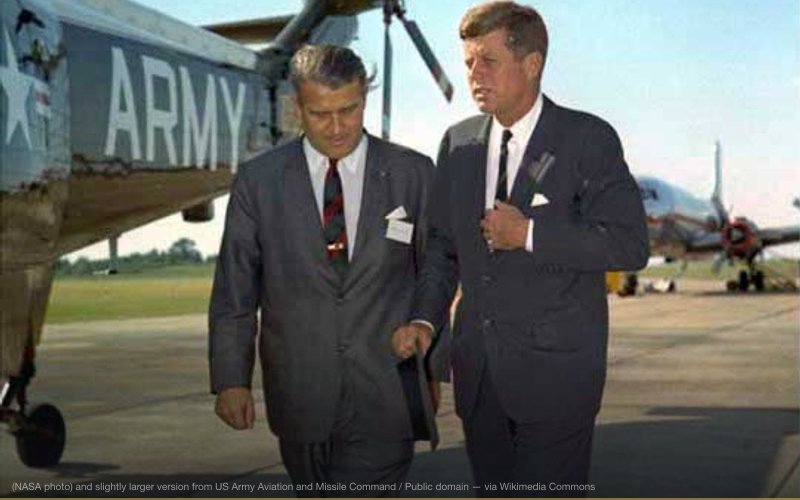
Wernher von Braun — The most famous Paperclip recruit. An SS officer (rank of Sturmbannführer/Major) who directed V-2 rocket development at Peenemünde. The V-2 program relied on slave labor from the Mittelbau-Dora concentration camp, where an estimated 20,000 prisoners died. Von Braun later claimed ignorance of camp conditions, though evidence suggests he visited the underground factory at least once. In America, he became director of NASA’s Marshall Space Flight Center and was the chief architect of the Saturn V rocket that carried Apollo astronauts to the Moon.
Hubertus Strughold — Known as the “Father of Space Medicine,” Strughold directed the German Aviation Medicine Research Institute during the war. He was connected to human experiments at the Dachau concentration camp, where prisoners were subjected to extreme altitude, hypothermia, and oxygen deprivation tests. Despite these connections, he became head of the US Air Force School of Aviation Medicine and helped design life support systems for NASA astronauts.
Kurt Blome — Deputy Surgeon General of the Third Reich and head of Germany’s biological weapons program. Blome was charged with war crimes at the Nuremberg Doctors’ Trial for human experimentation with plague bacteria but was acquitted, reportedly with American intervention. He was subsequently recruited by the US Army Chemical Corps to advise on biological weapons defense.
Arthur Rudolph — Director of V-2 production at the Mittelwerk underground factory, where concentration camp slave labor was used. Rudolph was classified as a “100% Nazi” in his initial security evaluation. His file was sanitized by JIOA. He later directed development of the Saturn V rocket’s first stage at NASA. In 1984, facing investigation by the Office of Special Investigations, Rudolph renounced his US citizenship and returned to Germany.
Walter Schreiber — Surgeon General of the German Army who had knowledge of Nazi medical experiments. He was brought to the US in 1951 but was publicly identified by journalist Drew Pearson, causing a political scandal. Schreiber was quietly transferred to Argentina.
Evidence
Declassified Documents
The most comprehensive evidence comes from files released under the Nazi War Crimes Disclosure Act of 1998, which mandated the declassification of millions of pages of records related to Nazi war criminals. These documents include:
- Original OMGUS security evaluations with unfavorable assessments
- JIOA-altered versions of the same files with negative information removed
- Internal memoranda discussing the strategy for circumventing Truman’s exclusion policy
- Records from the National Archives documenting the scope and participants of the program
Annie Jacobsen’s Investigation
Journalist Annie Jacobsen’s 2014 book Operation Paperclip: The Secret Intelligence Program That Brought Nazi Scientists to America drew on newly declassified documents and interviews to provide the most detailed public account of the program. Her research documented specific instances of file alteration and identified scientists whose war crimes records were deliberately concealed.
Congressional Investigations
The program was partially exposed through congressional investigations in the 1970s, coinciding with broader revelations about CIA activities. The General Accounting Office (GAO) conducted a review in 1985, and the Office of Special Investigations (OSI) within the Department of Justice investigated several Paperclip scientists for potential deportation based on concealed war crimes.
Cultural Impact
The Space Race Paradox
Operation Paperclip created a profound moral paradox at the heart of America’s greatest technological achievement. The Saturn V rocket that carried astronauts to the Moon was designed by a former SS officer whose previous rocket program killed 20,000 concentration camp prisoners. This tension between scientific achievement and moral accountability has been explored extensively in literature, film, and academic discourse.
Tom Lehrer’s satirical song “Wernher von Braun” (1965) captured this paradox: “Once the rockets are up, who cares where they come down? / That’s not my department, says Wernher von Braun.”
Erosion of Institutional Trust
The program is frequently cited as evidence that the US government will engage in moral compromise and systematic deception when national security interests are at stake. It appears alongside MKUltra, COINTELPRO, and the Tuskegee experiment as a confirmed example of government conspiracy, lending credibility to claims about other alleged secret programs.
Legal and Ethical Legacy
Operation Paperclip contributed to ongoing debates about the ethics of recruiting individuals with compromised moral records for national security purposes. The program has been cited in discussions about the CIA’s post-9/11 recruitment of individuals with human rights violations, the use of enhanced interrogation techniques, and other cases where security concerns are weighed against ethical standards.
International Relations
The program strained relations with Allied nations, particularly France and the United Kingdom, which had their own (smaller) recruitment programs. It also complicated denazification efforts in occupied Germany, as scientists who should have faced tribunals were instead given new identities and employment in America.
Timeline
- May 1945 — US forces capture V-2 rocket components and German scientists at Peenemünde and Nordhausen
- July 1945 — Operation Overcast authorized by Joint Chiefs of Staff to bring German scientists to US temporarily
- September 1945 — First group of German rocket scientists, including von Braun, arrives at Fort Bliss, Texas
- November 1945 — Program renamed Operation Paperclip
- September 1946 — President Truman authorizes long-term recruitment but excludes Nazi war criminals
- 1947 — JIOA Director Bosquet Wev argues national security overrides Truman’s exclusion policy
- 1947-1950 — JIOA systematically alters security files to conceal Nazi affiliations
- 1951 — Walter Schreiber publicly identified; transferred to Argentina to avoid scandal
- 1955 — Wernher von Braun becomes a US citizen; appears on Walt Disney television programs promoting space exploration
- 1958 — Von Braun becomes director of NASA’s Marshall Space Flight Center
- 1959 — Operation Paperclip officially concluded, though related recruitment continued
- 1969 — Saturn V rocket designed by Paperclip scientists carries Apollo 11 to the Moon
- 1984 — Arthur Rudolph, Saturn V program manager, renounces US citizenship and leaves the country after OSI investigation
- 1985 — GAO reviews Operation Paperclip records
- 1998 — Nazi War Crimes Disclosure Act mandates declassification of related documents
- 2006 — Hubertus Strughold’s name removed from the Space Medicine Association’s annual award due to Dachau connections
- 2014 — Annie Jacobsen publishes Operation Paperclip based on newly declassified files
Sources & Further Reading
- Jacobsen, Annie. Operation Paperclip: The Secret Intelligence Program That Brought Nazi Scientists to America. Little, Brown and Company, 2014.
- Hunt, Linda. Secret Agenda: The United States Government, Nazi Scientists, and Project Paperclip, 1945 to 1990. St. Martin’s Press, 1991.
- Bower, Tom. The Paperclip Conspiracy: The Hunt for the Nazi Scientists. Little, Brown and Company, 1987.
- Neufeld, Michael J. Von Braun: Dreamer of Space, Engineer of War. Alfred A. Knopf, 2007.
- National Archives. “Operation Paperclip.” Records of the Office of the Secretary of Defense.
- United States General Accounting Office. “Nazis and Axis Collaborators Were Used to Further US Anti-Communist Objectives in Europe.” GAO Report, 1985.
- Nazi War Crimes Disclosure Act, Public Law 105-246, 1998.
- Lasby, Clarence G. Project Paperclip: German Scientists and the Cold War. Atheneum, 1971.
Frequently Asked Questions
What was Operation Paperclip?
Was Wernher von Braun a Nazi?
How many Nazi scientists came to America?

Infographic
Share this visual summary. Right-click to save.
