Northwest Academy — The CEDU School on Ruby Creek Road
Overview
The address tells you everything you need to know about how far off the grid CEDU was willing to go. Northwest Academy sat on 85 acres at 1 Ruby Creek Road, Naples, Idaho 83847 — Boundary County, population nothing. The Ascent wilderness program’s mailing address was even more on the nose: Box 230, Ruby Ridge, Idaho 83847. The same stretch of rural panhandle where, two years before the school opened, federal agents killed a fourteen-year-old boy and shot a mother holding her baby in what became known as the Ruby Ridge standoff. The same county where CEDU already operated Rocky Mountain Academy, the Ascent wilderness program, and what would become Boulder Creek Academy. The same remote, sparsely populated corner of Idaho that made it possible to do essentially whatever you wanted to teenagers without anyone asking questions.
Northwest Academy opened in 1994 as CEDU Educational Services’ fourth Boundary County program. It served adolescents aged thirteen to seventeen — younger than Rocky Mountain Academy’s population — and it operated on the same philosophical DNA that ran through every CEDU campus: Synanon-derived confrontational group therapy, emotional manipulation dressed up as personal growth, and a level system that gave the institution total control over every aspect of a teenager’s life. CEDU was one of the top five employers in Boundary County. Four schools, a wilderness program, and all the associated staff — in a county with fewer than 10,000 people. The company essentially ran the place.
And then, in January 1997, the kids fought back.
The 1997 Riot
It happened at night. Approximately twenty students — teenagers, thirteen to seventeen years old, locked in a facility in the Idaho woods hundreds or thousands of miles from home — organized and took over Northwest Academy.
The details that emerged in the aftermath are striking. Students attacked staff with fire extinguishers. They damaged a car and buildings with an ax. A group described by one student to his parents as “a gang” seized control of the facility overnight. Staff fought back with flashlights — the available improvised weapons on their end. Five people were hospitalized.
What happened next is arguably more revealing than the riot itself.
No criminal charges were filed. Not against the students. Not against anyone. The school conducted its own internal investigation — an institution investigating its own institutional failure — and, according to parents who contacted the Spokesman-Review, attempted to remove some students from the campus before state investigators and child protection workers could interview them. Parents reported that the school gave them almost no information about what had happened. Some hired attorneys for their children. The state’s child protection workers and Boundary County detectives were brought in to conduct interviews, but the school’s initial instinct was containment, not transparency.
The riot did not happen in a vacuum. It happened in a facility where teenagers had been placed involuntarily, where communication with the outside world was restricted, where the program’s methods relied on emotional confrontation and behavioral control, and where the staff — as subsequent investigations and lawsuits would confirm — included people who were inadequately trained and, in some cases, actively abusive. When you lock teenagers in a remote facility and subject them to that kind of environment, a riot is not a mystery. It’s a natural consequence. The only question is when.
Origins: CEDU’s Boundary County Empire
Why Idaho?
The question of why a California-based company built an empire of teen programs in the Idaho panhandle answers itself once you understand the business model. The troubled teen industry has always gravitated toward isolation. Remote locations serve multiple purposes: they make it nearly impossible for students to run away (where would they go?), they limit access by parents and advocates, they place programs in jurisdictions with minimal regulatory infrastructure, and they create the kind of total environmental control that allows programs to operate with virtually no external oversight.
Boundary County, Idaho, checked every box. Sparse population, vast wilderness, limited state regulatory capacity, a culture of live-and-let-live libertarianism that didn’t ask too many questions about what private businesses did on private property. CEDU’s founder Mel Wasserman began building in Boundary County in the early 1980s, when a group of staff and students from the original CEDU campus in Running Springs, California — the “original seven” — relocated to Bonners Ferry to open Rocky Mountain Academy in 1982.
By the mid-1990s, CEDU had turned Boundary County into a company town of sorts. The network operated:
- Rocky Mountain Academy (1982) — the original Idaho campus, serving older teens
- Ascent Wilderness Program (1992) — a multi-week wilderness intake program located near Ruby Ridge
- Northwest Academy (1994) — serving younger teens, ages 13-17
- Boulder Creek Academy (later 1990s) — on the former RMA property after RMA’s closure
Four facilities in a single rural county. CEDU was the largest private employer in Boundary County — approximately 260 jobs and roughly $9 million pumped into the local economy annually. CEDU schools and parents spent nearly $200,000 per year at local outdoor stores just equipping students. When CEDU eventually collapsed in 2005, the county’s unemployment rate would have jumped from 6.5% to 12.7% if employees hadn’t found other work — the second major economic blow after Louisiana-Pacific Corp closed its Bonners Ferry mill in 2003. That economic dependency created a dynamic where local authorities had powerful financial incentives to avoid aggressive oversight of an employer that kept the county running.
The Synanon Blueprint
Every CEDU school, including Northwest Academy, ran on the same core methodology: a system derived from Synanon, the 1960s drug rehabilitation commune that devolved into a violent cult. Synanon’s founder Charles Dederich invented “The Game” — a form of aggressive confrontational group therapy where participants screamed accusations, insults, and personal attacks at each other in marathon sessions. Dederich believed that psychological demolition, achieved through sustained verbal assault in a group setting, was the path to personal transformation.
Mel Wasserman took The Game and repackaged it for teenagers. At CEDU schools, the sessions were called “raps” — confrontational group marathons where students were expected to verbally attack one another, confess their deepest fears and secrets, and achieve emotional breakdowns that the program interpreted as therapeutic breakthroughs. More intense versions, called “propheets,” could last for hours and employed techniques including sleep deprivation, food restriction, emotional manipulation, and sustained psychological pressure.
Northwest Academy applied these methods to its younger population — thirteen-year-olds subjected to the same Synanon-derived psychological machinery that had been designed for adult drug addicts. Whether these techniques were appropriate or safe for any population is debatable. Whether they were appropriate for young teenagers is not.
The Program Structure
Like all CEDU schools, Northwest Academy operated on a level system that controlled every aspect of student life. New students entered at the lowest level with the fewest privileges — no phone calls, no unsupervised time, restricted movement, limited personal belongings. Advancement through the levels required demonstrating “emotional growth,” which in practice meant demonstrating compliance: participating enthusiastically in raps, conforming to program expectations, reporting other students’ rule violations, and performing the emotional vocabulary the program demanded.
Students at the lowest levels were assigned “big brothers” or “big sisters” — more senior students who were responsible for monitoring and guiding the new arrival. This peer hierarchy served the program’s control structure: it distributed surveillance among the student population itself, making every student both a participant in and an enforcer of the program’s behavioral expectations. Students who wanted to advance had to become active agents of the system that confined them.
Communication with family was controlled by the program. Phone calls were earned through level advancement. Letters were monitored. Visits were scheduled and supervised. The informational barrier between the student and the outside world was as carefully maintained as the physical one. Parents received the program’s narrative of their child’s progress. Students received nothing from the outside that hadn’t been filtered through program staff.
The Abuse Record
State Investigation Findings
The Idaho Department of Health and Welfare investigated Northwest Academy following the 1997 riot and subsequent complaints. Their finding was unambiguous: “Allegations regarding abuse and neglect by specific employees of Northwest Academy are found to be valid.”
This was not an advocacy group’s claim or a disgruntled parent’s accusation. It was the conclusion of the state agency responsible for child welfare, following a formal investigation with interviews, evidence review, and the application of Idaho’s legal standards for abuse and neglect determinations. The state found that what was happening at Northwest Academy met the legal definition of abuse and neglect.
Lawsuits
The litigation record tells the same story from the civil side:
March 1998: Marsha and Ronald Accomazzo filed a lawsuit alleging abuse and neglect at Northwest Academy, referencing injuries their son sustained during the January 1997 riot as well as injuries from a staff restraint incident.
April 1998: A broader civil lawsuit was filed naming CEDU Educational Services and multiple affiliated programs — including Ascent, Rocky Mountain Academy, and Northwest Academy. The suit alleged fraud, racketeering, and battery. Former students accused the organization of grossly overcharging parents while maintaining practices that enabled verbal and physical abuse by inadequately trained staff. Specific allegations included a school counselor who broke a student’s arm by grabbing him in a bear hug to prevent him from leaving a room — and CEDU then charged the family $30 to drive their son to the hospital. Other allegations included students being punished by sitting on stools in the cold for as long as two days, students having their heads slammed against the floor during restraints, and being forced to sit at a table pushed against a wall for weeks as punishment. The Accomazzo case eventually reached the Idaho Supreme Court (15 P.3d 1153, 135 Idaho 145).
November 2002: CEDU paid a $300,000 settlement in a lawsuit filed by the families of two former Northwest Academy students who alleged that staff was poorly trained and abusive.
The settlement is significant not because $300,000 is a large amount — for a company operating multiple residential programs charging tens of thousands of dollars per year per student, it was a cost of doing business — but because it represented CEDU’s calculation that fighting the claims in court would be more expensive, more public, and more damaging than making the case disappear with a check.
Survivor Accounts
Former Northwest Academy students describe experiences consistent with the broader pattern documented across CEDU schools and the troubled teen industry at large. Accounts include:
- Involuntary transport: Students arrived via hired escort services, often extracted from their homes in the middle of the night with no warning and no choice.
- Confrontational group therapy: Raps and emotional processing sessions where students were subjected to sustained verbal attack, required to confess personal information, and pressured to achieve emotional breakdowns.
- Physical discipline: Reports of staff using physical restraint techniques, forced exercise, and exposure to cold as punitive measures.
- Isolation: Restricted communication with family, no contact with friends outside the program, no access to independent information or advocacy.
- Peer surveillance: The level system required students to report on each other, creating an environment of constant mutual monitoring that survivors describe as one of the most psychologically damaging aspects of the experience.
- Retaliation: Students who complained, resisted program methods, or attempted to communicate their experiences to parents faced consequences including loss of privileges, demotion within the level system, and — in the pre-riot period — the implicit threat of extended enrollment.
The consistency of these accounts across years and cohorts, combined with the state investigation’s validation of abuse allegations and the settlement of civil litigation, establishes a documented pattern of institutional abuse at Northwest Academy.
The North Idaho Context
Ruby Creek Road
The geographic symbolism is impossible to ignore. Northwest Academy’s address was on Ruby Creek Road — the same Ruby Creek that gives its name to the ridge where, in August 1992, US Marshals shot and killed fourteen-year-old Sammy Weaver and an FBI sniper killed Vicki Weaver while she held her infant daughter in the doorway of her cabin. Ruby Ridge became a defining event for the American militia movement, a symbol of federal government overreach, and a genuine scandal that resulted in a $3.1 million settlement and multiple investigations into the conduct of federal law enforcement.
Two years after those shots were fired, CEDU opened Northwest Academy down the road. The troubled teen industry moved into the same neighborhood where the federal government had just demonstrated what can happen when institutions exercise unchecked power over individuals in remote locations. The irony writes itself.
Boundary County’s Institutional Landscape
Zoom out from Ruby Creek Road and the picture gets stranger. Boundary County and the broader North Idaho panhandle was, during the same decades that CEDU operated its schools there, simultaneously:
- Home to CEDU’s network of four teen programs and a wilderness operation, processing hundreds of teenagers through Synanon-derived behavior modification
- Site of the Ruby Ridge standoff (1992), the federal law enforcement debacle that radicalized a generation of anti-government activists
- Near the Aryan Nations compound in Hayden Lake (roughly 80 miles south), which served as the headquarters of American white supremacy from the late 1970s until its seizure via lawsuit in 2000
This was the landscape. The same sparsely populated stretch of Idaho that attracted Richard Butler because its remoteness and demographic homogeneity made it ideal for building a white supremacist enclave also attracted CEDU because its remoteness and regulatory vacuum made it ideal for operating unaccountable teen programs. Different organizations, different purposes, same geographic logic: go where nobody’s watching.
The teenagers at Northwest Academy — shipped in from across the country, confined to an 85-acre campus in the woods, cut off from outside communication — were living within this landscape without knowing any of it. They didn’t know about Ruby Ridge. They didn’t know about the Aryan Nations. They didn’t know that the county where they were being “treated” was simultaneously a flashpoint in multiple American crises — government overreach, white supremacist organizing, and the unregulated institutionalization of children. They only knew the campus, the raps, the level system, and the cold.
Corporate Ownership and Transitions
CEDU Era (1994–2005)
Northwest Academy operated under CEDU ownership for its first eleven years. During this period, the school was part of a network that generated substantial revenue — families paid upward of $40,000 to $60,000 per year for enrollment — while maintaining the methods and the culture that produced the 1997 riot, the validated abuse allegations, and the civil litigation.
CEDU’s corporate structure placed Northwest Academy under the same management umbrella as Rocky Mountain Academy, Ascent, and the company’s California campuses. The Boundary County programs shared staff, resources, and — critically — students. Teenagers moved between facilities based on program decisions, not family preference. A student at Northwest Academy could be sent to Ascent’s wilderness program as a disciplinary measure or transferred to another CEDU campus. The corporate structure created a closed system where the company controlled every placement option.
Brown Schools and UHS (2005–2018)
CEDU filed for bankruptcy in early 2005, brought down by a combination of litigation costs, regulatory pressure, and the financial burden of operating multiple residential campuses. Several former CEDU employees stated that pending lawsuits alleging abuse and rights violations, along with citations against the schools, contributed to the company’s financial collapse.
Universal Health Services, Inc. — a Fortune 500 hospital and behavioral health company — bid $13.5 million for CEDU’s properties and reopened three of the Idaho facilities under the umbrella name “Idaho Educational Services”: Boulder Creek Academy (on the former Rocky Mountain Academy property), Northwest Academy, and the Ascent wilderness program, which UHS later renamed Caribou Ridge Intervention.
Under UHS, Northwest Academy continued to operate, though the corporate context shifted. UHS was a publicly traded company with $11 billion in annual revenue, not a family-founded school operator. The troubled teen programs were a small line item in a massive healthcare corporation. The same programs, the same campus, the same Boundary County location — but now owned by a company whose primary business was hospitals and whose relationship to the individual programs was several layers of corporate remove from anything resembling personal involvement.
Closure (2018)
Northwest Academy closed on September 26, 2018, after twenty-four years. The official explanation was low enrollment: the school stated that “we are no longer able to attract a sufficient number of students in today’s treatment landscape who would benefit from this approach.”
The phrasing is revealing. Not “our methods have been discredited.” Not “the evidence shows our approach causes harm.” The school framed its closure as a market problem — insufficient demand — rather than a product problem. The “treatment landscape” had changed, not because CEDU-style programming had been shown to be abusive (though it had), but because parents and referring professionals had more options (which they did) and were increasingly skeptical of the residential troubled teen model (which they were, thanks in part to survivor advocacy and investigative journalism).
Boulder Creek Academy followed in 2022, the last of CEDU’s Idaho campuses to close. The empire that Mel Wasserman built in Boundary County — four schools, a wilderness program, one of the county’s largest employers — is gone. The buildings remain. The survivors remain. The institutional record, documented in state investigations, court filings, and the consistent accounts of former students, remains.
Evidence
Documentary Record
The evidence supporting the characterization of Northwest Academy as an abusive institution comes from multiple independent sources:
-
Idaho Department of Health and Welfare: Formal investigation finding that “allegations regarding abuse and neglect by specific employees of Northwest Academy are found to be valid.”
-
Civil litigation: Multiple lawsuits alleging abuse, neglect, fraud, racketeering, and battery, including the 1998 Accomazzo lawsuit and the case that resulted in CEDU’s $300,000 settlement in 2002.
-
Law enforcement investigation: Boundary County detectives and state child protection workers investigated the 1997 riot and interviewed students and staff.
-
Contemporary journalism: The Spokesman-Review’s coverage of the riot and the subsequent lawsuits provides contemporaneous documentation of events as they unfolded.
-
Survivor testimony: Consistent accounts from former students across multiple years and cohorts, documented through advocacy organizations including Unsilenced and HEAL Online.
-
CEDU corporate history: The pattern of abuse, litigation, and regulatory action across CEDU’s network of schools — not limited to Northwest Academy — establishes institutional rather than individual-level dysfunction.
The Riot as Evidence
The 1997 riot is itself a form of evidence. Twenty teenagers did not simultaneously decide to attack staff with fire extinguishers and axes because they were having a good experience. Institutional uprisings are symptomatic — they indicate conditions that have become intolerable for the confined population. The riot at Northwest Academy, whatever its proximate trigger, is evidence that the conditions at the facility had reached a point where a significant portion of the student body concluded that violent resistance was preferable to continued compliance.
The school’s response to the riot — internal investigation, attempted removal of students before state interviews, minimal communication with parents — is evidence of an institution prioritizing its own narrative control over the welfare and rights of the children in its care.
Cultural Impact
Northwest Academy is one node in the larger story of the troubled teen industry — a multi-billion-dollar sector that has confined hundreds of thousands of American teenagers in residential facilities operating with minimal oversight. The school’s history illustrates several patterns that run through the industry:
- Geographic isolation as strategy: Locating programs in remote areas specifically to avoid oversight and make escape impossible.
- Corporate succession without reform: Ownership changing from CEDU to Brown Schools to UHS without fundamental changes to the programs or their methods.
- State validation of abuse followed by continued operation: Idaho’s Health and Welfare department found abuse allegations valid, yet the school continued to operate for more than twenty additional years.
- Market-driven closure: The school closed due to low enrollment, not regulatory action — the market corrected what the state did not.
The survivor advocacy movement — organizations like Unsilenced and the Breaking Code Silence campaign — has brought accounts from Northwest Academy and hundreds of other programs into public view, contributing to legislative efforts including the Stop Institutional Child Abuse Act and state-level reforms to the regulation of residential teen programs.
Timeline
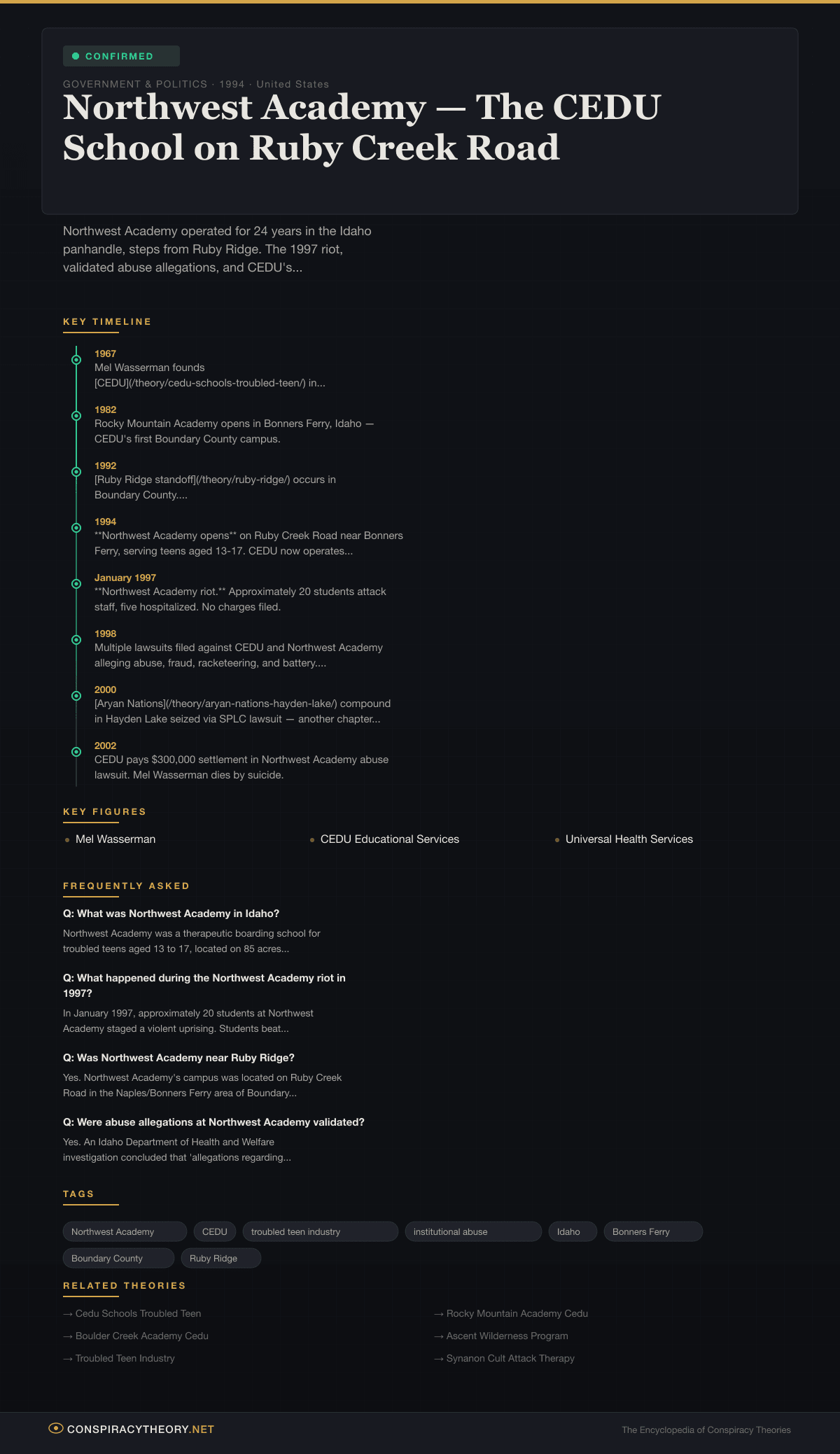
- 1967 — Mel Wasserman founds CEDU in Running Springs, California, adapting Synanon methods for teenagers.
- 1982 — Rocky Mountain Academy opens in Bonners Ferry, Idaho — CEDU’s first Boundary County campus.
- 1992 — Ruby Ridge standoff occurs in Boundary County. The Ascent wilderness program opens near Ruby Ridge the same year.
- 1994 — Northwest Academy opens on Ruby Creek Road near Bonners Ferry, serving teens aged 13-17. CEDU now operates four programs in Boundary County.
- January 1997 — Northwest Academy riot. Approximately 20 students attack staff, five hospitalized. No charges filed.
- 1998 — Multiple lawsuits filed against CEDU and Northwest Academy alleging abuse, fraud, racketeering, and battery. Idaho Health and Welfare finds abuse allegations “valid.”
- 2000 — Aryan Nations compound in Hayden Lake seized via SPLC lawsuit — another chapter in North Idaho’s institutional history closes.
- 2002 — CEDU pays $300,000 settlement in Northwest Academy abuse lawsuit. Mel Wasserman dies by suicide.
- 2005 — CEDU files for bankruptcy. Rocky Mountain Academy closes. Universal Health Services acquires remaining assets.
- 2005–2018 — Northwest Academy continues under UHS ownership. Ascent is renamed Caribou Ridge Intervention.
- September 26, 2018 — Northwest Academy closes after 24 years, citing low enrollment.
- 2022 — Boulder Creek Academy closes — the last of CEDU’s Idaho campuses.
Sources and Further Reading
- “Parents, Authorities Trying To Get To Bottom Of Riot: No Charges Filed After Violent Outbreak At Academy For Troubled Teens,” The Spokesman-Review, January 11, 1997 — contemporaneous reporting on the Northwest Academy riot.
- “Suit Says Schools For Troubled Teens Set Stage For Abuse: State Report Says Allegations By Former Students Are Valid,” The Spokesman-Review, April 1, 1998 — coverage of the 1998 lawsuit and state investigation findings.
- “Northwest Academy closing after 24 years,” Sandpoint Reader, September 2018 — reporting on the school’s closure.
- “Northwest Academy to Close,” Struggling Teens, August 22, 2018 — industry publication coverage of closure.
- Maia Szalavitz, Help at Any Cost: How the Troubled-Teen Industry Cons Parents and Hurts Kids (Riverhead Books, 2006) — comprehensive investigation of the troubled teen industry including CEDU programs.
- Government Accountability Office, Residential Treatment Programs: Concerns Regarding Abuse and Death in Certain Programs for Troubled Youth (2007) — federal report on abuse in residential teen programs.
- Unsilenced program archive — Northwest Academy survivor accounts and documentation.
- HEAL Online — survivor-maintained database of troubled teen program conditions and outcomes.
Related Theories
- CEDU Schools — the Synanon-derived network that owned and operated Northwest Academy.
- Rocky Mountain Academy — CEDU’s first Idaho campus, the template for Northwest Academy.
- Boulder Creek Academy — the last CEDU Idaho school to close, in 2022.
- Ascent Wilderness Program — the wilderness intake program that operated near Ruby Ridge, feeding students into CEDU’s Idaho schools.
- The Troubled Teen Industry — the broader multi-billion-dollar sector of unregulated residential programs for minors.
- Synanon — the cult whose confrontational methods became the philosophical foundation of CEDU’s programming.
- Ruby Ridge — the 1992 federal standoff that occurred in the same Boundary County neighborhood where CEDU built its empire.
- Aryan Nations — Hayden Lake — the white supremacist compound in the same North Idaho panhandle, part of the region’s broader institutional history.
- Brown Schools / UHS — the corporate owners who acquired CEDU and continued operating its programs.
Frequently Asked Questions
What was Northwest Academy in Idaho?
What happened during the Northwest Academy riot in 1997?
Was Northwest Academy near Ruby Ridge?
Were abuse allegations at Northwest Academy validated?

Infographic
Share this visual summary. Right-click to save.