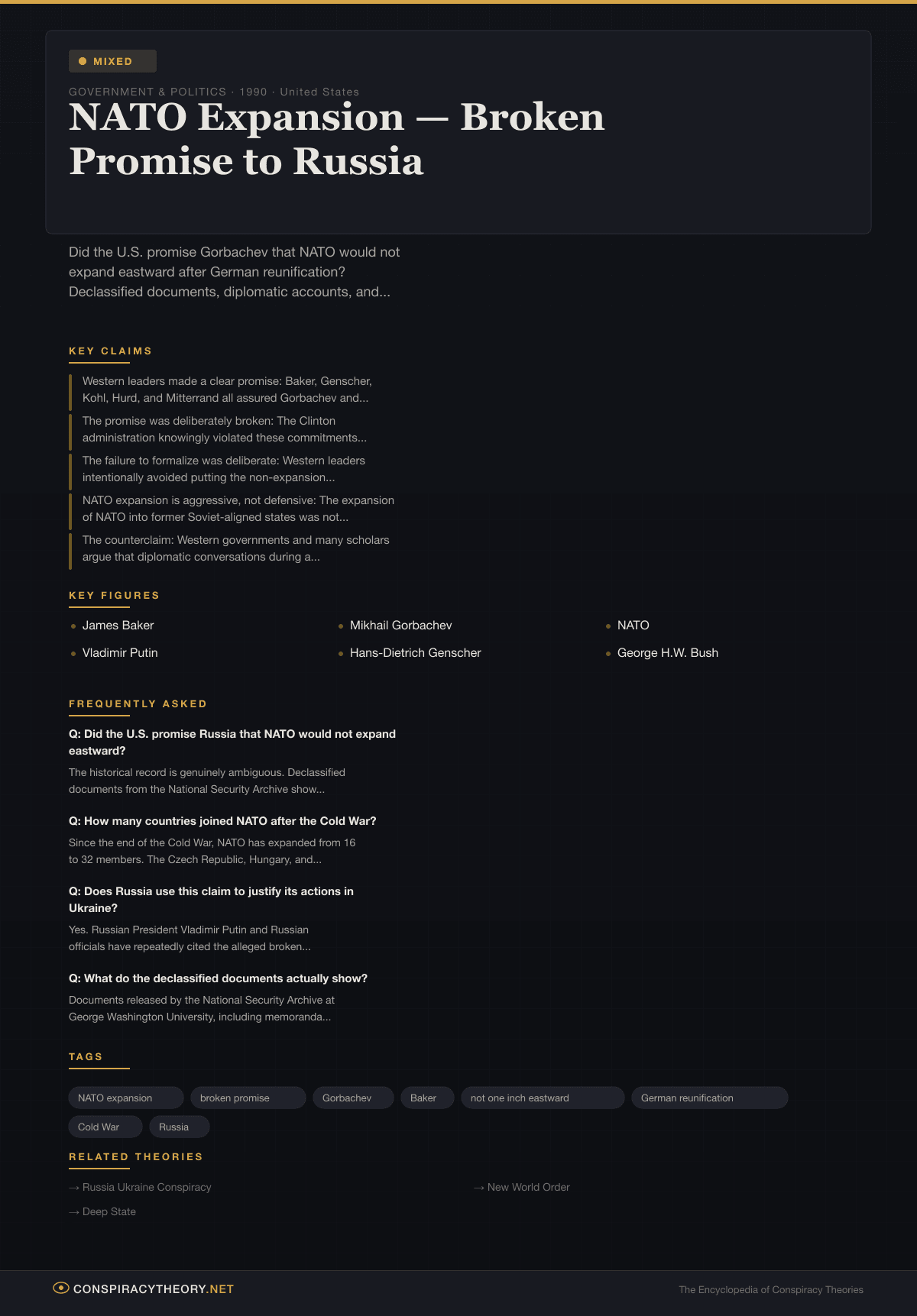
NATO Expansion — Broken Promise to Russia

Overview
Few phrases in modern diplomatic history have generated as much controversy as “not one inch eastward.” Attributed to U.S. Secretary of State James Baker during a pivotal meeting with Soviet leader Mikhail Gorbachev on February 9, 1990, the phrase has become the centerpiece of one of the most consequential geopolitical disputes of the post-Cold War era: did the Western powers promise the Soviet Union that NATO would not expand into the former Eastern bloc, and did they subsequently break that promise?
The answer, maddeningly for anyone seeking clarity, is both yes and no. Yes, multiple Western officials, including Baker, West German Foreign Minister Hans-Dietrich Genscher, and others, made verbal statements during the negotiations over German reunification suggesting that NATO’s military jurisdiction would not move eastward. No, these assurances were never formalized in any treaty, written agreement, or binding document. The final agreement on German reunification — the Two Plus Four Agreement, signed in September 1990 — addressed the military status of the former East Germany but said nothing about NATO expansion to other countries.
This ambiguity has had enormous real-world consequences. Russia, under Vladimir Putin, has used the alleged broken promise as a central pillar of its grievance narrative against the West, deploying it to justify military aggression in Georgia (2008), Ukraine (2014 and 2022), and broader confrontation with NATO. Western governments have countered that no binding commitment was made and that sovereign nations have the inherent right to choose their own security alliances. Meanwhile, historians and political scientists have spent decades combing through declassified documents, diplomatic memoirs, and oral histories, producing a scholarly literature that, characteristically, offers no consensus.
This theory is classified as mixed because the underlying diplomatic exchanges are confirmed by declassified documents, but the characterization of those exchanges as a binding “promise” that was subsequently “broken” involves interpretive judgments that legitimate scholars and diplomats continue to dispute.
Origins & History
The Context: German Reunification and the End of the Cold War
When the Berlin Wall fell on November 9, 1989, the question of German reunification immediately raised a problem that had haunted European diplomacy for over a century: what would a united Germany’s military allegiance look like, and how would it affect the balance of power on the continent?
For the Soviet Union, the prospect of a reunified Germany remaining in NATO was deeply alarming. East Germany had been a cornerstone of the Warsaw Pact. A unified Germany inside NATO would push the Western alliance’s eastern frontier hundreds of miles closer to Soviet territory. Gorbachev needed domestic political cover to accept reunification, and Western leaders understood that some form of security assurance would be necessary.
The Baker-Gorbachev Meeting (February 9, 1990)
The critical meeting took place in the Kremlin on February 9, 1990. Baker was visiting Moscow to discuss the framework for German reunification. According to the U.S. memorandum of conversation, declassified and published by the National Security Archive, Baker asked Gorbachev: “Would you prefer to see a unified Germany outside of NATO, independent and with no U.S. forces, or would you prefer a unified Germany to be tied to NATO, with assurances that NATO’s jurisdiction would not shift one inch eastward from its present position?”
Gorbachev responded that any extension of NATO’s zone was unacceptable. Baker replied: “I agree.” He then repeated the assurance in slightly different formulations during the same conversation.
This exchange is the documentary foundation of the “broken promise” narrative. The words are in the official transcript. Baker said “not one inch eastward.” Gorbachev understood it as a commitment.
Genscher, Kohl, and the European Dimension
Baker was not the only Western official offering assurances. West German Foreign Minister Hans-Dietrich Genscher gave a speech on January 31, 1990, in which he said: “What NATO must do is state unequivocally that whatever happens in the Warsaw Pact, there will be no expansion of NATO territory eastward, that is to say, closer to the borders of the Soviet Union.” West German Chancellor Helmut Kohl conveyed similar messages to Gorbachev in private meetings.
British Foreign Secretary Douglas Hurd and French President Francois Mitterrand also made statements suggesting that NATO would not expand eastward. Declassified British and French documents, published by scholars including Mary Elise Sarotte, confirm that these assurances were part of a broader Western effort to secure Soviet acquiescence to German reunification.
The Walk-Back and the Two Plus Four Agreement
Here is where the narrative becomes complicated. In the days and weeks following Baker’s February 9 meeting, the U.S. position shifted. Baker’s own colleagues, including National Security Adviser Brent Scowcroft and Deputy Secretary of State Lawrence Eagleburger, questioned whether such sweeping assurances were wise or necessary. Baker himself appeared to retreat from the “not one inch” formulation in subsequent meetings.
The final Two Plus Four Agreement, signed on September 12, 1990, by the two Germanys and the four World War II occupying powers (the U.S., UK, France, and Soviet Union), addressed the military status of the former East Germany specifically. It prohibited the deployment of NATO troops and nuclear weapons in the territory of the former GDR while Soviet forces remained there (and subsequently limited foreign NATO forces permanently). But the agreement said nothing about NATO expansion to other countries.
The Soviet Union, for its part, signed the agreement without insisting on a written ban on NATO expansion beyond Germany. Why? Historians have offered several explanations: Gorbachev believed the verbal assurances were sufficient; he was focused on immediate concerns (German unification, economic aid) and did not foresee the rapid dissolution of the Warsaw Pact and the Soviet Union itself; or he lacked the political leverage to demand more.
NATO Expansion Begins (1994-1999)
The question of NATO expansion remained largely theoretical until 1993-1994, when the Clinton administration began developing a policy of enlargement. The Partnership for Peace program, launched in 1994, created a pathway for former Warsaw Pact states and Soviet republics to develop relationships with NATO. By 1997, the Clinton administration had committed to inviting Poland, Hungary, and the Czech Republic to join the alliance.
Russian President Boris Yeltsin objected vociferously. In 1993, Yeltsin wrote to Clinton that NATO expansion would violate “the spirit of the treaty on the final settlement” of German reunification. Clinton proceeded anyway. In 1999, Poland, Hungary, and the Czech Republic became NATO members.
The Putin Era and the Weaponization of the Narrative (2000-Present)
Vladimir Putin initially adopted a pragmatic posture toward NATO, even expressing interest in Russian membership during meetings with NATO Secretary General George Robertson in 2000. But as NATO continued to expand — with the massive 2004 enlargement bringing in Estonia, Latvia, Lithuania, and other former Soviet-aligned states — Putin increasingly invoked the “broken promise” as evidence of Western duplicity.
The narrative became central to Russian foreign policy during the 2007 Munich Security Conference, where Putin delivered a landmark speech accusing the West of broken commitments and aggressive expansionism. It was invoked to justify Russia’s 2008 war with Georgia (after NATO discussed membership for Georgia and Ukraine at the 2008 Bucharest Summit), and it became a cornerstone of the justification for Russia’s 2014 annexation of Crimea and the full-scale invasion of Ukraine in February 2022.
Key Claims
-
Western leaders made a clear promise: Baker, Genscher, Kohl, Hurd, and Mitterrand all assured Gorbachev and other Soviet leaders that NATO would not expand eastward, and these assurances were understood by all parties as commitments.
-
The promise was deliberately broken: The Clinton administration knowingly violated these commitments by expanding NATO, prioritizing geopolitical advantage over diplomatic integrity.
-
The failure to formalize was deliberate: Western leaders intentionally avoided putting the non-expansion assurance in writing so they could later deny it, making the absence of a written agreement evidence of bad faith, not proof that no commitment existed.
-
NATO expansion is aggressive, not defensive: The expansion of NATO into former Soviet-aligned states was not a response to Russian aggression but a cause of it, destabilizing European security rather than enhancing it.
-
The counterclaim: Western governments and many scholars argue that diplomatic conversations during a rapidly evolving situation do not constitute binding commitments, that the assurances were made in the specific context of German reunification (not broader expansion), and that sovereign nations have the right to choose their own alliances regardless of any promises made to a state (the Soviet Union) that subsequently ceased to exist.
Evidence
Declassified Documents
The National Security Archive at George Washington University has published extensive collections of declassified documents related to the NATO expansion debate. These documents, drawn from U.S., British, German, and French archives, confirm that assurances about NATO’s future scope were made by multiple Western officials during the 1990 negotiations.
Key documents include:
- The U.S. memorandum of conversation from the Baker-Gorbachev meeting on February 9, 1990, containing Baker’s “not one inch eastward” statement
- Records of Genscher’s January 31, 1990, speech and subsequent private assurances
- British Foreign Office records of Douglas Hurd’s conversations with Soviet Foreign Minister Eduard Shevardnadze
- Records of Kohl-Gorbachev meetings in February 1990
Memoirs and Oral Histories
Gorbachev himself stated repeatedly in interviews and his memoirs that he understood the Western assurances as a commitment not to expand NATO. Jack Matlock, the U.S. Ambassador to the Soviet Union from 1987 to 1991, has said that the understanding at the time was clear: NATO would not expand. Baker, in his own memoir The Politics of Diplomacy (1995), acknowledged the “not one inch” formulation but argued it was a negotiating position that was not adopted as policy.
Scholarly Analysis
The scholarly community is divided. Mary Elise Sarotte, in Not One Inch: America, Russia, and the Making of Post-Cold War Stalemate (2021), argues that the assurances were made but were never formalized, creating a genuine ambiguity that both sides have exploited. Mark Kramer of Harvard has argued that the assurances applied only to the territory of East Germany, not to broader expansion, and that Gorbachev himself later acknowledged this limitation (a point Gorbachev’s statements on the matter are inconsistent about). Joshua Shifrinson of Boston University has argued, based on declassified documents, that the assurances were broader than defenders of NATO expansion admit.
Debunking / Verification
The central factual claim — that Western officials made verbal statements suggesting NATO would not expand eastward — is confirmed by declassified documents and is no longer seriously disputed. What is disputed is the interpretation: whether these statements constituted a binding promise, whether they applied only to Germany or to broader expansion, and whether the subsequent dissolution of the Soviet Union changed the equation.
The Western position — that only formal treaty commitments count, and that no treaty limited NATO expansion — is legally defensible but politically and morally contested. The Russian position — that verbal assurances between heads of state and foreign ministers carry weight regardless of formal documentation — has its own logic but is difficult to enforce.
Neither side’s position is entirely wrong or entirely right, which is precisely why this issue has remained so contentious for over three decades.
Cultural Impact
The “broken promise” narrative has had profound geopolitical consequences. It has become the single most frequently cited justification for Russian assertiveness and aggression in the post-Cold War era. It is central to the narrative that Putin presents to the Russian public about why the West cannot be trusted and why Russia must defend itself through military action.
In Western policy circles, the debate over whether the promise was real has influenced thinking about alliance management, diplomatic communication, and the risks of informal assurances. Some Western strategists, including former Ambassador Matlock and former Secretary of Defense Robert Gates, have argued that NATO expansion was a strategic error, regardless of whether a formal promise was made, because it poisoned relations with Russia and contributed to the security dilemma that culminated in the Ukraine crisis.
The debate has also become a fault line in Western academic and policy discussions about the causes of the Ukraine conflict. Those who emphasize Russian agency and imperial ambition tend to downplay the significance of the NATO expansion question. Those who emphasize structural and geopolitical factors tend to see the broken promise as a contributing cause of the current crisis.
In Popular Culture
The NATO expansion debate has not been the subject of major films or television series per se, but it features prominently in geopolitical documentaries and non-fiction works. Oliver Stone’s 2017 interview series The Putin Interviews gave Putin an extended platform to make the broken promise argument directly to a Western audience. Adam Curtis’s BBC documentary series HyperNormalisation (2016) touched on the theme. The debate is central to several influential nonfiction books, including Sarotte’s Not One Inch, Shifrinson’s Rising Titans, Falling Giants, and Stephen Cohen’s War with Russia?
Timeline
| Date | Event |
|---|---|
| November 9, 1989 | Fall of the Berlin Wall |
| January 31, 1990 | Genscher speech: NATO should not expand eastward |
| February 9, 1990 | Baker tells Gorbachev NATO will not move “one inch eastward” |
| February 10, 1990 | Kohl provides similar assurances to Gorbachev |
| September 12, 1990 | Two Plus Four Agreement signed; addresses East Germany but not broader NATO expansion |
| December 25, 1991 | Soviet Union dissolves |
| January 1994 | NATO Partnership for Peace program launched |
| 1997 | NATO-Russia Founding Act signed |
| March 12, 1999 | Poland, Hungary, Czech Republic join NATO |
| March 29, 2004 | Bulgaria, Estonia, Latvia, Lithuania, Romania, Slovakia, Slovenia join NATO |
| February 10, 2007 | Putin’s Munich Security Conference speech denouncing NATO expansion |
| April 2008 | Bucharest Summit: NATO declares Georgia and Ukraine “will become members” |
| August 2008 | Russia-Georgia War |
| February 2014 | Russia annexes Crimea; cites NATO expansion as factor |
| February 24, 2022 | Russia launches full-scale invasion of Ukraine; NATO expansion cited as justification |
| April 4, 2023 | Finland joins NATO |
| March 7, 2024 | Sweden joins NATO |
Sources & Further Reading
- Sarotte, Mary Elise. Not One Inch: America, Russia, and the Making of Post-Cold War Stalemate. Yale University Press, 2021.
- Shifrinson, Joshua R. Itzkowitz. Rising Titans, Falling Giants: How Great Powers Exploit Power Shifts. Cornell University Press, 2018.
- National Security Archive. “NATO Expansion: What Gorbachev Heard.” George Washington University, December 12, 2017.
- Baker, James A. III. The Politics of Diplomacy: Revolution, War and Peace, 1989-1992. G.P. Putnam’s Sons, 1995.
- Gorbachev, Mikhail. Memoirs. Doubleday, 1996.
- Matlock, Jack F., Jr. Superpower Illusions: How Myths and False Ideologies Led America Astray. Yale University Press, 2010.
- Kramer, Mark. “The Myth of a No-NATO-Enlargement Pledge to Russia.” The Washington Quarterly, Spring 2009.
- Cohen, Stephen F. War with Russia? From Putin and Ukraine to Trump and Russiagate. Hot Books, 2019.
- Stent, Angela. The Limits of Partnership: U.S.-Russian Relations in the Twenty-First Century. Princeton University Press, 2014.
Related Theories
- Russia-Ukraine Conspiracy Theories — Broader conspiracy narratives surrounding the Ukraine conflict
- New World Order — The theory of global governance that NATO expansion is sometimes linked to
- Deep State — Claims of unaccountable foreign policy establishments driving expansion

Frequently Asked Questions
Did the U.S. promise Russia that NATO would not expand eastward?
How many countries joined NATO after the Cold War?
Does Russia use this claim to justify its actions in Ukraine?
What do the declassified documents actually show?
Infographic
Share this visual summary. Right-click to save.