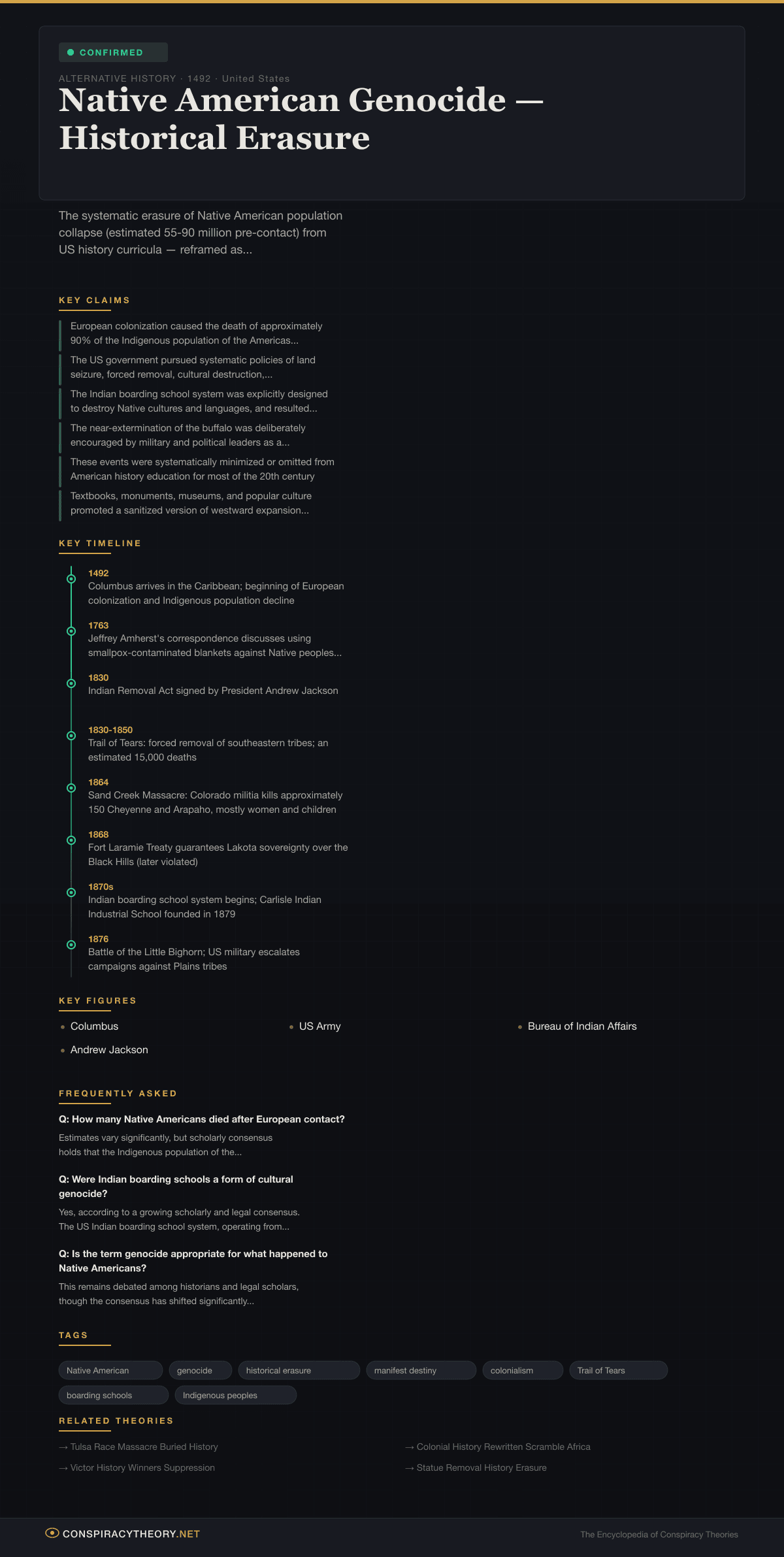
Native American Genocide — Historical Erasure

Overview
The systematic destruction of Native American peoples, cultures, and lands following European colonization of the Americas represents one of history’s most devastating demographic catastrophes. What makes this a conspiracy theory — specifically, a confirmed one — is not the events themselves, which are extensively documented, but the sustained, deliberate effort to minimize, sanitize, and erase these events from public memory and educational curricula.
For generations, the dominant historical narrative in the United States presented European colonization and westward expansion as a story of progress, civilization, and manifest destiny. Native Americans appeared in this narrative primarily as obstacles to be overcome, noble but doomed remnants of a primitive past, or allies and antagonists in European conflicts. The systematic violence, forced removal, cultural destruction, and deliberate policy decisions that devastated Indigenous populations were downplayed, omitted, or reframed as regrettable but inevitable consequences of progress.
This erasure was not accidental but reflected deliberate choices by textbook publishers, curriculum designers, museum curators, monument builders, and political leaders to construct a national mythology that celebrated expansion while obscuring its human cost. The progressive recovery of this suppressed history over the past half-century, driven by Indigenous activists, historians, and the discovery of new evidence — including the recent investigation of Indian boarding school burial sites — confirms both the scale of the original catastrophe and the depth of the subsequent cover-up.
Origins & History
The destruction of Native American peoples began with the first European contact. Christopher Columbus, arriving in the Caribbean in 1492, initiated a pattern that would repeat across the hemisphere: initial contact and exchange, followed by enslavement, exploitation, disease transmission, and military violence. Columbus himself enslaved hundreds of Taino people and oversaw a regime on Hispaniola that reduced the island’s Indigenous population from an estimated 250,000 to near extinction within decades.
The colonial period saw the establishment of patterns that would define European-Indigenous relations for centuries. English, French, Spanish, and Dutch colonizers employed various strategies — trade alliances, religious conversion, treaty-making, military campaigns, and biological warfare — in their interactions with Native peoples. The deliberate use of smallpox-contaminated blankets, documented in the correspondence of British General Jeffrey Amherst during the Pontiac’s War of 1763, represents one of the earliest documented instances of biological warfare.
The founding of the United States formalized the dispossession of Native lands as national policy. The Indian Removal Act of 1830, signed by President Andrew Jackson, authorized the forced relocation of southeastern tribes to territory west of the Mississippi River. The resulting Trail of Tears (1830-1850) killed an estimated 15,000 Cherokee, Choctaw, Chickasaw, Creek, and Seminole people through exposure, disease, and starvation during forced marches covering hundreds of miles.
The post-Civil War period saw the most intensive phase of military campaigns against western Native peoples. The US Army fought over 1,000 engagements against Native Americans between 1866 and 1891. The deliberate destruction of the buffalo herds — which declined from an estimated 30-60 million to fewer than 1,000 by the late 1880s — was explicitly understood by military and political leaders as a weapon against Plains tribes. General Philip Sheridan reportedly endorsed the slaughter as a means of depriving Native peoples of their subsistence base.
The massacre at Wounded Knee on December 29, 1890, in which the US 7th Cavalry killed approximately 250-300 Lakota men, women, and children, is often cited as the symbolic end of the Indian Wars. Twenty soldiers received the Medal of Honor for their actions at Wounded Knee — a recognition that Indigenous advocates have long sought to have revoked.
The boarding school era, beginning in the 1870s and continuing into the 1960s, represented a shift from physical destruction to cultural annihilation. The US government established over 350 boarding schools where Native children were forcibly separated from their families, forbidden to speak their languages or practice their cultures, subjected to military-style discipline, and often physically and sexually abused. A 2022 Department of the Interior investigation led by Secretary Deb Haaland (herself a member of the Laguna Pueblo) identified burial sites at approximately 53 schools and documented over 500 known student deaths.
Key Claims
Because this theory’s status is confirmed, its “claims” are established facts:
- European colonization caused the death of approximately 90% of the Indigenous population of the Americas through disease, violence, forced removal, and deliberate policy
- The US government pursued systematic policies of land seizure, forced removal, cultural destruction, and military violence against Native Americans throughout the 18th, 19th, and early 20th centuries
- The Indian boarding school system was explicitly designed to destroy Native cultures and languages, and resulted in widespread abuse and death
- The near-extermination of the buffalo was deliberately encouraged by military and political leaders as a weapon against Plains tribes
- These events were systematically minimized or omitted from American history education for most of the 20th century
- Textbooks, monuments, museums, and popular culture promoted a sanitized version of westward expansion that obscured the violence and injustice involved
- The erasure itself was a deliberate choice, not an accidental oversight, reflecting the priorities and biases of those who controlled educational and cultural institutions
Evidence
The evidence supporting both the genocide and its subsequent erasure is overwhelming:
Government records: Treaties, military orders, congressional records, Bureau of Indian Affairs documents, and presidential correspondence provide an extensive paper trail documenting US policy toward Native Americans. Andrew Jackson’s correspondence about Indian removal, General Sheridan’s statements about buffalo destruction, and Captain Pratt’s explicit statements about the boarding school philosophy are all available in government archives.
Military records: Detailed records of military campaigns, including after-action reports, casualty counts, and strategic planning documents, document the systematic nature of military operations against Native peoples.
Boarding school documentation: The 2022 Federal Indian Boarding School Initiative investigation, led by the Department of the Interior, produced a comprehensive report documenting over 400 schools, identifying burial sites, and confirming widespread abuse and death.
Demographic evidence: Population estimates derived from archaeological evidence, colonial-era records, and modern demographic analysis document the catastrophic decline of Native American populations. The evidence is consistent across multiple methodologies and research teams.
Textbook analysis: Scholarly studies of American history textbooks, including James Loewen’s Lies My Teacher Told Me (1995), have documented systematic patterns of omission, minimization, and misrepresentation of Indigenous history. Loewen’s analysis of twelve leading high school history textbooks found that all of them sanitized or omitted key events in the treatment of Native Americans.
Counter-evidence: Some historians argue that the term “genocide” overstates the intentionality of the demographic collapse, noting that disease — not deliberate policy — was responsible for the majority of deaths. Others argue that applying modern moral standards to historical events is anachronistic. These arguments, while representing legitimate historiographic debates, do not negate the documented evidence of deliberate policies of violence, removal, and cultural destruction.
Debunking / Verification
Confirmed: The demographic collapse, military campaigns, forced removal, boarding school system, and deliberate destruction of subsistence resources are all thoroughly documented in government records, military archives, and scholarly research. The subsequent minimization of these events in education and public memory is also well-documented through textbook analysis and cultural studies.
Debated: The precise pre-contact population of the Americas remains uncertain, with estimates ranging from 50 million to over 100 million. The relative contribution of deliberate policy versus unintentional disease transmission to the overall death toll is debated, though both factors are acknowledged. The applicability of the term “genocide” in a legal sense remains contested, though scholarly opinion has shifted significantly toward its use.
Actively changing: The historical narrative is currently undergoing significant revision. State education standards are increasingly incorporating Native American history, the boarding school investigation has brought new evidence to light, and public monuments and place names are being reconsidered. In 2022, the Department of the Interior formally acknowledged the boarding school policy’s intent and impact. Several states have enacted laws requiring the teaching of Native American history in public schools.
Cultural Impact
The erasure of Native American history has had profound and ongoing consequences. The sanitized narrative of westward expansion became a foundational American myth, shaping national identity, foreign policy, and domestic politics. The trope of the “vanishing Indian” — the idea that Native peoples were a dying race whose disappearance was natural and inevitable — was used to justify further dispossession well into the twentieth century.
The recovery of suppressed history has been driven primarily by Indigenous activists, scholars, and communities. The American Indian Movement (AIM), founded in 1968, brought national attention to contemporary Native issues and historical injustices. Vine Deloria Jr.’s Custer Died for Your Sins (1969) challenged dominant narratives from an Indigenous perspective. The occupation of Wounded Knee in 1973 forced a national reckoning with the site’s symbolic significance.
In recent decades, works like Dee Brown’s Bury My Heart at Wounded Knee (1970), James Loewen’s Lies My Teacher Told Me (1995), and Roxanne Dunbar-Ortiz’s An Indigenous Peoples’ History of the United States (2014) have brought suppressed history to broad public audiences. The controversy over Columbus Day celebrations, the renaming of sports teams with Native American mascots, and the opposition to the Dakota Access Pipeline have kept these issues in public discourse.
The 2022 boarding school investigation represented a significant institutional acknowledgment of historical wrongs. Secretary Deb Haaland’s personal connection to the issue — as the first Native American Cabinet secretary and a descendant of boarding school survivors — underscored the living legacy of these policies.
Timeline
- 1492 — Columbus arrives in the Caribbean; beginning of European colonization and Indigenous population decline
- 1763 — Jeffrey Amherst’s correspondence discusses using smallpox-contaminated blankets against Native peoples during Pontiac’s War
- 1830 — Indian Removal Act signed by President Andrew Jackson
- 1830-1850 — Trail of Tears: forced removal of southeastern tribes; an estimated 15,000 deaths
- 1864 — Sand Creek Massacre: Colorado militia kills approximately 150 Cheyenne and Arapaho, mostly women and children
- 1868 — Fort Laramie Treaty guarantees Lakota sovereignty over the Black Hills (later violated)
- 1870s — Indian boarding school system begins; Carlisle Indian Industrial School founded in 1879
- 1876 — Battle of the Little Bighorn; US military escalates campaigns against Plains tribes
- 1880s — Buffalo herds reduced from tens of millions to fewer than 1,000
- 1887 — Dawes Act breaks up tribal lands into individual allotments, resulting in loss of 90 million acres
- 1890 — Wounded Knee Massacre: US 7th Cavalry kills approximately 250-300 Lakota
- 1924 — Indian Citizenship Act grants US citizenship to all Native Americans
- 1968 — American Indian Movement (AIM) founded
- 1969 — Vine Deloria Jr. publishes Custer Died for Your Sins
- 1970 — Dee Brown publishes Bury My Heart at Wounded Knee
- 1973 — Occupation of Wounded Knee by AIM members
- 1995 — James Loewen publishes Lies My Teacher Told Me
- 2014 — Roxanne Dunbar-Ortiz publishes An Indigenous Peoples’ History of the United States
- 2022 — Department of the Interior releases Federal Indian Boarding School Initiative report
Sources & Further Reading
- Brown, Dee. Bury My Heart at Wounded Knee: An Indian History of the American West. Holt, Rinehart & Winston, 1970
- Dunbar-Ortiz, Roxanne. An Indigenous Peoples’ History of the United States. Beacon Press, 2014
- Loewen, James W. Lies My Teacher Told Me: Everything Your American History Textbook Got Wrong. New Press, 1995
- Madley, Benjamin. An American Genocide: The United States and the California Indian Catastrophe. Yale University Press, 2016
- Stannard, David E. American Holocaust: The Conquest of the New World. Oxford University Press, 1992
- US Department of the Interior. Federal Indian Boarding School Initiative Investigative Report. 2022
- Deloria, Vine Jr. Custer Died for Your Sins: An Indian Manifesto. Macmillan, 1969
- Treuer, David. The Heartbeat of Wounded Knee: Native America from 1890 to the Present. Riverhead Books, 2019
Frequently Asked Questions
How many Native Americans died after European contact?
Were Indian boarding schools a form of cultural genocide?
Is the term genocide appropriate for what happened to Native Americans?

Infographic
Share this visual summary. Right-click to save.