McCarthyism — Communist Witch Hunt
Overview
On February 9, 1950, an obscure first-term senator from Wisconsin named Joseph McCarthy stood before the Republican Women’s Club of Wheeling, West Virginia, and waved a piece of paper that he claimed contained the names of 205 Communists working in the State Department. The number would change — to 57, then 81, then other figures — in subsequent speeches, and McCarthy would never produce the actual list. But the gesture itself was one of the most consequential acts of political theater in American history, launching a four-year reign of accusation, investigation, and fear that would define an era and give the English language a new word: McCarthyism.
Here is the maddening thing about McCarthyism, the reason it still generates arguments seven decades later: McCarthy was swinging wildly, but he wasn’t swinging at nothing. The Soviet Union really did have an extensive espionage network operating inside the United States government. Hundreds of Americans really did pass classified information to Moscow. Alger Hiss really was a Soviet agent. Julius Rosenberg really did help steal nuclear secrets. The Venona decrypts — thousands of decoded Soviet intelligence messages, kept secret until 1995 — confirmed a scale of infiltration that even some anti-Communist hawks hadn’t fully appreciated.
And yet McCarthy himself was a fraud. His famous lists were cobbled together from outdated security files. His accusations relied on guilt by association, hearsay, and outright fabrication. He destroyed careers and lives based on innuendo. He never actually uncovered a single Soviet spy. The genuine Communist infiltration of the American government was being addressed by real counterintelligence professionals — the FBI, Army intelligence, the Venona codebreakers — who operated in careful secrecy. McCarthy’s public circus made their work harder, not easier, by creating so much noise that the signal was lost.
The result is a historical paradox that resists simple narrative: the conspiracy was real, but the conspiracy theorist was a con man.
Origins & History
The Soil Before the Seed
The Red Scare that McCarthy exploited did not begin with him. Anti-Communist anxiety had been a feature of American politics since the Bolshevik Revolution of 1917. The first Red Scare, in 1919-1920, saw Attorney General A. Mitchell Palmer order mass raids that rounded up thousands of suspected radicals, many of whom were deported. The American Communist Party, founded in 1919, attracted genuine ideological adherents throughout the 1920s and 1930s — and, as the Venona decrypts would later confirm, the Soviet intelligence services used the party as a recruiting ground for espionage agents.
By the late 1940s, several events had created fertile ground for a renewed panic. The Soviet Union detonated its first atomic bomb in August 1949, years earlier than American intelligence had predicted. China fell to Mao Zedong’s Communists in October 1949. In January 1950, Alger Hiss — a former senior State Department official who had been present at the Yalta Conference with FDR — was convicted of perjury for denying that he had passed documents to a Soviet agent. The conviction seemed to validate the darkest fears about Communist infiltration at the highest levels of American government.
It was into this atmosphere of genuine national anxiety that McCarthy stepped, with his piece of paper and his talent for spectacle.
The Rise of McCarthy
Joseph Raymond McCarthy was an unlikely demagogue. A former chicken farmer and circuit court judge from Grand Chute, Wisconsin, he had won his Senate seat in 1946 by defeating the incumbent, Robert M. La Follette Jr., in the Republican primary. His first three years in the Senate were undistinguished. He was looking for an issue that would revive his political fortunes when, according to most accounts, a Georgetown dinner conversation with a Jesuit priest and a political science professor suggested anti-Communism as a winning theme.
The Wheeling speech was a sensation. McCarthy had tapped into something real — public fear of Soviet power and internal subversion — and he rode it with reckless abandon. Over the next four years, he accused the State Department, the Voice of America, the Army, the CIA, and eventually the Eisenhower administration itself of harboring Communists. He chaired the Permanent Subcommittee on Investigations, where he hauled witnesses before public hearings and berated them on live television. His chief counsel was Roy Cohn, a 25-year-old legal prodigy who had helped prosecute the Rosenbergs and who brought a prosecutorial ruthlessness to McCarthy’s investigations.
McCarthy’s method was consistent: make accusations publicly, demand that the accused prove their innocence (reversing the traditional burden of proof), and treat any resistance or invocation of constitutional rights as evidence of guilt. “Are you now or have you ever been a member of the Communist Party?” became the defining question of the era, though it was actually the signature question of the House Un-American Activities Committee (HUAC), a separate body that McCarthy is often conflated with.
The Hollywood Blacklist
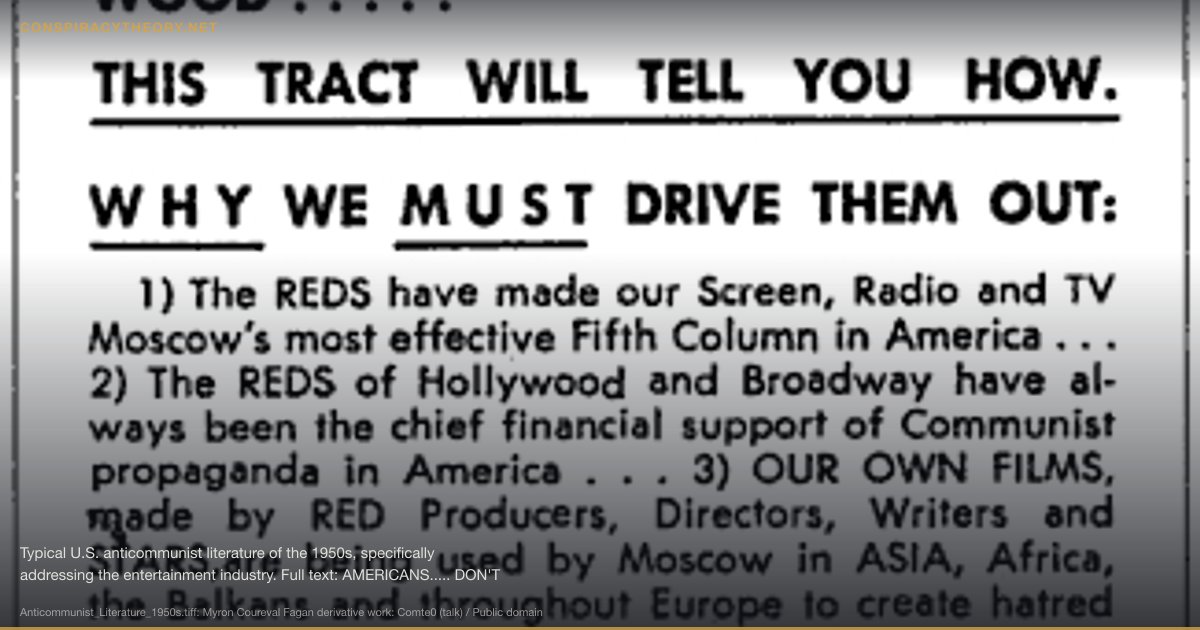
While McCarthy operated in the Senate, HUAC conducted its own parallel inquisition, focused on the entertainment industry. In 1947, HUAC had summoned the “Hollywood Ten” — a group of screenwriters and directors who refused to answer questions about their political affiliations, citing the First Amendment. All ten were cited for contempt of Congress and imprisoned.
The studios, terrified of public boycotts, created the blacklist. Beginning in 1950, the publication Red Channels: The Report of Communist Influence in Radio and Television named 151 entertainment industry professionals as having Communist ties. The networks and studios would not hire anyone on the list — or anyone who refused to testify before HUAC and “name names” of associates who had attended Communist-related meetings or events. Over 300 people were formally blacklisted. Many more were informally frozen out.
The blacklist destroyed careers. Screenwriter Dalton Trumbo, one of the Hollywood Ten, could not work under his own name for over a decade. He continued writing screenplays under pseudonyms, winning an Academy Award for The Brave One (1956) under the name Robert Rich. Actor Philip Loeb, blacklisted from his starring role on the television show The Goldbergs, died by suicide in 1955. Actress Jean Muir was dropped from the cast of The Aldrich Family after a single phone call from a pressure group. The careers and lives destroyed numbered in the thousands, and only a fraction of those blacklisted had any connection to actual espionage.
Key Claims
-
Soviet infiltration was real and extensive. Hundreds of Americans, including senior government officials, spied for the Soviet Union from the 1930s through the 1950s. The Venona decrypts confirmed the scope of the problem.
-
McCarthy was broadly right about the threat. While his specific accusations were often inaccurate, his central claim — that the U.S. government had been penetrated by Soviet agents — was vindicated by subsequent evidence.
-
The counterargument: McCarthy was a demagogue who exploited a real threat for political gain. His methods — public accusation without evidence, guilt by association, destruction of reputations — were fundamentally un-American and did more damage than the infiltration itself.
-
The Venona decrypts changed everything. Released in 1995, the decoded Soviet messages confirmed that Alger Hiss, Harry Dexter White, Lauchlin Currie, and hundreds of others had been Soviet sources, validating the general shape of anti-Communist concerns while highlighting the irony that McCarthy never had access to this actual evidence.
-
The liberal establishment suppressed knowledge of real Soviet espionage. Some conservative commentators argue that the academic and media establishments, sympathetic to the accused, minimized the genuine scope of Communist infiltration and turned “McCarthyism” into a term of opprobrium to discredit legitimate national security concerns.
Evidence & Analysis
What the Venona Decrypts Revealed
The Venona project, operated by the Army Security Agency (later the National Security Agency), ran from 1943 to 1980. American codebreakers, led initially by Meredith Gardner, began cracking Soviet diplomatic communications that used a theoretically unbreakable one-time pad cipher system. The Soviets had made a critical error: under wartime production pressure, they had duplicated some pages of their one-time pads, creating a mathematical vulnerability that the Americans exploited.
The decrypts revealed a spy network of stunning breadth. Among the confirmed Soviet sources identified through Venona:
Alger Hiss (codenamed ALES) — a senior State Department official who advised FDR at Yalta. His case had been the most bitterly contested of the era. The Venona evidence, combined with material from Soviet archives released after the Cold War, has convinced most historians that Hiss was indeed a Soviet agent, though some scholars still contest the identification.
Harry Dexter White (codenamed JURIST) — an Assistant Secretary of the Treasury who helped design the Bretton Woods international monetary system. Venona showed he passed information to Soviet intelligence, though the extent of his espionage remains debated.
Julius Rosenberg (codenamed LIBERAL) — confirmed as the leader of a spy ring that provided nuclear weapons information to the Soviets. His wife Ethel’s role appears to have been smaller than the prosecution claimed at their trial, and her execution remains controversial.
Lauchlin Currie — a senior White House economic adviser who served on FDR’s staff. Venona identified him as a Soviet source, and subsequent evidence from Soviet archives corroborated this.
The total number of Americans identified in the Venona decrypts as having some relationship with Soviet intelligence was approximately 350, though not all were confirmed spies — some were identified as contacts, couriers, or sources of varying significance.
What McCarthy Actually Got Wrong
Here is the paradox: despite the genuine scope of Soviet espionage, McCarthy’s own track record was abysmal. His famous lists were not based on current intelligence. The “205 names” from Wheeling were drawn from a 1946 security screening of State Department employees — many of whom had already left government service. When pressed, McCarthy could not identify a single active Soviet spy.
His most prominent target, Owen Lattimore — a Johns Hopkins professor and Asia expert whom McCarthy called the “top Russian espionage agent” in the United States — was never shown to have been a spy. Lattimore’s name does not appear in the Venona decrypts. His career was destroyed nonetheless.
McCarthy’s investigation of the Army in 1954 — prompted by the Army’s refusal to give preferential treatment to G. David Schine, Roy Cohn’s close friend who had been drafted — was transparently about personal grievances rather than national security. The Army-McCarthy hearings, broadcast live on television to an audience of 20 million, provided the public its first extended look at McCarthy’s bullying tactics.
The climactic moment came on June 9, 1954, when Army counsel Joseph Welch, after McCarthy attacked a young lawyer in Welch’s firm, delivered the words that effectively ended McCarthy’s career: “Have you no sense of decency, sir, at long last? Have you left no sense of decency?” The gallery erupted in applause. McCarthy’s approval ratings, already declining, collapsed. On December 2, 1954, the Senate voted 67-22 to censure him. He died of acute hepatitis, exacerbated by alcoholism, on May 2, 1957, at the age of 48.
The Ironic Tragedy
The deepest irony of McCarthyism is that the people who were actually fighting Soviet espionage — the FBI counterintelligence agents, the Venona codebreakers, the military intelligence officers running double agents — were doing so in secret, and McCarthy’s public carnival made their work harder. The Venona program was so classified that even the President of the United States was not fully briefed on it until the late 1950s. McCarthy certainly never had access to the decrypts. His accusations were based on rumors, outdated files, and political intuition — and they risked alerting actual Soviet agents that counterintelligence efforts were underway.
J. Edgar Hoover walked a complicated line. The FBI director privately fed information to McCarthy and his allies, using the senator as a blunt instrument against the Bureau’s political enemies. But Hoover also understood that McCarthy’s recklessness was dangerous. When McCarthy began attacking the Army — and by extension, the Eisenhower administration — Hoover withdrew his support, and McCarthy’s fall became inevitable.
Cultural Impact
McCarthyism left a scar on American political culture that has never fully healed. The word itself has become the standard shorthand for any campaign of politically motivated accusation — sometimes fairly applied, sometimes used to deflect legitimate criticism.
Arthur Miller’s The Crucible (1953), ostensibly about the Salem witch trials, was the era’s defining cultural response — a barely veiled allegory about the McCarthy hearings that remains one of the most performed plays in the American canon. Miller himself was called before HUAC in 1956 and refused to name names, for which he was convicted of contempt of Congress (the conviction was later overturned).
The Hollywood blacklist’s legacy reshaped the entertainment industry’s politics permanently. The experience of the blacklist — in which artists were punished for their beliefs and pressured to inform on their colleagues — pushed Hollywood decisively leftward. The Academy of Motion Picture Arts and Sciences, which had cooperated with the blacklist, eventually repudiated it; in 2020, it formally apologized to those who had been blacklisted.
The debate over McCarthyism has been revived periodically. After the Venona decrypts were released in 1995, conservative scholars like M. Stanton Evans (Blacklisted by History, 2007) argued that McCarthy had been vindicated, while liberal scholars like Ellen Schrecker (Many Are the Crimes, 1998) countered that the existence of real spies did not justify McCarthy’s methods. The argument remains unresolved because both sides are partially right: the threat was real, the response was reckless, and the innocent people destroyed by McCarthyism cannot be un-destroyed by the fact that some of those accused were guilty.
In contemporary American politics, accusations of “McCarthyism” are deployed by both left and right, each claiming the other is engaging in politically motivated persecution. The term’s flexibility — and its power — is a testament to how deeply the original trauma embedded itself in the national psyche.
Timeline
- 1917 — Bolshevik Revolution; first wave of American anti-Communist sentiment begins.
- 1938 — House Un-American Activities Committee (HUAC) established as a permanent committee.
- 1943 — U.S. Army begins the Venona project to decrypt Soviet communications.
- 1947 — HUAC Hollywood hearings; the Hollywood Ten cited for contempt of Congress.
- 1948 — Alger Hiss accused of espionage by Whittaker Chambers before HUAC.
- August 1949 — Soviet Union detonates its first atomic bomb.
- January 1950 — Alger Hiss convicted of perjury.
- February 9, 1950 — McCarthy delivers the Wheeling speech claiming 205 Communists in the State Department.
- 1950 — Red Channels published, initiating the broadcast entertainment blacklist.
- June 1951 — Julius and Ethel Rosenberg sentenced to death for espionage.
- June 1953 — The Rosenbergs executed.
- April-June 1954 — Army-McCarthy hearings broadcast live on television.
- June 9, 1954 — Joseph Welch’s “Have you no sense of decency?” confrontation.
- December 2, 1954 — Senate votes 67-22 to censure McCarthy.
- May 2, 1957 — McCarthy dies of acute hepatitis at age 48.
- 1960 — Dalton Trumbo receives screen credit for Spartacus and Exodus, effectively breaking the blacklist.
- 1995 — Venona decrypts publicly released, confirming extensive Soviet espionage networks.
- 2007 — M. Stanton Evans publishes Blacklisted by History, arguing McCarthy was vindicated.
Sources & Further Reading
- Haynes, John Earl, and Harvey Klehr. Venona: Decoding Soviet Espionage in America. Yale University Press, 1999
- Schrecker, Ellen. Many Are the Crimes: McCarthyism in America. Little, Brown, 1998
- Evans, M. Stanton. Blacklisted by History: The Untold Story of Senator Joe McCarthy. Crown Forum, 2007
- Oshinsky, David M. A Conspiracy So Immense: The World of Joe McCarthy. Oxford University Press, 2005
- Weinstein, Allen, and Alexander Vassiliev. The Haunted Wood: Soviet Espionage in America — The Stalin Era. Random House, 1999
- Miller, Arthur. The Crucible. Viking Press, 1953
- Ceplair, Larry, and Steven Englund. The Inquisition in Hollywood: Politics in the Film Community, 1930-1960. University of Illinois Press, 2003
- National Security Agency. “Venona: Soviet Espionage and the American Response, 1939-1957.” Declassified monograph, 1995
Related Theories
- COINTELPRO — the FBI’s later domestic surveillance and disruption programs, rooted in the same institutional culture
- Lavender Scare — the parallel persecution of gay government employees, intertwined with McCarthyism
- Deep State — modern theories about unelected officials wielding secret power, echoing McCarthy-era claims
- Soviet Manipulation — documented Soviet influence operations in the United States

Frequently Asked Questions
Was McCarthy right about Communist infiltration of the U.S. government?
What were the Venona decrypts?
How many people were blacklisted during McCarthyism?
Did McCarthyism have any connection to actual counterintelligence operations?

Infographic
Share this visual summary. Right-click to save.
