Marilyn Monroe Was Murdered
Overview
Marilyn Monroe, Hollywood’s most iconic star, was found dead in her Brentwood, Los Angeles home in the early hours of August 5, 1962, at the age of 36. The Los Angeles County Coroner ruled her death a “probable suicide” from acute barbiturate poisoning, specifically a lethal combination of Nembutal (pentobarbital) and chloral hydrate. The case was closed within days.
Almost immediately, questions arose. The crime scene had been disturbed before police arrived. Monroe’s housekeeper, Eunice Murray, had washed the bed linens. Critical telephone records for Monroe’s final hours vanished from phone company archives. The timeline provided by witnesses contained contradictions. And Monroe’s documented relationships with President John F. Kennedy and Attorney General Robert F. Kennedy placed her death at the intersection of Hollywood, politics, and national security during the Cold War.
The theory is classified as unresolved. While no definitive evidence of murder has been produced, the inconsistencies in the official account have never been satisfactorily explained, and the case has been reviewed by the Los Angeles District Attorney (1982) and investigated by numerous journalists and biographers without producing a definitive conclusion.
Origins & History
The Death
On the evening of August 4, 1962, Monroe spoke to several people by telephone, including actor Peter Lawford (JFK’s brother-in-law) and her psychiatrist Dr. Ralph Greenson. According to the official account, housekeeper Eunice Murray noticed a light under Monroe’s locked bedroom door around midnight and, unable to get a response, called Dr. Greenson, who arrived and broke a window to enter the room. Monroe was found face down on her bed, nude, with an empty Nembutal bottle nearby. She was pronounced dead at 3:40 AM on August 5.
Immediate Irregularities
Several aspects of the scene and investigation drew immediate scrutiny. Sergeant Jack Clemmons, the first LAPD officer on the scene, later stated that the death appeared “staged” and that Murray and the two doctors present (Greenson and Monroe’s physician Dr. Hyman Engelberg) appeared rehearsed in their accounts. Their stories about the timeline changed multiple times in subsequent interviews.
The absence of a drinking glass in the bedroom was notable — the massive barbiturate dose would have required something to swallow the pills. Monroe’s stomach contents showed surprisingly little pill residue for the lethal blood concentration detected, leading some forensic pathologists to suggest the drugs may have been administered by injection or suppository.
The Kennedy Connection
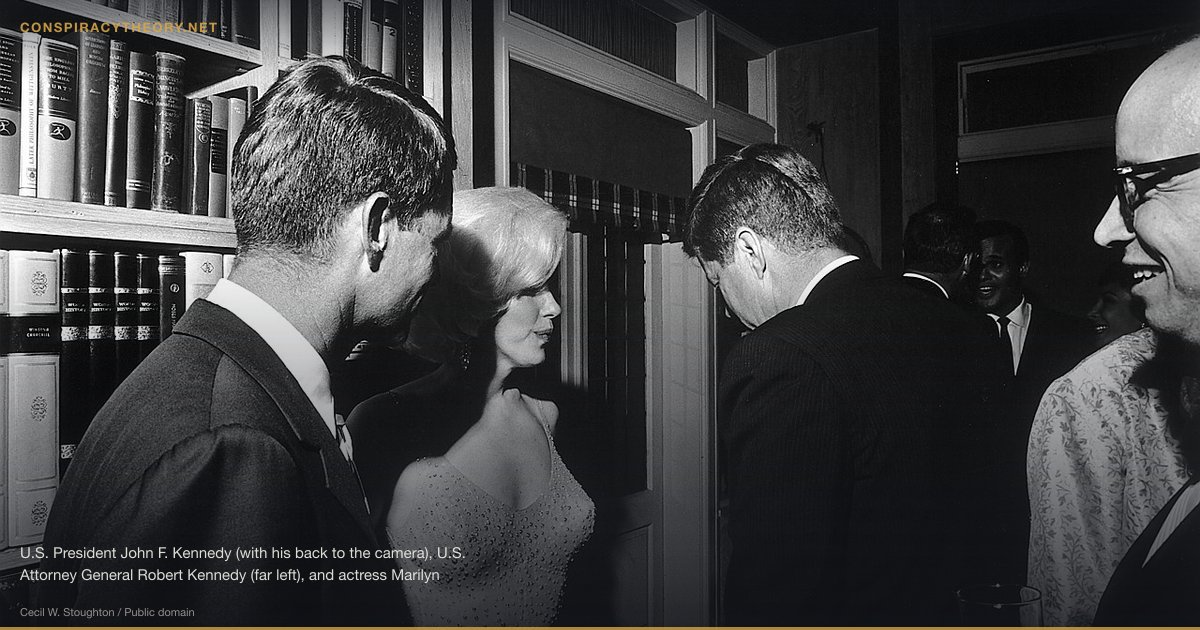
Monroe’s relationships with both Kennedy brothers are central to most murder theories. Her famous “Happy Birthday, Mr. President” performance at Madison Square Garden on May 19, 1962, publicly displayed the relationship. In the weeks before her death, Monroe was reportedly distressed about being cut off by both brothers. Some theorists claim she threatened to hold a press conference revealing the affairs and potentially state secrets she had overheard.
Key Claims
- CIA assassination: Monroe was killed by the CIA because she had learned classified information through her relationship with JFK, potentially about UFOs, Cuba operations, or organized crime connections, and threatened to go public
- Robert Kennedy involvement: RFK ordered Monroe silenced because she knew about the Kennedy family’s affairs and mob connections, or because she had become emotionally unstable and threatened public exposure
- Mob hit: Organized crime figures, particularly Sam Giancana (who shared a mistress, Judith Exner, with JFK), arranged Monroe’s death to remove a loose end in the Kennedy-mob relationship
- Administered overdose: Rather than swallowing pills, Monroe was given a lethal barbiturate suppository or injection, explaining the toxicology discrepancy between blood levels and stomach contents
- Cover-up by LAPD: The Los Angeles Police Department, under pressure from political figures, conducted a superficial investigation and failed to pursue obvious leads
- Missing evidence: Monroe’s phone records for her final weeks were confiscated and have never been released, and her personal diary (the “red diary” reportedly containing details about conversations with the Kennedys) disappeared
Evidence & Analysis
The Toxicology Question
The most compelling forensic argument centers on the drug distribution in Monroe’s body. Her blood contained 8.0 mg% pentobarbital and 4.5 mg% chloral hydrate — lethal levels. However, the stomach and intestines showed relatively little pill residue, and no needle marks were found in the standard autopsy. Some forensic experts argue this distribution is inconsistent with oral ingestion of a massive pill quantity, suggesting rectal or intravenous administration.
Dr. Thomas Noguchi, the assistant coroner who performed the autopsy, later acknowledged in his memoir Coroner (1983) that he had requested additional toxicological analysis of the organs but that the specimens had been destroyed before testing could be completed — a significant procedural failure.
The Timeline Contradictions
Witnesses gave inconsistent accounts of events that night. Murray initially told police she discovered the situation around midnight but later changed her account to 3:30 AM. Phone company records indicated Monroe made calls into the late evening, contradicting some witness statements. Peter Lawford’s account of his phone conversations with Monroe that evening changed over the years.
The 1982 DA Review
In 1982, the Los Angeles District Attorney’s office conducted a review prompted by new witness claims. The review concluded that while there were “factual discrepancies” and “unanswered questions,” there was insufficient evidence to warrant a criminal investigation. The finding satisfied neither those who believed the death was suicide nor those who suspected murder.
The Missing Phone Records
Monroe’s phone records for her final weeks were subpoenaed by investigators but had been removed from phone company files. Who removed them, when, and why has never been determined. This remains one of the most suspicious elements of the case.
Cultural Impact
The Enduring Mystery
Monroe’s death has become perhaps the most analyzed celebrity death in history, generating hundreds of books, documentaries, and films. The mystery has become inseparable from her mythology — the beautiful star, entangled with the most powerful men in America, dying under suspicious circumstances at 36.
Political Conspiracy Template
The Monroe case, occurring just 15 months before JFK’s assassination, established a framework for viewing celebrity and political deaths through a conspiratorial lens. The overlapping cast of characters — the Kennedys, the CIA, organized crime — connects Monroe’s death to the broader web of 1960s conspiracy theories.
Timeline
- May 19, 1962 — Monroe performs “Happy Birthday” for JFK at Madison Square Garden
- June-July 1962 — Monroe reportedly cut off from contact with both Kennedy brothers
- August 4, 1962, evening — Monroe speaks by phone with Peter Lawford and Dr. Greenson
- August 5, 1962, ~3:40 AM — Monroe pronounced dead at her Brentwood home
- August 5, 1962 — Housekeeper Murray washes linens; crime scene compromised before full investigation
- August 17, 1962 — Coroner rules death “probable suicide”
- 1973 — Norman Mailer’s biography raises murder possibility
- 1982 — LA District Attorney reviews case; finds discrepancies but insufficient evidence for prosecution
- 1983 — Dr. Noguchi publishes memoir acknowledging procedural failures in autopsy
- 1985 — Anthony Summers’ Goddess presents extensive evidence of Kennedy connection and cover-up
- 2022 — Netflix documentary The Mystery of Marilyn Monroe: The Unheard Tapes renews public interest
Sources & Further Reading
- Summers, Anthony. Goddess: The Secret Lives of Marilyn Monroe. Macmillan, 1985.
- Noguchi, Thomas T. Coroner. Simon & Schuster, 1983.
- Wolfe, Donald H. The Last Days of Marilyn Monroe. William Morrow, 1998.
- Mailer, Norman. Marilyn: A Biography. Grosset & Dunlap, 1973.
- Brown, Peter Harry, and Patte B. Barham. Marilyn: The Last Take. Dutton, 1992.
- Los Angeles County District Attorney. Review of Marilyn Monroe case, 1982.

Frequently Asked Questions
Was Marilyn Monroe murdered?
Did Marilyn Monroe have an affair with JFK?
Why do people think Marilyn Monroe was killed?

Infographic
Share this visual summary. Right-click to save.
