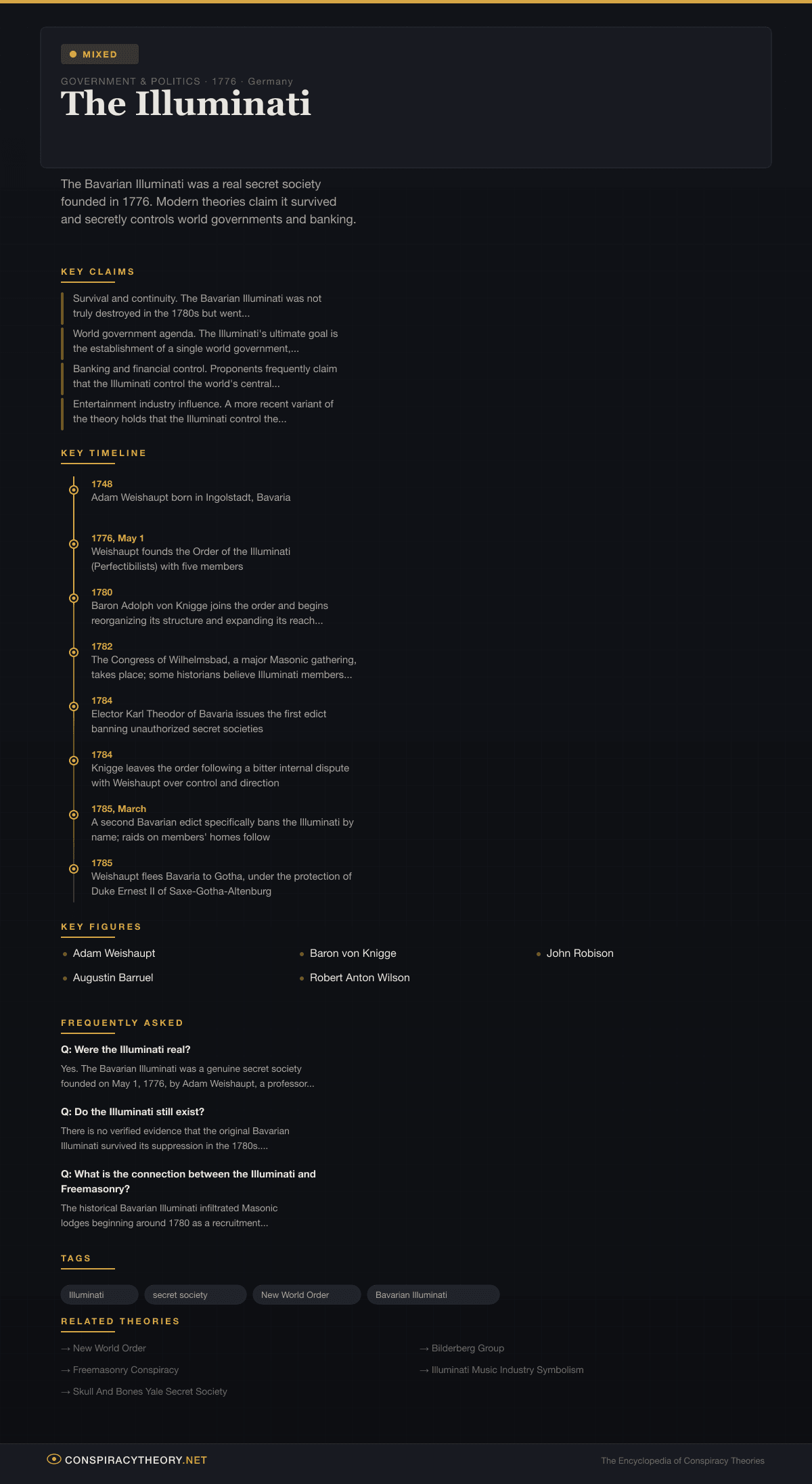
The Illuminati

Overview
The Illuminati is one of the most enduring and widely referenced subjects in the history of conspiracy theories. The term refers to two distinct but often conflated phenomena: the historical Bavarian Illuminati, a real secret society founded on May 1, 1776, in Ingolstadt, Bavaria, by Adam Weishaupt; and the modern conspiracy theory construct, which holds that the Illuminati survived its eighteenth-century suppression and continues to operate as a shadowy cabal controlling world governments, international finance, and popular culture.
The historical organization is well-documented. Weishaupt, a professor of canon law and a former Jesuit student, created the Order of the Illuminati (originally called the Perfectibilists) with the stated goal of promoting Enlightenment ideals: reason, secularism, and the reduction of religious and monarchical authority over public life. The order grew rapidly through the early 1780s, recruited members from the upper echelons of Bavarian society, and infiltrated Masonic lodges to expand its reach. At its peak it counted somewhere between 2,000 and 3,000 members across Bavaria and other parts of Central Europe. The Bavarian government banned the order in 1784-1785, and by 1787 it had effectively ceased to exist as an organization.
The modern conspiracy theory, by contrast, is vast and largely unverifiable. Proponents claim that the Illuminati secretly reformed, absorbed other elite networks, and now orchestrates global events from behind the scenes. This theory has persisted for more than two centuries and has been adapted to fit nearly every era’s anxieties, from the French Revolution to twenty-first-century pop music. The status of these claims is classified as mixed: the historical existence of the Bavarian Illuminati is confirmed fact, but the assertion that the order survived and continues to wield covert global power has no credible evidentiary basis.
Origins & History
The Historical Bavarian Illuminati (1776-1787)
Adam Weishaupt was born on February 6, 1748, in Ingolstadt, a university town in the Electorate of Bavaria. Educated by Jesuits but drawn to Enlightenment philosophy, Weishaupt became the first lay professor of canon law at the University of Ingolstadt. Frustrated by what he perceived as the intellectual stranglehold of the Catholic Church and the conservative Bavarian establishment, he sought to create a secret society dedicated to promoting rationalism and opposing superstition, religious influence over government, and abuses of state power.
On May 1, 1776, Weishaupt founded the Order of the Illuminati with five initial members, all students. The order’s internal structure was modeled on a hierarchical system of degrees, borrowing elements from both Jesuit organization and Masonic ritual. Members adopted classical pseudonyms; Weishaupt took the name “Spartacus,” and the order’s inner circle used codenames for cities and regions.
A pivotal moment in the order’s expansion came in 1780 when Baron Adolph Franz Friedrich Ludwig von Knigge, a prominent Freemason and diplomat, joined the Illuminati. Knigge was a gifted organizer, and he restructured the order’s degree system and oversaw its infiltration of existing Masonic lodges across Germany. This strategy allowed the Illuminati to recruit from an established network of influential men without attracting public attention. Under Knigge’s guidance, the order spread beyond Bavaria into Saxony, Thuringia, Franconia, and other German states, as well as into Austria, Switzerland, and possibly parts of Italy and France.
At its height around 1784, the order included notable members such as Johann Wolfgang von Goethe (though the extent of his involvement is debated), Duke Ernest II of Saxe-Gotha-Altenburg, and several other aristocrats, clergymen, and intellectuals. Internal documents reveal an organization preoccupied with self-improvement, mutual observation, and the gradual reform of society from within.
Suppression and Dissolution
The Bavarian Illuminati’s downfall was swift. In 1784, Elector Karl Theodor of Bavaria, alarmed by reports of secret societies undermining religious and political authority, issued his first edict banning all unauthorized secret organizations. A second, more specific ban targeting the Illuminati by name followed in March 1785. Government raids on the homes of prominent members — including the diplomat Xavier von Zwack — yielded extensive internal correspondence, membership lists, and organizational documents.
These seized papers were published by the Bavarian government in 1787 under the title Einige Originalschriften des Illuminatenordens (“Some Original Writings of the Order of the Illuminati”). The documents revealed the order’s structure, recruitment methods, and internal disputes, but also its relatively modest scope and largely philosophical aims. Weishaupt fled Bavaria and took refuge under the protection of Duke Ernest II of Saxe-Gotha-Altenburg, where he lived until his death in 1830. He spent his later years writing defenses of the order and his own intentions.
By the late 1780s, the Bavarian Illuminati had effectively ceased to function as an organization. No credible evidence has emerged of a continuous organizational structure surviving the suppression.
Revival in Conspiracy Lore
Within a decade of the order’s dissolution, however, the Illuminati entered the realm of conspiracy theory. Two authors were primarily responsible for this transformation.
In 1797, the French Jesuit priest Augustin Barruel published Memoirs Illustrating the History of Jacobinism, a four-volume work arguing that the French Revolution was the deliberate product of a conspiracy involving the Illuminati, Freemasons, and other secret societies. Barruel claimed that the philosophes of the Enlightenment had deliberately engineered the overthrow of the French monarchy and the Catholic Church, and that the Illuminati were the hidden directors of this plot.
That same year, the Scottish physicist and mathematician John Robison published Proofs of a Conspiracy Against All the Religions and Governments of Europe, making similar claims. Robison, himself a Mason, argued that Continental Freemasonry had been corrupted by Illuminati infiltration and that the resulting conspiracy was responsible for revolutionary upheaval across Europe.
These two works established the template for virtually all subsequent Illuminati conspiracy theories: a secret, elite group operating through front organizations and covert influence, pursuing a long-term plan to overthrow existing institutions and establish a new form of global governance. The basic structure of this narrative has been adapted and reapplied to different targets and contexts for over two centuries.
In the United States, concern about the Illuminati reached a brief peak during the late 1790s, when several New England clergymen, including Jedidiah Morse, preached sermons warning of Illuminati infiltration. These fears subsided quickly, but they represent one of the earliest examples of the Illuminati conspiracy theory taking root in American public discourse.
Throughout the nineteenth and twentieth centuries, the Illuminati conspiracy theory was periodically revived, often merged with antisemitic narratives (such as the fabricated Protocols of the Elders of Zion), anti-Masonic sentiment, and broader fears about secret cabals controlling world events. The theory gained renewed momentum in the second half of the twentieth century, fueled by the counterculture movement, the rise of alternative media, and a series of influential books and cultural works.
Key Claims
Modern Illuminati conspiracy theories encompass a wide range of specific assertions. The following are the most prominent claims made by proponents:
-
Survival and continuity. The Bavarian Illuminati was not truly destroyed in the 1780s but went underground, reconstituting itself under new names and through infiltration of other organizations. Proponents often claim the order simply absorbed into Freemasonry, the Skull and Bones society at Yale, the Bilderberg Group, the Council on Foreign Relations, the Trilateral Commission, or other elite networks.
-
World government agenda. The Illuminati’s ultimate goal is the establishment of a single world government, often referred to as the “New World Order.” This government would abolish national sovereignty, centralize political authority, and control the global population through surveillance, economic manipulation, and social engineering.
-
Banking and financial control. Proponents frequently claim that the Illuminati control the world’s central banking systems, including the Federal Reserve, the Bank of England, and the European Central Bank. Prominent banking families, particularly the Rothschilds, are often named as key players. These claims frequently overlap with and draw upon older antisemitic conspiracy tropes.
-
Entertainment industry influence. A more recent variant of the theory holds that the Illuminati control the global entertainment industry, particularly the music business. Proponents point to alleged symbolism in music videos, award show performances, and album artwork as evidence. Artists such as Jay-Z, Beyonce, Rihanna, Lady Gaga, and Kanye West have all been subject to these accusations. Specific symbols cited include the “Eye of Providence” (the “all-seeing eye”), pyramids, triangular hand gestures, and certain numerical patterns.
-
Symbolic communication. A central tenet of the modern theory is that the Illuminati embed hidden symbols in architecture, currency, corporate logos, and media. The most commonly cited example is the Eye of Providence on the reverse of the Great Seal of the United States (and on the U.S. one-dollar bill). Proponents argue this symbol was placed there by Illuminati-affiliated Founding Fathers as a marker of their influence.
-
Orchestration of historical events. Various proponents have attributed a wide range of historical events to Illuminati planning, including the French Revolution, the American Revolution, both World Wars, the assassination of John F. Kennedy, the September 11 attacks, and numerous economic crises. The specific events attributed to the Illuminati vary widely among different authors and communities.
-
Population control. Some versions of the theory claim the Illuminati pursue deliberate depopulation through engineered pandemics, control of food supplies, and promotion of social policies intended to reduce birth rates.
Evidence
Evaluating the Illuminati conspiracy theory requires distinguishing between the well-documented historical record and the largely speculative modern claims.
Historical Evidence (Confirmed)
The existence and activities of the Bavarian Illuminati are supported by a substantial body of primary sources:
-
Seized documents. The Bavarian government’s confiscation and publication of internal Illuminati correspondence and organizational documents in the 1780s provides a detailed record of the order’s structure, membership, rituals, and aims. These documents are held in Bavarian state archives and have been studied by academic historians.
-
Published defenses. Adam Weishaupt himself wrote several published works defending the Illuminati and clarifying its objectives after fleeing Bavaria, including Apologie der Illuminaten (1786) and Das verbesserte System der Illuminaten (1787).
-
Contemporary accounts. Numerous contemporary observers, both sympathetic and hostile, documented the order’s existence and activities.
-
Academic scholarship. Modern historians including Reinhard Markner, Monika Neugebauer-Wolk, and Hermann Schuttler have conducted extensive research on the original Illuminati using primary archival sources.
Modern Conspiracy Claims (Unsubstantiated)
The modern claim that the Illuminati survived and continues to operate as a global conspiracy lacks comparable evidence:
-
No organizational continuity. No documents, membership records, financial records, or other tangible evidence demonstrating a continuous Illuminati organization from the 1780s to the present has ever been produced or discovered.
-
Symbolic arguments. Claims based on the appearance of the Eye of Providence on the U.S. dollar or in corporate logos rely on circumstantial interpretation. Historians note that the Eye of Providence was a common Christian and Enlightenment symbol long before the Illuminati adopted it, and that its placement on the Great Seal was proposed by non-Illuminati figures. The symbol was not even associated with the Illuminati in its original historical context.
-
Guilt by association. Much of the modern theory rests on identifying members of elite organizations and inferring a hidden conspiratorial agenda. The existence of groups like the Bilderberg Group, the Bohemian Grove, or Skull and Bones is not in dispute, but the claim that these organizations serve as fronts for a surviving Illuminati order is not supported by direct evidence.
-
Unfalsifiability. Critics point out that Illuminati conspiracy theories are structured in ways that resist disproof: the absence of evidence is itself interpreted as evidence of the conspiracy’s success in maintaining secrecy, and any contradicting evidence can be dismissed as disinformation.
-
Source quality. Many of the foundational texts of the modern Illuminati conspiracy theory, including Nesta Webster’s Secret Societies and Subversive Movements (1924) and William Guy Carr’s Pawns in the Game (1958), have been criticized by historians for selective sourcing, unsubstantiated assertions, and, in some cases, reliance on fabricated documents such as the Protocols of the Elders of Zion.
The Illuminati in Popular Culture
The Illuminati occupy a unique position in popular culture, simultaneously serving as the subject of serious conspiracy belief and as a source of irony, satire, and entertainment.
The most influential fictional treatment is Robert Anton Wilson and Robert Shea’s The Illuminatus! Trilogy (1975), a satirical novel series that deliberately blends real Illuminati history with absurdist fiction, parody of conspiracy thinking, and countercultural philosophy. Wilson and Shea’s work is widely credited with introducing the Illuminati to the American counterculture and, paradoxically, with both mocking and popularizing conspiracy theories about the group. Wilson later wrote extensively about the psychology of conspiracy belief and the Illuminati mythos in works such as Cosmic Trigger (1977) and Everything Is Under Control (1998).
Dan Brown’s 2000 novel Angels & Demons (and its 2009 film adaptation starring Tom Hanks) brought the Illuminati to a mass global audience, depicting a fictionalized version of the order in conflict with the Catholic Church. While Brown’s narrative is entirely fictional, the novel’s enormous commercial success introduced millions of readers to the basic historical outline of the Bavarian Illuminati.
The Illuminati have become a pervasive reference point in music, particularly hip-hop. References to Illuminati membership, symbolism, and influence are common in lyrics, music videos, and interviews. Jay-Z’s Roc-A-Fella Records diamond hand gesture, which resembles a triangle, has been repeatedly cited as an alleged Illuminati symbol. Beyonce, Rihanna, Lady Gaga, and numerous other artists have faced similar accusations, generally based on visual imagery in performances and videos. Most of these artists have publicly denied any Illuminati affiliation; Jay-Z has addressed the rumors directly in several songs.
The card game Illuminati (1982), designed by Steve Jackson, is a satirical strategy game based on conspiracy theories. It later spawned the collectible card game Illuminati: New World Order (1994). The game has itself become the subject of conspiracy theories, with proponents claiming that certain cards “predicted” real-world events.
Video games, television shows, and films regularly reference or incorporate the Illuminati, including the Deus Ex franchise, Assassin’s Creed, the television series The X-Files, and the animated show Gravity Falls, among many others. The “Illuminati confirmed” meme, which humorously “proves” Illuminati involvement in trivial everyday occurrences using triangle shapes and the number three, became one of the internet’s most widespread ironic memes during the 2010s.
Cultural Impact
The Illuminati conspiracy theory has had significant effects on public discourse, political rhetoric, and social dynamics.
Political mobilization. References to the Illuminati and related “New World Order” theories have been used to mobilize political movements, particularly on the populist right. Pat Robertson’s 1991 book The New World Order drew on Illuminati conspiracy narratives to argue that a secular elite was working to undermine American sovereignty and Christian values. These themes have continued to resonate in various political movements through the present day.
Erosion of institutional trust. The widespread circulation of Illuminati theories contributes to broader patterns of institutional distrust. When any concentration of wealth or political power can be attributed to a hidden conspiracy, it becomes more difficult to engage with legitimate concerns about inequality, corruption, or democratic accountability on their merits.
Antisemitic overlap. Historians and anti-hate researchers have documented significant overlap between Illuminati conspiracy theories and antisemitic narratives. The frequent identification of Jewish banking families (particularly the Rothschilds) as Illuminati leaders, and the incorporation of tropes from the fabricated Protocols of the Elders of Zion, means that Illuminati theories sometimes serve as a vehicle for antisemitic ideas, even when individual proponents may not consciously intend this.
Democratization of conspiracy thinking. The internet and social media have transformed the Illuminati from a niche conspiracy topic into a mainstream cultural reference. The theory’s simplicity and adaptability make it accessible to wide audiences, and its presence in entertainment and meme culture means that many people encounter Illuminati narratives without necessarily realizing their origins in centuries-old conspiratorial traditions.
Academic and journalistic interest. The Illuminati have become a case study in the academic study of conspiracy theories. Scholars such as Michael Barkun (A Culture of Conspiracy, 2003), Mark Fenster (Conspiracy Theories: Secrecy and Power in American Culture, 1999), and Jesse Walker (The United States of Paranoia, 2013) have examined how Illuminati narratives function, spread, and evolve.
Timeline
- 1748 — Adam Weishaupt born in Ingolstadt, Bavaria
- 1776, May 1 — Weishaupt founds the Order of the Illuminati (Perfectibilists) with five members
- 1780 — Baron Adolph von Knigge joins the order and begins reorganizing its structure and expanding its reach through Masonic lodges
- 1782 — The Congress of Wilhelmsbad, a major Masonic gathering, takes place; some historians believe Illuminati members used the event to recruit, though the extent of their influence is debated
- 1784 — Elector Karl Theodor of Bavaria issues the first edict banning unauthorized secret societies
- 1784 — Knigge leaves the order following a bitter internal dispute with Weishaupt over control and direction
- 1785, March — A second Bavarian edict specifically bans the Illuminati by name; raids on members’ homes follow
- 1785 — Weishaupt flees Bavaria to Gotha, under the protection of Duke Ernest II of Saxe-Gotha-Altenburg
- 1787 — The Bavarian government publishes confiscated Illuminati documents, revealing the order’s internal workings
- 1797 — Augustin Barruel publishes Memoirs Illustrating the History of Jacobinism, blaming the Illuminati for the French Revolution
- 1797 — John Robison publishes Proofs of a Conspiracy, making similar claims about Illuminati involvement in European revolution
- 1798 — Jedidiah Morse delivers sermons in New England warning of Illuminati subversion in America
- 1830 — Adam Weishaupt dies in Gotha at the age of 82
- 1903 — The fabricated Protocols of the Elders of Zion first published in Russia; later editions incorporate Illuminati themes
- 1924 — Nesta Webster publishes Secret Societies and Subversive Movements, reviving Illuminati conspiracy narratives for a twentieth-century audience
- 1958 — William Guy Carr publishes Pawns in the Game, linking the Illuminati to an alleged centuries-long plan for world domination
- 1967 — The Discordian text Principia Discordia incorporates Illuminati references, planting seeds for the counterculture’s engagement with the topic
- 1975 — Robert Anton Wilson and Robert Shea publish The Illuminatus! Trilogy, blending Illuminati lore with satirical fiction and becoming a countercultural landmark
- 1991 — Pat Robertson publishes The New World Order, incorporating Illuminati conspiracy themes into mainstream American political discourse
- 2000 — Dan Brown publishes Angels & Demons, bringing a fictionalized Illuminati to a global mass audience
- 2009 — Angels & Demons film adaptation released, further popularizing Illuminati themes
- 2010s — “Illuminati confirmed” becomes a widespread internet meme; Illuminati accusations against music industry figures peak on social media
- 2020s — Illuminati conspiracy theories continue to circulate, often merged with QAnon, Great Reset, and New World Order narratives in online communities
Sources & Further Reading
- Barruel, Augustin. Memoirs Illustrating the History of Jacobinism. 4 vols. London, 1797-1798
- Robison, John. Proofs of a Conspiracy Against All the Religions and Governments of Europe. Edinburgh, 1797
- Weishaupt, Adam. Apologie der Illuminaten. Frankfurt and Leipzig, 1786
- Stauffer, Vernon. New England and the Bavarian Illuminati. Columbia University Press, 1918
- Wilson, Robert Anton, and Robert Shea. The Illuminatus! Trilogy. Dell Publishing, 1975
- Webster, Nesta. Secret Societies and Subversive Movements. Boswell Publishing, 1924
- Barkun, Michael. A Culture of Conspiracy: Apocalyptic Visions in Contemporary America. University of California Press, 2003
- Melanson, Terry. Perfectibilists: The 18th Century Bavarian Order of the Illuminati. Trine Day, 2009
- Markner, Reinhard, Monika Neugebauer-Wolk, and Hermann Schuttler, eds. Die Korrespondenz des Illuminatenordens. Max Niemeyer Verlag, 2005
- Fenster, Mark. Conspiracy Theories: Secrecy and Power in American Culture. University of Minnesota Press, 1999
- Walker, Jesse. The United States of Paranoia: A Conspiracy Theory. Harper, 2013
- Pipes, Daniel. Conspiracy: How the Paranoid Style Flourishes and Where It Comes From. Free Press, 1997
- Robertson, Pat. The New World Order. Word Publishing, 1991
- Brown, Dan. Angels & Demons. Pocket Books, 2000
Frequently Asked Questions
Were the Illuminati real?
Do the Illuminati still exist?
What is the connection between the Illuminati and Freemasonry?
Infographic
Share this visual summary. Right-click to save.