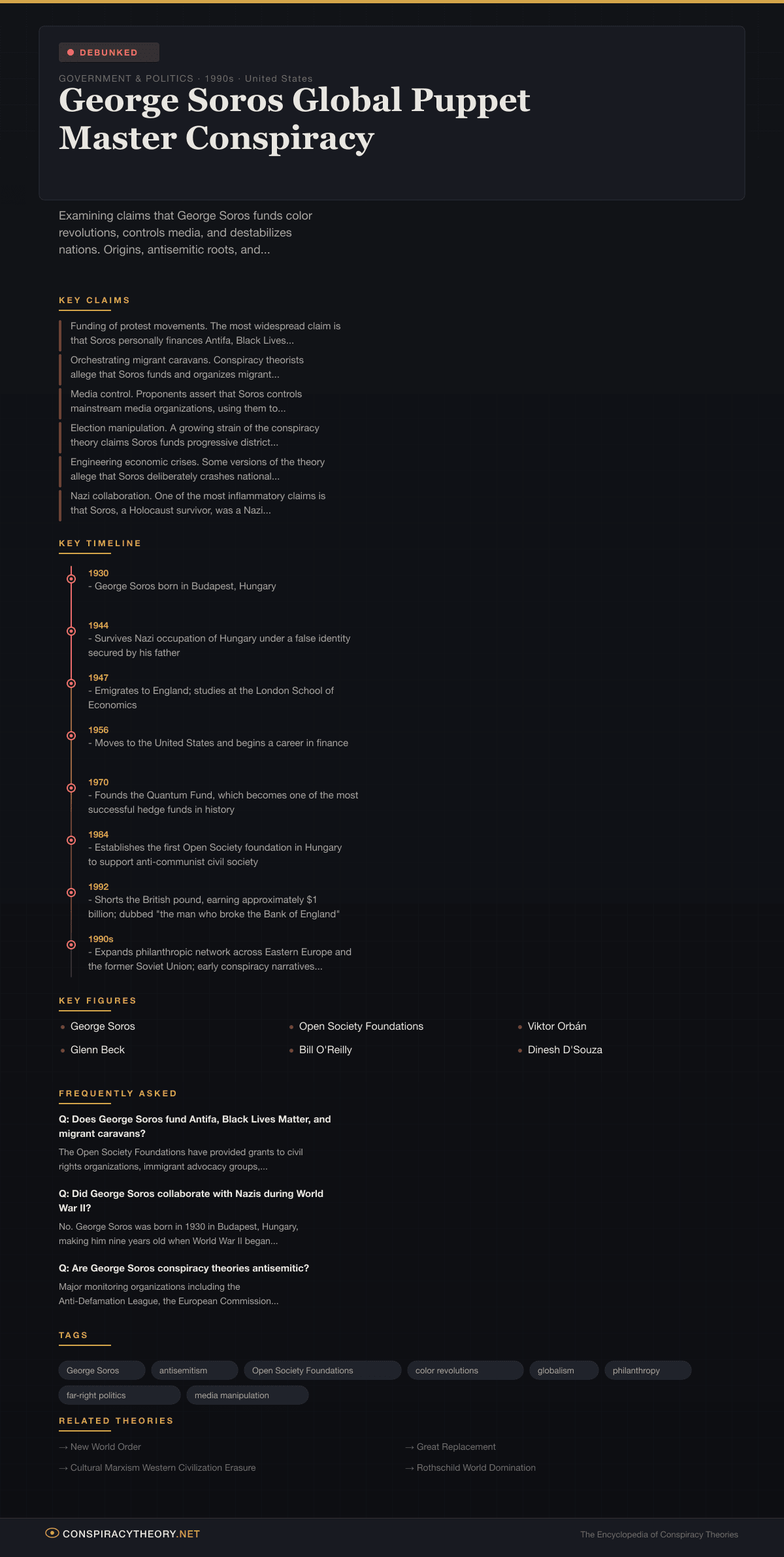
George Soros Global Puppet Master Conspiracy
Overview
The George Soros conspiracy theory is a sprawling network of claims asserting that Hungarian-American billionaire investor and philanthropist George Soros secretly funds and orchestrates political unrest, social movements, media narratives, and regime changes around the world in pursuit of a globalist agenda. Specific allegations include that Soros finances Antifa, Black Lives Matter, migrant caravans, and so-called “color revolutions” in Eastern Europe and the former Soviet Union; that he controls mainstream media organizations; that the Open Society Foundations — his philanthropic network — functions as a front for political destabilization; and that his ultimate goal is the destruction of national sovereignty in favor of a borderless, centrally managed global order.
The historical reality is substantially different. George Soros is a real billionaire whose philanthropic activities are extensive and well-documented. The Open Society Foundations have distributed more than $32 billion since their founding in 1984, funding programs in education, public health, democratic governance, media independence, and civil liberties across more than 120 countries. These activities are conducted openly, with publicly available financial disclosures, annual reports, and stated organizational objectives. Soros has also been a prominent political donor in the United States, supporting Democratic candidates and progressive causes — a fact that is a matter of public record, not a secret conspiracy.
The conspiracy theories surrounding Soros are classified as debunked. They rely on distortions of his philanthropic record, fabricated claims about his wartime childhood, unfounded assertions of puppet-master control over global events, and narratives that have been thoroughly investigated and rejected by mainstream journalists, fact-checkers, and academic researchers. The theories also carry a profound antisemitic dimension: they draw directly on centuries-old tropes about Jewish financial manipulation, secret control, and civilizational subversion, and they have been explicitly identified as antisemitic by the Anti-Defamation League, the European Commission against Racism and Intolerance, and numerous scholars of hate speech and extremism.
Origins & History
George Soros: The Historical Figure
George Soros was born Schwartz Gyorgy in Budapest, Hungary, on August 12, 1930, to a non-observant Jewish family. His father, Tivadar Schwartz — who later changed the family name to Soros — was a lawyer and Esperanto enthusiast who had survived a Russian prisoner-of-war camp during World War I. When Nazi Germany occupied Hungary in March 1944, Tivadar secured forged identity documents for family members and others, an act credited with saving multiple lives. The young George Soros survived the occupation under a false identity as the godson of a Hungarian government official.
After the war, Soros emigrated to England in 1947, studied at the London School of Economics under the philosopher Karl Popper — whose concept of the “open society” would later inspire Soros’s philanthropic mission — and began a career in finance. He moved to the United States in 1956 and eventually founded the Quantum Fund, which became one of the most successful hedge funds in history. Soros’s most famous trade came on September 16, 1992, when he shorted the British pound ahead of the currency’s exit from the European Exchange Rate Mechanism, reportedly earning approximately $1 billion in a single day. This episode earned him the nickname “the man who broke the Bank of England.”
Beginning in the 1980s, Soros turned increasingly to philanthropy, funding anti-communist dissident movements in Eastern Europe through what would become the Open Society Foundations. After the fall of the Soviet Union, he expanded his philanthropic network across the former Eastern Bloc, Central Asia, and eventually the world, supporting programs aligned with democratic governance, press freedom, public health, education, and human rights.
Early Political Opposition in Eastern Europe
The origins of the Soros conspiracy theory are closely tied to the political landscape of post-communist Eastern Europe. During the 1990s and 2000s, Soros’s philanthropic activities in the region — funding independent media, civil society organizations, election monitoring, and anticorruption initiatives — placed him in direct opposition to authoritarian-leaning political figures who viewed his work as foreign interference in domestic affairs.
The most consequential political opponent to emerge was Viktor Orban, the Prime Minister of Hungary. Orban had himself been a beneficiary of Soros’s philanthropy: he received a scholarship funded by the Soros Foundation to study at Oxford University in 1989. However, as Orban’s political trajectory moved from liberal to conservative to nationalist-populist, his relationship with Soros transformed into outright hostility. Beginning around 2015, the Orban government launched a sustained public campaign against Soros, deploying government-funded billboards, media campaigns, and legislative initiatives targeting the Open Society Foundations and Soros-funded organizations operating in Hungary. The Hungarian government’s rhetoric portrayed Soros as a shadowy foreign manipulator seeking to undermine Hungarian sovereignty, flood the country with migrants, and destroy traditional Christian European culture.
This state-sponsored anti-Soros campaign provided a template that was adopted and adapted by political figures in other countries, including Russia, Poland, Israel, Turkey, and the United States.
The “Color Revolutions” Narrative
A central pillar of the Soros conspiracy theory is the claim that he personally engineered the “color revolutions” — the series of peaceful pro-democracy movements that swept through parts of the former Soviet Union and the Balkans in the early 2000s. These include the Rose Revolution in Georgia (2003), the Orange Revolution in Ukraine (2004), and the Tulip Revolution in Kyrgyzstan (2005).
The Open Society Foundations did provide funding to civil society organizations in these countries, including election monitoring groups, independent media outlets, and civic education programs. Russian state media and allied political figures seized on this funding to construct a narrative in which the revolutions were not genuine popular movements but were instead orchestrated by Soros as part of a Western-backed campaign to encircle and weaken Russia. This narrative served Russian geopolitical interests by delegitimizing democratic movements in countries Moscow considered within its sphere of influence.
Independent analyses of the color revolutions by political scientists and regional specialists have found that while Western-funded civil society organizations played supporting roles, the movements were driven by genuine domestic grievances — electoral fraud, corruption, authoritarian governance — and involved mass participation far beyond the capacity of any single philanthropist to manufacture. The claim that Soros single-handedly engineered these revolutions overstates his influence by orders of magnitude and erases the agency of millions of citizens who participated in the movements.
Amplification in American Politics
The Soros conspiracy theory entered mainstream American political discourse primarily through right-wing media in the late 2000s and 2010s. Fox News host Glenn Beck devoted extensive segments to Soros in 2010, describing him as a “puppet master” who was orchestrating the decline of the United States. Beck’s televised presentations, which included diagrams connecting Soros to various organizations and political movements, helped popularize the conspiracy framework for an American audience.
The narrative accelerated during the 2016 U.S. presidential election cycle and its aftermath. Soros became a fixture of far-right social media discourse, blamed for funding protests against the Trump administration, organizing migrant caravans to the U.S.-Mexico border, bankrolling progressive district attorney candidates, rigging voting machines, and controlling mainstream media coverage. The “Soros-funded” label became a ubiquitous tag applied to virtually any organization, movement, or event opposed by right-wing commentators.
Key Claims
Modern Soros conspiracy theories encompass a range of specific assertions, most of which have been investigated and debunked by journalists, fact-checkers, and researchers:
-
Funding of protest movements. The most widespread claim is that Soros personally finances Antifa, Black Lives Matter, and other protest movements, paying individual protesters to attend demonstrations. This claim has been repeatedly debunked. Antifa is a decentralized movement with no formal organizational structure, membership rolls, or central funding mechanism. While the Open Society Foundations have provided grants to organizations involved in social justice and civil rights work, the claim that Soros pays individual protesters is without evidence and has been rejected by every major fact-checking organization that has investigated it.
-
Orchestrating migrant caravans. Conspiracy theorists allege that Soros funds and organizes migrant caravans from Central America to the United States as part of a plan to destabilize American society or alter its demographic composition. This claim, which intersects with the “Great Replacement” conspiracy theory, has no evidentiary basis. Migration patterns from Central America are driven by documented factors including gang violence, economic deprivation, natural disasters, and political instability. The Open Society Foundations have funded immigrant rights organizations, but funding legal aid and advocacy for migrants is categorically different from orchestrating mass migration.
-
Media control. Proponents assert that Soros controls mainstream media organizations, using them to suppress unfavorable coverage and promote his political agenda. While Soros has made media investments and the Open Society Foundations have funded media development programs — particularly independent journalism in countries with restricted press freedom — the claim of comprehensive media control is false. Major media corporations are publicly traded companies owned by diverse shareholders, and their editorial operations are not directed by Soros.
-
Election manipulation. A growing strain of the conspiracy theory claims Soros funds progressive district attorney candidates in American cities and influences election outcomes through donations to voting-related organizations. Soros has indeed donated to political action committees supporting certain district attorney candidates — this is a matter of public campaign finance records. However, the conspiratorial version transforms legal political donations into evidence of a sinister scheme to undermine the justice system, ignoring that political donations are a standard feature of the American electoral process and that Soros’s contributions, while substantial, represent a small fraction of overall political spending.
-
Engineering economic crises. Some versions of the theory allege that Soros deliberately crashes national currencies and economies for personal profit and political leverage. This claim draws on his 1992 shorting of the British pound but extends it into a pattern of deliberate economic sabotage. While Soros’s currency trades were aggressive and controversial, they operated within the legal framework of currency markets. Economists who have analyzed the 1992 pound crisis attribute the currency’s collapse to fundamental macroeconomic imbalances, not to the actions of a single trader.
-
Nazi collaboration. One of the most inflammatory claims is that Soros, a Holocaust survivor, was a Nazi collaborator during World War II. This allegation distorts the circumstances of his childhood survival in Nazi-occupied Hungary. Soros was thirteen and fourteen years old during the German occupation, living under a false identity arranged by his father. The accusation weaponizes a child’s survival experience during genocide.
-
Open Society as a destabilization front. Conspiracy theorists characterize the Open Society Foundations not as a philanthropic organization but as a covert mechanism for political destabilization and regime change. While the foundations’ programs do promote democratic governance, civil liberties, and government accountability — goals that place them in opposition to authoritarian regimes — their activities are conducted openly, documented in public reports, and subject to the regulatory requirements of the jurisdictions in which they operate.
Evidence and Debunking
What Is Documented
The factual record regarding George Soros and the Open Society Foundations is extensive and publicly available:
- Soros is one of the wealthiest people in the world, with a net worth that has fluctuated in the range of $7 billion to $8 billion in recent years, having transferred approximately $32 billion to the Open Society Foundations.
- The Open Society Foundations operate in more than 120 countries and are one of the largest private philanthropic networks in the world. Their grantmaking is documented in annual reports and tax filings available to the public.
- Soros is a significant political donor in the United States, contributing to Democratic candidates and progressive causes. These donations are recorded in public campaign finance databases maintained by the Federal Election Commission.
- Soros’s investment activities, including the 1992 pound trade, are documented and have been the subject of extensive financial journalism and academic analysis.
- The Open Society Foundations have funded civil society organizations in Eastern Europe, the former Soviet Union, and other regions, including organizations involved in election monitoring, media development, and anticorruption efforts.
What Is Not Supported
The conspiratorial claims about Soros fail on multiple evidentiary grounds:
-
Scale and coordination. The theories attribute to Soros a level of control over global events — simultaneous orchestration of protest movements, media narratives, migration patterns, electoral outcomes, and currency markets across dozens of countries — that exceeds the capacity of any individual or organization. The Open Society Foundations, while large, employ a staff and grantmaking apparatus that is orders of magnitude smaller than what would be required to execute the conspiracies attributed to them.
-
Conflation of philanthropy with conspiracy. The theories treat any grant from the Open Society Foundations to any organization that is subsequently involved in any controversial activity as evidence of Soros’s personal orchestration of that activity. This reasoning would implicate every major foundation — Ford, Rockefeller, Gates, Koch — in conspiracies based on the downstream activities of their grantees.
-
Erasure of agency. The Soros conspiracy framework denies agency to the millions of people who participate in social movements, protest actions, democratic revolutions, and migration. It reduces complex social phenomena with deep structural causes to the machinations of a single wealthy individual.
-
Fabricated and distorted sources. Key claims in the conspiracy narrative, particularly the Nazi collaboration allegation, rely on distortions of documented historical facts. The claim has been debunked by historians of the Holocaust and by journalists who have investigated Soros’s wartime childhood.
-
Unfalsifiability. As with many conspiracy theories, Soros conspiracy claims are structured to resist disproof. The absence of evidence is interpreted as proof of Soros’s power to suppress information, and any contradicting evidence is dismissed as part of the cover-up or attributed to Soros-controlled media.
The Antisemitic Dimension
The antisemitic character of the Soros conspiracy theory is one of its most extensively documented and analyzed features. Scholars of antisemitism have identified the theory as a contemporary manifestation of centuries-old antisemitic tropes, updated with modern names and institutions but structurally identical to their historical predecessors.
The core narrative — a wealthy Jewish financier secretly manipulating governments, controlling media, engineering social chaos, funding subversive movements, and working toward the dissolution of national sovereignty in favor of a globalist order — maps directly onto the template established by the Protocols of the Elders of Zion and other foundational antisemitic texts. The imagery used in anti-Soros campaigns frequently employs visual tropes associated with historical antisemitic propaganda: Soros depicted as a puppet master pulling strings, as an octopus with tentacles wrapped around the globe, or as a shadowy figure lurking behind political events.
The Hungarian government’s anti-Soros campaign was explicitly criticized by Jewish organizations and European human rights bodies for its antisemitic overtones. The government-funded billboard campaign depicting Soros’s face alongside slogans about “not letting Soros have the last laugh” drew comparisons to Nazi-era propaganda posters. Israeli Ambassador to Hungary Yossi Amrani issued a statement in 2017 noting that the campaign “evokes sad memories but also sows hatred and fear,” though the Israeli government later complicated the picture by partially aligning with the Orban government’s criticism of Soros.
In the United States, the Soros conspiracy theory has been linked to acts of violence. In October 2018, pipe bombs were mailed to prominent Democratic political figures and to CNN; the first bomb was sent to Soros’s home in Katonah, New York. The perpetrator, Cesar Sayoc, was a consumer of far-right media and conspiracy theories about Soros. Days later, a gunman killed eleven people at the Tree of Life synagogue in Pittsburgh, Pennsylvania — the deadliest antisemitic attack in American history. The shooter had posted extensively about Soros conspiracy theories on social media, specifically the claim that Soros was funding a migrant “invasion” through the Hebrew Immigrant Aid Society.
These events underscore that the Soros conspiracy theory is not merely an abstract political narrative but has real-world consequences in the form of violence directed at Jewish individuals and institutions.
Cultural Impact
Political Weaponization
The Soros conspiracy theory has become one of the most widely deployed political narratives in the world. It has been used by political leaders and movements across multiple continents to delegitimize civil society, discredit opposition movements, justify restrictions on NGOs, and rally nationalist sentiment. Governments in Hungary, Russia, Turkey, and several other countries have passed legislation restricting the operations of foreign-funded NGOs, with Soros and the Open Society Foundations frequently cited as the explicit or implicit targets.
In the United States, “Soros-funded” has become a standard epithet in conservative media, applied to organizations ranging from the American Civil Liberties Union to local school boards. The term functions as a shorthand that simultaneously delegitimizes the target organization and invokes the broader conspiracy framework without requiring explicit articulation of its claims.
Online Amplification
Social media has been the primary vector for the spread of the Soros conspiracy theory in the twenty-first century. The theory circulates across all major platforms and in multiple languages. Research by the Oxford Internet Institute, the Institute for Strategic Dialogue, and other organizations studying online disinformation has documented coordinated campaigns to amplify anti-Soros content, including campaigns originating from Russian-linked accounts and from domestic political actors in multiple countries.
The hashtag #StopSoros, originally associated with the Hungarian government’s campaign, has been adopted internationally as a rallying point for anti-Soros content. Algorithms on major social media platforms have been documented directing users from mainstream political content to increasingly conspiratorial Soros-related material, a radicalization pathway that researchers have termed the “rabbit hole” effect.
Impact on Philanthropy and Civil Society
The Soros conspiracy theory has had measurable effects on the operations of the Open Society Foundations and the broader philanthropic sector. The foundations closed their Budapest office in 2018 and relocated to Berlin in response to the Hungarian government’s legislative campaign against them. In several other countries, organizations receiving Soros-affiliated funding have faced governmental pressure, social stigma, or threats of violence. The broader chilling effect on international philanthropy — the demonstration that funding civil society can make a donor the target of a global conspiracy campaign — has been noted by observers of the philanthropic sector as a concerning development.
Timeline
- 1930 — George Soros born in Budapest, Hungary
- 1944 — Survives Nazi occupation of Hungary under a false identity secured by his father
- 1947 — Emigrates to England; studies at the London School of Economics
- 1956 — Moves to the United States and begins a career in finance
- 1970 — Founds the Quantum Fund, which becomes one of the most successful hedge funds in history
- 1984 — Establishes the first Open Society foundation in Hungary to support anti-communist civil society
- 1992 — Shorts the British pound, earning approximately $1 billion; dubbed “the man who broke the Bank of England”
- 1990s — Expands philanthropic network across Eastern Europe and the former Soviet Union; early conspiracy narratives emerge in countries where his foundations operate
- 2003-2005 — Color revolutions in Georgia, Ukraine, and Kyrgyzstan; Russian and allied media blame Soros for engineering the movements
- 2010 — Glenn Beck devotes extensive Fox News segments to Soros as a “puppet master,” popularizing the conspiracy theory for American audiences
- 2015-2018 — Hungarian government launches state-sponsored anti-Soros campaign with billboards, legislation, and media campaigns
- 2017 — The “Stop Soros” legislative package introduced in Hungary, targeting NGOs receiving foreign funding
- 2018 — Pipe bomb mailed to Soros’s home in October; Open Society Foundations close Budapest office and relocate to Berlin
- 2018 — Tree of Life synagogue shooting in Pittsburgh; the perpetrator had posted Soros conspiracy theories on social media
- 2020s — Soros conspiracy theories become a staple of global far-right discourse, applied to COVID-19 pandemic responses, racial justice protests, immigration debates, and election integrity disputes
Sources & Further Reading
- Finkel, Jenna, and Steven Feldstein. “The Soros Conspiracy Theory and Its Effects on Civil Society.” Carnegie Endowment for International Peace, 2019
- Mayer, Jane. “The Money Man: Can George Soros’s Millions Insure the Defeat of President Bush?” The New Yorker, October 18, 2004
- Soros, George. The Age of Fallibility: Consequences of the War on Terror. PublicAffairs, 2006
- Soros, George. In Defense of Open Society. PublicAffairs, 2019
- Kaufmann, Eric. Whiteshift: Populism, Immigration, and the Future of White Majorities. Abrams Press, 2019
- Anti-Defamation League. “Antisemitism and the Soros Conspiracy Theory.” ADL, 2018
- European Commission against Racism and Intolerance. ECRI Report on Hungary (Fifth Monitoring Cycle). Council of Europe, 2015
- Lendvai, Paul. Orbán: Europe’s New Strongman. Oxford University Press, 2017
- Tucker, Joshua A. “Enough! Electoral Fraud, Collective Action Problems, and Post-Communist Colored Revolutions.” Perspectives on Politics 5, no. 3 (2007)
- Beauchamp, Zack. “George Soros Conspiracy Theories Are a New, Virulent Form of an Old Antisemitic Tradition.” Vox, October 25, 2018
- Institute for Strategic Dialogue. “The Weaponisation of the Soros Conspiracy Theory.” ISD, 2019
- Barkun, Michael. A Culture of Conspiracy: Apocalyptic Visions in Contemporary America. University of California Press, 2003
Related Theories
- New World Order — Soros is frequently named as a key architect of an alleged globalist government
- The Great Replacement — the claim that Soros funds mass immigration to alter Western demographics
- Cultural Marxism — overlapping narrative that progressive institutions are subverting Western civilization
- Antifa Conspiracy — the claim that Antifa is a centrally organized and funded domestic terrorist group
- Rothschild Family World Domination Theory — predecessor antisemitic conspiracy theory about Jewish financial manipulation
Frequently Asked Questions
Does George Soros fund Antifa, Black Lives Matter, and migrant caravans?
Did George Soros collaborate with Nazis during World War II?
Are George Soros conspiracy theories antisemitic?
Infographic
Share this visual summary. Right-click to save.