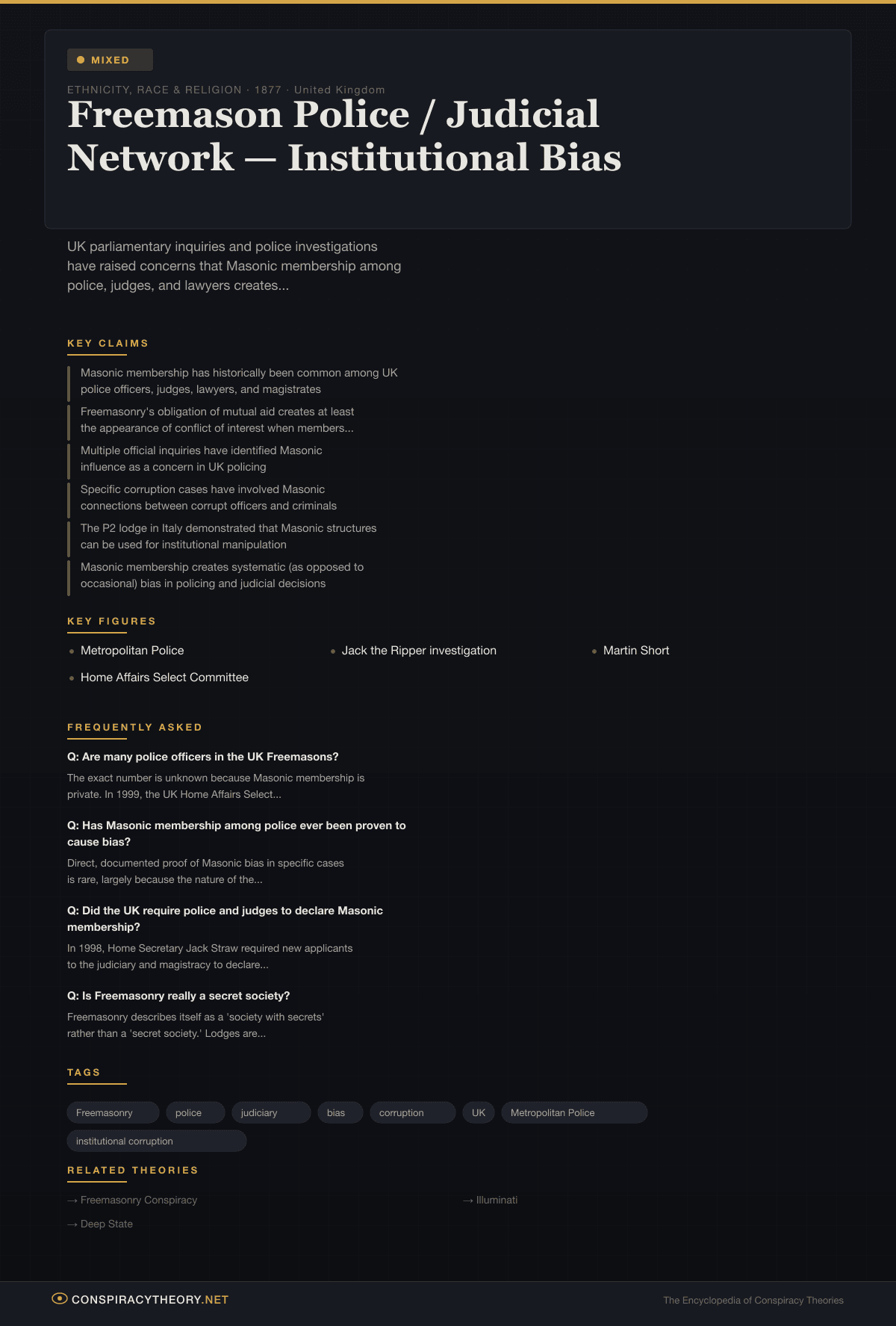
Freemason Police / Judicial Network — Institutional Bias

Overview
In 1972, Sir Robert Mark became Commissioner of the Metropolitan Police, London’s police force and one of the largest in the world. He inherited a force that he later described as the most corrupt in the country. Over the next five years, he launched an unprecedented internal cleanup, dismissing or forcing the resignation of nearly 500 officers.
Mark was blunt about what he found at the root of much of the corruption: Freemasonry. In his 1978 autobiography In the Office of Constable, he wrote that the “ichneumon wasps” of Masonic membership had burrowed deep into the Metropolitan Police, creating a network of mutual obligation that undermined discipline, corrupted investigations, and protected dirty cops from consequences.
Mark was not a conspiracy theorist. He was the Commissioner. And his was not an isolated voice. Over the following decades, multiple UK parliamentary inquiries, investigative journalists, and police whistleblowers raised the same alarm: that Masonic membership among police officers, judges, lawyers, and court officials created a shadow network of loyalty that could — and sometimes did — compromise the justice system.
The question is not whether Freemasonry exists in the criminal justice system. It demonstrably does. The question is whether that presence creates systematic bias, and if so, how much. The evidence is genuinely mixed. Confirmed cases of Masonic corruption exist but are relatively few. The structural conditions for bias — secret oaths of mutual aid, overlapping membership across police, judiciary, and legal profession — are documented but difficult to quantify. What remains is a gap between what can be proven and what many people in the system believe, a gap that has sustained this theory for well over a century.
Origins & History
Freemasonry and the British Establishment
Freemasonry has been deeply embedded in British institutional life since at least the eighteenth century. The United Grand Lodge of England (UGLE), founded in 1717, is the oldest Masonic grand lodge in the world, and the British royal family has long maintained connections to the fraternity (multiple kings and princes have served as Grand Master).
By the nineteenth century, Masonic membership was common among the professional classes — military officers, clergy, physicians, lawyers, magistrates, and police officers. The fraternity offered social networking, mutual aid, and a sense of belonging. For professionals who moved frequently or worked in hierarchical organizations, lodge membership provided a ready-made community and support system.
The concerns about Masonic bias in the justice system are as old as this professional penetration. The central issue is Freemasonry’s obligation of mutual aid. When a Mason takes his obligations, he swears (with variations by jurisdiction and rite) to assist fellow Masons in need, to keep their secrets, and to prefer them in dealings where doing so does not conflict with duty to God, country, and the law.
The qualifier is important — Masonic obligations explicitly exclude situations where helping a Brother would violate the law or professional duty. But critics argue that in practice, the social bonds of fraternity, reinforced through regular lodge meetings, shared rituals, and personal friendship, create an implicit expectation of preferential treatment that may override formal ethical boundaries, particularly in ambiguous situations.
The Metropolitan Police Scandals
The Metropolitan Police — “the Met” — has been at the center of Masonic influence concerns for over a century:
The Jack the Ripper connection: One of the most persistent (if poorly evidenced) theories about the Jack the Ripper murders of 1888 involves Masonic cover-up. The theory, popularized by Stephen Knight in Jack the Ripper: The Final Solution (1976), alleged that the murders were committed to cover up a royal scandal and that senior Freemasons in the Met and government orchestrated the cover-up. The theory has been largely debunked by subsequent researchers, but it cemented the association between Masonic police corruption and public imagination.
The 1960s and 1970s corruption scandals: The Met’s most serious corruption crisis coincided with concerns about Masonic influence. The CID (Criminal Investigation Department) was riddled with officers taking bribes from criminals, and investigations repeatedly found Masonic connections linking corrupt officers. The most notorious cases involved detectives who were members of the same lodges as the criminals they were supposed to be investigating.
Sir Robert Mark’s tenure (1972-1977): Mark’s campaign against corruption explicitly identified Freemasonry as a contributing factor. He reorganized the force, established the internal affairs department (A10), and pushed out hundreds of officers. His public statements about Masonic influence were extraordinary for a serving Commissioner and helped make the issue a matter of political concern.
Operation Countryman (1978-1982): An investigation by officers from outside London into Met corruption that identified Masonic links among corrupt detectives. The investigation was controversial and was itself accused of being undermined by Masonic officers protecting colleagues.
Parliamentary Inquiries
The political response to Masonic concerns has been episodic and ultimately inconclusive:
The 1997 Home Affairs Select Committee inquiry: Following years of concern, the committee investigated Freemasonry in the police and judiciary. Key findings included:
- The committee concluded that “nothing inherently wrong with being a Freemason,” but that membership created “reasonable public concern” about potential conflicts of interest
- Witnesses included police officers who described a culture of mutual favoring among Masonic colleagues
- The committee recommended a voluntary register of Masonic membership for police officers, judges, and magistrates
Jack Straw’s 1998 declaration requirement: Home Secretary Jack Straw required new applicants to the judiciary and magistracy to declare Masonic membership. This was a significant step but had limited practical impact:
- The requirement applied only to new applicants, not existing members
- Enforcement was weak
- Many applicants were believed to have declined to declare honestly
- The requirement was eventually allowed to lapse
The 1999 voluntary police register: The Home Affairs Committee recommended that police officers in England and Wales voluntarily declare Masonic membership. The registers were established but widely regarded as failures:
- Participation was voluntary and compliance was low
- The Police Federation (the officers’ union) opposed the registers
- Legal challenges raised human rights concerns (freedom of association)
- The registers were quietly abandoned within a few years
The Italian Comparison
UK concerns about Masonic influence in the justice system were amplified by developments in Italy, where the relationship between Freemasonry and institutional power took a far more dramatic turn.
In 1981, Italian authorities discovered the membership list of Propaganda Due (P2), a secret Masonic lodge led by Licio Gelli. The list included 962 names, among them cabinet ministers, military commanders, intelligence chiefs, judges, journalists, and business leaders. P2 was not a typical Masonic lodge; it functioned as a parallel power structure, involved in political manipulation, financial fraud, and allegedly connected to terrorist attacks and the Vatican banking scandal.
P2 was an Italian phenomenon, not a British one, and its extreme character was not replicated in the UK. But the P2 revelation reinforced the fear that Masonic networks could function as covert power structures within democratic institutions. The precedent was there.
Key Claims
The Masonic police/judicial network theory encompasses several claims of varying credibility:
Well-Documented Claims
- Masonic membership has historically been common among UK police officers, judges, lawyers, and magistrates
- Freemasonry’s obligation of mutual aid creates at least the appearance of conflict of interest when members hold positions in the justice system
- Multiple official inquiries have identified Masonic influence as a concern in UK policing
- Specific corruption cases have involved Masonic connections between corrupt officers and criminals
- The P2 lodge in Italy demonstrated that Masonic structures can be used for institutional manipulation
Contested Claims
- Masonic membership creates systematic (as opposed to occasional) bias in policing and judicial decisions
- Officers are promoted, protected, or assigned favorable duties based on lodge membership
- Criminal investigations are dropped or mishandled to protect Masonic suspects
- Masonic judges give preferential sentences to Masonic defendants
Unsubstantiated Claims
- Freemasonry operates as a coordinated criminal conspiracy within the justice system
- All or most police corruption in the UK is attributable to Masonic influence
- Masonic rituals involve criminal oaths that override legal obligations
Evidence
Supporting Evidence
- Sir Robert Mark’s testimony: A Metropolitan Police Commissioner publicly identified Freemasonry as a factor in police corruption
- Home Affairs Select Committee findings: A parliamentary committee concluded Masonic membership created “reasonable public concern” about conflicts of interest
- Specific corruption cases: Multiple Met corruption investigations (including Operation Countryman) identified Masonic connections among corrupt officers
- P2 as precedent: The Italian P2 lodge demonstrated that Masonic structures could be weaponized for institutional manipulation
- Whistleblower accounts: Multiple former officers have described cultures of Masonic favoritism in their forces
- Martin Short’s investigation: Journalist Martin Short’s Inside the Brotherhood (1989) documented extensive Masonic networks in UK policing through interviews, FOIA requests, and undercover research
Against Systematic Conspiracy
- Scale uncertainty: The actual number of Masonic police officers and judges is unknown, making it impossible to assess whether Masonic membership correlates with bias at a statistical level
- Declining membership: UK Freemasonry has experienced significant membership decline since the 1970s, with UGLE membership falling from approximately 600,000 in the 1950s to roughly 170,000 by the 2020s. The influence of lodge membership necessarily declines as membership shrinks
- Masonic defense: The United Grand Lodge of England has consistently argued that Masonic obligations do not override professional or legal duties, that members who use Freemasonry for personal advantage are violating Masonic principles, and that the fraternity actively discourages such behavior
- Alternative explanations: The “old boy network” phenomenon — preferential treatment among people who share social, educational, or institutional backgrounds — is common across many organizations (Oxbridge networks, military connections, public school ties) and is not unique to Freemasonry
- Selection bias in evidence: The cases where Masonic connections were identified in corruption may not be representative. Officers who happen to be Masons may also be corrupt, without the Masonic membership being the causal factor
Debunking / Verification
This theory is classified as mixed because:
Confirmed: Masonic membership has been common in the UK justice system. Official inquiries have found the appearance of conflict of interest. Specific corruption cases have involved Masonic connections. P2 demonstrated the potential for Masonic institutional manipulation.
Unconfirmed: Whether Masonic membership creates systematic bias (as opposed to occasional, individual cases) has never been demonstrated at a statistical level. The proposed registers that might have provided data were abandoned before yielding meaningful results.
Context: The difficulty of assessing this theory is partly structural. The alleged bias — preferential treatment, dropped investigations, lenient decisions — is inherently subtle and difficult to attribute to any specific cause. A judge who gives a lenient sentence to a defendant who happens to be a fellow Mason may be exercising legitimate judicial discretion. Or not. Without comprehensive membership data and systematic outcome analysis, the question cannot be definitively answered.
Cultural Impact
The Masonic police/judicial network theory has had significant impact on British institutional culture and public trust:
Transparency reforms: The concerns, even when unresolved, have driven transparency initiatives in UK policing and the judiciary. While the specific Masonic registers failed, the broader principle that potential conflicts of interest should be disclosed has gained ground.
Public trust: Surveys consistently show that a significant portion of the British public believes Freemasonry influences the justice system. Whether or not the belief is accurate, it affects public confidence in institutions.
Police culture: The Masonic issue has become part of the broader conversation about police culture, alongside concerns about racism, sexism, and the “code of silence.” The allegation that officers might protect each other based on lodge membership parallels (and sometimes intersects with) concerns about officers protecting each other based on institutional loyalty.
Fiction and media: The Masonic police conspiracy has become a staple of British crime fiction, appearing in novels, television series, and films. The image of the corrupt Mason-cop, giving the secret handshake to avoid investigation, is deeply embedded in British cultural imagination.
In Popular Culture
- Inside the Brotherhood (Martin Short, 1989) — The most influential journalistic investigation of Masonic influence in British institutions
- The Brotherhood (Stephen Knight, 1984) — Earlier investigation that helped bring the issue to public attention
- Jack the Ripper: The Final Solution (Stephen Knight, 1976) — Proposed a Masonic conspiracy behind the Ripper murders, influencing decades of subsequent Ripper theories
- From Hell (Alan Moore, 1989-1998) — Graphic novel drawing on the Masonic Ripper theory, later adapted into a film starring Johnny Depp
- A Touch of Frost, Inspector Morse, and other British police dramas — Masonic corruption has been a recurring plot element in UK crime television
- Jericho (ITV, 2005) — Police drama directly addressing Masonic influence in the justice system
Key Figures
- Sir Robert Mark (1917-2010) — Metropolitan Police Commissioner who publicly identified Freemasonry as a factor in police corruption and launched the most significant anti-corruption drive in Met history
- Martin Short (b. 1941) — Investigative journalist whose Inside the Brotherhood provided the most detailed public examination of Masonic influence in UK institutions
- Stephen Knight (1951-1985) — Author whose books on Freemasonry, including the Jack the Ripper theory, helped define public perception of Masonic conspiracies
- Jack Straw (b. 1946) — Home Secretary who introduced Masonic declaration requirements for judicial appointees
- Licio Gelli (1919-2015) — Grand Master of Italy’s P2 lodge, whose exposure demonstrated the potential for Masonic institutional manipulation at its most extreme
Timeline
| Date | Event |
|---|---|
| 1717 | United Grand Lodge of England founded |
| 1877 | Earliest formal concerns about Masonic influence in the Metropolitan Police |
| 1888 | Jack the Ripper murders; later theories would allege Masonic involvement in the cover-up |
| 1960s | Met CID corruption scandals reveal Masonic connections among corrupt officers |
| 1972 | Sir Robert Mark becomes Met Commissioner; launches anti-corruption campaign |
| 1976 | Stephen Knight publishes Jack the Ripper: The Final Solution |
| 1978 | Mark publishes In the Office of Constable, identifying Masonic influence in police corruption |
| 1978-1982 | Operation Countryman investigates Met corruption; Masonic links identified |
| 1981 | Italian P2 lodge membership list discovered, revealing Masonic infiltration of Italian institutions |
| 1984 | Stephen Knight publishes The Brotherhood |
| 1989 | Martin Short publishes Inside the Brotherhood |
| 1997 | Home Affairs Select Committee investigates Freemasonry in police and judiciary |
| 1998 | Home Secretary Jack Straw requires new judicial applicants to declare Masonic membership |
| 1999 | Voluntary Masonic registers introduced for police officers; poorly complied with |
| 2000s | Registers quietly abandoned; debate continues without resolution |
| 2018 | Guardian investigation reveals Masonic lodges for judges, police, and lawyers still meeting in the Inns of Court |
| 2020s | UGLE membership continues to decline; issue recedes but is not resolved |
Sources & Further Reading
- Mark, Sir Robert. In the Office of Constable. Collins, 1978.
- Short, Martin. Inside the Brotherhood: Further Secrets of the Freemasons. Grafton, 1989.
- Knight, Stephen. The Brotherhood: The Explosive Expose of the Secret World of the Freemasons. Granada, 1984.
- Home Affairs Select Committee. “Freemasonry in the Police and the Judiciary.” Third Report, Session 1996-97.
- Dickie, John. The Craft: How the Freemasons Made the Modern World. PublicAffairs, 2020.
- Moore, Alan, and Eddie Campbell. From Hell. Top Shelf Productions, 1999.
- Beha, Ernesto. The Masonic Network: A Social and Historical Account of Freemasonry in the West. 2015.
Related Theories
- Freemasonry — The broader body of conspiracy theories surrounding Masonic organizations
- Illuminati — The related but distinct theory of secret society control of global institutions
- Deep State — The broader concept of hidden power networks within government institutions

Frequently Asked Questions
Are many police officers in the UK Freemasons?
Has Masonic membership among police ever been proven to cause bias?
Did the UK require police and judges to declare Masonic membership?
Is Freemasonry really a secret society?
Infographic
Share this visual summary. Right-click to save.