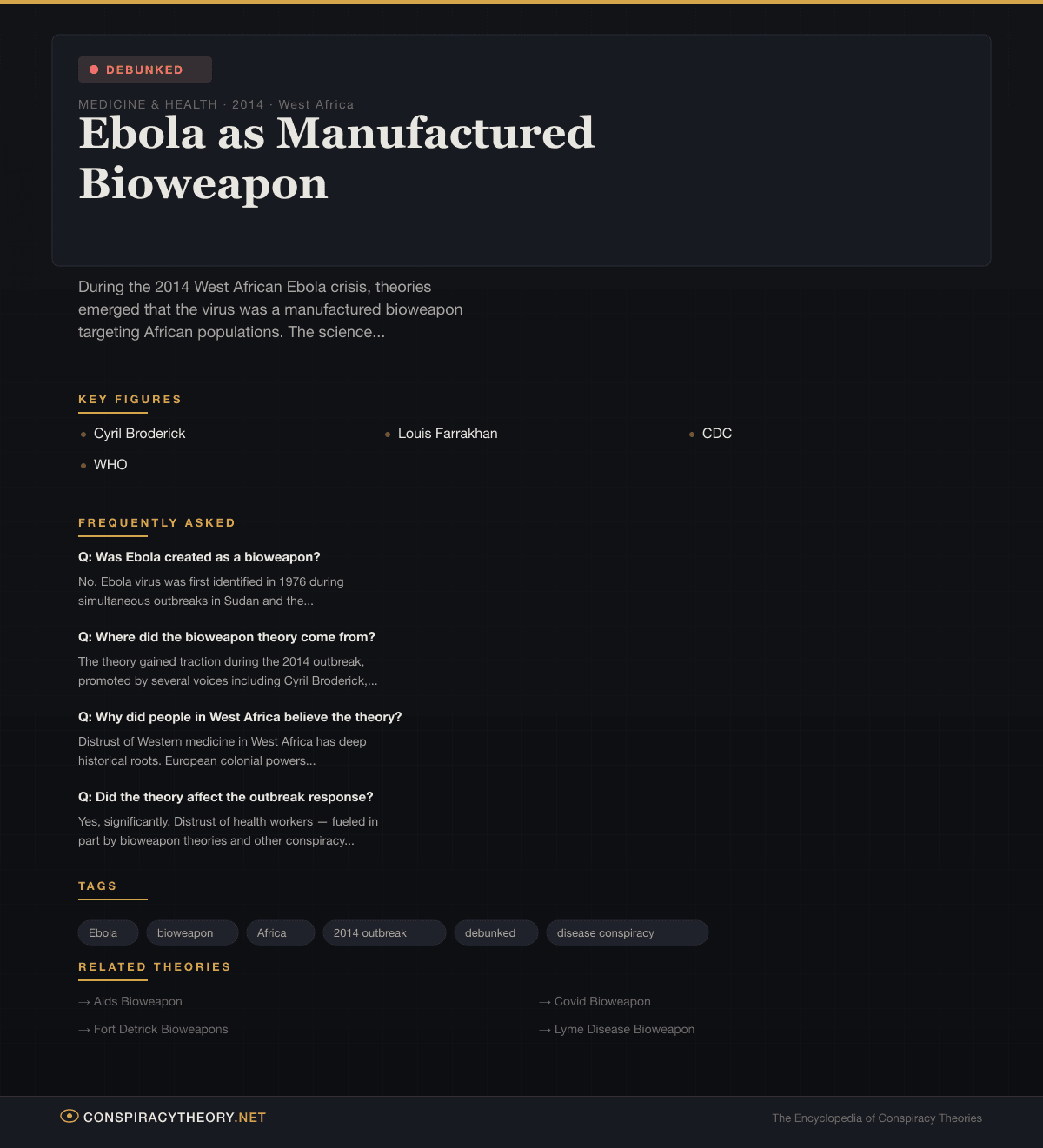
Ebola as Manufactured Bioweapon

Overview
In the summer of 2014, as Ebola virus disease swept through Guinea, Liberia, and Sierra Leone — killing thousands, overwhelming hospitals, and generating worldwide panic — a theory emerged that the outbreak was not a natural disaster but a deliberate attack.
The claim: Ebola was a bioweapon, manufactured in Western laboratories, and deliberately released in Africa. The motive, depending on the version, was population reduction, weapons testing, resource extraction, or some combination of the above. The accused varied — the U.S. Department of Defense, the CIA, pharmaceutical companies — but the basic narrative was consistent: the West did this to Africa on purpose.
The theory was wrong. Ebola virus is a natural pathogen that evolved in animal reservoirs over millennia. Its genomic fingerprint is consistent with natural evolution, not laboratory engineering. The 2014 outbreak was traced to a specific spillover event in a specific village in Guinea. The science is clear.
But the theory didn’t come from nowhere. And understanding why millions of people in West Africa believed it — why they attacked treatment centers, hid their sick relatives, and refused vaccines — requires reckoning with a history that makes the bioweapon theory feel, emotionally if not scientifically, plausible.
The 2014 Outbreak
Patient Zero
The 2014 Ebola outbreak — the largest in history — began in December 2013 in Meliandou, a village in the forest region of Guinea. Emile Ouamouno, a two-year-old boy, developed fever, vomiting, and bloody diarrhea. He died on December 28. His sister, mother, and grandmother fell ill next, and they died too. Village mourners who had handled the bodies at traditional funerals carried the virus to neighboring villages.
By March 2014, the outbreak had spread to Guinea’s capital, Conakry. By summer, it had crossed into Liberia and Sierra Leone. By fall, it was the worst Ebola outbreak the world had ever seen — exponential growth in three countries with fragile health systems, porous borders, and densely populated urban areas.
The virus killed with terrifying efficiency: fever, vomiting, diarrhea, hemorrhaging, organ failure, death. Case fatality rates ranged from 40% to 70%. By the time the outbreak was declared over in June 2016, it had infected more than 28,600 people and killed more than 11,325.
The Response
The international response was initially slow — the WHO and Western governments underestimated the outbreak’s severity for critical months. When the response finally scaled up, it involved thousands of foreign health workers in hazmat suits, quarantine zones, contact tracing, and the construction of Ebola Treatment Units (ETUs).
For communities in rural West Africa, this response was frightening. People in alien-looking protective gear arrived in villages, declared that a deadly disease was spreading, and began separating sick family members from their homes. Patients who entered ETUs often didn’t come out alive. Traditional burial practices — washing and touching the dead — were banned because corpses were highly infectious.
The combination of a terrifying disease, a frightening response, and deep-seated distrust of Western institutions created fertile ground for conspiracy theories.
The Bioweapon Claims
Cyril Broderick
The most prominent articulation of the bioweapon theory came from Cyril Broderick, a Liberian-born professor of plant pathology at Delaware State University. In September 2014, Broderick published a letter in the Liberian Daily Observer titled “Ebola, AIDS Manufactured By Western Pharmaceuticals, US DoD?”
Broderick claimed that:
- Ebola was a genetically modified organism developed by the U.S. Department of Defense
- The U.S. had been conducting bioweapons research in West Africa
- The outbreak was connected to U.S. military laboratories in Sierra Leone and Liberia
- Pharmaceutical companies stood to profit from the outbreak through vaccine sales
Broderick offered no evidence for these claims beyond citations to conspiracy websites. His letter was not a scientific publication. But his academic credentials — a PhD, a university position — gave the claims a veneer of authority that resonated in Liberia, where trust in American institutions was already fragile.
Louis Farrakhan
Nation of Islam leader Louis Farrakhan amplified the theory during a November 2014 speech, calling Ebola a “race-targeting weapon” designed to depopulate Africa. Farrakhan connected the claim to broader theories about Western conspiracies against Black populations — theories that draw on the very real history of the Tuskegee Syphilis Experiment and other documented abuses.
Russian Amplification
Russian state media, including RT and Sputnik, amplified the Ebola bioweapon theory as part of broader disinformation campaigns. This was consistent with Soviet and Russian intelligence traditions — the KGB had promoted the theory that HIV/AIDS was created by the CIA during Operation INFEKTION in the 1980s, a disinformation campaign that the Russian government continued to echo decades later.
The Scientific Reality
Natural Origins
The scientific evidence for Ebola’s natural origin is comprehensive:
Evolutionary history: Ebola virus belongs to the family Filoviridae. Genomic analysis shows it has been evolving in animal populations for millions of years. The genetic diversity among Ebola strains is consistent with long-term natural evolution, not recent laboratory construction.
Animal reservoir: Fruit bats (particularly species in the genus Eidolon) are the suspected natural reservoir. Antibodies to Ebola-related viruses have been found in multiple bat species across Africa. The pattern of outbreaks correlates with human-bat contact in forest environments.
Spillover events: Every known Ebola outbreak has been traced to a plausible natural spillover event — typically involving human contact with infected bat guano, consumption of bushmeat, or proximity to bat colonies. The 2014 outbreak was traced to Meliandou, Guinea, where the index case likely contracted the virus from bats living in a hollow tree near his home.
Genomic analysis of the 2014 strain: Researchers sequenced the 2014 virus early in the outbreak and confirmed it was most closely related to Ebola strains that had been circulating in the region since at least the 1970s. The sequence showed the gradual accumulation of mutations expected from natural evolution, not the abrupt genetic changes that would indicate laboratory engineering.
The Bioweapon Argument Doesn’t Work
Even setting aside the positive evidence for natural origins, Ebola would make a poor bioweapon:
- Transmission: Ebola spreads through direct contact with bodily fluids, not through the air. An effective bioweapon should be highly transmissible. Ebola isn’t.
- Incubation period: Ebola’s incubation period (2-21 days) is well-understood and allows for quarantine-based containment
- Visibility: Ebola’s symptoms are dramatic and obvious, making it easy to identify and isolate cases
- Self-limiting: Ebola outbreaks tend to burn themselves out because the virus kills its hosts before they can spread it widely
- Instability: Ebola virus is fragile outside the human body, making it difficult to weaponize effectively
If a government wanted to create a bioweapon for depopulation, Ebola would be a remarkably poor choice.
Why the Theory Resonated
The Colonial Legacy
The bioweapon theory’s power in West Africa cannot be understood without confronting the region’s history with Western medicine and colonial exploitation.
The truth is that Western institutions have used Africa as a laboratory:
- Colonial-era experiments: European colonial powers conducted medical experiments on African subjects without consent, including forced vaccination campaigns that sometimes caused harm
- The Pfizer Trovan trial (1996): During a meningitis outbreak in Kano, Nigeria, Pfizer tested an experimental antibiotic (trovafloxacin) on children. Eleven children died. Families alleged they were not informed that an experimental drug was being used. Nigeria later sued Pfizer, which settled for $75 million.
- Pharmaceutical testing: Africa remains a site of clinical trials for Western pharmaceutical companies, often under ethical conditions that would not be acceptable in the companies’ home countries
When communities in West Africa expressed distrust of Western health workers during the Ebola outbreak, they were drawing on generations of experience. The bioweapon theory was wrong in its specifics but rooted in a legitimate pattern of exploitation.
The Deadly Consequences
The practical consequences of the bioweapon theory — and the broader distrust it represented — were devastating:
- Health workers were attacked. In Guinea, a team of eight Ebola educators and journalists was murdered by villagers in Womey in September 2014.
- Sick people hid from health authorities, allowing the virus to spread unchecked in some communities
- Traditional burial practices continued despite the extreme infection risk, because communities distrusted the alternative (body bags and cremation ordered by foreign authorities)
- Vaccination campaigns were resisted
The WHO identified community mistrust as one of the most significant obstacles to outbreak containment. Some portion of the 11,325 deaths can be attributed to the delayed treatment and continued transmission caused by distrust.
Timeline
| Date | Event |
|---|---|
| 1976 | Ebola virus first identified in DRC and Sudan |
| Dec 2013 | 2014 outbreak begins in Meliandou, Guinea |
| March 2014 | WHO notified of outbreak |
| Summer 2014 | Outbreak spreads to Liberia and Sierra Leone |
| Sept 2014 | Broderick publishes bioweapon claims in Liberian Daily Observer |
| Sept 2014 | Eight health workers killed in Womey, Guinea |
| Oct 2014 | Peak of outbreak; cases doubling every few weeks |
| Nov 2014 | Farrakhan promotes bioweapon theory |
| Late 2014 | International response scales up |
| 2015 | Outbreak begins to decline |
| June 2016 | WHO declares outbreak over; 28,600+ infected, 11,325+ dead |
Sources & Further Reading
- WHO. Ebola Situation Reports. 2014-2016.
- Bausch, Daniel G., and Lara Schwarz. “Outbreak of Ebola Virus Disease in Guinea: Where Ecology Meets Economy.” PLOS Neglected Tropical Diseases, 2014.
- Gire, Stephen K., et al. “Genomic Surveillance Elucidates Ebola Virus Origin and Transmission During the 2014 Outbreak.” Science, 2014.
- Chandler, Clare, et al. “Ebola: Limitations of Correcting Misinformation.” The Lancet, 2015.
- Broderick, Cyril. “Ebola, AIDS Manufactured By Western Pharmaceuticals, US DoD?” Liberian Daily Observer, September 9, 2014.
Related Theories
- AIDS Bioweapon — Similar bioweapon claims about HIV/AIDS
- COVID Bioweapon — Same pattern applied to COVID-19
- Fort Detrick Bioweapons — U.S. biological weapons program
- Tuskegee Syphilis Experiment — Documented government medical experimentation

Frequently Asked Questions
Was Ebola created as a bioweapon?
Where did the bioweapon theory come from?
Why did people in West Africa believe the theory?
Did the theory affect the outbreak response?
Infographic
Share this visual summary. Right-click to save.