The Denver International Airport Conspiracy: Bunkers, Murals, and Blucifer

Denver International Airport occupies 33,531 acres of high plains landscape northeast of downtown Denver, making it the largest airport by land area in the United States and the second largest in the world. Since its official opening on February 28, 1995, the facility has functioned as more than just a transportation hub. It has become a central icon in modern conspiracy culture, serving as a physical landmark for theories involving the New World Order, secret government bunkers, and occult symbolism. The airport’s construction history, characterized by massive cost overruns and significant delays, provided the initial foundation for claims that the visible terminal and runways are merely the surface layer of a much larger, more sinister subterranean complex. These claims are supported by a unique collection of public art, architectural anomalies, and Masonic associations that many observers find unsettling or deliberately cryptic.
Overview
The Denver International Airport (DIA) conspiracy theory posits that the facility serves as a future headquarters for a global elite or a secret shadow government. Proponents of the theory point to a series of unusual features: a 32-foot-tall blue horse sculpture that killed its creator, murals depicting apocalyptic scenes and the eventual triumph of a unified world, a dedication capstone featuring Masonic symbols and a reference to an organization called the New World Airport Commission, and an extensive network of underground tunnels that were originally intended for an automated baggage system that never functioned as designed. While airport officials have historically dismissed these claims as groundless, the airport’s marketing department has recently adopted a strategy of leaning into the conspiracy theories for branding purposes, further blurring the line between urban legend and institutional identity. The theories remain a staple of late-night radio, internet forums, and alternative media, maintaining a high level of public interest despite repeated debunking by journalists and aviation experts.
Origins and History
The transition from Stapleton International Airport to the new Denver International Airport was a process fraught with controversy from its inception. By the late 1980s, Stapleton had reached its maximum capacity, and the surrounding residential areas made further expansion impossible. In 1989, Denver voters approved the construction of a new airport, which was initially estimated to cost $1.7 billion with an opening date set for October 1993. The project immediately faced criticism for its location, which was significantly further from the city center than Stapleton, and for its massive scale, which many felt was unnecessary for Denver’s needs at the time.
Construction began in 1989 and was quickly plagued by logistical failures and design changes. The opening was delayed five times, eventually pushed back to February 1995. By the time the first flights departed, the total cost had ballooned to $4.8 billion, nearly $3 billion over the original budget. This enormous discrepancy in cost and timing is the primary historical “evidence” cited by conspiracy theorists. They argue that the $3 billion in excess spending was not simply the result of mismanagement, but was instead used to fund the construction of a massive, secret underground facility beneath the airport grounds.
The most significant technical failure during construction was the automated baggage handling system. Designed by BAE Automated Systems, it was intended to be the most advanced system in the world, using computer-controlled carts to move luggage between the terminal and the concourses through a network of underground tunnels. During testing, the system famously shredded bags, launched luggage off the tracks, and crashed repeatedly. The system’s failure was the primary reason for the airport’s delayed opening and contributed significantly to the cost overruns. While the airport eventually abandoned the system in favor of traditional tugs and carts, the miles of underground tunnels built to house the tracks remained in place, sitting empty and fueling speculation about their “true” purpose.
Key Claims
The Underground Bunkers and Tunnels
The central pillar of the Denver Airport conspiracy is the existence of a massive underground complex. Theorists claim that the 33,531 acres of land were acquired specifically to provide a buffer for a secret continuity-of-government facility or a New World Order command center. Some variations of the theory suggest the bunkers are intended to house the global elite during a planned global catastrophe, while others claim the tunnels connect to a national network of Deep Underground Military Bases (DUMBs).
Evidence for these bunkers often relies on eyewitness accounts from construction workers who claimed to have seen multi-level structures beneath the runways and terminal. Proponents also point to the “buried buildings” claim, which suggests that five buildings were constructed during the early phases of the project, then declared to be positioned incorrectly and buried rather than demolished. Conspiracy researchers argue these buried structures now serve as the upper levels of the subterranean complex.
The Murals of Leo Tanguma
The airport’s Great Hall features two massive murals by Chicano artist Leo Tanguma titled “Children of the World Dream of Peace” and “In Peace and Harmony with Nature.” These artworks are diptychs, meaning each consists of two panels meant to be viewed in sequence. However, conspiracy theorists frequently isolate specific imagery to support claims of an upcoming global genocide or a New World Order takeover.
The first mural, “Children of the World Dream of Peace,” contains a panel depicting a menacing figure in a gas mask and a military uniform, wielding a scimitar and a machine gun. Beneath the figure are dead or grieving children and burning buildings. Theorists interpret this as a depiction of a planned culling of the human population. The second panel, which shows children from around the world bringing their weapons to a boy who is beating them into plowshares, is often ignored or interpreted as the “peace” that follows the global takeover.
The second mural, “In Peace and Harmony with Nature,” features panels depicting environmental destruction and the extinction of species, followed by a panel showing a restored earth where humans and animals live in harmony. Conspiratorial interpretations suggest these murals are a roadmap for the global elite’s plan to reduce the population and reset the world’s ecosystem under their control.
Blucifer: The Blue Mustang
Standing near the airport entrance is a 32-foot-tall, blue fiberglass horse sculpture with glowing red eyes, officially titled “Blue Mustang” but widely known as “Blucifer.” The sculpture is a point of intense speculation due to its aggressive appearance and its tragic history. In 2006, while the artist Luis Jimenez was working on the sculpture, a large section fell on him, severing an artery in his leg and killing him. The sculpture was eventually finished by his family and assistants.
Theorists claim the horse is a representation of the Fourth Horseman of the Apocalypse from the Book of Revelation, the pale horse whose rider is Death. The glowing red eyes are seen as demonic, and the fact that the statue killed its own creator is interpreted as a dark omen. Despite the artist’s statement that the horse was a tribute to the wild mustangs of the American West and the red eyes were a tribute to his father’s neon sign business, the “Blucifer” legend remains one of the airport’s most popular features.
The Freemason Capstone
The airport’s dedication stone, located in the Great Hall, features the Masonic square and compasses and a dedication by the “New World Airport Commission.” It also contains a time capsule to be opened in 2094. Conspiracy researchers point to the term “New World” as a direct reference to the New World Order and claim the Masonic symbols prove that the facility was built by and for secret societies. The stone also includes Braille, which some theorists have claimed is a secret code, though it actually just translates the text on the stone.
The Swastika Runways
Viewed from above, the configuration of the airport’s six runways bears a resemblance to a swastika. While aviation experts explain this as a “pinwheel” design that allows for simultaneous takeoffs and landings in multiple directions regardless of wind conditions, theorists argue it is a deliberate occult or Nazi symbol embedded into the landscape.
Evidence Cited
The primary evidence cited by those who believe in the DIA conspiracy is the documented history of the airport’s construction. The $3 billion cost overrun is the most frequently mentioned data point, as theorists argue that such a large sum could not be accounted for by simple mismanagement of a baggage system. They also point to the enormous amount of dirt removed during construction, approximately 110 million cubic yards, which is significantly more than was removed for other major airports like Dallas/Fort Worth or O’Hare. This volume of earth removal, they claim, is proof of the massive excavations required for underground cities.
Visual evidence is also heavily utilized. Photographs of the murals, the capstone, and Blucifer are shared widely online as “proof” that the designers were hiding their agenda in plain sight. Some researchers have also pointed to the airport’s fueling system, which consists of 2.7 million gallons of fuel stored in underground tanks, as being far in excess of what a commercial airport needs, suggesting it is intended to fuel a military or government fleet during an emergency.
Another piece of cited evidence is the existence of the “New World Airport Commission.” When journalists and researchers looked for this organization, they found it did not exist as a permanent government body. This led to the claim that the name was a slip of the tongue or a deliberate admission by the global elite. In reality, it was a temporary committee of local business and political leaders formed to organize the airport’s opening celebrations, but the lack of a paper trail for a permanent agency fueled the fire.
Debunking and Counter Evidence
Journalists, aviation experts, and airport officials have addressed the claims surrounding DIA for over three decades, providing rational explanations for the anomalies that fuel the theories.
Underground Bunkers
The massive amount of earth removed during construction is explained by the airport’s unique layout and its location on the high plains. Unlike Stapleton, which was built on relatively flat terrain, DIA was built on undulating plains that required significant leveling to create a safe environment for runways. Furthermore, the extensive underground tunnel system for the baggage handling system and the passenger train (the AGTS) required deep excavation. The “buried buildings” are actually the foundations and lower levels of the terminal and concourses that were reconfigured due to design changes during the five-year construction period. Engineers note that building a secret underground city without the knowledge of the thousands of contractors and workers involved would be a logistical impossibility.
The Murals
Leo Tanguma has spent years defending his work against conspiratorial interpretations. He explains that the murals are a narrative sequence about social justice and environmentalism. The “menacing figure” in the gas mask is a representation of war being defeated by the world’s children. The dead animals and grieving children represent the current state of the environment, while the final panels represent a hopeful future of peace and ecological restoration. This narrative structure is a common feature of Chicano muralism and social realism.
The Runways
The “swastika” runway layout is a standard pinwheel configuration. This design is highly efficient for large hub airports because it allows planes to land and take off from multiple angles simultaneously without their flight paths crossing. Similar layouts exist at other airports, but they lack the other “spooky” elements that make DIA a target for theorists. The orientation of the runways was determined strictly by the prevailing wind patterns of the Colorado plains.
The New World Airport Commission
The “New World Airport Commission” was a documented, albeit temporary, group of Denver civic leaders. Its name was a common marketing phrase used in the 1990s to emphasize Denver’s ambition to become a “world class” city. There is no evidence connecting the group to any global shadow government.
The Cost Overruns
Economists and public works experts note that massive cost overruns are common in mega-projects. The primary driver of the DIA overruns was the baggage system, but other factors included the 1990-1991 recession, changes in airline requirements, and the sheer scale of the project. The $4.8 billion final price tag, while high, is not outside the realm of possibility for a project of this magnitude, especially considering the technical challenges faced during its construction.
Pop Culture
The Denver Airport conspiracy has transitioned from a niche interest in the paranormal community to a widely recognized part of American pop culture. The airport itself has played a major role in this transition. In 2018, during a major renovation of the Great Hall, DIA officials installed construction barriers featuring posters that directly addressed the theories. One sign asked, “Construction? Or a cover up?” while another featured a picture of an alien and a lizard person. This marketing campaign was widely praised for its creativity and for the way it turned a potential public relations headache into a branding win.
In 2019, the airport installed an animatronic gargoyle in the terminal that would talk to passing travelers. The gargoyle would joke about being 243 years old and being a member of the Illuminati, further cementing the airport’s relationship with its own mythology. This “trolling” of conspiracy theorists has become a hallmark of the airport’s public identity.
The conspiracy has also been featured in numerous television shows and documentaries. Jesse Ventura investigated the airport for his show “Conspiracy Theory with Jesse Ventura,” where he attempted to gain access to the underground levels. The airport has also been a frequent topic on the “Coast to Coast AM” radio show and has been analyzed in countless YouTube videos that have garnered millions of views. It is often cited as a prime example of “hiding in plain sight,” a concept where secret societies allegedly place their symbols and plans in public spaces to taunt or desensitize the population.

Frequently Asked Questions
Are there really lizard people at Denver International Airport?
Can I visit the underground tunnels?
Why did the horse statue kill its creator?
What is inside the time capsule?
Is the airport a FEMA camp?
Does the runway layout represent a swastika?
Who is the 'New World Airport Commission'?
Why are there gargoyles in the baggage claim?
Is Denver Airport the headquarters of the Illuminati?
What do the murals really mean?
Why was the airport built so far from the city?
How much did the airport actually cost?

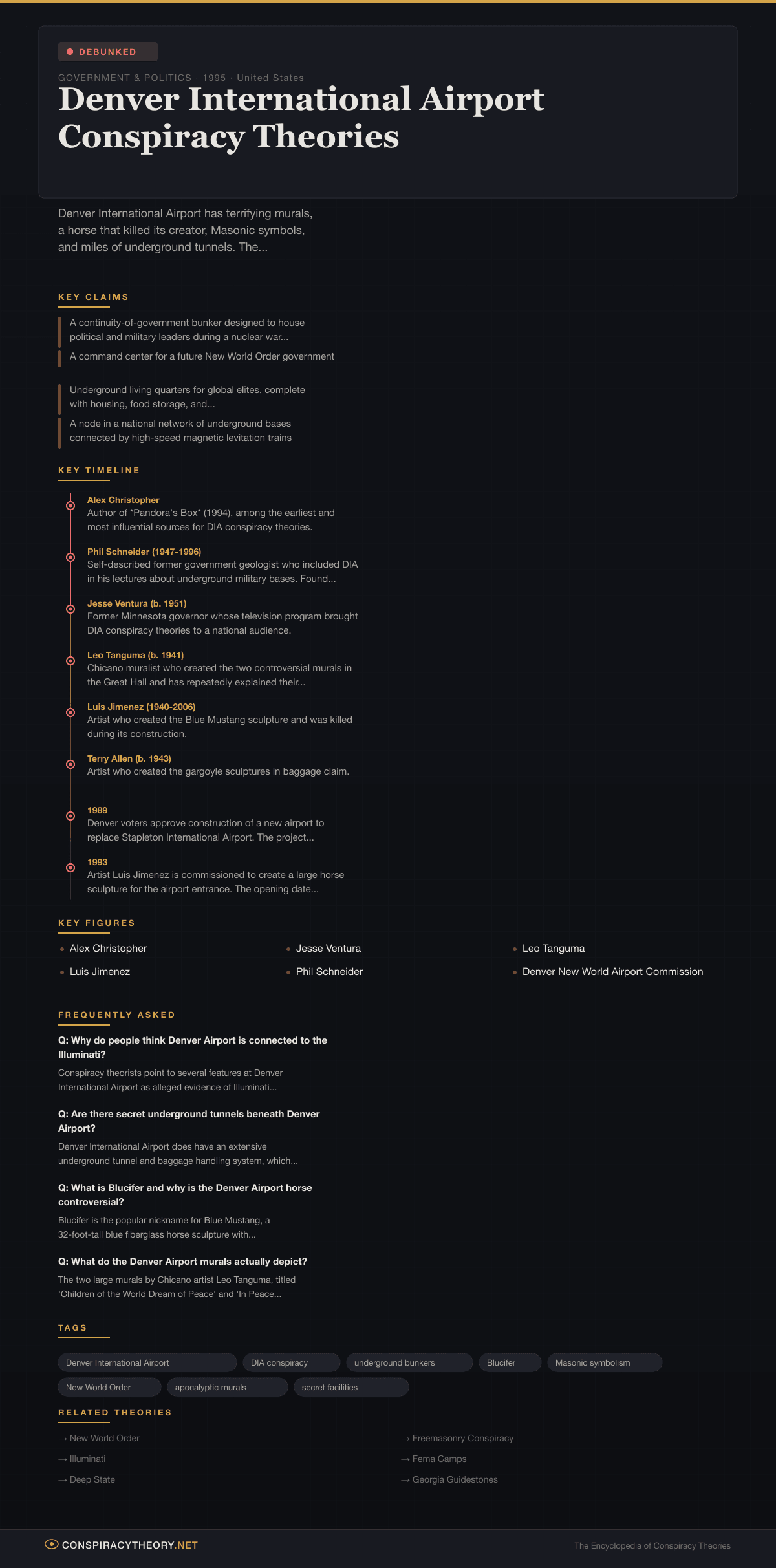
Infographic
Share this visual summary. Right-click to save.