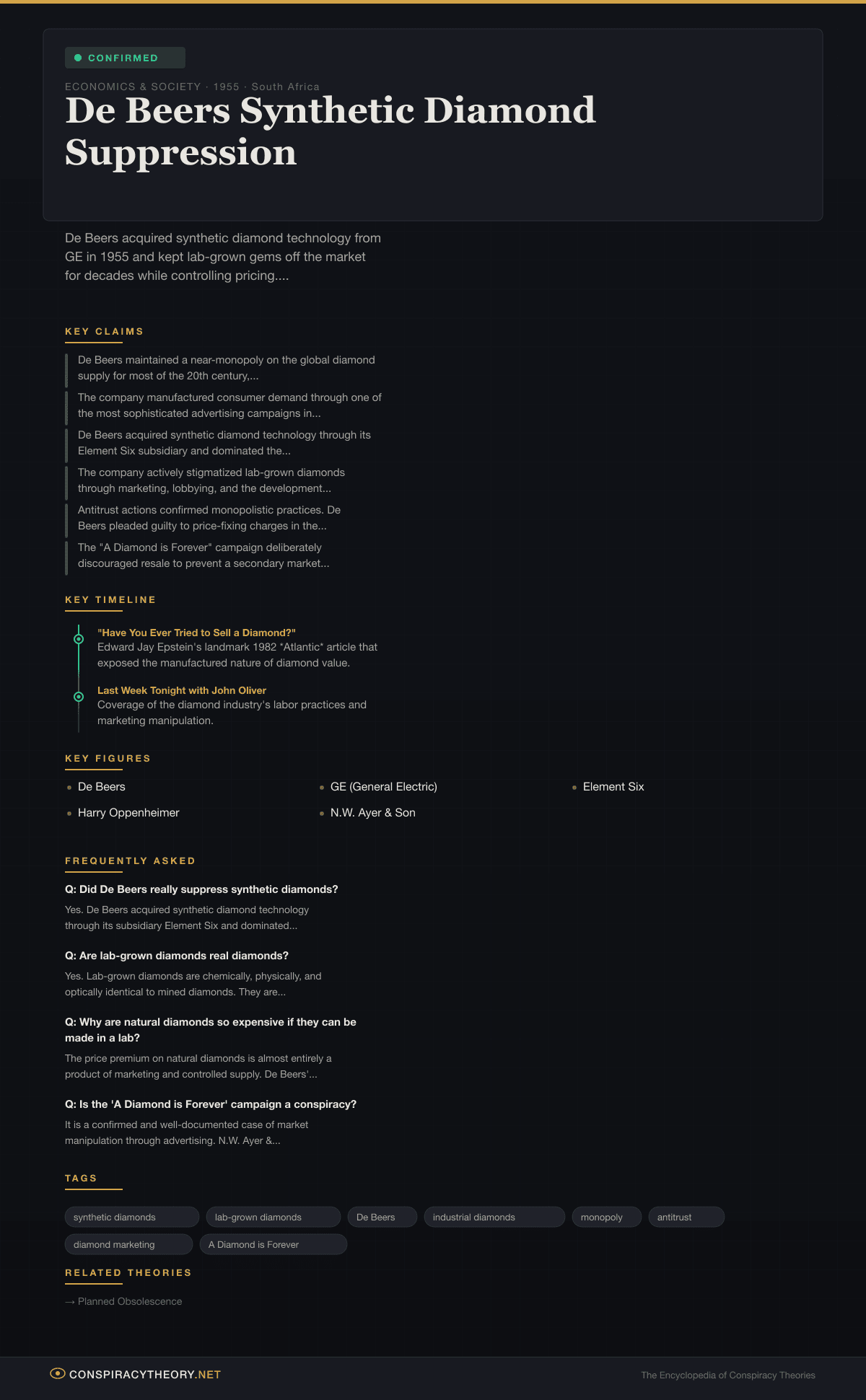
De Beers Synthetic Diamond Suppression
Overview
Here is a story about how to sell a rock for two months’ salary.
Diamonds are not rare. They are not particularly useful for most consumer purposes. Their value as gemstones is largely a cultural construct — a construct that was deliberately engineered by one of the most effective monopolies in the history of capitalism. And when technology threatened to make diamonds truly abundant by allowing them to be grown in laboratories, that same monopoly worked systematically to suppress, stigmatize, and control the technology to protect its pricing power.
This is not a conspiracy theory. It is a confirmed, documented case of market manipulation, monopolistic practice, and the deliberate shaping of consumer psychology — backed by antitrust investigations, corporate records, and one of the most studied advertising campaigns in marketing history. The story of De Beers and synthetic diamonds is, in many ways, the purest example of how a commodity’s value can be manufactured not through scarcity or utility but through narrative control.
Origins & History
Building the Monopoly
The De Beers story begins in 1888, when Cecil Rhodes consolidated the Kimberley diamond mines in South Africa into a single company: De Beers Consolidated Mines. Rhodes understood something critical: diamonds were valuable only as long as they were scarce, and scarcity had to be manufactured. The South African mines contained far more diamonds than the market could absorb at luxury prices. If they all reached the market, prices would collapse.
Rhodes — and his successor Ernest Oppenheimer, who took control of De Beers in 1927 — built a monopoly that at its peak controlled approximately 80-85% of the global rough diamond supply. The mechanism was the Central Selling Organisation (CSO), later renamed the Diamond Trading Company (DTC), through which De Beers purchased diamonds from producers worldwide and released them to the market in carefully controlled quantities.
The genius of the system was its simplicity: buy everything, sell slowly. When new diamond deposits were discovered — in Australia, Russia, Canada — De Beers either acquired them, signed exclusive purchasing agreements, or accumulated enough stock to flood the market and drive prices down if the producers tried to sell independently. The company maintained a massive stockpile of uncut diamonds in London, releasing stones to the market at a pace calibrated to maintain prices.
”A Diamond is Forever”
But controlling supply was only half the equation. De Beers also needed to control demand — and the demand for diamond engagement rings, the bedrock of the consumer diamond market, was itself a manufactured phenomenon.
In 1938, De Beers hired the advertising agency N.W. Ayer & Son to increase diamond sales in the United States, where the tradition of diamond engagement rings was fading during the Depression. The campaign that followed is widely regarded as one of the most successful advertising operations in history.
N.W. Ayer did not simply advertise diamonds. It reshaped American culture. The agency placed diamonds in movies, arranged for celebrities to be photographed wearing them, planted stories in newspapers about celebrity diamond purchases, and worked with fashion designers to feature diamonds in their shows. The campaign’s most enduring creation was the 1947 slogan “A Diamond is Forever” — a phrase that simultaneously positioned diamonds as symbols of eternal love and, crucially, discouraged resale (because if people sold their diamonds, the resulting supply would collapse prices).
The campaign worked spectacularly. Diamond engagement ring sales in the U.S. increased by 55% in the two decades following the campaign’s launch. By the 1960s, more than 80% of American brides received diamond engagement rings, up from roughly 10% in the 1930s. The “two months’ salary” guideline — also a De Beers marketing invention — established a spending benchmark that persists to this day.
The Synthetic Threat
In 1954, scientists at General Electric achieved something that alchemists had dreamed of for centuries: they created synthetic diamonds. The process, known as High Pressure High Temperature (HPHT) synthesis, subjected carbon to extreme pressure and temperature to replicate the conditions under which natural diamonds form deep in the Earth’s mantle. The first synthetic diamonds were tiny, industrial-grade stones — suitable for cutting tools and abrasives, not engagement rings.
De Beers recognized the threat immediately. If diamond synthesis improved — and it was clear that it would — the company’s entire business model was at risk. A commodity whose value depended on perceived scarcity would be destroyed by abundance.
De Beers’ response was multi-pronged:
Acquire the technology. De Beers established its own synthetic diamond operation through a subsidiary that eventually became Element Six, now one of the world’s largest producers of industrial synthetic diamonds. By participating in the synthetic market, De Beers could monitor technological developments, control pricing of industrial synthetics, and ensure that no competitor gained a significant advantage.
Contain synthetic diamonds in the industrial market. For decades, De Beers worked to ensure that synthetic diamonds were used only for industrial applications — cutting, grinding, drilling — and did not enter the gem market. The company promoted the narrative that synthetic diamonds were an industrial product, fundamentally different from the “real” gems that came from the earth.
Stigmatize lab-grown gems. As synthesis technology improved and gem-quality lab-grown diamonds became feasible in the 2000s and 2010s, De Beers launched marketing campaigns designed to stigmatize them. The company invested heavily in detection technology (machines that could distinguish natural from synthetic diamonds) and lobbied industry organizations and regulators to require that lab-grown stones be explicitly labeled as such. The message was consistent: lab-grown diamonds might be chemically identical, but they lacked the “authenticity” and “emotional value” of natural stones.
The Lightbox reversal. In 2018, in a dramatic strategic reversal, De Beers launched Lightbox Jewelry — its own line of lab-grown diamond jewelry, priced significantly below natural diamonds. The move was widely interpreted not as an embrace of synthetics but as a strategy to commoditize them: by selling lab-grown diamonds cheaply under its own brand, De Beers could establish the perception that synthetics were affordable fashion items, not luxury goods — thereby protecting the premium on natural stones.
Key Claims
This is a confirmed case, so the “claims” are documented facts:
- De Beers maintained a near-monopoly on the global diamond supply for most of the 20th century, controlling approximately 80-85% of rough diamond distribution through the Central Selling Organisation.
- The company manufactured consumer demand through one of the most sophisticated advertising campaigns in history, creating the cultural expectation of diamond engagement rings and the “two months’ salary” spending guideline.
- De Beers acquired synthetic diamond technology through its Element Six subsidiary and dominated the industrial synthetic diamond market while working to keep synthetics out of the gem market.
- The company actively stigmatized lab-grown diamonds through marketing, lobbying, and the development of detection technology designed to identify and separate synthetic stones.
- Antitrust actions confirmed monopolistic practices. De Beers pleaded guilty to price-fixing charges in the United States in 2004, paying a $10 million fine. The company was also investigated by the European Commission for antitrust violations.
- The “A Diamond is Forever” campaign deliberately discouraged resale to prevent a secondary market that would undermine De Beers’ supply control.
Evidence
Antitrust Record
U.S. Department of Justice (2004). De Beers pleaded guilty to criminal charges of conspiring to fix prices of industrial diamonds. The company paid a $10 million fine and, for the first time in decades, became legally able to do business directly in the United States (the company had avoided U.S. jurisdiction for years to evade potential prosecution).
European Commission investigations. The EC investigated De Beers’ exclusive purchasing agreement with ALROSA, the Russian diamond producer, finding that the arrangement restricted competition. De Beers agreed to terminate the agreement by 2009.
GE lawsuit (1994). General Electric sued De Beers, alleging that De Beers had conspired with other companies to fix prices in the industrial diamond market. The lawsuit was settled confidentially.
Corporate Records and Marketing History
The N.W. Ayer advertising archive. The advertising agency’s internal documents — including strategy memos, market research, and campaign plans — have been partially disclosed and analyzed by journalists and researchers. Edward Jay Epstein’s 1982 article “Have You Ever Tried to Sell a Diamond?” in The Atlantic and his subsequent book The Rise and Fall of Diamonds drew extensively on these materials.
The stockpile. De Beers’ London diamond stockpile — maintained for decades as the mechanism for supply control — was a poorly kept secret within the diamond industry. At its peak, the stockpile was estimated to contain billions of dollars’ worth of uncut diamonds, deliberately held off the market to maintain prices.
Element Six operations. De Beers’ synthetic diamond subsidiary has been openly acknowledged by the company. Element Six is one of the world’s largest producers of synthetic diamonds for industrial applications, generating substantial revenue — a business that exists because De Beers recognized the strategic importance of controlling the synthetic market.
The Lab-Grown Diamond Revolution
Despite De Beers’ efforts, the lab-grown gem market has grown rapidly since the 2010s. Companies like Diamond Foundry, Brilliant Earth, and numerous Chinese manufacturers have produced gem-quality lab-grown diamonds that are optically and chemically indistinguishable from mined stones. By 2025, lab-grown diamonds had captured an estimated 20% of the engagement ring market, with prices roughly 60-80% lower than comparable natural stones.
De Beers’ response — the Lightbox brand — has been interpreted by industry analysts as an attempt to create a two-tier market: expensive “real” diamonds for serious occasions and cheap synthetics for fashion. Whether this strategy will succeed in the long term remains to be seen. The generational shift toward lab-grown diamonds, driven by both cost and ethical concerns (mined diamonds are associated with environmental damage and, in some cases, conflict financing), may be difficult to reverse through marketing alone.
Cultural Impact
The De Beers story has become the go-to example of how corporate power can shape culture. The “A Diamond is Forever” campaign is taught in marketing courses worldwide as a case study in demand creation. The broader narrative — that the value of diamonds is artificial, maintained through monopoly and propaganda — has entered mainstream consciousness to the point where it is one of those facts that people share at dinner parties.
The synthetic diamond story adds another dimension. It demonstrates how incumbent industries respond to disruptive technology: not by competing on the merits but by acquiring the technology, restricting its application, and using marketing to maintain the status quo. The parallels to other industries — fossil fuels suppressing renewable technology, pharmaceutical companies managing generic competition — are striking.
The ethical dimension has also grown in significance. The diamond industry’s association with conflict financing (so-called “blood diamonds”), environmental destruction from mining operations, and labor exploitation in African mines has created a market opening for lab-grown stones that De Beers’ marketing has struggled to close. For younger consumers, a lab-grown diamond is not a lesser product — it is an ethical choice.
In Popular Culture
- “Have You Ever Tried to Sell a Diamond?” — Edward Jay Epstein’s landmark 1982 Atlantic article that exposed the manufactured nature of diamond value.
- Blood Diamond (2006) — Leonardo DiCaprio’s film about conflict diamonds in Sierra Leone brought the industry’s ethical problems to mainstream attention.
- Adam Ruins Everything, “Why Engagement Rings Are a Scam” (2015) — The popular segment that introduced millions of viewers to the De Beers marketing story.
- The Simpsons, various episodes — Homer’s diamond-buying misadventures have parodied the engagement ring industry.
- Last Week Tonight with John Oliver — Coverage of the diamond industry’s labor practices and marketing manipulation.
Key Figures
| Figure | Role |
|---|---|
| Cecil Rhodes | Founder of De Beers Consolidated Mines; architect of the diamond monopoly |
| Ernest Oppenheimer | Took control of De Beers in 1927; expanded and consolidated the monopoly |
| Harry Oppenheimer | Ernest’s son; continued the family’s control of De Beers through the mid-20th century |
| N.W. Ayer & Son | Advertising agency that created the “A Diamond is Forever” campaign |
| General Electric | Created the first synthetic diamonds in 1954 |
| Element Six | De Beers’ synthetic diamond subsidiary |
| Edward Jay Epstein | Journalist who exposed the diamond industry’s manufactured scarcity |
Timeline
| Date | Event |
|---|---|
| 1888 | Cecil Rhodes consolidates the Kimberley mines into De Beers Consolidated Mines |
| 1927 | Ernest Oppenheimer takes control of De Beers; establishes the Central Selling Organisation |
| 1938 | De Beers hires N.W. Ayer & Son to increase U.S. diamond demand |
| 1947 | Frances Gerety of N.W. Ayer coins “A Diamond is Forever” |
| 1954 | General Electric creates the first synthetic diamonds using HPHT synthesis |
| 1950s-1960s | De Beers establishes its own synthetic diamond operations (later Element Six) |
| 1970s-1980s | De Beers controls ~80-85% of global rough diamond distribution |
| 1982 | Edward Jay Epstein publishes “Have You Ever Tried to Sell a Diamond?” in The Atlantic |
| 1994 | GE sues De Beers for industrial diamond price-fixing |
| 2000s | Gem-quality synthetic diamonds become commercially feasible |
| 2004 | De Beers pleads guilty to U.S. price-fixing charges; pays $10 million fine |
| 2006 | European Commission orders De Beers to end exclusive ALROSA agreement |
| 2011 | De Beers sells its stockpile, effectively ending the centralized supply-control model |
| 2018 | De Beers launches Lightbox Jewelry, its own lab-grown diamond brand at low price points |
| 2020s | Lab-grown diamonds capture growing market share; De Beers’ monopoly is effectively broken |
Sources & Further Reading
- Epstein, Edward Jay. “Have You Ever Tried to Sell a Diamond?” The Atlantic, February 1982.
- Epstein, Edward Jay. The Rise and Fall of Diamonds: The Shattering of a Brilliant Illusion. Simon & Schuster, 1982.
- Kanfer, Stefan. The Last Empire: De Beers, Diamonds, and the World. Farrar, Straus and Giroux, 1993.
- Roberts, Janine. Glitter & Greed: The Secret World of the Diamond Cartel. The Disinformation Company, 2003.
- U.S. Department of Justice. “De Beers Pleads Guilty to Price Fixing.” Press release, July 13, 2004.
- European Commission. “Antitrust: Commission Accepts Commitments from De Beers and Alrosa.” Press release, February 22, 2006.
- “The Diamond Invention.” Edward Jay Epstein, edwardjayepstein.com (complete online text).
Related Theories
- Planned Obsolescence — The practice of deliberately designing products with limited lifespans to drive repeat purchases
- Patent Suppression — The broader theory that corporations suppress competing technologies to protect market position
Frequently Asked Questions
Did De Beers really suppress synthetic diamonds?
Are lab-grown diamonds real diamonds?
Why are natural diamonds so expensive if they can be made in a lab?
Is the 'A Diamond is Forever' campaign a conspiracy?
Infographic
Share this visual summary. Right-click to save.