Business Plot — Attempted Fascist Coup Against FDR

Overview
The Business Plot — also called the Wall Street Putsch or the White House Coup — was a confirmed 1933 conspiracy by a group of wealthy American industrialists and financiers to overthrow President Franklin D. Roosevelt and replace the democratic government with a fascist dictatorship. The plotters approached retired Marine Major General Smedley Butler, one of the most decorated soldiers in American history, to lead an army of 500,000 veterans to Washington, D.C. and seize power.
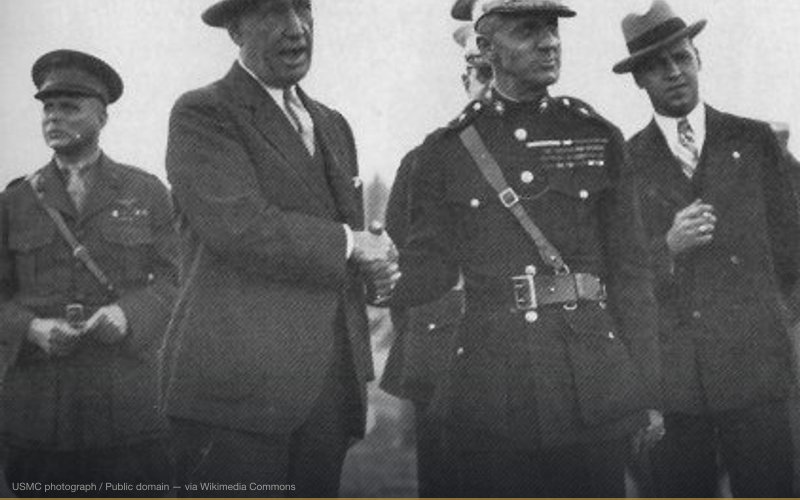
Butler, a lifelong patriot who would later publish War Is a Racket (1935) criticizing the military-industrial complex, instead reported the plot to the Special Committee on Un-American Activities chaired by Congressmen John McCormack and Samuel Dickstein. The committee’s investigation, conducted in November 1934, confirmed that a conspiracy existed and that Butler’s testimony was credible.
The Business Plot is classified as confirmed based on the congressional committee’s findings. However, its full scope remains debated because no conspirators were prosecuted, key testimony was taken in private, and the final report was heavily redacted. The episode is one of the most dramatic and least-known confirmed conspiracies in American history.
Origins & History
The Political Context
The Business Plot emerged in the context of the Great Depression and FDR’s New Deal. Roosevelt’s programs — which included banking regulation, securities oversight, labor protections, and social welfare spending — alarmed segments of the American business elite who viewed them as socialist overreach threatening the capitalist system. Some looked admiringly at European fascist movements, which had crushed labor unions and restored corporate power in Italy and Germany.
The Approach to Butler
In mid-1933, Gerald MacGuire, a bond salesman and veteran of the American Legion, approached General Butler. Over a series of meetings, MacGuire gradually revealed a plan to organize a massive veteran army under Butler’s leadership that would march on Washington and force Roosevelt to either accept a “Secretary of General Affairs” (effectively a fascist dictator controlling the government while Roosevelt served as a figurehead) or be removed from office.
Butler was an unusual choice for the conspirators — and a disastrously poor one. While famous and respected by veterans, Butler was a vocal populist who had grown increasingly critical of war profiteering. He played along with MacGuire to gather information before reporting to Congress.
The Financial Backers
Butler testified that MacGuire claimed the plot was backed by a group of wealthy men who could raise $300 million (equivalent to approximately $7 billion today). While MacGuire named some individuals during his conversations with Butler, the congressional committee’s public report was cautious about identifying specific backers.
Historians have connected the plot to the American Liberty League, a political organization formed in August 1934 and funded by the DuPont family, members of the J.P. Morgan banking circle, General Motors executives, and other major industrialists. The League publicly opposed the New Deal; the Business Plot allegedly represented its covert arm.
Key Confirmed Facts
- The plot existed: The McCormack-Dickstein Committee stated: “There is no question that these attempts were discussed, were planned, and might have been placed in execution”
- Butler’s testimony was credible: The committee explicitly found Butler to be a reliable witness
- MacGuire was involved: Gerald MacGuire was identified as a primary intermediary
- Financial backing was real: MacGuire demonstrated access to substantial funds and claimed connections to major financial figures
- European models were cited: The plotters explicitly referenced Mussolini’s Blackshirts and the French Croix-de-Feu as models for their veteran army
What Remains Disputed
- The full list of backers: The committee’s public report did not name all individuals Butler identified in private testimony. The redacted portions have never been fully released
- How serious the threat was: Some historians argue the plot was amateurish and never came close to execution; others contend it represented a genuine threat from the most powerful men in America
- Prescott Bush’s role: Prescott Bush (father and grandfather of two future presidents) has been linked to the plot through his business connections to the alleged conspirators, though direct evidence of his personal involvement is limited
- Why no prosecutions: Whether the lack of prosecution reflected insufficient evidence, political calculation by Roosevelt, or the influence of the plotters themselves remains debated
Cultural Impact
Historical Memory
The Business Plot remains remarkably obscure for a confirmed conspiracy to overthrow the American government. It receives minimal coverage in standard American history textbooks. This obscurity itself has become part of the narrative — cited as evidence of how powerful interests can suppress inconvenient history.
Smedley Butler’s Legacy
Butler’s role as whistleblower, combined with his subsequent publication of War Is a Racket, made him an enduring hero for anti-war and anti-corporate movements. His testimony is frequently cited in discussions of the military-industrial complex and corporate influence on government.
Modern Relevance
The Business Plot is invoked in contemporary discussions about the relationship between wealth, corporate power, and democracy. It is cited by both left-wing critics of corporate influence and conspiracy theorists who see it as evidence of a permanent ruling class willing to subvert democratic governance.
Timeline
- March 1933 — FDR inaugurated; begins implementing New Deal programs
- Mid-1933 — Gerald MacGuire first approaches General Butler
- 1933-1934 — MacGuire makes multiple visits to Butler, gradually revealing the plot
- August 1934 — American Liberty League founded by DuPont and Morgan interests
- November 1934 — Butler testifies before the McCormack-Dickstein Committee
- November 1934 — MacGuire testifies; denies the plot but is contradicted by evidence
- February 1935 — Committee’s final report confirms the conspiracy existed
- 1935 — Butler publishes War Is a Racket
- 1936 — Gerald MacGuire dies of pneumonia at age 37
- 2007 — BBC Radio 4 documentary “The White House Coup” brings renewed attention
Sources & Further Reading
- Archer, Jules. The Plot to Seize the White House. Hawthorn Books, 1973.
- Butler, Smedley D. War Is a Racket. Round Table Press, 1935.
- Schmidt, Hans. Maverick Marine: General Smedley D. Butler and the Contradictions of American Military History. University Press of Kentucky, 1987.
- US House of Representatives. Special Committee on Un-American Activities. “Investigation of Nazi Propaganda Activities and Investigation of Certain Other Propaganda Activities.” 1934-1935.
- Denton, Sally. The Plots Against the President: FDR, a Nation in Crisis, and the Rise of the American Right. Bloomsbury Press, 2012.
Frequently Asked Questions
What was the Business Plot?
Was the Business Plot real?
Why wasn't anyone arrested for the Business Plot?

Infographic
Share this visual summary. Right-click to save.
