Big Pharma Conspiracy Theories

Overview
“Big Pharma” conspiracy theories encompass a range of claims about the pharmaceutical industry, from the demonstrably true to the wildly unfounded. At one extreme, proponents allege that drug companies have cured diseases like cancer and AIDS but suppress these cures because chronic treatment is more profitable. At the other, critics point to documented cases of pharmaceutical fraud, price manipulation, and regulatory capture that represent genuine, confirmed abuses of corporate power.
This theory is classified as mixed because the pharmaceutical industry has a documented record of serious misconduct — including fraud, bribery, and concealment of deadly side effects — while the more extreme claims about suppressed miracle cures and deliberate population poisoning lack credible evidence. The challenge is distinguishing legitimate criticism of a powerful industry from conspiratorial thinking that rejects modern medicine entirely.
The conflation of real pharmaceutical scandals with unfounded conspiracy claims creates a dangerous feedback loop: genuine corporate malfeasance lends credibility to baseless theories, which in turn undermine public trust in medicines that save millions of lives.
Origins & History
The Thalidomide Disaster
Modern pharmaceutical skepticism traces to the thalidomide tragedy of the late 1950s and early 1960s, when the sedative thalidomide caused severe birth defects in thousands of children worldwide. The drug had been marketed as safe for pregnant women despite inadequate testing. The scandal led directly to the 1962 Kefauver-Harris Amendment, which required drug manufacturers to prove both safety and efficacy before FDA approval.
The Patent Medicine Legacy
Distrust of the pharmaceutical industry also builds on the historical memory of patent medicines — the 19th and early 20th century market of unregulated “cure-alls” that often contained alcohol, opium, cocaine, or toxic substances. The Pure Food and Drug Act of 1906 was a response to these abuses, but the cultural memory of snake-oil salesmen persists.
The Modern Conspiracy Framework
The contemporary Big Pharma conspiracy narrative crystallized in the 1990s and 2000s, driven by several factors: the AIDS crisis and ACT UP activism highlighting drug pricing, the explosion of direct-to-consumer pharmaceutical advertising (legal in the US since 1997), the rise of the internet enabling rapid dissemination of anti-pharma content, and a series of genuine pharmaceutical scandals that validated suspicion of the industry.
Key Claims
- Cure suppression: Drug companies have discovered cures for cancer, diabetes, and other chronic diseases but suppress them because ongoing treatment generates more revenue than one-time cures
- Regulatory capture: The FDA is controlled by the pharmaceutical industry through the revolving door of personnel, industry-funded approval processes, and lobbying
- Manufactured illness: Pharmaceutical companies invent or exaggerate conditions (such as ADHD, restless leg syndrome, or social anxiety disorder) to create markets for their drugs
- Research manipulation: Drug companies design clinical trials to produce favorable results, suppress negative findings, and ghostwrite medical literature
- Natural medicine suppression: Effective natural remedies, herbal treatments, and alternative therapies are suppressed because they cannot be patented and would undermine pharmaceutical profits
- Vaccine profiteering: Vaccines are pushed not because they’re necessary but because they generate revenue and create lifetime customers through adverse effects
What Is Confirmed
The Opioid Crisis
The most devastating confirmed pharmaceutical conspiracy of the modern era. Purdue Pharma, the Sackler family’s company, systematically lied about OxyContin’s addictive properties, aggressively marketed it to physicians, and funded misleading research claiming less than 1% of patients became addicted. The resulting opioid epidemic has killed over 500,000 Americans. In 2020, Purdue pleaded guilty to federal criminal charges. Multiple Sackler family members faced civil liability.
The Vioxx Scandal
Merck’s arthritis drug Vioxx (rofecoxib) was withdrawn in 2004 after an estimated 88,000-140,000 cases of heart disease in the US alone. Internal documents revealed Merck knew about cardiovascular risks years before withdrawal, manipulated research data, intimidated critical researchers, and ghostwrote favorable journal articles. Merck paid $4.85 billion to settle approximately 27,000 lawsuits.
Selective Publication
A landmark 2008 study in the New England Journal of Medicine showed that 94% of published trials of antidepressants reported positive results, while the FDA’s own data showed only 51% of trials were positive. Negative results were either not published or rewritten to appear positive. This confirmed bias in the medical literature driven by industry interests.
Criminal Fines
Major pharmaceutical companies have paid billions in criminal and civil penalties for fraud, illegal marketing, and kickbacks. Notable cases include GlaxoSmithKline ($3 billion, 2012), Pfizer ($2.3 billion, 2009), and Johnson & Johnson ($2.2 billion, 2013). These settlements confirm patterns of corporate misconduct.
What Is Not Supported
Cure Suppression
The claim that cures exist but are hidden fails on multiple levels. Cancer researchers worldwide work in thousands of independent institutions across dozens of countries with competing economic interests. A genuine cure would generate enormous revenue through patents and would be impossible to suppress across the global research community. Many breakthrough drugs (like Gilead’s hepatitis C cure Sovaldi) demonstrate that pharmaceutical companies can profit enormously from actual cures.
Natural Medicine Suppression
While the pharmaceutical industry has financial incentives to promote patented drugs over unpatentable natural substances, the claim that effective natural cures are being suppressed ignores that many successful drugs are derived from natural sources (aspirin from willow bark, taxol from yew trees, artemisinin from wormwood). Natural substances that demonstrate genuine efficacy in clinical trials are routinely studied and adopted.
Anti-Vaccine Claims
The claim that vaccines are unnecessary profit-driven products ignores that vaccines are among the least profitable pharmaceutical products, which is why many companies abandoned vaccine production in the 1990s-2000s, creating supply shortages that required government intervention.
Cultural Impact
Erosion of Medical Trust
Big Pharma conspiracy theories contribute to declining trust in medical institutions, with real consequences: vaccine hesitancy, refusal of effective treatments, and reliance on unproven alternatives. The COVID-19 pandemic demonstrated how pre-existing pharmaceutical distrust translated into resistance to vaccines and public health measures.
Alternative Medicine Industry
Ironically, the $140+ billion global alternative medicine industry — which promotes unproven supplements, homeopathy, and naturopathy — benefits directly from anti-pharma sentiment while itself operating with minimal regulation, efficacy requirements, or transparency.
Legitimate Reform Movements
Pharmaceutical conspiracy theories coexist with and sometimes undermine legitimate reform efforts around drug pricing, clinical trial transparency, conflict-of-interest regulations, and universal healthcare advocacy.
Timeline
- 1937 — Elixir Sulfanilamide disaster kills 107 people; leads to 1938 Federal Food, Drug, and Cosmetic Act
- 1957-1961 — Thalidomide causes birth defects worldwide; leads to 1962 Kefauver-Harris Amendment
- 1996 — Purdue Pharma launches OxyContin with aggressive marketing
- 1997 — FDA loosens rules on direct-to-consumer pharmaceutical advertising
- 2001 — Bayer withdraws Baycol (cerivastatin) after fatal rhabdomyolysis cases
- 2004 — Merck withdraws Vioxx after concealing heart attack risks
- 2008 — NEJM study reveals massive selective publication bias in antidepressant trials
- 2009 — Pfizer pays $2.3 billion for illegal marketing of Bextra
- 2012 — GlaxoSmithKline pays $3 billion for fraud and illegal marketing
- 2020 — Purdue Pharma pleads guilty to federal criminal charges over opioid deception
- 2021-2022 — COVID vaccines fuel new wave of pharmaceutical conspiracy theories
Sources & Further Reading
- Gøtzsche, Peter C. Deadly Medicines and Organised Crime: How Big Pharma Has Corrupted Healthcare. Radcliffe Publishing, 2013.
- Goldacre, Ben. Bad Pharma: How Drug Companies Mislead Doctors and Harm Patients. Faber & Faber, 2012.
- Angell, Marcia. The Truth About the Drug Companies. Random House, 2004.
- Macy, Beth. Dopesick: Dealers, Doctors, and the Drug Company That Addicted America. Little, Brown, 2018.
- Turner, Erick H., et al. “Selective Publication of Antidepressant Trials.” New England Journal of Medicine 358.3 (2008).
- US Department of Justice. Purdue Pharma plea agreement, 2020.
- Keefe, Patrick Radden. Empire of Pain: The Secret History of the Sackler Dynasty. Doubleday, 2021.
Frequently Asked Questions
Do pharmaceutical companies suppress cures for diseases?
Is Big Pharma a real conspiracy?
Does the FDA protect pharmaceutical companies?
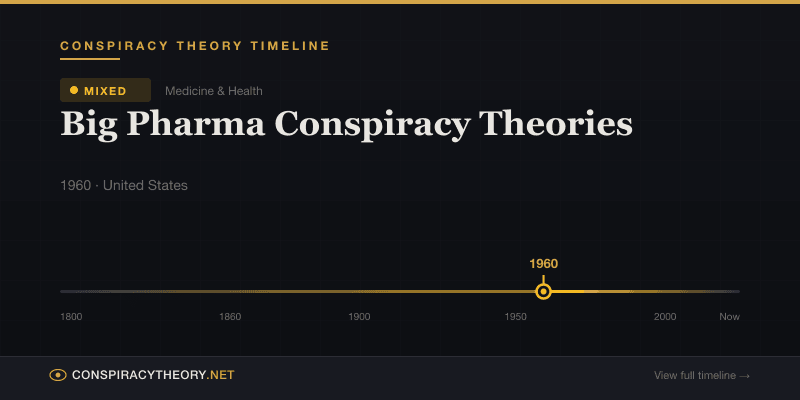
Infographic
Share this visual summary. Right-click to save.
