Nephilim / Biblical Giants — Archaeological Cover-Up
Overview
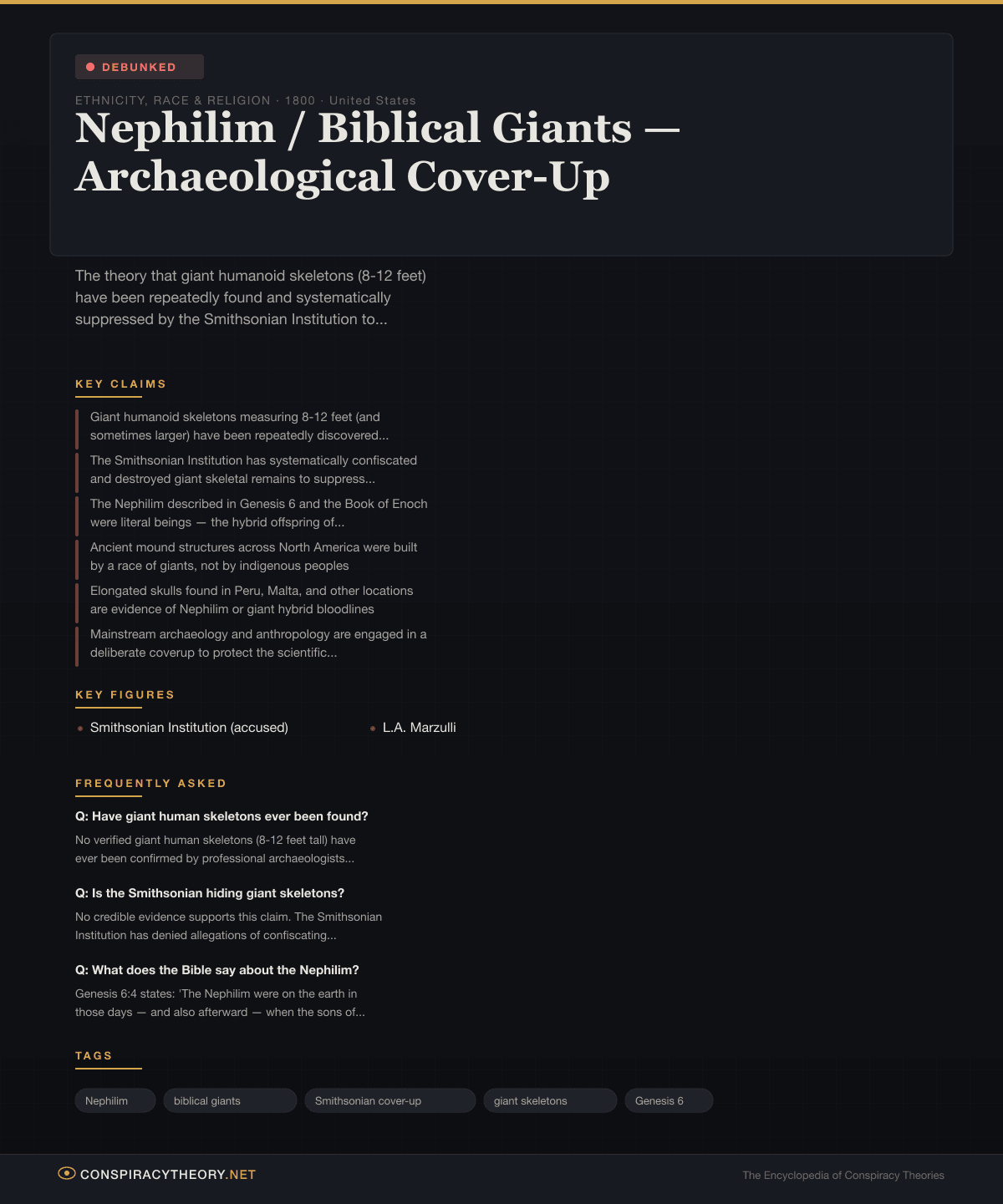
The theory that giant humanoid skeletons (8-12 feet) have been repeatedly found and systematically suppressed by the Smithsonian Institution to protect the Darwinian evolutionary narrative.
Origins & History
The story of the giants begins, as so many do, with a handful of enigmatic verses. Genesis 6:1-4 describes a time before the Flood when “the sons of God saw that the daughters of humans were beautiful, and they married any of them they chose.” Their offspring were the Nephilim — “the heroes of old, men of renown.” The passage is only four verses long, tantalizing in its brevity, and has generated more theological debate per word than almost any other section of the Hebrew Bible.
The 1 Book of Enoch, a Jewish apocalyptic text dating to the third century BCE that was excluded from the mainstream Biblical canon but preserved in the Ethiopian Orthodox tradition, expanded dramatically on the Genesis account. In Enoch’s telling, two hundred angels called Watchers descended to Mount Hermon, took human wives, and produced a race of giants 450 feet tall who devoured the earth’s resources and terrorized humanity. The Book of Enoch provided the narrative scaffolding that later giant enthusiasts would build upon — a detailed origin story of monstrous beings whose very existence challenged the natural order.
The archaeological dimension emerged in nineteenth-century America. As settlers expanded westward, they encountered earthen mounds built by indigenous cultures across the Ohio and Mississippi River valleys. The mounds — some enormous, like the Great Serpent Mound in Ohio — posed a question that many white settlers preferred not to answer honestly: who built them? Rather than credit Native American civilizations, a popular theory emerged that the mounds were built by a vanished race of giants, sometimes identified with the Biblical Nephilim. This “Mound Builder” myth served a dual purpose: it provided Biblical legitimacy for the new continent and conveniently erased indigenous achievement.
Throughout the 1800s and early 1900s, American newspapers published hundreds of accounts of giant skeleton discoveries. The New York Times, the Worthington Advance, the Clearfield Republican, and dozens of other papers ran stories describing the unearthing of human remains seven, eight, nine, even twelve feet in length. These reports typically followed a pattern: workers digging a foundation or farmers plowing a field would uncover enormous bones; a local authority would express amazement; and the bones would then disappear — sent to a museum, lost in transit, or simply never mentioned again.
The modern conspiracy theory crystallized around the Smithsonian Institution. Proponents argue that the Smithsonian — America’s largest museum and research complex — systematically collected giant skeletons from across the country and either locked them away in inaccessible storage or destroyed them outright. The motive, they claim, was to protect the Darwinian evolutionary narrative, which cannot accommodate a race of beings far exceeding normal human dimensions.
This theory was amplified in the twenty-first century by researchers like L.A. Marzulli, who produced a series of documentary films and books under the Watchers banner investigating alleged giant remains and Nephilim connections. The History Channel’s Search for the Lost Giants (2014) brought the topic to a mass television audience, treating the hunt with the earnest energy of a treasure-seeking adventure show.
In 2014, a satirical article published by World News Daily Report claimed that a U.S. Supreme Court ruling had forced the Smithsonian to release classified documents admitting to the destruction of thousands of giant skeletons. The article was entirely fabricated, but it went viral on social media, and its claims continue to circulate as fact in Nephilim communities despite multiple debunkings.
Key Claims
- Giant humanoid skeletons measuring 8-12 feet (and sometimes larger) have been repeatedly discovered across North America, the Middle East, and other regions throughout history
- The Smithsonian Institution has systematically confiscated and destroyed giant skeletal remains to suppress evidence that contradicts Darwinian evolution
- The Nephilim described in Genesis 6 and the Book of Enoch were literal beings — the hybrid offspring of fallen angels and human women — and their skeletal remains prove the historical accuracy of the Bible
- Ancient mound structures across North America were built by a race of giants, not by indigenous peoples
- Elongated skulls found in Peru, Malta, and other locations are evidence of Nephilim or giant hybrid bloodlines
- Mainstream archaeology and anthropology are engaged in a deliberate coverup to protect the scientific establishment from evidence that would undermine evolutionary theory
- Nineteenth-century newspaper accounts of giant skeleton discoveries constitute a reliable evidentiary record that mainstream science refuses to acknowledge
- Giants appear in mythologies worldwide — from Greek Titans to Norse Jotnar to the Patagonian giants described by Magellan’s chronicler — because they are racial memories of real beings
Evidence
The evidentiary foundation of the giant skeleton theory collapses under systematic examination.
The nineteenth-century newspaper reports, while numerous, were products of an era when American journalism operated under radically different standards. The late 1800s were the heyday of “tall tales” in American newspapers, when editors routinely published sensationalized, exaggerated, or entirely fabricated stories to attract readers. Researcher Jason Colavito has documented how many giant skeleton reports were reprinted from paper to paper without independent verification, often growing in height with each retelling. Critically, not a single report from this period has been corroborated by surviving physical specimens, institutional records, or photographs of the actual remains.
The Smithsonian conspiracy specifically has been examined and found baseless. The institution’s physical anthropology collection, housed at the National Museum of Natural History, is accessible to qualified researchers and has been catalogued extensively. No anomalous giant specimens exist in the collection. The Smithsonian’s historical records of acquisitions — including skeletal remains collected from mound excavations in the nineteenth century — are archived and available for scholarly review. They document the recovery of normal human remains, not giants.
The Mound Builder myth was definitively debunked by Cyrus Thomas in his 1894 Bureau of American Ethnology report, which conclusively demonstrated through systematic excavation that the mounds were built by ancestors of living Native American peoples. The giant skeleton claims associated with the mounds were not supported by any physical evidence Thomas or his team encountered across hundreds of excavations.
Elongated skulls, frequently cited as Nephilim evidence, are well understood by physical anthropologists. Artificial cranial deformation — the practice of binding infants’ heads to produce elongated skull shapes — was practiced by cultures worldwide, including the Paracas culture in Peru, various Mesoamerican civilizations, and communities in Europe, Africa, and Oceania. DNA analysis of Paracas skulls has confirmed they belong to anatomically modern humans. The elongation is a cultural modification, not a genetic anomaly.
The 2014 World News Daily Report article claiming a Supreme Court ruling against the Smithsonian has been debunked by Snopes, PolitiFact, and multiple other fact-checking organizations. The website’s own disclaimer identifies its content as satirical. No such court case exists in any legal database.
Individuals with pituitary gigantism can reach heights of 7-8 feet and have been documented archaeologically — such as a Roman-era skeleton found in Fidenae, Italy, measuring approximately 6 feet 8 inches, confirmed to show signs of gigantism. These are pathological cases within normal human biology, not evidence of a separate species or race.
Cultural Impact
The Nephilim giant theory occupies a fascinating crossroads between Biblical literalism, alternative archaeology, and anti-establishment conspiracy thinking. It draws its audience primarily from evangelical and fundamentalist Christian communities seeking archaeological confirmation of Biblical narratives, but it has also attracted secular conspiracy theorists suspicious of institutional science.
The theory has generated a substantial media ecosystem. L.A. Marzulli’s Watchers documentary series, Steve Quayle’s books including Genesis 6 Giants (2002), and Timothy Alberino’s investigations have created a genre of Nephilim-focused content that spans books, films, podcasts, and conferences. The annual True Legends conferences draw hundreds of attendees and feature presentations on giant remains, fallen angels, and alternative human history.
The impact on indigenous cultural heritage has been less discussed but is significant. The Mound Builder myth, which the giant skeleton theory perpetuates, was historically used to delegitimize Native American civilizations and justify territorial dispossession. By attributing the sophisticated engineering of mound complexes to a vanished race of Biblical giants rather than to the ancestors of living indigenous peoples, the theory continues a colonial-era erasure that professional archaeology has spent over a century correcting.
Within the broader conspiracy landscape, the Nephilim theory functions as a bridge between religious fundamentalism and secular conspiracy culture. It provides a Biblical framework for the idea that powerful institutions suppress inconvenient truths — a narrative structure that maps easily onto other conspiracy theories about suppressed technologies, hidden histories, and institutional coverups.
Sources & Further Reading
- Thomas, Cyrus. “Report on the Mound Explorations of the Bureau of Ethnology.” Twelfth Annual Report of the Bureau of American Ethnology. Washington: Government Printing Office, 1894.
- Colavito, Jason. “The Mound Builder Myth” and related investigations. JasonColavito.com, various dates.
- Charlesworth, James H., ed. The Old Testament Pseudepigrapha, Volume 1: Apocalyptic Literature and Testaments (includes 1 Enoch). New York: Doubleday, 1983.
- Quayle, Steve. Genesis 6 Giants: Master Builders of Prehistoric and Ancient Civilizations. Bozeman, MT: End Time Thunder Publishers, 2002.
- Marzulli, L.A. On the Trail of the Nephilim: Giant Skeletons and Ancient Megalithic Structures. Spiral of Life Publishing, 2013.
- Tiesler, Vera. “Artificial Cranial Deformation in the Pre-Columbian Maya.” KIVA: Journal of Southwestern Anthropology and History 69, no. 2 (2003): 169–186.
- Snopes. “Did a Supreme Court Rule the Smithsonian Must Release Giant Skeleton Documents?” Snopes.com, December 2014.
Frequently Asked Questions
Have giant human skeletons ever been found?
Is the Smithsonian hiding giant skeletons?
What does the Bible say about the Nephilim?

Infographic
Share this visual summary. Right-click to save.