Bermuda Triangle — Ships and Aircraft Disappear
Overview
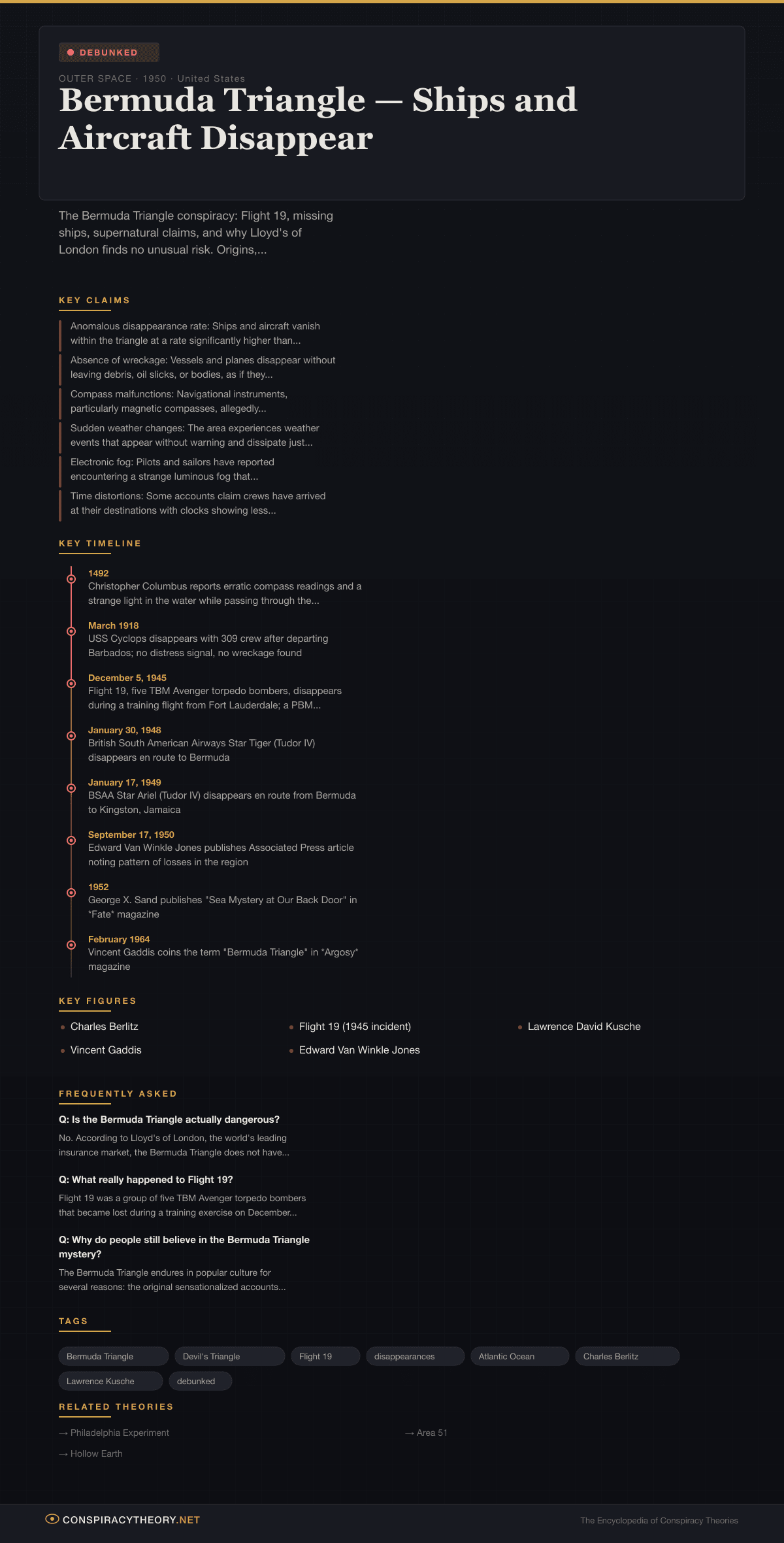
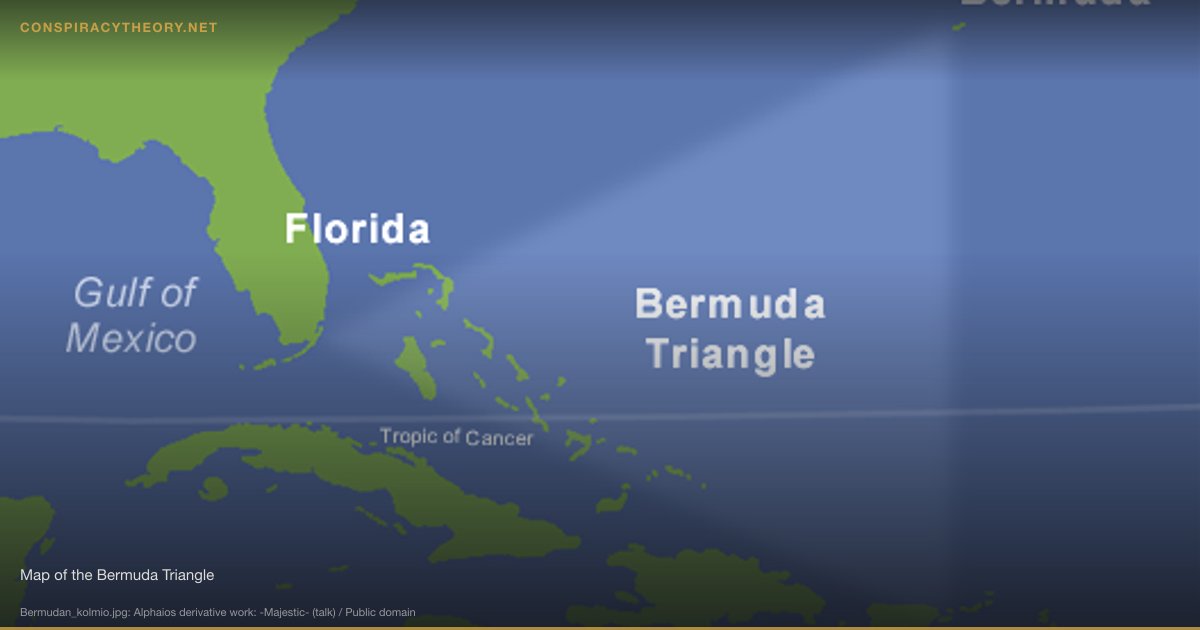
The Bermuda Triangle, also called the Devil’s Triangle, is a loosely defined region of the western North Atlantic Ocean roughly bounded by Miami, Bermuda, and Puerto Rico. Since the early 1960s, this approximately 500,000-square-mile stretch of ocean has been the subject of persistent claims that ships, aircraft, and their crews vanish within it at rates far exceeding those of comparable ocean regions, often under inexplicable or supernatural circumstances. Proposed explanations from proponents have ranged from magnetic anomalies and rogue waves to alien abduction, time warps, and remnants of the lost civilization of Atlantis.
The conspiracy theory rests on a selective catalog of maritime and aviation disasters — most prominently the December 1945 disappearance of Flight 19, a squadron of five United States Navy torpedo bombers — presented as evidence of some anomalous force operating within the triangle’s boundaries. Authors such as Vincent Gaddis, Charles Berlitz, and Richard Winer popularized the mystery through bestselling books in the 1960s and 1970s, transforming a collection of unrelated incidents into one of the twentieth century’s most recognizable paranormal legends.
The Bermuda Triangle is classified as debunked. Investigative journalist Lawrence David Kusche demonstrated in his 1975 book The Bermuda Triangle Mystery — Solved that the supposedly mysterious disappearances were the product of sloppy research, exaggeration, fabrication, and the omission of explanatory details readily available in official records. Lloyd’s of London, the world’s preeminent maritime insurance market, has confirmed that the Bermuda Triangle shows no statistical increase in vessel losses. The United States Coast Guard, the National Oceanic and Atmospheric Administration (NOAA), and the National Transportation Safety Board (NTSB) have all stated that disappearances in the region are neither unusual in number nor inexplicable in nature.
Origins & History
Early Reports and Edward Van Winkle Jones
The notion that the waters between Florida, Bermuda, and Puerto Rico might harbor some unusual danger predates the coining of the term “Bermuda Triangle” by more than a decade. On September 17, 1950, Edward Van Winkle Jones published an article in the Associated Press noting that an unusual number of ships and planes had been lost in the sea between the Florida coast and Bermuda. Jones’s article was brief and speculative, but it planted the seed of a pattern where none had been formally identified.
Two years later, in 1952, Fate magazine published an article by George X. Sand titled “Sea Mystery at Our Back Door,” which focused on several disappearances and the apparent difficulty in locating wreckage. Neither Jones nor Sand proposed supernatural explanations, but both framed the incidents as collectively unusual, establishing the editorial template that later writers would exploit.
Vincent Gaddis and the Naming of the Triangle
The term “Bermuda Triangle” first appeared in print in a February 1964 article by Vincent Gaddis in Argosy magazine titled “The Deadly Bermuda Triangle.” Gaddis compiled a list of disappearances and presented them as elements of a genuine mystery. He expanded this article into a chapter of his 1965 book Invisible Horizons: True Mysteries of the Sea, which placed the Bermuda Triangle alongside other maritime legends. Gaddis was the first to draw the triangle on a map and to argue explicitly that the area contained some force hostile to ships and aircraft.
The Berlitz Bestseller
The Bermuda Triangle entered the mainstream of popular culture with the 1974 publication of The Bermuda Triangle by Charles Berlitz, a linguist and author who had previously written bestselling language instruction books. Berlitz’s volume was a publishing phenomenon, selling nearly 20 million copies worldwide and being translated into 30 languages. It presented dozens of disappearances in dramatic prose, proposing explanations that included electromagnetic anomalies from the lost city of Atlantis, alien intervention, and distortions in the fabric of space-time.
Berlitz’s methodology was questionable at best. He frequently omitted critical details from official accident reports — weather conditions, mechanical failures, pilot errors — that would have provided mundane explanations for the incidents he described. He included cases that did not occur within the Bermuda Triangle’s boundaries, inflated the number of people aboard lost vessels, and in several documented instances fabricated details entirely. Despite these flaws, the book’s commercial success established the Bermuda Triangle as a cultural fixture and spawned a cottage industry of imitative books, documentaries, and television specials throughout the late 1970s and 1980s.
Lawrence Kusche and the Debunking
The most thorough rebuttal of the Bermuda Triangle legend came from Lawrence David Kusche, a research librarian and pilot at Arizona State University. Kusche undertook what none of the mystery’s promoters had done: he systematically checked the original sources — Coast Guard reports, Navy investigations, weather records, Lloyd’s of London data, and newspaper archives — for every incident cited in Berlitz’s book and other Bermuda Triangle literature.
His 1975 book The Bermuda Triangle Mystery — Solved was devastating. Kusche found that many of the supposedly mysterious incidents had well-documented explanations that Berlitz and others had simply omitted. Ships lost in storms were presented as having vanished on calm seas. Vessels that disappeared far outside the triangle were included in the count. Some incidents that supposedly had no explanation had, in fact, been explained at the time they occurred. A few entries in the Bermuda Triangle canon turned out not to have happened at all — Kusche could find no record that the ships or aircraft in question had ever existed.
Key Claims
Proponents of the Bermuda Triangle mystery have advanced numerous claims over the decades. The core assertions include:
- Anomalous disappearance rate: Ships and aircraft vanish within the triangle at a rate significantly higher than in other comparable ocean regions, suggesting an unknown force at work
- Absence of wreckage: Vessels and planes disappear without leaving debris, oil slicks, or bodies, as if they were removed from existence entirely
- Compass malfunctions: Navigational instruments, particularly magnetic compasses, allegedly malfunction within the triangle, pointing to electromagnetic anomalies
- Sudden weather changes: The area experiences weather events that appear without warning and dissipate just as quickly, catching crews off guard
- Electronic fog: Pilots and sailors have reported encountering a strange luminous fog that disables instruments and causes spatial disorientation
- Time distortions: Some accounts claim crews have arrived at their destinations with clocks showing less time elapsed than the journey should have required
- Supernatural and extraterrestrial forces: Explanations proposed by various authors include energy beams from the sunken city of Atlantis, alien abduction, gateways to other dimensions, and underwater UFO bases
The Case of Flight 19
No incident is more central to the Bermuda Triangle legend than the disappearance of Flight 19 on December 5, 1945. The event has been retold so many times, with so many embellishments, that separating the documented facts from the mythology requires careful attention to the official Navy investigation.
The Facts
Flight 19 consisted of five TBM Avenger torpedo bombers on a routine overwater navigation training exercise from Naval Air Station Fort Lauderdale, Florida. The flight was led by Lieutenant Charles Carroll Taylor, an experienced pilot with approximately 2,500 flight hours. The other four planes were piloted by student aviators, with a total of 14 men aboard the five aircraft.
The planned route was a triangular course: east to the Hen and Chicken Shoals for a practice bombing run, then north, and then southwest back to Fort Lauderdale. Weather conditions were fair to partly cloudy, with moderate seas.
Approximately 90 minutes into the flight, Taylor radioed that his compasses were malfunctioning and that he believed he was over the Florida Keys — far to the southwest of his actual position. Radio transmissions over the next several hours reveal a flight leader who was fundamentally disoriented. Taylor was almost certainly over the Bahamas, but his conviction that he was over the Keys led him to direct the flight northeast, believing this would take them over the Florida peninsula. In reality, the heading took them further out into the open Atlantic.
As fuel ran low and daylight faded, communications became intermittent. The last verified radio contact occurred at approximately 7:04 p.m. The five Avengers were never found.
The Search and the Mariner Explosion
The Navy launched an immediate search that would become one of the largest air-sea rescue operations in history to that point. Among the search aircraft was a PBM-5 Mariner flying boat, Bureau Number 59225, carrying a crew of 13. At 7:50 p.m., the crew of the SS Gaines Mills reported observing an explosion in the air and subsequently sailing through an oil slick and debris at the Mariner’s projected position. No survivors were found.
The Mariner’s loss is often presented by Bermuda Triangle authors as an additional mystery — “a rescue plane vanishing while searching for the lost flight.” In reality, PBM Mariners were well known among Navy aircrews for chronic fuel vapor leaks that earned them the grim nickname “flying gas tanks.” The Navy Board of Investigation concluded that the Mariner had suffered a mid-air explosion due to fuel vapor ignition, an explanation consistent with the type’s known deficiencies and the physical evidence observed by the Gaines Mills.
How the Legend Was Built
The Navy’s original investigation attributed Flight 19’s loss to Taylor’s navigational error, though this finding was later amended to “causes or reasons unknown” at the request of Taylor’s family. This administrative change — intended as a kindness to the deceased pilot’s relatives — inadvertently provided ammunition for mystery writers who could now point to the Navy’s official conclusion as evidence of the inexplicable.
Berlitz and subsequent authors further embellished the story. In some retellings, Taylor’s preflight statement “I just don’t want to go” became evidence of a premonition. The routine training exercise was recast as a mission into uncharted waters. The compass malfunction — plausibly explained by a known defect in the Avenger’s compass system or by pilot error — became evidence of an electromagnetic anomaly. The reasonable explanation that the planes ran out of fuel and ditched into rough winter seas, where they would sink rapidly, was dismissed in favor of the assertion that they had simply vanished.
Evidence & Debunking
Statistical Analysis
The most fundamental debunking of the Bermuda Triangle comes from statistics. Lloyd’s of London conducted a review of shipping losses worldwide and concluded that the Bermuda Triangle did not present an unusual hazard. The number of vessels lost in the region is proportional to the volume of traffic passing through it — which is substantial, given that the area includes major shipping lanes between the Americas, Europe, and the Caribbean.
The United States Coast Guard has similarly stated: “The Coast Guard does not recognize the existence of the so-called Bermuda Triangle as a geographic area of specific hazard to ships or aircraft. In a review of many aircraft and vessel losses in the area over the years, there has been nothing discovered that would indicate that casualties were the result of anything other than physical causes. No extraordinary factors have ever been identified.”
Environmental Explanations
The Bermuda Triangle encompasses waters that are genuinely hazardous for entirely natural reasons, which paradoxically both explains the real incidents and undermines the need for supernatural hypotheses:
- The Gulf Stream: One of the world’s most powerful ocean currents flows through the triangle, capable of rapidly dispersing wreckage and carrying debris far from the site of an accident, which explains the frequent absence of wreckage at a vessel’s last known position
- Sudden storms: The tropical and subtropical waters of the western Atlantic are prone to sudden, intense thunderstorms and waterspouts that can develop faster than weather forecasts can predict, particularly before the satellite era
- Shallow waters: Extensive shoals throughout the Bahamas and Caribbean can ground vessels unexpectedly, and the transition from shallow to extremely deep water (the Puerto Rico Trench reaches depths exceeding 27,000 feet) means that wreckage sinking in deep zones may never be recovered
- Methane hydrates: Geological surveys have identified large deposits of methane hydrates on the ocean floor in parts of the triangle. Theoretical models suggest that a sudden release of methane gas could reduce water density enough to sink a ship, though no such event has been documented in the region during the modern era
- Magnetic variation: The Bermuda Triangle is one of two places on Earth where magnetic north and true north align (a phenomenon called agonic line), which can cause compass errors if navigators fail to account for the absence of the expected magnetic declination. This well-understood navigational factor has been misleadingly presented as a mysterious “compass anomaly”
Kusche’s Specific Findings
Lawrence Kusche’s case-by-case investigation yielded consistent patterns of error in the Bermuda Triangle literature:
- The Rosalie (1840): Berlitz described finding a ship completely abandoned with cargo intact and no sign of the crew. Kusche found the actual vessel was named the Rossini, was found partially dismasted after a storm, and its crew had been rescued by a passing vessel
- The Ellen Austin (1881): The popular account claims a derelict ship was found, a prize crew was placed aboard, and both the derelict and prize crew vanished. Kusche found that the story varied wildly between sources and that the earliest versions contained no mention of a disappearance
- The Cyclops (1918): The USS Cyclops, a Navy collier carrying 309 men, did disappear without a trace. However, the ship was overloaded with manganese ore, had a history of structural problems, was captained by an officer facing a criminal investigation, and vanished during wartime in an area patrolled by German U-boats. The loss is tragic but far from inexplicable
- The Star Tiger and Star Ariel (1948-1949): Two British South American Airways Tudor IV aircraft were lost on routes near Bermuda. Bermuda Triangle authors present these as paired mysteries. Aviation investigators noted that the Tudor IV had a troubled service record, poor heating systems that could incapacitate crews at altitude, and design flaws that were serious enough to lead to the type’s withdrawal from passenger service
Cultural Impact
Books and Publishing
The Bermuda Triangle generated a publishing phenomenon that extended well beyond Berlitz’s original bestseller. Richard Winer’s The Devil’s Triangle (1974), John Wallace Spencer’s Limbo of the Lost (1969), and dozens of imitators kept the topic alive throughout the 1970s and 1980s. The subject became a staple of “unexplained mysteries” anthologies and encyclopedias of the paranormal. Kusche’s debunking book, while well-received by critics and scientists, sold far fewer copies than the works it debunked — a pattern common to sensationalist claims and their corrections.
Film and Television
Steven Spielberg’s Close Encounters of the Third Kind (1977) opens with the discovery of Flight 19’s Avengers in the Sonoran Desert — placed there by extraterrestrials — cementing the connection between the Bermuda Triangle and UFO mythology in popular culture. Numerous television documentaries have covered the topic, ranging from credulous presentations on series like In Search Of… (hosted by Leonard Nimoy) to skeptical examinations on programs like NOVA and The UnXplained. The 2005 Sci-Fi Channel miniseries The Triangle and the 2012 BBC drama The Bermuda Triangle brought fictional versions of the mystery to prime-time audiences.
Gaming, Music, and Broader Media
The Bermuda Triangle has appeared as a setting or plot device in numerous video games, board games, and musical works. The region’s name has become a widely understood cultural shorthand for any situation in which things mysteriously vanish, used colloquially in contexts entirely removed from maritime navigation.
Impact on Paranormal Discourse
The Bermuda Triangle occupies an important place in the broader history of paranormal and conspiracy culture. Its popularity in the 1970s coincided with a peak of public interest in UFOs, psychic phenomena, and ancient mysteries. The triangle served as a gateway topic, introducing general audiences to a worldview in which official explanations were inherently suspect and hidden forces operated just beyond the reach of mainstream science. In this sense, the Bermuda Triangle functioned as a precursor to later conspiracy movements that similarly relied on selective evidence, distrust of institutional authority, and the appeal of secret knowledge.
Timeline
- 1492 — Christopher Columbus reports erratic compass readings and a strange light in the water while passing through the region; frequently cited by Bermuda Triangle authors, though Columbus’s logs describe navigation phenomena common throughout the Atlantic
- March 1918 — USS Cyclops disappears with 309 crew after departing Barbados; no distress signal, no wreckage found
- December 5, 1945 — Flight 19, five TBM Avenger torpedo bombers, disappears during a training flight from Fort Lauderdale; a PBM Mariner search plane also lost the same evening
- January 30, 1948 — British South American Airways Star Tiger (Tudor IV) disappears en route to Bermuda
- January 17, 1949 — BSAA Star Ariel (Tudor IV) disappears en route from Bermuda to Kingston, Jamaica
- September 17, 1950 — Edward Van Winkle Jones publishes Associated Press article noting pattern of losses in the region
- 1952 — George X. Sand publishes “Sea Mystery at Our Back Door” in Fate magazine
- February 1964 — Vincent Gaddis coins the term “Bermuda Triangle” in Argosy magazine
- 1965 — Gaddis publishes Invisible Horizons, expanding the Bermuda Triangle chapter
- 1969 — John Wallace Spencer publishes Limbo of the Lost
- 1974 — Charles Berlitz publishes The Bermuda Triangle; sells nearly 20 million copies worldwide
- 1975 — Lawrence David Kusche publishes The Bermuda Triangle Mystery — Solved, systematically debunking the claims
- 1977 — Steven Spielberg’s Close Encounters of the Third Kind opens with the discovery of Flight 19 aircraft
- 2013 — World Wildlife Fund study of the world’s most dangerous shipping lanes omits the Bermuda Triangle entirely
- 2017 — NOAA publishes an official statement: “There is no evidence that mysterious disappearances occur with any greater frequency in the Bermuda Triangle than in any other large, well-traveled area of the ocean”
Sources & Further Reading
- Kusche, Lawrence David. The Bermuda Triangle Mystery — Solved. Harper & Row, 1975.
- Berlitz, Charles. The Bermuda Triangle. Doubleday, 1974.
- Gaddis, Vincent. “The Deadly Bermuda Triangle.” Argosy, February 1964.
- Gaddis, Vincent. Invisible Horizons: True Mysteries of the Sea. Chilton Books, 1965.
- Winer, Richard. The Devil’s Triangle. Bantam Books, 1974.
- United States Navy. “Flight 19 Board of Investigation Report.” Naval Historical Center, 1946.
- United States Coast Guard. “Does the Bermuda Triangle Really Exist?” USCG Navigation Center FAQ.
- National Oceanic and Atmospheric Administration. “What Is the Bermuda Triangle?” NOAA Ocean Facts.
- Nickell, Joe. “The Bermuda Triangle and the Supernatural.” Skeptical Inquirer, 2003.
- Randi, James. Flim-Flam! Psychics, ESP, Unicorns, and Other Delusions. Prometheus Books, 1982.
- Radford, Benjamin. “The Bermuda Triangle: Mysterious or Misunderstood?” Live Science, 2012.
- Lloyd’s of London. Maritime Loss Records, Atlantic Region.
Frequently Asked Questions
Is the Bermuda Triangle actually dangerous?
What really happened to Flight 19?
Why do people still believe in the Bermuda Triangle mystery?
Infographic
Share this visual summary. Right-click to save.