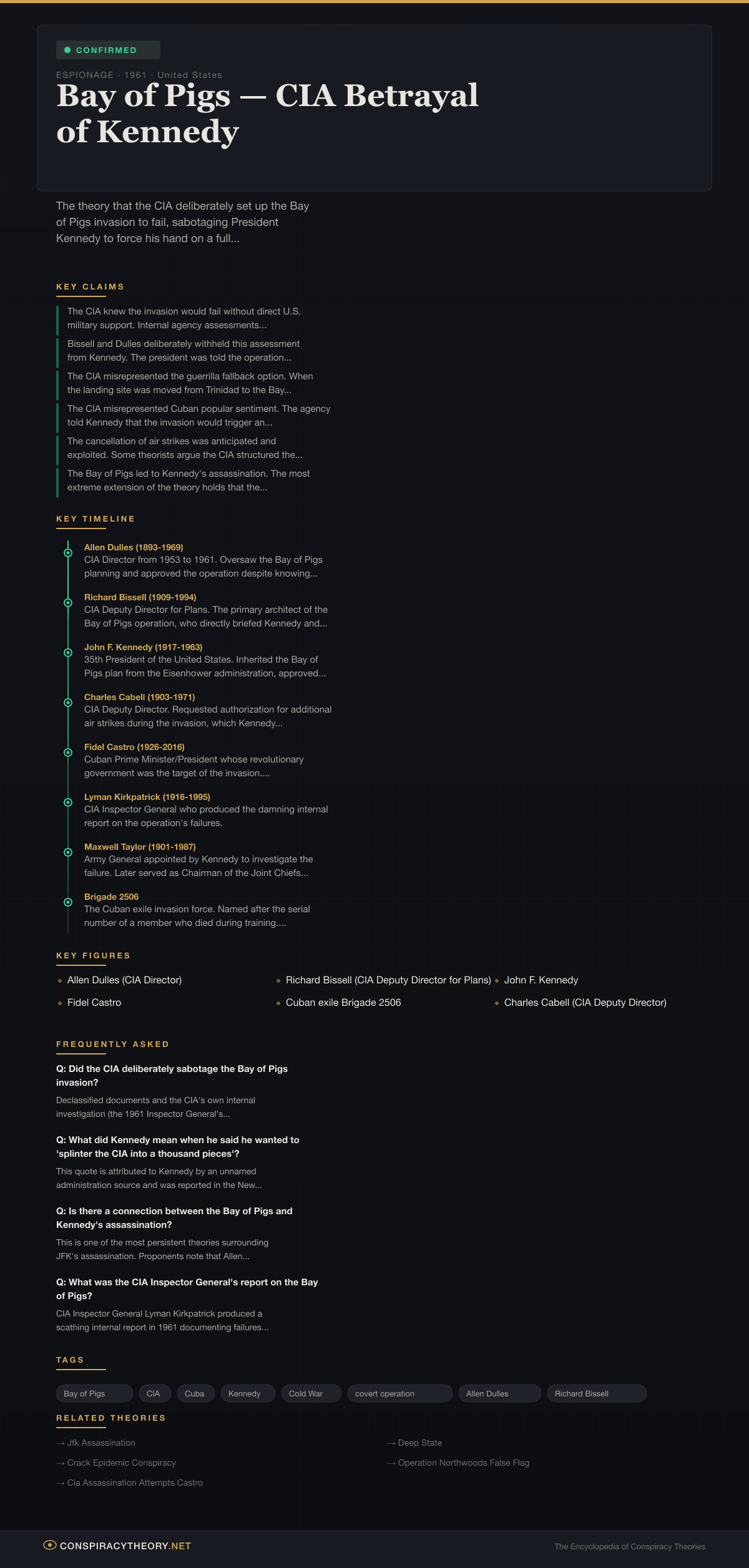
Bay of Pigs — CIA Betrayal of Kennedy
Overview
On April 17, 1961, approximately 1,400 Cuban exiles trained and equipped by the Central Intelligence Agency landed at the Bay of Pigs on Cuba’s southern coast in an attempt to overthrow Fidel Castro’s government. Within three days, the invasion force — known as Brigade 2506 — was crushed by the Cuban military. The operation was a humiliating failure for the United States and a personal political disaster for the newly inaugurated President John F. Kennedy.
The conspiracy theory — now largely confirmed by declassified documents — holds that senior CIA officials deliberately set the operation up to fail. Not out of loyalty to Castro, but as a calculated gambit: by engineering a crisis on the beach, the CIA expected to force Kennedy into authorizing the direct U.S. military intervention (particularly air strikes and naval support) that the operation actually required to succeed. When Kennedy refused to escalate, the invasion collapsed, but the CIA’s institutional gamble was exposed.
The CIA’s own Inspector General report, produced in 1961 but not declassified until 1998, confirmed that the agency had withheld critical intelligence from Kennedy, misrepresented the operation’s chances of success, and proceeded with a plan it knew could not work without the full U.S. military commitment that the president had explicitly prohibited. The aftermath reshaped the relationship between the presidency and the intelligence community, led to the firing of CIA Director Allen Dulles and two top deputies, and — according to some theorists — set in motion a chain of events that culminated in Kennedy’s assassination two and a half years later.
Origins & History
The Eisenhower Inheritance
The Bay of Pigs operation did not originate with Kennedy. In March 1960, President Dwight D. Eisenhower authorized the CIA to develop a plan for removing Castro from power. The original concept was a guerrilla campaign — small teams of Cuban exiles infiltrating the island to organize internal resistance and destabilize the regime from within.
Under the direction of Richard Bissell, the CIA’s Deputy Director for Plans (the title for the head of covert operations), the plan rapidly evolved from guerrilla infiltration into a full-scale amphibious invasion. This transformation occurred without the corresponding military analysis that such an operation demanded. The invasion plan was developed within the CIA’s Directorate of Plans rather than by the Joint Chiefs of Staff, meaning it lacked the rigorous military planning that an amphibious assault requires.
By the time Kennedy took office on January 20, 1961, he inherited an operation already in advanced preparation. Brigade 2506 was training in Guatemala. Arms and equipment had been procured. Cuban exile leaders had been recruited and briefed. The operation had its own bureaucratic momentum.
The Briefings Kennedy Received
Kennedy was briefed on the operation in the weeks after his inauguration. What he was told — and what he was not told — is the crux of the conspiracy.
Bissell and Dulles presented the plan to Kennedy as having a reasonable chance of success even without direct U.S. military involvement. They told the president that upon landing, the invasion force would spark a popular uprising against Castro, with thousands of Cubans joining the rebel cause. They assured Kennedy that if the beach landing failed, the invaders could melt into the Escambray Mountains and continue as guerrillas.
Both of these assurances were false, and the CIA knew it.
The agency’s own intelligence assessments showed that Castro had broad popular support and that a spontaneous uprising was extremely unlikely. The original landing site near the city of Trinidad offered access to the Escambray Mountains, but when Kennedy rejected it as too conspicuous (wanting plausible deniability of U.S. involvement), the landing was moved to the Bay of Pigs — a location surrounded by impassable swamps with no guerrilla fallback option. The CIA made this change without informing Kennedy that it eliminated the guerrilla alternative.
The Invasion
The operation began on April 15, 1961, with air strikes by B-26 bombers painted in Cuban Air Force markings, flown by Cuban exile pilots from Nicaragua. The strikes targeted Cuban airfields but failed to destroy Castro’s air force — critically, several T-33 jet trainers and Sea Fury fighters survived. Kennedy, concerned about the transparency of U.S. involvement after the air strikes generated international outrage, cancelled the second wave of air strikes planned for April 17.
Brigade 2506 landed at the Bay of Pigs early on April 17. The landing achieved initial surprise, but the surviving Cuban air force quickly established air superiority, sinking the brigade’s supply ships — including the vessel carrying most of their ammunition and communications equipment. Without supplies, air cover, or the promised popular uprising, the invasion force was overwhelmed.
By April 19, the operation was over. Of the approximately 1,400 invaders, 114 were killed and 1,189 were captured. They were eventually ransomed for $53 million in food and medicine in December 1962.
Kennedy’s Response
Kennedy was furious. He publicly accepted responsibility for the failure — famously remarking that “victory has a hundred fathers, and defeat is an orphan” — but privately blamed the CIA for deceiving him. According to multiple accounts from administration insiders, Kennedy felt he had been manipulated into approving an operation designed to force his hand.
The reported statement that Kennedy wanted to “splinter the CIA into a thousand pieces and scatter it to the winds” — first published in the New York Times in 1966, attributed to an unnamed official — captured the intensity of the rupture between the White House and Langley.
Kennedy took concrete action. In September 1961, he fired Allen Dulles as CIA Director. Deputy Director Charles Cabell and Deputy Director for Plans Richard Bissell were also forced out. Kennedy signed National Security Action Memorandum 55 (NSAM 55), which shifted responsibility for peacetime military operations from the CIA to the Joint Chiefs of Staff, and NSAM 57, which established that large-scale paramilitary operations would be conducted by the military rather than the CIA.
Key Claims
-
The CIA knew the invasion would fail without direct U.S. military support. Internal agency assessments recognized that 1,400 men could not overthrow a government commanding 200,000 troops and a loyal militia. Success required air superiority and naval support that Kennedy had ruled out.
-
Bissell and Dulles deliberately withheld this assessment from Kennedy. The president was told the operation could succeed on its own merits. The expectation was that once men were dying on the beach, Kennedy would be forced to authorize military intervention rather than accept the political consequences of failure.
-
The CIA misrepresented the guerrilla fallback option. When the landing site was moved from Trinidad to the Bay of Pigs, the guerrilla alternative was eliminated by the surrounding swamps. Kennedy was not informed of this change in the operation’s risk profile.
-
The CIA misrepresented Cuban popular sentiment. The agency told Kennedy that the invasion would trigger an uprising. Its own intelligence showed this was unlikely.
-
The cancellation of air strikes was anticipated and exploited. Some theorists argue the CIA structured the air campaign knowing Kennedy would likely cancel follow-up strikes once international criticism mounted, creating the failure scenario that would justify escalation.
-
The Bay of Pigs led to Kennedy’s assassination. The most extreme extension of the theory holds that the CIA’s institutional fury at Kennedy’s post-invasion reforms, combined with anti-Castro Cuban exile rage at his refusal to provide air support, created the motive and means for his assassination in Dallas on November 22, 1963.
Evidence
The CIA Inspector General’s Report (1961/1998)
The most important document confirming the conspiracy is the CIA’s own Inspector General report, produced by Lyman Kirkpatrick in 1961. This classified document was so damaging that Director Dulles ordered all copies destroyed except one, which was locked in the CIA Director’s safe.
The report was declassified in 1998 and confirmed the core allegations:
- The CIA had proceeded with an operation it knew could not succeed as planned
- Agency officials had presented an “overly optimistic” picture to the president
- Security failures had compromised the operation before it began (Castro’s intelligence services were aware of the invasion plans)
- Planning was inadequate for an amphibious operation of this scale
- The agency had failed to develop contingency plans for the operation’s failure
The Taylor Committee Report
Immediately after the disaster, Kennedy appointed General Maxwell Taylor to lead an investigation. The Taylor Committee’s classified report found that the CIA had “failed to appraise the president and his advisors in a realistic manner” about the operation’s prospects. It noted that no one in the CIA or the Joint Chiefs of Staff had ever told Kennedy plainly that the operation could not succeed without U.S. military intervention.
The Joint Chiefs’ Qualified Assessment
The Joint Chiefs of Staff reviewed the CIA’s plan and rated its chance of success as “fair” — a notably lukewarm assessment for a military operation. However, this qualification was not clearly communicated to Kennedy. Years later, members of the JCS testified that they had assumed direct U.S. military support would be provided if needed, an assumption that was never presented to the president as a condition of their assessment.
Personal Accounts
Multiple Kennedy administration figures — including Arthur Schlesinger Jr., Theodore Sorensen, and Robert Kennedy — documented the president’s belief that he had been deliberately misled. Robert Kennedy later told journalist Jack Newfield that his brother believed the CIA had set up the invasion to fail in order to force escalation.
Richard Bissell himself, in a 1984 oral history recorded before his death, acknowledged that the CIA had been “overly optimistic” in its assessments but framed this as institutional bias rather than deliberate deception.
Allen Dulles’s Writings
A document found in Allen Dulles’s papers after his death, analyzed by historian Lucien S. Vandenbroucke, reveals that Dulles operated on the assumption that the president would authorize whatever support was necessary once the operation was underway. Dulles wrote that “when the chips were down — when the crisis arose in reality — no president could let it fail.” This document confirms that the CIA’s leadership planned for a presidential escalation that Kennedy had explicitly prohibited.
Debunking / Verification
This theory is classified as confirmed based on the weight of declassified documentary evidence.
The core claim — that the CIA withheld critical intelligence from President Kennedy and misrepresented the operation’s chances of success — has been verified by the CIA’s own Inspector General report, the Taylor Committee investigation, declassified CIA cables and memoranda, and the personal testimony of multiple participants.
The more specific claim that the deception was a deliberate strategy to force presidential escalation is supported by the Dulles memorandum and the logical framework of the operation as planned. The CIA leadership designed an operation that required direct U.S. military intervention to succeed, told the president it could succeed without such intervention, and expected that the unfolding crisis would compel Kennedy to provide the support they had planned for all along.
What remains debated is the degree of intentionality. Defenders of Dulles and Bissell characterize the failures as institutional groupthink, bureaucratic momentum, and the cognitive bias of operators who had invested years in the project. Critics argue the pattern of deception was too systematic and too consistent to be accidental.
The claimed connection between the Bay of Pigs and Kennedy’s assassination remains unresolved. While the circumstantial links are numerous and suggestive — Dulles on the Warren Commission, Cuban exile involvement in various assassination theories, the documented hostility between Kennedy and the CIA — no direct evidentiary chain connects the Bay of Pigs to Dallas.
Cultural Impact
The Bay of Pigs invasion became a defining moment in the relationship between the American presidency and the intelligence community. Kennedy’s experience — being manipulated by his own intelligence agency into a catastrophic foreign policy failure — established a template for presidential distrust of the CIA that persisted through subsequent administrations.
The incident introduced the concept of “plausible deniability” into American political discourse. The entire operation was structured to allow the U.S. government to deny involvement — a fiction that collapsed almost immediately but that became a permanent feature of covert operations doctrine.
The failure also shaped the Cuban Missile Crisis of October 1962. Kennedy’s experience at the Bay of Pigs made him deeply skeptical of military and intelligence advice during the missile crisis, leading him to resist pressure for air strikes and invasion in favor of a naval blockade. Several historians have argued that Kennedy’s Bay of Pigs experience — specifically his understanding that institutions could pursue their own agendas against presidential wishes — was critical to his management of the most dangerous moment of the Cold War.
The event permanently radicalized segments of the Cuban exile community, who felt betrayed by Kennedy’s refusal to provide air support. This bitterness became a significant element in the political landscape of South Florida and in various theories about Kennedy’s assassination.
Within the CIA, the Bay of Pigs led to a fundamental restructuring. The agency’s monopoly on covert paramilitary operations was broken, oversight mechanisms were strengthened, and the personal power of the Director was curtailed. These reforms, however, were incomplete and were partially reversed in later administrations.
In Popular Culture
- Film: The Bay of Pigs (various documentaries); the invasion features prominently in Oliver Stone’s JFK (1991) as part of the assassination conspiracy narrative; Thirteen Days (2000) references the Bay of Pigs as context for the Cuban Missile Crisis; The Good Shepherd (2006) explores CIA culture
- Television: Featured in The Kennedys (2011 miniseries); Manhattan references the operation; numerous documentary series
- Literature: Peter Wyden’s Bay of Pigs: The Untold Story (1979); Jim Rasenberger’s The Brilliant Disaster (2011); Howard Jones’s The Bay of Pigs (2008)
- Non-fiction: Theodore Sorensen’s Kennedy (1965); Arthur Schlesinger Jr.’s A Thousand Days (1965); Evan Thomas’s The Very Best Men (1995)
Key Figures
- Allen Dulles (1893-1969) — CIA Director from 1953 to 1961. Oversaw the Bay of Pigs planning and approved the operation despite knowing its limitations. Fired by Kennedy in September 1961. Later served on the Warren Commission investigating Kennedy’s assassination, a fact conspiracy theorists find deeply significant.
- Richard Bissell (1909-1994) — CIA Deputy Director for Plans. The primary architect of the Bay of Pigs operation, who directly briefed Kennedy and is confirmed to have withheld critical intelligence about the operation’s prospects. Forced to resign in February 1962.
- John F. Kennedy (1917-1963) — 35th President of the United States. Inherited the Bay of Pigs plan from the Eisenhower administration, approved it with the understanding it could succeed without direct U.S. military involvement, and accepted public responsibility for its failure while privately blaming the CIA.
- Charles Cabell (1903-1971) — CIA Deputy Director. Requested authorization for additional air strikes during the invasion, which Kennedy denied. Forced to resign in January 1962. His brother, Earle Cabell, was the Mayor of Dallas at the time of Kennedy’s assassination — another coincidence noted by conspiracy theorists.
- Fidel Castro (1926-2016) — Cuban Prime Minister/President whose revolutionary government was the target of the invasion. Castro’s intelligence services had advance knowledge of the operation.
- Lyman Kirkpatrick (1916-1995) — CIA Inspector General who produced the damning internal report on the operation’s failures.
- Maxwell Taylor (1901-1987) — Army General appointed by Kennedy to investigate the failure. Later served as Chairman of the Joint Chiefs of Staff and Ambassador to South Vietnam.
- Brigade 2506 — The Cuban exile invasion force. Named after the serial number of a member who died during training. Approximately 1,400 men participated in the invasion.
Timeline
- March 1960 — President Eisenhower authorizes CIA to develop plan for removing Castro
- 1960 — CIA recruits and begins training Cuban exiles in Guatemala; plan evolves from guerrilla infiltration to amphibious invasion
- January 20, 1961 — Kennedy inaugurated; inherits Bay of Pigs plan
- January-March 1961 — CIA briefs Kennedy on operation; misrepresents prospects of success
- March 1961 — Kennedy rejects Trinidad landing site; CIA moves operation to Bay of Pigs without informing Kennedy of altered risk profile
- April 15, 1961 — Pre-invasion air strikes partially destroy Cuban air force; international outcry follows
- April 16, 1961 — Kennedy cancels second wave of air strikes
- April 17, 1961 — Brigade 2506 lands at Bay of Pigs; Cuban air force sinks supply ships
- April 19, 1961 — Invasion force surrenders; 114 killed, 1,189 captured
- April 21, 1961 — Kennedy accepts public responsibility; privately blames CIA
- June 1961 — Taylor Committee investigation begins
- Late 1961 — Kirkpatrick Inspector General report completed; Dulles orders copies destroyed
- September 1961 — Kennedy fires Allen Dulles as CIA Director
- November 1961 — Kennedy signs NSAM 55 and 57, restructuring covert operations oversight
- February 1962 — Bissell and Cabell forced to resign
- December 1962 — Brigade 2506 prisoners ransomed for $53 million in food and medicine
- November 22, 1963 — Kennedy assassinated in Dallas
- 1998 — CIA Inspector General’s report on Bay of Pigs declassified
- 2011 — CIA releases additional Bay of Pigs documents through internal review
Sources & Further Reading
- Kornbluh, Peter, ed. Bay of Pigs Declassified: The Secret CIA Report on the Invasion of Cuba. The New Press, 1998.
- Rasenberger, Jim. The Brilliant Disaster: JFK, Castro, and America’s Doomed Invasion of Cuba’s Bay of Pigs. Scribner, 2011.
- Jones, Howard. The Bay of Pigs. Oxford University Press, 2008.
- Wyden, Peter. Bay of Pigs: The Untold Story. Simon & Schuster, 1979.
- Thomas, Evan. The Very Best Men: The Daring Early Years of the CIA. Simon & Schuster, 1995.
- Schlesinger, Arthur M. Jr. A Thousand Days: John F. Kennedy in the White House. Houghton Mifflin, 1965.
- Vandenbroucke, Lucien S. “The ‘Confessions’ of Allen Dulles: New Evidence on the Bay of Pigs.” Diplomatic History 8, no. 4 (1984): 365-375.
- CIA Inspector General’s Survey of the Cuban Operation (Kirkpatrick Report), 1961. Declassified 1998.
- National Security Archive, George Washington University. Bay of Pigs Chronology and Declassified Documents Collection.
Related Theories
- JFK Assassination — Theories connecting Kennedy’s murder to his conflicts with the CIA, Cuban exiles, and the military-industrial complex
- Deep State — The broader theory of a permanent government operating independently of elected leadership
- CIA Drug Trafficking — Allegations of CIA involvement in narcotics trafficking, often linked to covert operations funding
- Operation Northwoods — A confirmed plan by the Joint Chiefs to stage false flag attacks to justify invasion of Cuba, rejected by Kennedy
- Operation Mongoose — The CIA’s post-Bay of Pigs covert campaign against Cuba
Frequently Asked Questions
Did the CIA deliberately sabotage the Bay of Pigs invasion?
What did Kennedy mean when he said he wanted to 'splinter the CIA into a thousand pieces'?
Is there a connection between the Bay of Pigs and Kennedy's assassination?
What was the CIA Inspector General's report on the Bay of Pigs?
Infographic
Share this visual summary. Right-click to save.