Aryan Nations — Hayden Lake White Supremacist Compound
Overview
For a quarter century, the most important address in American white supremacy was a twenty-acre parcel of timbered land off Rimrock Road, near the quiet resort town of Hayden Lake, Idaho. The property belonged to Richard Girnt Butler, a retired aeronautical engineer from Southern California, and it served as the headquarters of the Aryan Nations — the organization that, more than any other, stitched together the fractured, feuding factions of American racist extremism into something resembling a movement. From 1977 until a civil lawsuit bankrupted the operation in 2000, the compound near Coeur d’Alene functioned as the nerve center, convention hall, and spiritual home of white supremacist ideology in the United States.
This is not a conspiracy theory in the speculative sense. The Aryan Nations compound was real, its activities are extensively documented, and its consequences are confirmed by court records, FBI investigations, congressional testimony, and the dead bodies it left in its wake. The compound’s most notorious offspring — a domestic terrorist cell called The Order that committed armed robberies and murdered a Jewish radio host in Denver — represents one of the clearest throughlines in American history between organized hate ideology and lethal violence. The Aryan Nations did not operate in the shadows. They held parades. They distributed literature. They invited the press. And the FBI watched them for decades, sometimes intervening, sometimes not, in ways that raise their own set of uncomfortable questions about law enforcement priorities and informant entanglement.
What makes the Hayden Lake story significant beyond the specifics of one compound in one corner of Idaho is what it reveals about the infrastructure of extremism — how fringe movements build institutional bases, recruit across organizational lines, and create the conditions for violence even when their leaders maintain plausible deniability. Butler was always careful to frame his rhetoric as religious speech and political expression. The men who walked out of his compound and started killing people were, in his telling, acting on their own. The historical record suggests otherwise.
Origins and History
Richard Butler and the Church of Jesus Christ-Christian
Richard Girnt Butler was born in Bennett, Colorado, in 1918 and raised in Los Angeles. He served in the Army Air Corps during World War II, then built a career as an engineer in the aerospace industry, working on aircraft hydraulics for Lockheed. He was, by the standards of postwar Southern California, solidly middle-class and unremarkable — until you got him talking about race.
Butler’s radicalization began in the 1960s when he fell under the influence of Wesley Swift, a former KKK organizer and the founder of a racist pseudo-theological movement called Christian Identity. The core premise of Christian Identity is that white Europeans — not Jews — are the true chosen people of God, that Jews are the literal descendants of Satan, and that nonwhite people are sub-human “mud races.” It is theology engineered specifically to provide religious justification for racial hatred, and Swift was its most charismatic American promoter.
When Swift died in 1970, Butler inherited his church — the Church of Jesus Christ-Christian — and the small congregation that came with it. But Butler had bigger ambitions than running a storefront church in Lancaster, California. He wanted a homeland. Specifically, he wanted to establish a white separatist stronghold in the Pacific Northwest, a concept rooted in the idea that the region’s overwhelming whiteness, rural isolation, and libertarian political culture made it the ideal location for an Aryan nation-state. This was sometimes called the “10% solution” — the notion that if even ten percent of America’s white population could be convinced to relocate to the Northwest, whites could establish a demographically and politically dominant homeland encompassing Washington, Oregon, Idaho, Montana, and Wyoming.
In 1973, Butler purchased twenty acres of wooded land on Rimrock Road, about ten miles north of Coeur d’Alene, in the Hayden Lake area of Kootenai County, Idaho. He moved his church operation there and, over the next several years, built out a compound that included a chapel, a meeting hall, guard towers, a printing facility, and residential buildings. By 1977, the Aryan Nations was formally established as the political arm of the Church of Jesus Christ-Christian, and the compound was open for business.
Why North Idaho?
Butler’s choice of location was not random, and understanding it requires understanding the particular character of the Idaho panhandle. Northern Idaho in the 1970s was — and in many ways remains — one of the most remote, lightly governed, and overwhelmingly white regions in the contiguous United States. Kootenai County’s population was over 97% white. Land was cheap. The nearest city of any real size was Spokane, Washington, thirty miles to the west. The region attracted a certain kind of American: self-reliant, gun-owning, distrustful of federal authority, and inclined to be left alone.
None of this means the people of North Idaho were racists. Most were not, and many were appalled by Butler’s arrival. But the region’s demographics and culture provided an environment where a white supremacist organization could operate without encountering the kind of diversity or social pressure that would have made the enterprise untenable in most American cities. Butler also benefited from the legal reality that his activities — however repugnant — were largely protected speech. He preached racial separation, held meetings, published newsletters, and invited like-minded people to visit. Until members of his orbit started committing crimes, there was limited legal basis for intervention.
The Aryan Nations compound was not the first extremist outfit to discover North Idaho’s appeal. Robert Mathews, who would later found The Order, had moved to Metaline Falls, Washington — just across the state line — for similar reasons. The region would also become the setting for the Ruby Ridge standoff in 1992, when federal agents laid siege to the mountain cabin of Randy Weaver, a separatist who had attended Aryan Nations gatherings. The pattern was consistent: the rural Northwest attracted people seeking to live outside mainstream society, and some of those people held views that ranged from merely eccentric to violently extreme.
The World Congresses
The annual Aryan Nations World Congress was the event that transformed Butler’s compound from a local oddity into a national institution. Held every July from the late 1970s through the late 1990s, the World Congress was essentially a convention for the American white supremacist movement. Over a long weekend, members of organizations that normally refused to cooperate — Klansmen, neo-Nazis, skinheads, Christian Identity adherents, militia members, prison gang leaders — would converge on the Hayden Lake compound for speeches, cross burnings, weapons training, and networking.
The World Congresses typically drew anywhere from a hundred to several hundred attendees, though Butler often inflated the numbers for press consumption. What mattered was not the headcount but the cross-pollination. Butler’s genius — if that word can be applied to someone whose life’s work was racial hatred — was organizational. He understood that the American far right was crippled by sectarianism, and he positioned the Aryan Nations as a big tent. Klansmen who despised neo-Nazis could share a meal with them at Hayden Lake. Prison gang members from the Aryan Brotherhood could compare notes with suburban militia organizers. Identity Christians could find common ground with secular white nationalists. The compound was a node in a network, and the World Congress was its annual sync.
Federal law enforcement monitored these gatherings closely, and the FBI maintained informants inside the Aryan Nations throughout its existence. The extent of that infiltration — and the question of whether the Bureau could have disrupted the organization more aggressively — remains a subject of debate. What is beyond dispute is that the World Congresses served as a direct recruitment pipeline for violent actors, including the most dangerous domestic terrorist cell to emerge from the American far right in the 1980s.
The Order: From Ideology to Terrorism
Robert Jay Mathews and the Silent Brotherhood
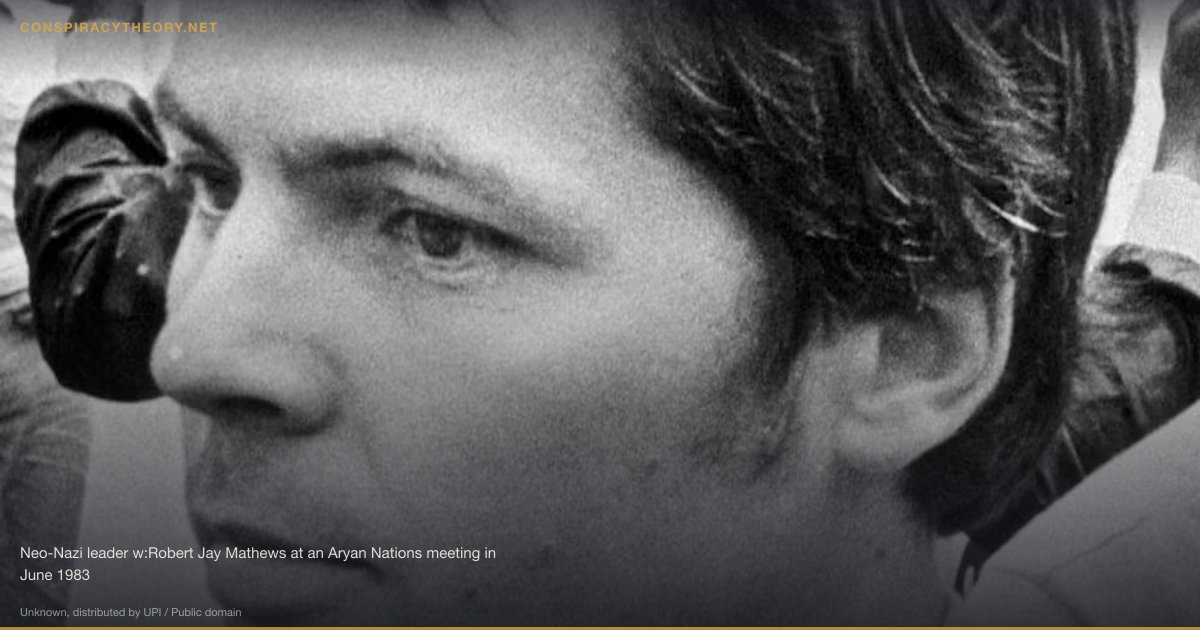
The most consequential figure to emerge from the Aryan Nations orbit was Robert Jay Mathews, a young activist from Metaline Falls, Washington, who attended World Congresses and became deeply embedded in the movement. Mathews was charismatic, disciplined, and impatient. He believed that the white supremacist movement spent too much time talking and not enough time acting. In September 1983, Mathews gathered eight men — most of them recruited through Aryan Nations connections — in a barn in Metaline Falls and founded a secret organization called The Order, also known as Brüder Schweigen (German for “Silent Brotherhood”).
The name was taken from The Turner Diaries, a 1978 novel by William Luther Pierce (writing as Andrew Macdonald) that depicted a violent white supremacist revolution in the United States. The book was effectively the sacred text of the radical right, and its fictional “Organization” provided the template for Mathews’ real-world cell. Pierce ran the National Alliance, another white supremacist group with close ties to the Aryan Nations. The ideological DNA was seamless.
The Order started small — a robbery of a Spokane adult bookstore that netted $369 — but escalated rapidly. Over the next year and a half, the group committed a series of increasingly brazen crimes:
- Counterfeiting: The Order produced counterfeit $50 bills, distributing them across the Northwest.
- Armored car robberies: In March 1984, they robbed a Continental Armored Transport truck in Seattle, netting approximately $500,000. In July 1984, they hit a Brink’s armored car in Ukiah, California, for $3.8 million — one of the largest armored car robberies in American history at that point.
- Assassination: On June 18, 1984, Order members Bruce Pierce and David Lane gunned down Alan Berg in the driveway of his Denver townhouse. Berg was a Jewish radio talk show host on KOA-AM whose confrontational style and willingness to debate white supremacists on air had made him a target. Pierce shot Berg with a MAC-10 submachine gun, firing thirteen rounds. Berg died on his driveway.
- Bombings and other attacks: The Order bombed a synagogue in Boise, Idaho, and planned additional attacks that were disrupted by arrests.
The money from The Order’s robberies was distributed across the white supremacist movement, with funds going to the Aryan Nations, the National Alliance, the Ku Klux Klan, and various smaller groups. Butler’s compound benefited directly from this influx of cash, though Butler maintained he had no knowledge of the crimes. This claim strained credibility given the extent of The Order’s integration with the Aryan Nations network.
The End of Robert Jay Mathews
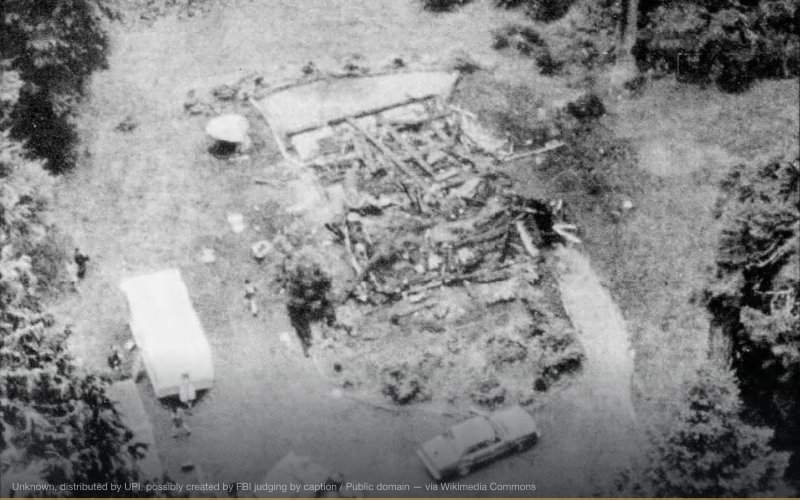
The FBI, aided by Order member Tom Martinez — who became an informant after his arrest for passing counterfeit bills — closed in on Mathews in late 1984. On December 7, FBI agents surrounded a house on Whidbey Island, Washington, where Mathews had barricaded himself. After a 36-hour standoff during which Mathews refused to surrender and fired on agents, the FBI launched M-79 illumination flares into the house. The structure caught fire. Mathews, true to his ideology to the end, chose to die in the blaze rather than submit to arrest. He was 31 years old.
Over the next two years, more than two dozen Order members were arrested and prosecuted. Bruce Pierce received a 252-year sentence for the Berg assassination. David Lane received 190 years. Richard Scutari, the group’s head of security, received 60 years. The organization was thoroughly dismantled, but not before it had demonstrated the lethal potential of white supremacist ideology when channeled into organized action.
Butler himself was indicted in 1987 along with thirteen other white supremacist leaders on federal seditious conspiracy charges, accused of plotting to overthrow the US government. He was acquitted in 1988 at a trial in Fort Smith, Arkansas. The acquittal reinforced Butler’s conviction that he was untouchable — and perhaps emboldened the sense of impunity that would eventually lead to his organization’s downfall through a very different legal avenue.
Key Claims and Conspiracy Angles
The Aryan Nations compound generates several distinct lines of conspiracy-related inquiry, some originating from within the movement and some from outside observers:
The “White Homeland” Conspiracy: Butler and the Aryan Nations actively promoted the idea that whites were the victims of a deliberate campaign of racial dilution orchestrated by Jewish elites. This worldview — the “Zionist Occupation Government” (ZOG) conspiracy — held that the US federal government was controlled by Jews and that white Americans were being systematically displaced through immigration, intermarriage, and cultural manipulation. The Aryan Nations’ proposed solution — the creation of a whites-only homeland in the Pacific Northwest — was based entirely on this conspiratorial framework. The ZOG narrative was not unique to the Aryan Nations; it was (and remains) a foundational element of virtually all white supremacist ideology.
FBI Infiltration and the Entrapment Question: Federal law enforcement maintained a substantial presence inside the Aryan Nations throughout its existence. The FBI’s use of informants within the organization — and the question of whether those informants sometimes crossed the line from monitoring to encouraging illegal activity — echoes the broader pattern of FBI entrapment operations documented across the spectrum of domestic extremism. The fact that the ATF’s entrapment of Randy Weaver began at an Aryan Nations gathering is particularly telling. Kenneth Fadeley, the ATF informant who pressured Weaver into sawing off two shotguns at Aryan Nations events, was operating inside Butler’s organization — raising questions about how many other illegal acts were facilitated, directly or indirectly, by government agents embedded in the movement.
The “Allowed to Operate” Theory: Some observers have questioned why the Aryan Nations compound was permitted to function as openly as it did for a quarter century. The organization was not subtle — it held public marches, distributed literature advocating racial violence, and served as the known incubator for a domestic terrorist cell that committed murder. The argument is not that the Aryan Nations had legal protection (they did, under the First Amendment, until their members committed crimes) but rather that law enforcement’s tolerance of the compound reflected a broader institutional bias: that white supremacist organizations were simply not prioritized the way that, say, Black liberation groups had been under COINTELPRO. The FBI’s own post-COINTELPRO guidelines, imposed after revelations about the Bureau’s campaign against civil rights organizations, may have paradoxically constrained the FBI’s ability to act aggressively against white supremacist groups.
Evidence and Documentation
The Aryan Nations compound and its associated activities are among the most thoroughly documented extremist operations in American history. The evidentiary record includes:
Court Records: The Order trials (1985-1986) produced thousands of pages of testimony and physical evidence documenting the direct links between the Aryan Nations compound and the terrorist cell. The seditious conspiracy trial of Butler and others (1988) generated additional documentation of the organization’s ideology, structure, and activities. The Keenan v. Aryan Nations civil trial (2000) included testimony from former members, law enforcement officials, and the victims themselves.
FBI Surveillance: The Bureau’s decades-long monitoring of the Aryan Nations produced extensive files, portions of which have been released through Freedom of Information Act requests. These documents confirm the compound’s role as a central hub for the white supremacist movement and detail the activities of numerous individuals who passed through the organization.
Southern Poverty Law Center Documentation: The SPLC tracked the Aryan Nations from its founding through its dissolution, maintaining detailed records of the organization’s membership, activities, publications, and connections to other extremist groups. This documentation was central to the successful civil lawsuit.
Journalistic Coverage: Reporters from outlets including the Spokesman-Review (Spokane), the Coeur d’Alene Press, the Idaho Statesman, and national outlets covered the Aryan Nations extensively. The compound’s annual World Congresses were press-accessible events, and Butler actively courted media attention.
Survivor and Witness Testimony: Former members of the Aryan Nations and The Order have provided extensive testimony — in court, in interviews, and in published memoirs — about the inner workings of the compound and its satellite operations.
Debunking and Verification
Because the Aryan Nations compound is a confirmed historical reality rather than a speculative theory, the relevant analytical framework is verification rather than debunking. Several points merit clarification:
Butler’s Claims of Innocence Regarding The Order: Butler consistently maintained that he bore no responsibility for The Order’s crimes, characterizing Mathews and his followers as independent actors. The evidence contradicts this framing. The Order’s ideology was directly derived from the Aryan Nations’ teachings, its members were recruited through Aryan Nations channels, and stolen funds flowed back to the compound. While Butler’s 1988 acquittal on seditious conspiracy charges suggests the government could not prove his direct participation in criminal planning beyond a reasonable doubt, the organizational relationship between the Aryan Nations and The Order is a matter of documented fact.
The Scope of the Movement: Butler and his allies often inflated their numbers and significance, claiming to represent millions of sympathizers. In reality, the Aryan Nations’ active membership probably never exceeded a few hundred at its peak, and World Congress attendance ranged from roughly one hundred to three hundred. However, the organization’s influence as a networking hub extended far beyond its formal membership rolls.
The “Mainstream Idaho” Question: Butler’s presence prompted a persistent and understandable concern about whether North Idaho harbored broadly sympathetic views. The historical record shows clearly that the overwhelming majority of Kootenai County residents opposed the Aryan Nations. Local human rights organizations — particularly the Kootenai County Task Force on Human Relations, founded in 1981 — organized sustained opposition. Businesses posted “Not Welcome” signs for Aryan Nations members. When the compound was seized in 2000, the community celebrated.
The Keenan Lawsuit: How a Broken-Down Car Ended an Empire
The event that destroyed the Aryan Nations was almost absurdly mundane. On July 1, 1998, Victoria Keenan and her 19-year-old son Jason were driving past the compound on Rimrock Road when their 1977 Datsun backfired near the entrance. Aryan Nations security guards — including Jesse Warfield and John Yeager — apparently interpreted the sound as a gunshot. They chased the Keenans’ car in a pickup truck, firing multiple rifle rounds at the vehicle and eventually forcing it into a ditch. Victoria and Jason Keenan were assaulted and held at gunpoint before the guards retreated.
The incident was reported to police, and Warfield and Yeager were eventually charged with assault. But the Keenans’ most consequential decision was to contact the Southern Poverty Law Center.
Morris Dees, the SPLC’s co-founder and chief trial counsel, had built a career on using civil litigation to bankrupt hate groups. He had pioneered the strategy against the United Klans of America in 1987, winning a $7 million judgment that seized the Klan’s headquarters in Tuscaloosa, Alabama. Dees saw the Keenan case as an opportunity to apply the same approach to the Aryan Nations, arguing that Butler bore organizational liability for the actions of his security guards.
The trial, held in September 2000 in a Coeur d’Alene courtroom, lasted less than two weeks. Butler, then 82 and visibly frail, acted as his own co-counsel for portions of the trial — a decision that went about as well as one might expect. The jury deliberated for roughly five hours before returning a verdict of $6.3 million against Butler, the Aryan Nations, and the individual guards. The jury’s message was unmistakable: if you run an organization that employs armed thugs, you own the consequences.
Butler couldn’t pay. The compound — the physical and symbolic heart of his life’s work — was seized and transferred to the Keenans as partial satisfaction of the judgment. Victoria Keenan donated the property to the North Idaho College Foundation and the Carr Foundation, a local human rights organization. In March 2001, the buildings were demolished. The guard towers, the chapel where Butler preached his Christian Identity sermons, the meeting hall where World Congress attendees had gathered for two decades — all of it was reduced to rubble and hauled away. A peace park was proposed for the site.
Cultural Impact
The Aryan Nations compound cast a shadow over North Idaho that extended far beyond the twenty acres it physically occupied. For more than two decades, the phrases “Coeur d’Alene” and “white supremacist” were linked in the national imagination in ways that infuriated local residents who had nothing to do with Butler’s organization and actively opposed it.
The Kootenai County Task Force on Human Relations, formed in 1981 in direct response to the Aryan Nations, became one of the most effective community-level anti-hate organizations in the country. Its members organized counter-demonstrations, conducted community education programs, supported victims of hate crimes, and worked with law enforcement to monitor extremist activity. The task force’s work demonstrated that the most effective opposition to organized hate sometimes comes not from federal agencies or national organizations but from local people who refuse to cede their community to extremists.
The destruction of the compound in 2000-2001 was a watershed moment for the region. Coeur d’Alene and the surrounding communities invested heavily in rebranding, emphasizing the area’s natural beauty, recreational opportunities, and welcoming character. The effort was largely successful — the region experienced significant population and tourism growth in the years that followed.
But the legacy proved difficult to erase entirely. Periodic incidents — from racist flyers distributed in neighborhoods to the 2011 discovery of a bomb along a Martin Luther King Jr. Day parade route in Spokane (planted by Kevin William Harpham, a former member of the National Alliance) — served as reminders that the ideology the compound had promoted did not disappear with the compound itself. The national conversation about white supremacist violence, particularly after events like the 2017 Charlottesville rally and the 2019 El Paso shooting, repeatedly invoked the Aryan Nations as a historical precedent for organized racial extremism.
The compound also left a literary and cinematic footprint. The Order’s crime spree inspired the 1991 film Betrayed (directed by Costa-Gavras) and numerous nonfiction books, most notably Kevin Flynn and Gary Gerhardt’s The Silent Brotherhood (1989), a definitive account of Mathews’ organization. The broader story of North Idaho’s encounter with white supremacy has been covered in documentaries, longform journalism, and academic studies of domestic extremism.
The Ruby Ridge Connection
The Aryan Nations compound and the Ruby Ridge standoff of 1992 are inextricably linked — not just geographically (both occurred in North Idaho, roughly ninety miles apart) but ideologically and operationally. Randy Weaver attended Aryan Nations gatherings at the Hayden Lake compound, and it was at these events that ATF informant Kenneth Fadeley targeted him for the illegal weapons transaction that ultimately triggered the siege. The Ruby Ridge disaster became a rallying cry for the broader militia movement and was cited by Timothy McVeigh as a motivating factor in the Oklahoma City bombing. The through-line from Butler’s compound to Weaver’s cabin to the Murrah Federal Building in Oklahoma City illustrates how ideological networks generate cascading consequences that their originators may not have directly planned but bear responsibility for cultivating.
Key Figures
Richard Girnt Butler (1918-2004): Founder and leader of the Aryan Nations and the Church of Jesus Christ-Christian. A former Lockheed engineer who inherited Wesley Swift’s Christian Identity ministry, Butler established the Hayden Lake compound in the mid-1970s and spent the next quarter century building it into the organizational hub of American white supremacy. Acquitted of seditious conspiracy in 1988, he was ultimately bankrupted by the Keenan civil suit in 2000. He died on September 8, 2004, at his home in Hayden, Idaho, at age 86. Multiple factions claimed to be his successor; none achieved comparable influence.
Robert Jay Mathews (1953-1984): Founder of The Order, the domestic terrorist cell that emerged from the Aryan Nations orbit. Mathews was a true believer who decided that the white supremacist movement needed to transition from rhetoric to armed action. He died in a fire during an FBI standoff on Whidbey Island, Washington, on December 8, 1984, and became a martyr figure in far-right circles.
Morris Dees (1936-present): Co-founder and longtime chief trial counsel of the Southern Poverty Law Center. Dees developed the legal strategy of using civil lawsuits to bankrupt hate organizations, successfully applying it to the United Klans of America, White Aryan Resistance, and the Aryan Nations. His representation of the Keenan family in the 2000 lawsuit led to the destruction of the Aryan Nations compound.
Alan Berg (1934-1984): Denver radio talk show host murdered by Order members Bruce Pierce and David Lane on June 18, 1984. Berg, who was Jewish, was known for his aggressive on-air confrontations with extremists. His assassination was the most high-profile crime committed by The Order and demonstrated the lethal consequences of the ideology promoted at the Hayden Lake compound.
Victoria and Jason Keenan: The mother and son whose assault by Aryan Nations guards in 1998 led to the civil lawsuit that destroyed the organization. Their decision to pursue legal action — with the SPLC’s support — was the single most consequential blow ever struck against the Aryan Nations.
Bruce Pierce (1954-2010): Order member who fired the shots that killed Alan Berg. Sentenced to 252 years in federal prison, he died in the Allenwood Federal Correctional Complex in 2010.
David Lane (1938-2007): Order member and getaway driver in the Alan Berg assassination. Lane coined the white supremacist slogan known as the “14 Words” while in prison. He died serving a 190-year sentence at the federal penitentiary in Terre Haute, Indiana.
Timeline
- 1918: Richard Butler born in Bennett, Colorado
- 1960s: Butler joins Wesley Swift’s Church of Jesus Christ-Christian and embraces Christian Identity theology
- 1970: Wesley Swift dies; Butler inherits the church
- 1973: Butler purchases 20-acre property near Hayden Lake, Idaho
- 1977: Aryan Nations formally established as the political arm of the Church of Jesus Christ-Christian; compound operations begin
- Late 1970s: First annual World Congress held at the Hayden Lake compound
- 1981: Kootenai County Task Force on Human Relations founded in response to Aryan Nations activity
- September 1983: Robert Jay Mathews founds The Order (Brüder Schweigen) with members recruited through Aryan Nations
- December 1983: The Order robs an adult bookstore in Spokane for $369
- March 1984: The Order robs a Continental Armored Transport truck in Seattle for approximately $500,000
- June 18, 1984: Order members Bruce Pierce and David Lane assassinate Denver radio host Alan Berg
- July 1984: The Order robs a Brink’s armored car in Ukiah, California, for $3.8 million
- December 8, 1984: Robert Jay Mathews dies in an FBI standoff on Whidbey Island, Washington
- 1985-1986: Over two dozen Order members arrested, tried, and convicted on racketeering, robbery, and murder charges
- 1987: Richard Butler and thirteen others indicted on federal seditious conspiracy charges
- 1988: Butler acquitted of seditious conspiracy at trial in Fort Smith, Arkansas
- August 1992: Ruby Ridge standoff occurs approximately 90 miles from the Hayden Lake compound; Randy Weaver had attended Aryan Nations gatherings
- July 1, 1998: Victoria and Jason Keenan assaulted by Aryan Nations security guards near the compound entrance
- September 2000: Jury awards the Keenans $6.3 million in civil damages; compound seized to satisfy the judgment
- 2001: Aryan Nations compound buildings demolished
- September 8, 2004: Richard Butler dies at his home in Hayden, Idaho, at age 86
- 2010: Bruce Pierce dies in federal prison
- 2011: Kevin Harpham plants a bomb along a Martin Luther King Jr. Day parade route in Spokane, later sentenced to 32 years
Sources & Further Reading
- Flynn, Kevin, and Gary Gerhardt. The Silent Brotherhood: Inside America’s Racist Underground. Free Press, 1989.
- Walter, Jess. Every Knee Shall Bow: The Truth and Tragedy of Ruby Ridge and the Randy Weaver Family. Regan Books, 1995.
- Dees, Morris, with James Corcoran. Gathering Storm: America’s Militia Threat. HarperCollins, 1996.
- Aho, James A. The Politics of Righteousness: Idaho Christian Patriotism. University of Washington Press, 1990.
- Southern Poverty Law Center. “Aryan Nations / Church of Jesus Christ-Christian.” Intelligence Files.
- Ridgeway, James. Blood in the Face: The Ku Klux Klan, Aryan Nations, Nazi Skinheads, and the Rise of a New White Culture. Thunder’s Mouth Press, 1995.
- Stern, Kenneth S. A Force Upon the Plain: The American Militia Movement and the Politics of Hate. University of Oklahoma Press, 1996.
- FBI Records: The Vault — Aryan Nations. Federal Bureau of Investigation.
- Keenan v. Aryan Nations, No. CV-99-441 (Idaho 1st Dist. 2000). Court records and trial transcripts.
Related Theories
- Ruby Ridge — The 1992 standoff between Randy Weaver and federal agents in North Idaho, triggered in part by Weaver’s connections to the Aryan Nations
- Oklahoma City Bombing — Timothy McVeigh cited Ruby Ridge and Waco as motivations; the ideological pipeline from Aryan Nations to militia violence fed directly into the deadliest domestic terrorist attack in US history
- FBI Entrapment Operations — The FBI’s use of informants inside the Aryan Nations, including the operation that targeted Randy Weaver, raises persistent questions about the line between monitoring and manufacturing crime
- COINTELPRO — The FBI’s history of aggressively targeting left-wing and civil rights organizations while taking a comparatively restrained approach to white supremacist groups provides critical context for understanding the Aryan Nations’ longevity
Frequently Asked Questions
What was the Aryan Nations compound at Hayden Lake?
What was The Order and its connection to Aryan Nations?
How did the Aryan Nations lose their compound?
Infographic
Share this visual summary. Right-click to save.