Ark of the Covenant — Hidden Location Theories
Overview
The Ark of the Covenant disappeared from Biblical history around 586 BCE — theorists place it in Ethiopia (Axum), Ireland, France (Languedoc), Jerusalem’s underground, or Vatican vaults.
Origins & History
The mystery begins with a silence. When the Babylonian army under Nebuchadnezzar II breached the walls of Jerusalem and razed Solomon’s Temple in 586 BCE, the scribes who documented the catastrophe recorded in meticulous detail the treasures that were carried away to Babylon — the gold vessels, the silver bowls, the bronze pillars. But the most sacred object in all of Israelite religion, the one item that defined the Temple’s purpose for existing, goes unmentioned. The Ark of the Covenant simply vanishes from the historical record.
The silence invited speculation almost immediately. The apocryphal text 2 Maccabees, written in the second century BCE, offers one of the earliest theories: that the prophet Jeremiah, warned by God of the coming destruction, hid the Ark in a cave on Mount Nebo in modern-day Jordan, sealed the entrance, and declared that its location would remain unknown “until God gathers his people together again.” This account established the template that would endure for millennia — the Ark was not destroyed but hidden, waiting for the right moment to be revealed.
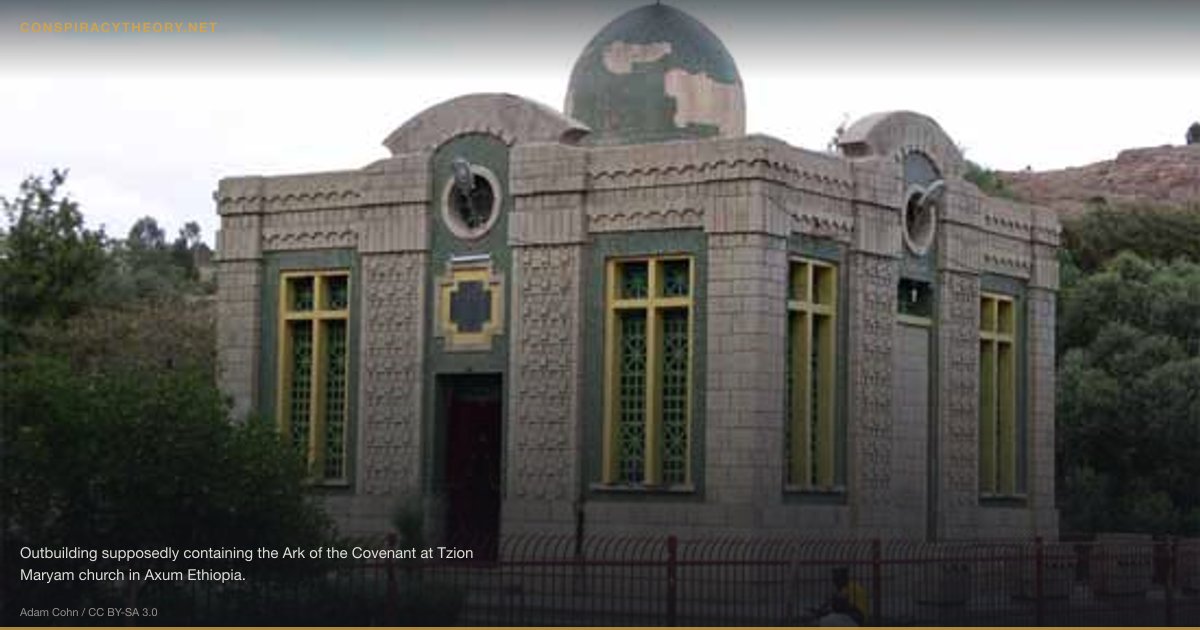
The Ethiopian claim is the most elaborate and institutionally sustained. The Kebra Nagast (“Glory of Kings”), a fourteenth-century text considered scripture by the Ethiopian Orthodox Church, tells of Menelik I, son of King Solomon and the Queen of Sheba, traveling to Jerusalem to meet his father and returning to Ethiopia with the Ark — either as a gift or through divine intervention, depending on the version. The Ethiopian Church maintains the Ark is currently housed in the Chapel of the Tablet in Axum, guarded by a single monk who is appointed for life and who alone may enter the Ark’s presence. No outside scholar, no government official, no foreign clergy has ever been permitted to verify this claim.
British journalist Graham Hancock brought the Ethiopian theory to a global audience with his 1992 bestseller The Sign and the Seal, in which he traced his own journey through Ethiopian monasteries and ancient texts, concluding that the Axum claim was the most credible of all the theories. Hancock’s book was criticized by academic historians for selective evidence and speculative reasoning, but it sold millions of copies and defined the popular imagination of the Ark hunt for a generation.
Alternative theories proliferated over the centuries. The Knights Templar theory, popularized in various forms since the nineteenth century, holds that the medieval military order discovered the Ark during their occupation of the Temple Mount in Jerusalem between 1119 and 1312, and spirited it to Europe — possibly to the Languedoc region of France, possibly to Scotland’s Rosslyn Chapel, possibly to the Vatican’s own archives. The theory gained new energy after the success of Dan Brown’s The Da Vinci Code, which drew on Templar mythology.
Other proposed locations include a hidden chamber beneath the Temple Mount in Jerusalem, where some researchers believe the Ark was concealed before the Babylonian siege. Archaeological excavations in the area are politically impossible due to the site’s status as the third holiest site in Islam (the Al-Aqsa Mosque and Dome of the Rock). Ron Wyatt, a controversial amateur archaeologist, claimed in 1982 to have found the Ark in a cave beneath Golgotha in Jerusalem, but never produced photographs or physical evidence, and his claims are rejected by both professional archaeologists and the Israeli Antiquities Authority.
Key Claims
- The Ark of the Covenant was not destroyed when Babylon sacked Jerusalem in 586 BCE but was hidden or removed beforehand, and still exists in a preserved state
- The Ethiopian Orthodox Church possesses the genuine Ark in its Chapel of the Tablet in Axum, brought there by Menelik I approximately 3,000 years ago
- The Knights Templar discovered the Ark beneath the Temple Mount during the Crusades and transported it to a secret location in Europe
- The Ark remains hidden in a sealed chamber beneath the Temple Mount in Jerusalem, inaccessible due to the political and religious sensitivity of the site
- The prophet Jeremiah hid the Ark in a cave on Mount Nebo before the Babylonian invasion, as described in 2 Maccabees
- The Vatican possesses the Ark or knowledge of its location, concealed within its vast archives and underground vaults
- The Ark was taken to Tanis in Egypt, a theory popularized by the 1981 film Raiders of the Lost Ark but with limited historical basis
- The Ark’s supernatural properties, as described in the Bible, were real phenomena — possibly an electrical capacitor effect or some form of advanced ancient technology
Evidence
No physical evidence for the Ark’s current existence has ever been produced, making this one of history’s most enduring cold cases. The evidence that does exist is textual, circumstantial, and deeply contested.
The Ethiopian claim rests primarily on the Kebra Nagast, a text whose historical reliability is disputed. While the Ethiopian Church’s tradition is ancient and deeply held, the Kebra Nagast was composed in its current form in the fourteenth century CE — nearly two millennia after the Ark’s disappearance. Historian Edward Ullendorff, who claimed to have seen the object in Axum during the Italian occupation of Ethiopia in 1941, described it as a medieval wooden slab, not matching the Biblical description. The Ethiopian Church rejected his account and has maintained its refusal to allow independent verification.
The Temple Mount theory draws support from the absence of the Ark from Babylonian loot lists. The detailed inventory in 2 Kings 25:13-17 and Jeremiah 52:17-23 of items taken from the Temple does not mention the Ark, which, as the most sacred object, should have been a trophy of first importance. This omission suggests the Ark was already gone before the Temple fell. Israeli archaeologist Leen Ritmeyer has proposed, based on his surveys of the Temple Mount, that a specific rectangular depression in the bedrock beneath the Dome of the Rock corresponds to the Ark’s dimensions as described in Exodus. However, no excavation has been or is likely to be permitted to test this hypothesis.
The Templar theory lacks documentary support from the order’s own extensive records. The Templars occupied the Temple Mount from approximately 1119 to 1187, and while they conducted some construction work there, no contemporary source — including the Templars’ own charters, papal correspondence, or the records of their eventual trial and dissolution by Pope Clement V in 1312 — mentions the Ark. The connection is largely a product of nineteenth- and twentieth-century esoteric literature.
The 2 Maccabees account (2:4-8) is the only ancient text to offer a specific hiding location — Mount Nebo — but the passage is considered historically unreliable by most biblical scholars. The book was written centuries after the events it describes, and the account is presented within a legendary rather than historical framework.
Archaeological searches have been conducted at various proposed sites, including Ron Wyatt’s claimed excavation near the Garden Tomb in Jerusalem. Wyatt’s claims, made between 1982 and his death in 1999, were never supported by photographic evidence, independent witnesses, or publication in any peer-reviewed archaeological journal. The Israel Antiquities Authority denied that any such discovery was made under their jurisdiction.
Cultural Impact
Few lost artifacts have commanded the cultural imagination as persistently as the Ark of the Covenant. Its disappearance — the gap between its central role in Biblical narrative and its total absence from the historical record after the sixth century BCE — creates a void that has been filled by religious devotion, scholarly debate, speculative adventure, and Hollywood mythology in roughly equal measure.
Steven Spielberg’s Raiders of the Lost Ark (1981) transformed the Ark from a subject of theological and archaeological interest into a global pop culture icon. The film’s portrayal of the Ark as a weapon of devastating supernatural power, sought by both adventurers and Nazis, established the template for an entire genre of relic-hunting adventure stories. The film’s success created a feedback loop: public interest in the Ark surged, which drove book sales and documentary productions, which in turn reinforced the Ark’s status as the ultimate archaeological prize.
The Ark holds living religious significance for the Ethiopian Orthodox Church, where it is central to worship and national identity. The annual Timkat festival, celebrating the Baptism of Jesus, features processions of tabotat — replicas of the Ark’s tablets — from every Ethiopian Orthodox church, making the Ark a present and active element of Ethiopian spiritual life rather than a lost relic.
The search for the Ark also intersects with one of the world’s most volatile geopolitical conflicts. The Temple Mount/Haram al-Sharif, claimed as a possible hiding place, sits at the heart of the Israeli-Palestinian dispute. Proposals to excavate beneath the site are perceived as threats to the Al-Aqsa Mosque and have triggered diplomatic crises. The Ark’s possible presence beneath the Mount has been invoked by religious Zionist groups as a reason to assert Jewish sovereignty over the site — making an archaeological question a matter of international security.
Sources & Further Reading
- Hancock, Graham. The Sign and the Seal: The Quest for the Lost Ark of the Covenant. New York: Crown Publishers, 1992.
- Munro-Hay, Stuart. The Quest for the Ark of the Covenant: The True History of the Tablets of Moses. London: I.B. Tauris, 2005.
- Ritmeyer, Leen. The Quest: Revealing the Temple Mount in Jerusalem. Jerusalem: Carta, 2006.
- Ullendorff, Edward. “The Ark of the Covenant.” Bulletin of the John Rylands Library 50 (1968): 209–221.
- Budge, E.A. Wallis, trans. The Kebra Nagast: The Glory of Kings. London: Oxford University Press, 1922.
- Cline, Eric H. “Raiders of the Faux Ark.” Boston Globe, September 30, 2007.
- 2 Maccabees 2:4-8. Apocryphal/Deuterocanonical text.
![Emperor Menelik I Bringing the Zion Tabot [ Ark of the covenant ] to Axum. — related to Ark of the Covenant — Hidden Location Theories](/images/theories/ark-of-the-covenant-location-theories/body.jpg)
Frequently Asked Questions
What was the Ark of the Covenant?
When did the Ark of the Covenant disappear?
Does the Ethiopian Orthodox Church really claim to have the Ark?
Infographic
Share this visual summary. Right-click to save.