Anunnaki — Ancient Alien Gods of Sumer
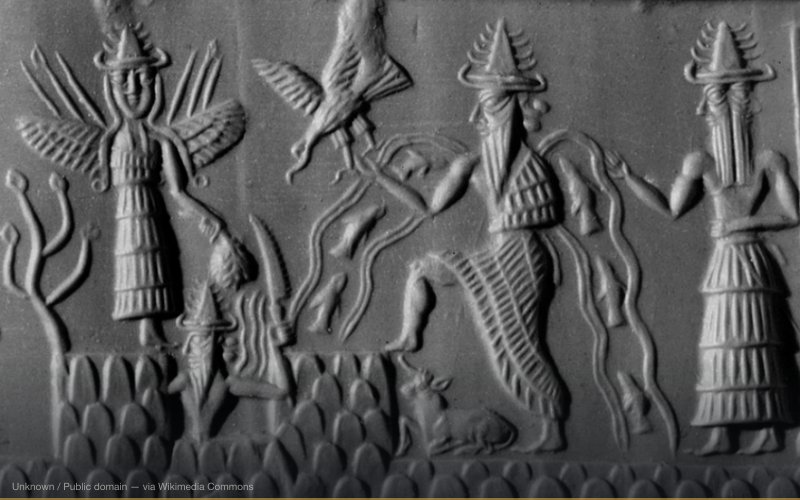
![Anunnaki — Ancient Alien Gods of Sumer (1976) — Black and white crop of full engraving plate scan - from Plate 5 of the work "A second series of the monuments of Nineveh: including bas-reliefs from the Palace of Sennacherib and bronzes from the ruins of Nimroud ; from drawings made on the spot, during a second expedition to Assyria" (AH Layard). The image depicts Ninurta (on the right) battling Anzû. The description given in the text of the work of the plate reads: PLATE V BAS-RELIEFS AT AN ENTRANCE TO A SMALL TEMPLE (NIMROUD) Part of one side of the entrance near which stood the bas-relief of the King last described. The group is believed to represent the god to whom the temple was dedicated, driving out the evil spirit.† On the opposite side of the doorway the same figures were repeated. These bas-reliefs are now in the British Museum [..] † Ibid.. p.348 The plate description is on page 2 of the work. The image in the book is by Faucher-Gudin , an drawing based on the excavated Bas-Relief. The Bas-Relief was in not as good condition. Sources for the description an full plate include : http://digi.ub.uni-heidelberg.de/diglit/layard1853/0010/image http://www.etana.org/sites/default/files/coretexts/17171.pdf (no text) The reference in the text to "Ibid. p.348" is to Discoveries in the ruins of Nineveh and Babylon (Layard, 1853) - which can be seen here https://archive.org/stream/discoveriesinru00layagoog#page/n398/mode/2up quote (p.348-349): About thirty feet to the right, or north, of the lion gateway was a second entrance, at each side of which were two singular figures. One was that of a monster, whose head, of fanciful and hideous form, had long pointed ears and extended jaws, armed with huge teeth. Its body was covered with feathers, its fore-feet were those of a lion, its hind legs ended in the talons of an eagle, and it had spreading wings and the tail of a bird. Behind this strange image was a winged man, whose dress consisted of an upper garment with a skirt of skin or fur, an under robe fringed with tassels, and the sacred horned hat. A long sword was suspended from his shoulders by an embossed belt; sandals, armlets, and bracelets, completed his attire. He grasped in each hand an object in the form of a double trident, resembling the thunderbolt of the Greek Jove, which he was in the attitude of hurling against the monster, who turned furiously towards him. This group appears to represent the bad spirit driven out by a good deity; a fit subject for the entrance to a temple, dedicated to the god of war. The singular combination of forms by which the Assyrian sculptor portrayed the evil principle, so prominent an element in the Chaldæan, and afterwards in the Magian, religions system, cannot fail to strike the reader. There is also in the same work and illustration of the relief in situ in the temple (between p.350 and 351) Interpretation There are at least two interpretations of what the image is/was intended to represent. Some sources interpret the image as [Bel-Merodach] Marduk (with thunderbolt) fighting Tiamat eg History of Egypt, Chaldea, Syria, Babylonia, and Assyria Vol. 3 (Maspero, G.; Sayce, A. H.) , https://archive.org/stream/egypt03maspuoft#page/n28/mode/1up Some modern sources state this is probably Anzu and Ninurta. eg in Gods, Demons and Symbols of Ancient Mesopotamia: An Illustrated Dictionary? (Jeremy A. Black and Anthony Green ISBN: 978-0-292-70794-8) p.142 states as text to same image: "Ninurta or Adad pursues a leonine bird-monster, perhaps the Anzû or Asakku."; Schroer, Silvia (2018) (in German) Die Ikonographie Palastinas/Israels und der Alte Orient, Band 4: Die Eisenzeit bis zum Beginn der achämenidischen Herrschaft, Schwabe Verlag, pp. 611 : "Ein kriegerischer, geflügelter Sturmgott, vielleicht Ninurta, vertreibt mit blitzgabelförmigen Waffen den Anzu-Drachen, einen geflügelten Löwendrachen." A discussion of the development of the interpretation of this image can be found here http://oracc.museum.upenn.edu/nimrud/livesofobjects/anzu/index.html archived link Original Source The original gypsum wall carving from which the drawing was taken is now (2018) displayed in Room 6 of the British Museum. Details of the object can be found here: British Museum reference BM 124571 http://www.britishmuseum.org/research/collection_online/collection_object_details.aspx?objectId=367087&partId=1&searchText=relief&people=117843&page=1 http://www.britishmuseum.org/research/collection_online/collection_object_details.aspx?objectId=367087&partId=1&searchText=relief&people=117843&page=2 The actual object also has a cuneiform inscription across the (approx.) middle third, not reproduced in the drawing. The texts is thought to be a "boilerplate" text used throughout the palace/temple on several reliefs - for more details and translation of a presumed nearly identical text see Assyrian Rulers of the Early First Millennium BC, I (1114-859 BC) vol. 1, (Grayson, Albert Kirk,Toronto, University of Toronto Press, 1991) p.232 no.5 (entry A.0.101.5) which references entry A.0.101.3 ; there were also inscriptions on the backs of the slabs - see same publication reference A.0.101.31 (no.31, p.293) .. the inscriptions reference Ashurnasirpal [II] son of Tukulti-Ninurta [II] - which dates the objects to 883 to 859 BC. (see en:Ashurnasirpal II) Note that the object was one of a pair on either side of the passage - [based on the drawing by Malan] the object's pair was left-right inverted so that the portrayals matched - a drawing of the object's pair by S.C. Malan partially in-situ at the excavation can be found in A Visiting Artist at Nineveh in 1850 (C. J. Gadd) in the journal "Iraq" vol.5, 1938 , DOI: 10.2307/4241628 , [1] , description p.120 no. 134, illus. plate XV](/images/theories/annunaki-ancient-alien-sumerian/header.jpg)
Overview
The Anunnaki ancient alien theory claims that an advanced extraterrestrial race from a planet called Nibiru visited Earth hundreds of thousands of years ago, genetically engineered Homo sapiens from existing hominids to serve as a slave labor force for gold mining, and were worshipped as gods by the ancient Sumerians. The theory was created almost entirely by Zecharia Sitchin (1920-2010), a self-taught Sumerian language enthusiast who published his interpretations in a series of books beginning with The 12th Planet (1976).
Sitchin claimed that standard translations of Sumerian cuneiform texts were wrong and that the texts actually described alien visitors, genetic engineering, nuclear warfare, and advanced technology. His work built on and expanded the “ancient astronaut” hypothesis popularized by Erich von Däniken’s Chariots of the Gods? (1968).
The theory is classified as debunked. Every professional Assyriologist who has examined Sitchin’s translations has found them to be fundamentally incorrect — filled with mistranslations, invented meanings, and selective misreadings of well-understood texts. No archaeological or astronomical evidence supports any element of his claims.
Origins & History
Erich von Däniken and the Ancient Astronaut Hypothesis
The intellectual foundation for Sitchin’s work was laid by Swiss author Erich von Däniken, whose 1968 bestseller Chariots of the Gods? proposed that ancient civilizations received technological knowledge from extraterrestrial visitors. Von Däniken pointed to ancient structures (the Egyptian pyramids, Nazca Lines, Easter Island statues) as evidence that ancient peoples could not have built them without alien assistance — a premise rejected by archaeologists as both factually wrong and implicitly racist in its denial of ancient peoples’ capabilities.
Zecharia Sitchin’s Earth Chronicles
Sitchin took the ancient astronaut concept further by claiming to derive his theory from direct translation of Sumerian texts. Born in Baku, Azerbaijan, educated in London, and working as a journalist and shipping executive in New York, Sitchin taught himself to read cuneiform and spent decades developing his interpretation. His Earth Chronicles series, beginning with The 12th Planet (1976), eventually spanned seven books and sold millions of copies worldwide.
Sitchin’s core narrative claimed that the Sumerian creation myth Enuma Elish described actual astronomical events — specifically, a collision between a rogue planet (Nibiru) and an existing planet (Tiamat), which he said created Earth and the asteroid belt. He further claimed that the Sumerian term “Anunnaki” (literally meaning “princely offspring” or “those of royal blood”) referred to alien beings who came to Earth approximately 450,000 years ago.
Mainstream Proliferation
Sitchin’s ideas remained in the fringe publishing world until the internet and the History Channel’s Ancient Aliens series (2010-present) brought them to mass audiences. The show, which has run for over 20 seasons, features Sitchin’s ideas alongside other ancient astronaut claims, presented to millions of viewers weekly. Social media further amplified the theory, with YouTube channels dedicated to Anunnaki content generating hundreds of millions of views.
Key Claims
- Planet Nibiru: A large planet on a 3,600-year elliptical orbit periodically enters the inner solar system, home to the Anunnaki civilization
- Gold mining mission: The Anunnaki came to Earth to mine gold, which they needed to repair their planet’s atmosphere
- Genetic engineering: When their own workers rebelled, the Anunnaki genetically combined their DNA with that of Homo erectus to create Homo sapiens as a slave race — this is what the Sumerian creation myths actually describe
- Civilization gifted, not developed: The sudden emergence of Sumerian civilization (writing, agriculture, astronomy, law) was not indigenous development but technology given by the Anunnaki
- Nuclear war: Ancient texts describe a nuclear war between factions of Anunnaki, which destroyed Sodom and Gomorrah and created a radioactive cloud that ended the Sumerian civilization
- Return of Nibiru: Nibiru will return on its 3,600-year orbit, with catastrophic consequences for Earth
Evidence & Debunking
The Translation Problem
The most fundamental debunking comes from scholars who actually read Sumerian and Akkadian. Michael Heiser, who held a PhD in Hebrew Bible and Semitic Languages from the University of Wisconsin-Madison, published extensive line-by-line analyses of Sitchin’s key translations. He demonstrated that Sitchin systematically mistranslated terms, ignored grammatical rules, and assigned meanings to words that bear no relationship to their actual definitions in Sumerian.
For example, Sitchin translated the Sumerian word “MU” as “rocket ship.” In actual Sumerian, MU means “name” or “year.” Sitchin translated “DIN.GIR” (the term for “god” or “deity”) as “righteous ones of the blazing rockets.” No Sumerian dictionary supports this reading.
No Planet Nibiru
Astronomers have confirmed there is no undiscovered giant planet on a 3,600-year orbit. Modern sky surveys — including WISE (Wide-field Infrared Survey Explorer) and Pan-STARRS — are capable of detecting objects far smaller and dimmer than a supposed inhabited planet. If Nibiru existed and were approaching the inner solar system, it would be one of the brightest objects in the night sky and would be gravitationally perturbing the orbits of known planets.
Sumerian Civilization Explained
The supposedly “sudden” emergence of Sumerian civilization is well understood by archaeologists as the result of thousands of years of gradual development, with clear archaeological evidence of progressive stages from simple agricultural villages to complex urban societies. The Ubaid period (6500-3800 BCE) shows continuous development of irrigation, pottery, and settlement patterns leading directly to the Sumerian civilization.
The Racism Problem
Both the Anunnaki theory and broader ancient astronaut claims carry an implicit racist assumption: that ancient non-European civilizations could not have built their monuments or developed their technologies without outside help. Archaeologists note that this dismisses the ingenuity of ancient Sumerian, Egyptian, Mesoamerican, and other peoples while providing detailed explanations of how these achievements were accomplished using available technology.
Cultural Impact
Ancient Aliens and Mainstream Media
The History Channel’s Ancient Aliens brought Anunnaki claims to mainstream audiences, averaging 1-2 million viewers per episode. The show has been widely criticized by archaeologists and historians for presenting fringe theories as credible alternatives to established science, but its commercial success has ensured continued production.
New Age and Spiritual Movements
The Anunnaki narrative has been incorporated into various New Age spiritual frameworks, including claims about DNA activation, dimensional ascension, and humanity’s “star seed” origins. These spiritual interpretations often diverge significantly from Sitchin’s original pseudo-archaeological claims.
Intersection with Other Conspiracies
The Anunnaki theory intersects with and feeds into numerous other conspiracy narratives — reptilian shapeshifters (David Icke incorporated Anunnaki mythology), Nibiru/Planet X doomsday predictions, hollow Earth theories, and anti-establishment narratives about suppressed history. It serves as a foundational mythology for a broader alternative worldview.
Timeline
- 1968 — Erich von Däniken publishes Chariots of the Gods?, popularizing ancient astronaut hypothesis
- 1976 — Zecharia Sitchin publishes The 12th Planet, introducing the Anunnaki-as-aliens narrative
- 1980s-2000s — Sitchin publishes six more Earth Chronicles books, selling millions worldwide
- 2002 — Michael Heiser begins publishing academic rebuttals of Sitchin’s translations
- 2010 — History Channel premieres Ancient Aliens, bringing Anunnaki claims to mass audience
- 2010 — Zecharia Sitchin dies at age 90
- 2012 — NASA issues public statement debunking Nibiru collision claims ahead of Mayan calendar date
- 2014 — WISE infrared survey data confirms no undiscovered giant planet in the outer solar system
- 2020s — Anunnaki content thrives on YouTube and social media, reaching new audiences
Sources & Further Reading
- Heiser, Michael S. “The Myth of a Sumerian 12th Planet.” SitchinIsWrong.com, 2002-2015.
- Fagan, Garrett G., ed. Archaeological Fantasies: How Pseudoarchaeology Misrepresents the Past and Misleads the Public. Routledge, 2006.
- Sitchin, Zecharia. The 12th Planet. Stein & Day, 1976. (Primary source)
- Von Däniken, Erich. Chariots of the Gods? Putnam, 1968. (Primary source)
- Kramer, Samuel Noah. The Sumerians: Their History, Culture, and Character. University of Chicago Press, 1963.
- NASA. “Beyond 2012: Why the World Didn’t End.” 2012.
- Colavito, Jason. The Cult of Alien Gods: H.P. Lovecraft and Extraterrestrial Pop Culture. Prometheus Books, 2005.
Frequently Asked Questions
Who are the Anunnaki?
Is Planet Nibiru real?
Did Zecharia Sitchin correctly translate Sumerian texts?

Infographic
Share this visual summary. Right-click to save.
