Amazon Alexa / Smart Speakers as Surveillance Devices
Overview
When Amazon introduced the Echo smart speaker in November 2014, it placed an always-listening, internet-connected microphone in millions of living rooms, bedrooms, and kitchens. The device — powered by the Alexa voice assistant — quickly became one of the most popular consumer electronics products in history, followed by competing devices from Google (Home/Nest), Apple (HomePod), and others. By 2025, an estimated 200 million smart speakers were in use in the United States alone.
The conspiracy theory — that these devices are surveillance tools that record private conversations, transmit data to corporations and government agencies, and serve as a platform for mass surveillance — emerged almost immediately upon the Echo’s release. Like many modern technology conspiracy theories, its status is “mixed” because the reality lies in an uncomfortable space between the dismissive assurances of technology companies and the most extreme fears of privacy advocates.
Several elements once dismissed as paranoia have been confirmed: Amazon does employ humans who listen to recordings from inside people’s homes; smart speakers do record and transmit audio when accidentally triggered; Amazon has provided Alexa data to law enforcement, including without warrants in some cases; and the technical capability for more extensive surveillance exists within the hardware. At the same time, the most extreme claims — that Alexa functions as a real-time CIA surveillance tool, that all conversations are continuously recorded and stored, or that smart speakers are deployed as part of a coordinated mass surveillance program — remain unsubstantiated.
The theory sits at the intersection of documented corporate practices, confirmed government surveillance capabilities (revealed by Edward Snowden in 2013), and the profound unease many people feel about devices that are, by design, always listening.
Origins & History
The Post-Snowden Context
The smart speaker surveillance theory cannot be understood apart from the Edward Snowden revelations of 2013, which demonstrated that the NSA had been conducting mass surveillance of electronic communications on a scale previously considered conspiratorial thinking. Programs like PRISM — which gave the NSA access to user data from major technology companies including Google, Apple, Microsoft, and Facebook — proved that government agencies were indeed collecting vast quantities of private communications with the cooperation (willing or compelled) of technology companies.
The Snowden revelations transformed public discourse about surveillance. Claims that had previously been dismissed as paranoid were shown to be accurate or even understated. When Amazon introduced the Echo the following year, a significant segment of the public was already primed to view any internet-connected device as a potential surveillance tool.
The Echo Launch and Early Concerns
Amazon released the Echo in November 2014 (initially to Amazon Prime members only, with general release in June 2015). Privacy advocates immediately raised concerns about a device designed to listen continuously for a wake word, noting that:
- The device contained an always-on microphone array
- Audio processing (beyond wake-word detection) occurred on Amazon’s cloud servers, not locally
- Amazon’s privacy policy gave the company broad rights to use collected data
- The terms of service were lengthy, complex, and rarely read by consumers
- Users had limited visibility into what data was being collected and how it was used
Amazon responded with assurances that the device only recorded and transmitted audio after detecting the wake word, that recordings could be reviewed and deleted by users, and that the company took privacy seriously. These assurances were initially accepted by mainstream technology reviewers, who praised the Echo’s functionality.
The Bloomberg Revelation (2019)
The most significant confirmation of surveillance concerns came in April 2019, when Bloomberg News reported that Amazon employed thousands of full-time workers and contractors around the world who listened to voice recordings captured by Echo devices. These workers, based in offices in Costa Rica, India, Romania, and the United States, transcribed and annotated Alexa interactions to improve the voice assistant’s accuracy.
Key details from the Bloomberg investigation:
- Workers reviewed as many as 1,000 audio clips per shift
- Recordings were associated with the user’s account number, device serial number, and first name
- Workers occasionally heard sensitive content including what appeared to be sexual assaults, domestic violence, and drug transactions
- Amazon had no formal process for handling recordings of potential crimes
- Workers shared amusing or disturbing recordings among themselves through internal chat rooms
- Amazon had not disclosed this human review process to users
Amazon confirmed the program’s existence after the Bloomberg report, stating that “an extremely small number” of interactions were reviewed and that the practice was standard across the voice assistant industry. This confirmation was significant because it validated a core element of the surveillance theory: human beings at Amazon were indeed listening to recordings from inside people’s homes, and the company had not been transparent about this practice.
Google and Apple subsequently confirmed similar programs for their voice assistants, and Apple temporarily suspended its program following public backlash.
Law Enforcement Access
The question of whether law enforcement agencies can access smart speaker data has been answered largely in the affirmative:
The Bates murder case (2015-2016). In a murder investigation in Bentonville, Arkansas, police issued a warrant for Amazon Echo data from the home where the victim was found dead. Amazon initially fought the warrant but provided the data after the defendant consented to its release. The case established that smart speaker recordings were a viable source of evidence in criminal investigations.
Amazon Ring and Echo data sharing. In 2022, Amazon disclosed in response to a Senate inquiry that it had provided Ring doorbell camera footage and, in some cases, Echo data to law enforcement without warrants or user consent in at least 11 instances, citing “emergency” circumstances. This disclosure confirmed that Amazon would share user data without legal process under certain conditions.
Transparency reports. Amazon’s transparency reports show that the company receives thousands of government data requests annually across its services. The company states it challenges requests it considers overbroad, but the volume indicates routine law enforcement interest in data held by Amazon, including data from voice assistants and smart home devices.
The CIA-Amazon Connection
The most conspiratorial element of the theory involves the relationship between Amazon and the intelligence community. Several documented facts provide the foundation:
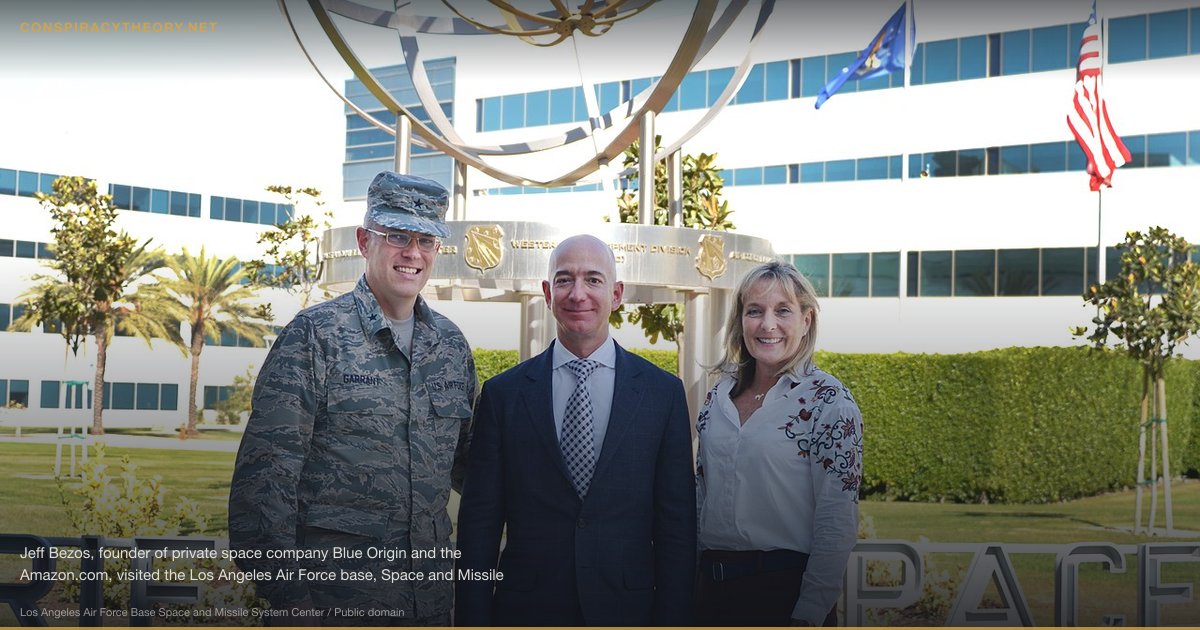
In 2013, Amazon Web Services won a $600 million contract to build a private cloud computing infrastructure for the CIA — one of the largest cloud contracts in history at the time. The contract was later expanded as part of the intelligence community’s broader cloud adoption.
In-Q-Tel, the CIA’s venture capital arm, has invested in various technology and data analysis companies over the years, though no public record shows a direct In-Q-Tel investment in Amazon.
Jeff Bezos purchased the Washington Post in 2013, the same year as the CIA cloud contract. Conspiracy theorists see this as significant, though no evidence links the two transactions beyond their timing.
These facts are used by conspiracy theorists to argue that Amazon’s consumer products — particularly always-listening smart speakers — serve dual purposes as commercial products and intelligence collection platforms. No evidence supports this specific claim, but the documented business relationship between Amazon and the CIA ensures the theory retains a surface plausibility that purely speculative theories lack.
Academic Research on Accidental Activation
Research by computer scientists has provided technical support for concerns about unintended recording. A 2020 study by researchers at Northeastern University and Imperial College London systematically tested how often smart speakers were accidentally activated by television audio, conversation, and ambient sounds. The study found:
- Smart speakers were accidentally triggered up to 19 times per day in normal household conditions
- Some activations lasted up to 43 seconds before the device recognized its error
- The wake-word detection algorithms could be triggered by words and phrases with phonetic similarity to the wake word
- Different devices had significantly different false-activation rates
A separate 2018 study demonstrated that smart speakers could be intentionally activated by sounds inaudible to humans (ultrasonic commands), raising concerns about deliberate exploitation of the devices.
Key Claims
-
Smart speakers record conversations even without the wake word. Accidental activations cause recordings when the device is not intentionally triggered. Status: Confirmed — research and Amazon’s own admissions verify this occurs, though Amazon characterizes it as infrequent and unintentional.
-
Amazon employees listen to recordings from inside homes. Human reviewers transcribe and analyze voice recordings captured by smart speakers. Status: Confirmed — Bloomberg’s 2019 investigation and Amazon’s subsequent acknowledgment verify this practice.
-
Amazon shares smart speaker data with law enforcement. Recordings and associated data are provided to police and intelligence agencies. Status: Confirmed — documented through court cases, Amazon’s own disclosures, and transparency reports.
-
Smart speakers are designed as CIA surveillance tools. The devices were developed in coordination with intelligence agencies to enable mass surveillance. Status: Unsubstantiated — the Amazon-CIA cloud contract is real, but no evidence connects it to consumer device design or surveillance functionality.
-
All conversations are continuously recorded and stored. Smart speakers record everything, not just post-wake-word interactions. Status: Unsubstantiated — technical analysis shows wake-word processing occurs locally, and continuous streaming of audio would be detectable through network monitoring. However, accidental activations do result in unintended recordings.
-
Smart speakers are used for targeted advertising based on overheard conversations. Devices listen to conversations and serve ads based on what they hear. Status: Debunked by available evidence — multiple independent technical analyses have found no evidence of continuous audio streaming for advertising purposes, though the persistent perception reflects broader concerns about digital advertising targeting.
-
Voice data is used to build comprehensive profiles of users’ private lives. The aggregate of voice interactions, even when legitimately triggered, creates a detailed picture of users’ habits, interests, relationships, and activities. Status: Confirmed — this is a natural consequence of the data collection model, though whether users understand or consent to this profiling is debated.
Evidence
Confirmed Practices
The evidentiary record for smart speaker surveillance concerns is unusually strong because much of it comes from the companies’ own admissions, employee whistleblowers, and academic research:
Human review programs. Amazon, Google, and Apple all confirmed that human workers review voice assistant recordings after Bloomberg’s investigation. The practice was not disclosed in user-facing privacy communications prior to the reporting.
Law enforcement data sharing. Amazon’s own disclosures confirm warrantless data sharing in emergency circumstances. Court records confirm warranted access to smart speaker data in criminal cases.
Accidental activation. Peer-reviewed research confirms that smart speakers are triggered significantly more often than manufacturers suggest, recording and transmitting audio from interactions users did not intend.
Data retention. Amazon retains transcripts of voice interactions indefinitely by default, even when users delete audio recordings. This was confirmed through a 2019 investigation by CNET and was subsequently addressed through policy changes, though the extent of data retention remains a concern.
Employee access. Bloomberg’s investigation revealed that Amazon workers could access recordings associated with account numbers and device serial numbers, creating potential for misuse — a risk that Amazon acknowledged.
What Remains Unproven
Despite the confirmed concerns, several core conspiracy claims lack evidence:
No evidence supports the claim that smart speakers continuously stream audio to servers. Independent network traffic analysis by researchers at Princeton, UC Berkeley, and other institutions has found that smart speakers transmit data only after wake-word activation (including false activations).
No evidence connects the Amazon-CIA cloud contract to the design or functionality of consumer Echo devices.
No evidence supports claims that smart speaker data is used for real-time intelligence monitoring of individuals.
The claim that smart speakers serve targeted advertisements based on overheard (non-activated) conversations has been investigated by multiple researchers and journalists without confirmation. The perception that devices are “listening” for advertising purposes likely reflects the broader phenomenon of digital advertising targeting through other means (browsing history, search data, social media activity, location data) that can appear eerily specific.
Debunking / Verification
The smart speaker surveillance theory is classified as mixed because it falls in the uncomfortable space where legitimate concerns have been validated by evidence while more extreme claims remain unsubstantiated.
Confirmed:
- Accidental activation and unintended recording occur regularly
- Human employees listen to recordings from inside homes
- Law enforcement can and does access smart speaker data
- Data retention exceeds what most users understand or expect
- The Amazon-CIA business relationship exists
Unsubstantiated:
- Continuous audio recording and streaming
- Deliberate design as intelligence surveillance tools
- CIA integration with consumer device functionality
- Advertising targeting based on overheard conversations
The theory’s mixed status reflects a broader pattern in technology surveillance concerns: the reality is less dramatic than the most extreme conspiracy claims but more invasive than technology companies’ public assurances suggest. The truth sits in the uncomfortable middle ground where consumers have voluntarily placed powerful surveillance-capable devices in their most private spaces, where the companies operating them have been less than fully transparent about their data practices, and where the technical capability for abuse exceeds the documented reality of actual abuse.
Cultural Impact
The smart speaker surveillance theory has had measurable effects on consumer behavior, corporate policy, and public discourse:
Consumer awareness. Surveys consistently show that a significant percentage of smart speaker owners express concern about privacy. A 2019 Microsoft survey found that 41% of voice assistant users had concerns about trust, privacy, and passive listening. However, these concerns have not prevented continued growth in smart speaker adoption, creating a paradox where people express anxiety about surveillance while voluntarily adopting surveillance-capable technology.
Corporate policy changes. The Bloomberg revelation and subsequent public pressure led to tangible changes: Amazon added the ability for users to opt out of human review, Apple suspended and restructured its review program, and Google made its program opt-in rather than opt-out. These changes demonstrate that the conspiracy theory — or more precisely, the factual reporting it drew upon — had real policy consequences.
Legislative attention. Smart speaker privacy has been the subject of congressional hearings, Federal Trade Commission scrutiny, and state-level legislation. The California Consumer Privacy Act and similar laws were partly motivated by concerns about smart device data collection.
Cultural shorthand. “Alexa is listening” has become cultural shorthand for digital surveillance concerns more broadly. The phrase appears in comedy, social media, and everyday conversation as a way of expressing unease about the erosion of privacy in the digital age.
The “nothing to hide” debate. Smart speakers have intensified the ongoing cultural debate about privacy in the digital age. The voluntary nature of smart speaker adoption — no one is forced to buy an Echo — complicates the privacy argument in ways that government surveillance programs do not.
In Popular Culture
- Television: Smart speaker surveillance features in episodes of Black Mirror, Silicon Valley, and numerous crime procedurals where Alexa recordings serve as evidence
- Comedy: Smart speaker paranoia has become a staple of stand-up comedy, with performers including John Mulaney and others building routines around the concept
- Film: Elements of the theory appear in various techno-thriller and surveillance-themed films
- Literature: Non-fiction works including The Age of Surveillance Capitalism by Shoshana Zuboff (2019) and Alexa, Are You Listening? examine the broader surveillance implications
- Music: References to smart speaker listening appear across genres, particularly in hip-hop and electronic music
- Social Media: “Alexa is listening” memes are among the most persistent technology-related conspiracy content
Key Figures
- Jeff Bezos (1964-) — Founder and executive chairman of Amazon. The architect of Amazon’s consumer technology and cloud computing empires, and by extension the business model that places always-listening devices in homes.
- Dave Limp — Former Senior Vice President of Amazon Devices, who oversaw the Echo and Alexa product lines during their period of maximum growth and controversy.
- Edward Snowden (1983-) — NSA whistleblower whose 2013 revelations about mass surveillance created the political context in which smart speaker concerns were received.
- Shoshana Zuboff — Harvard Business School professor whose concept of “surveillance capitalism” provides the theoretical framework for understanding smart speaker data collection.
- The Bloomberg investigative team — Journalists Matt Day, Giles Turner, and Natalia Drozdiak, whose 2019 reporting confirmed the human review of Alexa recordings.
Timeline
- June 2013 — Edward Snowden reveals NSA mass surveillance programs including PRISM
- November 2013 — Amazon Web Services wins $600 million CIA cloud contract
- November 2014 — Amazon Echo released to Amazon Prime members
- June 2015 — Amazon Echo general release; Google begins developing competing product
- November 2016 — Google Home released
- 2016 — Bates murder case in Arkansas raises first major legal questions about smart speaker evidence
- February 2018 — Apple releases HomePod
- 2018 — Researchers demonstrate ultrasonic attacks on smart speakers
- April 2019 — Bloomberg reveals Amazon’s human review of Alexa recordings
- 2019 — Apple suspends Siri review program; Google restructures Assistant review
- 2020 — Northeastern University study finds smart speakers accidentally activate up to 19 times daily
- 2022 — Amazon discloses 11 instances of warrantless data sharing with law enforcement
- 2023-2024 — FTC settlement with Amazon over children’s privacy violations through Alexa
- 2024-2025 — Ongoing legislative and regulatory attention to smart device privacy
Sources & Further Reading
- Day, Matt, Giles Turner, and Natalia Drozdiak. “Amazon Workers Are Listening to What You Tell Alexa.” Bloomberg, April 10, 2019.
- Zuboff, Shoshana. The Age of Surveillance Capitalism: The Fight for a Human Future at the New Frontier of Power. PublicAffairs, 2019.
- Edu, Jide S., et al. “Smart Home Personal Assistants: A Security and Privacy Review.” ACM Computing Surveys 53, no. 6 (2020).
- Dubois, Daniel J., Roman Kolcun, Anna Maria Mandalari, et al. “When Speakers Are All Ears: Characterizing Misactivations of IoT Smart Speakers.” Proceedings on Privacy Enhancing Technologies (2020).
- Amazon. Alexa Terms of Use and Privacy Notice. Various editions.
- Federal Trade Commission. “FTC Says Ring Employees Illegally Surveilled Customers, Failed to Stop Hackers.” Press release, May 2023.
- Apthorpe, Noah, Danny Huang, Dillon Reisman, Arvind Narayanan, and Nick Feamster. “Keeping the Smart Home Private with Smart(er) IoT Traffic Shaping.” Proceedings on Privacy Enhancing Technologies (2019).
- U.S. Senate Committee on Commerce, Science, and Transportation. Hearings on consumer privacy and smart devices, 2019-2022.
- Greenwald, Glenn. No Place to Hide: Edward Snowden, the NSA, and the U.S. Surveillance State. Metropolitan Books, 2014.
Related Theories
- NSA Mass Surveillance — The confirmed government surveillance programs revealed by Edward Snowden
- Dead Internet Theory — The theory that most internet activity is artificial, intersecting with concerns about AI-mediated surveillance
- 5G Conspiracy — Technology-based conspiracy theories about wireless infrastructure
- Social Media Mind Control — Theories about social media platforms manipulating users’ behavior and beliefs
- Smart TV Surveillance — Parallel concerns about internet-connected television sets recording viewers

Frequently Asked Questions
Does Alexa record conversations when you haven't said the wake word?
Has Amazon shared Alexa data with law enforcement?
Is there a connection between Amazon and the CIA?
Do smart speakers listen all the time even when not activated?

Infographic
Share this visual summary. Right-click to save.
