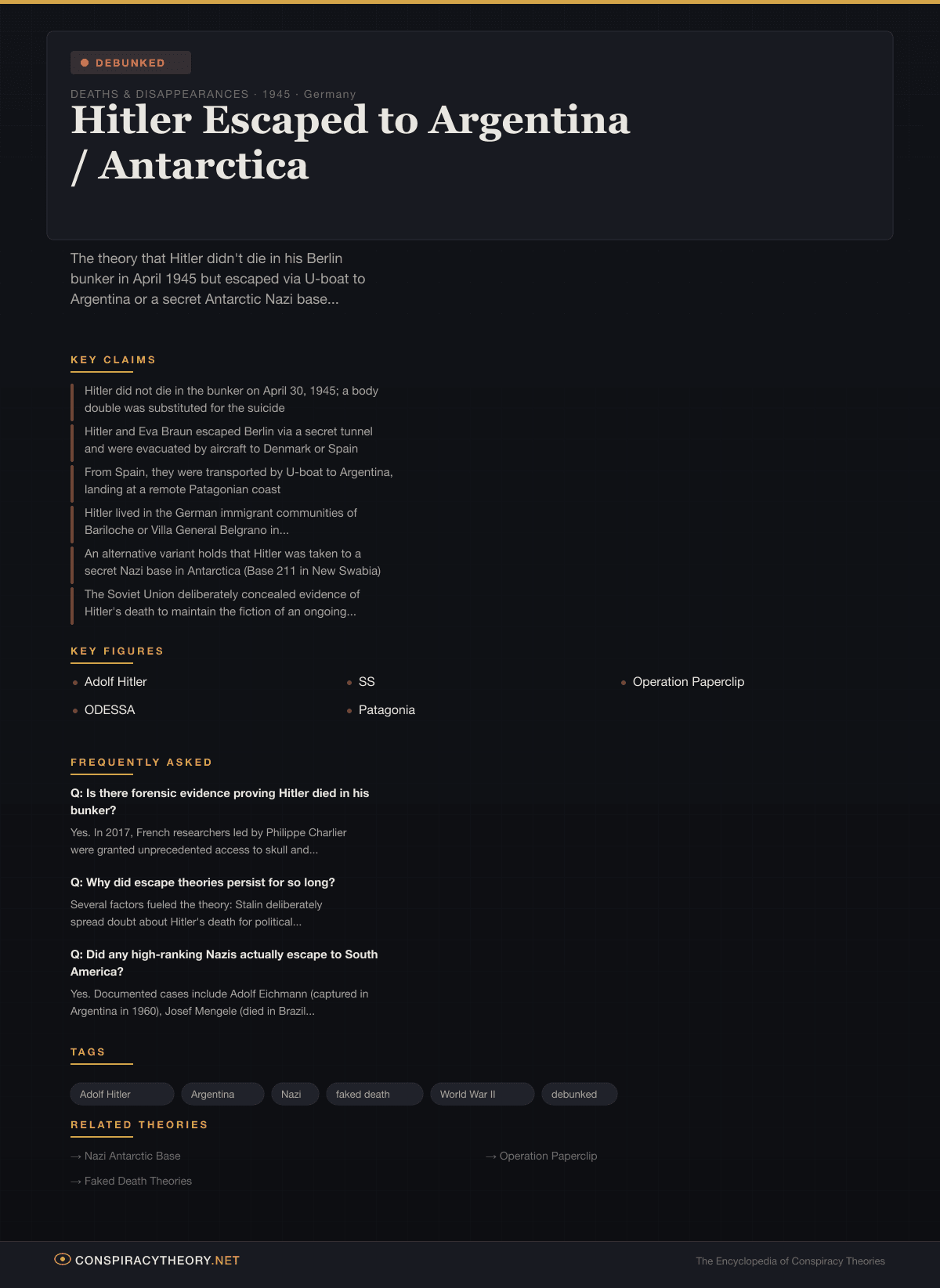
Hitler Escaped to Argentina / Antarctica

Overview
The theory that Hitler didn’t die in his Berlin bunker in April 1945 but escaped via U-boat to Argentina or a secret Antarctic Nazi base (New Swabia/Base 211), living out his life in South America under CIA/SS protection.
Origins & History
The theory that Adolf Hitler survived the fall of Berlin began within days of Germany’s surrender in May 1945 — and its earliest promoter was Joseph Stalin himself.
The official account holds that Hitler and Eva Braun committed suicide in the Fuhrerbunker beneath the Reich Chancellery on April 30, 1945. Hitler shot himself with a Walther PPK 7.65mm pistol; Braun ingested cyanide. Their bodies were carried to the Chancellery garden, doused in gasoline, and burned by SS adjutants Otto Gunsche and Heinz Linge, as Hitler had ordered. Soviet troops overran the Chancellery on May 2 and recovered partially burned remains.
But Stalin chose doubt over certainty. At the Potsdam Conference in July 1945, he told U.S. Secretary of State James Byrnes and British leaders that he believed Hitler was alive and had fled to Spain or Argentina. Whether Stalin genuinely believed this or was sowing disinformation remains debated among historians. Soviet intelligence officer Ivan Klimenko’s team had recovered jawbone fragments and dental bridgework from the Chancellery garden in early May, and Hitler’s personal dentist’s assistant, Kathe Heusermann, positively identified them. Yet the Soviet government kept these findings classified for decades.
The secrecy created a vacuum that speculation filled immediately. In July 1945, even before Japan’s surrender, American newspapers ran headlines questioning Hitler’s death. The U.S. Army’s Counter Intelligence Corps (CIC) and later the FBI investigated hundreds of tips claiming Hitler had been spotted in Argentina, Colombia, Indonesia, and Antarctica. Declassified FBI files — released in batches from the 1990s onward — reveal that the Bureau received over 700 such reports between 1945 and the early 1960s. Director J. Edgar Hoover took some reports seriously enough to forward them to field offices for investigation.
The Argentina variant gained traction from a genuine historical fact: thousands of Nazi war criminals did escape to South America through organized networks. The ODESSA organization (Organisation der ehemaligen SS-Angehorigen) and Catholic Church “ratlines” — facilitated by figures including Bishop Alois Hudal — smuggled war criminals including Adolf Eichmann, Josef Mengele, Klaus Barbie, and Erich Priebke to Argentina, Brazil, Bolivia, and other countries. If Eichmann could live undetected in Buenos Aires for 15 years, the reasoning went, why not Hitler?
The Antarctic variant emerged from the real German Antarctic expedition of 1938-39, which explored the region of Queen Maud Land (dubbed “Neuschwabenland”). Conspiracy theorists elaborated this into a full-scale secret base — “Base 211” — complete with U-boat supply lines and advanced technology. The theory gained a superficial boost from Admiral Richard Byrd’s 1946-47 Operation Highjump, a U.S. naval expedition to Antarctica that theorists recast as a military assault on the hidden Nazi base.
Argentine journalist Abel Basti revived the escape theory in his 2003 book Bariloche Nazi, claiming Hitler lived in the Patagonian resort town of San Carlos de Bariloche until the 1960s. The History Channel’s 2014-2018 series Hunting Hitler brought the theory to a mass American audience, following former CIA agent Bob Baer as he investigated declassified documents and sites in South America.
Key Claims
- Hitler did not die in the bunker on April 30, 1945; a body double was substituted for the suicide
- Hitler and Eva Braun escaped Berlin via a secret tunnel and were evacuated by aircraft to Denmark or Spain
- From Spain, they were transported by U-boat to Argentina, landing at a remote Patagonian coast
- Hitler lived in the German immigrant communities of Bariloche or Villa General Belgrano in Argentina, protected by Juan Peron’s government
- An alternative variant holds that Hitler was taken to a secret Nazi base in Antarctica (Base 211 in New Swabia)
- The Soviet Union deliberately concealed evidence of Hitler’s death to maintain the fiction of an ongoing Nazi threat
- The CIA and/or U.S. intelligence knew Hitler was alive but protected him as part of Cold War arrangements with former Nazi operatives
- The burned remains found in the Chancellery garden belonged to a double, not Hitler
Evidence
The forensic evidence for Hitler’s death in the bunker has strengthened considerably over time. The most significant development came in 2017, when a French team led by forensic pathologist Philippe Charlier was granted access to remains held by Russia’s FSB (Federal Security Service, successor to the KGB) and the Russian State Archive. These included jaw fragments and a skull piece with a bullet hole. Charlier’s analysis, published in the European Journal of Internal Medicine in May 2018, confirmed the teeth matched Hitler’s known dental records — including distinctive bridgework, a prosthetic jaw section, and extensive dental work documented in X-rays taken by Hitler’s dentist Hugo Blaschke. The teeth showed no meat fibers, consistent with Hitler’s well-documented vegetarianism. Bluish deposits on the false teeth were consistent with a chemical reaction between cyanide and the metal of the dental prostheses.
The earlier forensic history is more complicated. In 1945, Kathe Heusermann and dental technician Fritz Echtmann both identified the jaw fragments recovered by Soviet troops as Hitler’s, based on their intimate knowledge of his dental work. Soviet pathologist Faust Shkaravsky performed an autopsy on the remains but the results were classified until journalist Lev Bezymenski published them in 1968. In 1970, KGB chief Yuri Andropov ordered all remaining physical remains (except the jaw fragments and skull piece retained for archives) to be exhumed from their burial site in Magdeburg, East Germany, cremated, and scattered in the Biederitz river — an act that inadvertently fueled conspiracy theories by eliminating the possibility of independent examination.
Against the escape theories, historians note the extreme conditions in Berlin during the final week of April 1945. Soviet forces had encircled the city, artillery bombardment was constant, and every major exit was contested. Multiple bunker witnesses — including Linge, Gunsche, Artur Axmann, Rochus Misch, and pilot Hanna Reitsch — provided consistent accounts of Hitler’s final days, his physical deterioration, and the suicide. Their testimonies were given independently, over decades, to different interrogators and historians, and are broadly consistent in their essential details.
The FBI files, fully digitized and available on the FBI Vault website, reveal that while the Bureau investigated tips diligently, none produced credible evidence of Hitler’s survival. The most detailed investigations — including a 1945 tip about a submarine landing in Argentina — were closed without substantiation.
Cultural Impact
The Hitler escape theory occupies a unique place in conspiracy culture: widely disbelieved but endlessly fascinating. It has been the subject of dozens of books, several television series, and numerous films, from the satirical (Iron Sky, 2012) to the ostensibly investigative (Hunting Hitler, 2014-2018). The History Channel series ran for three seasons and attracted millions of viewers despite being criticized by historians for presenting speculation as investigation.
The theory’s persistence reflects broader unease about accountability for Nazi crimes. The documented escapes of Eichmann, Mengele, Barbie, and others demonstrate that the postwar reckoning was incomplete — that powerful war criminals did evade justice with institutional assistance. The Hitler escape theory extrapolates from this real history to its logical extreme: if the architects of the Holocaust could escape, perhaps the architect-in-chief did too.
In Argentina, the theory intersects with genuine history of Nazi immigration. The German-Argentine communities of Patagonia, the documented sympathies of the Peron government, and the real presence of fugitive Nazis have made the country’s relationship with its wartime past a subject of ongoing public reckoning. Abel Basti’s books, while lacking forensic evidence, have sold widely in the Spanish-speaking world.
The 2018 Charlier study — providing definitive forensic confirmation of Hitler’s death — received extensive global media coverage. Whether it will diminish the theory’s cultural power remains to be seen. As with many conspiracy theories, the question was never really about evidence.
Sources & Further Reading
- Charlier, Philippe, et al. “The Remains of Adolf Hitler: A Biomedical Analysis and Definitive Identification.” European Journal of Internal Medicine 54 (2018): e10-e12.
- Joachimsthaler, Anton. The Last Days of Hitler: The Legends, the Evidence, the Truth. London: Arms & Armour Press, 1996.
- Petrova, Ada, and Peter Watson. The Death of Hitler: The Full Story with New Evidence from Secret Russian Archives. New York: W.W. Norton, 1995.
- Basti, Abel. Bariloche Nazi. Buenos Aires: Editorial Sudamericana, 2003.
- Federal Bureau of Investigation. “Adolf Hitler, Part 01 of 04.” FBI Records: The Vault. vault.fbi.gov.
- Kershaw, Ian. The End: The Defiance and Destruction of Hitler’s Germany, 1944-1945. New York: Penguin Press, 2011.
- Bezymenski, Lev. The Death of Adolf Hitler: Unknown Documents from Soviet Archives. New York: Harcourt, Brace & World, 1968.

Frequently Asked Questions
Is there forensic evidence proving Hitler died in his bunker?
Why did escape theories persist for so long?
Did any high-ranking Nazis actually escape to South America?

Infographic
Share this visual summary. Right-click to save.