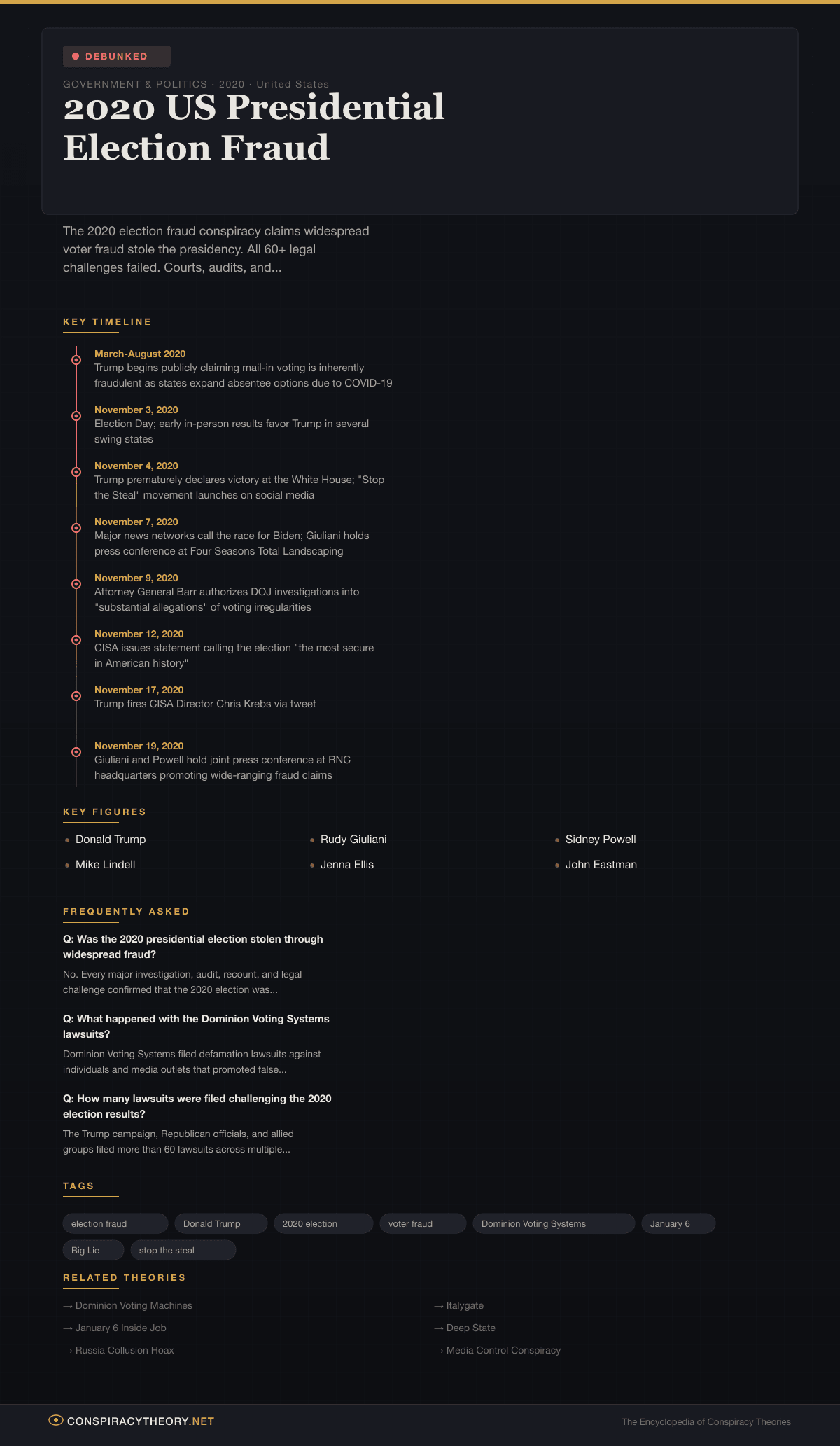
2020 US Presidential Election Fraud

Overview
The 2020 U.S. presidential election fraud conspiracy theory is a collection of false claims alleging that the election between incumbent President Donald Trump and challenger Joe Biden was rigged through widespread voter fraud, manipulated voting machines, illegal ballot dumps, and coordinated interference by election officials. Proponents — led primarily by Trump himself — assert that Trump actually won the election and that Biden’s victory was illegitimate.
Joe Biden won the 2020 election with 306 electoral votes to Trump’s 232, and a popular vote margin of more than seven million votes. Despite this decisive result, Trump refused to concede and launched an unprecedented campaign to overturn the outcome, filing more than 60 lawsuits across battleground states. Nearly all were dismissed or denied by courts at every level of the judiciary, including by judges Trump himself had appointed.
The conspiracy theory has been exhaustively investigated and debunked by federal and state courts, Republican and Democratic election officials, Trump’s own Department of Justice, the Department of Homeland Security’s Cybersecurity and Infrastructure Security Agency (CISA), independent audits, hand recounts, and bipartisan election monitoring organizations. No credible evidence of fraud sufficient to change the outcome has been found in any state.
The theory is classified as debunked based on the unanimous findings of courts, government agencies, bipartisan officials, and independent investigations. It is notable for being one of the most consequential conspiracy theories in American history, having directly contributed to the January 6, 2021, attack on the United States Capitol and fundamentally reshaping American political discourse around election integrity.
Origins & History
Pre-Election Groundwork
The foundation for the 2020 election fraud narrative was laid months before any votes were cast. Beginning in spring 2020, as the COVID-19 pandemic prompted states to expand mail-in voting options, Trump began publicly claiming that mail-in ballots were inherently fraudulent. In a July 2020 tweet, he suggested delaying the election entirely, and repeatedly stated that the only way he could lose would be if the election were “rigged.”
This preemptive framing was significant. Election experts noted at the time that Trump was establishing a narrative in which any outcome other than his victory would be treated as evidence of fraud. The strategy was not entirely new — Trump had made similar claims after the 2016 election, asserting without evidence that millions of illegal votes cost him the popular vote and establishing a short-lived Presidential Advisory Commission on Election Integrity that was dissolved in 2018 after finding no evidence of widespread fraud.
Election Night and the “Red Mirage”
On election night, November 3, 2020, early returns appeared favorable to Trump in several key battleground states, including Pennsylvania, Michigan, Wisconsin, and Georgia. This was widely anticipated by election analysts, who had warned for months about the so-called “red mirage” — the expected pattern in which in-person votes, which skewed Republican, would be counted first, while mail-in ballots, which skewed heavily Democratic due to partisan differences in attitudes toward pandemic-era voting, would take longer to process.
As mail-in ballots were counted over the following days, Biden’s totals steadily increased in the battleground states, ultimately overtaking Trump’s initial leads. This entirely predictable shift — caused by the order in which different types of ballots were counted, not by any irregularity — became a central element of the fraud narrative. Trump and his allies characterized the gradual shifts as suspicious “ballot dumps” that appeared in the middle of the night.
In the early hours of November 4, while millions of legitimate votes remained uncounted, Trump appeared at the White House and falsely declared victory, stating: “Frankly, we did win this election.” He demanded that vote counting be stopped, a request that, if honored, would have disenfranchised millions of American voters. This premature declaration of victory became the launching point for the broader conspiracy theory.
The “Stop the Steal” Movement
Within hours of election night, the phrase “Stop the Steal” became a rallying cry for Trump supporters who believed the election was being stolen in real time. The movement organized rapidly on social media, particularly on Facebook, where a “Stop the Steal” group gained over 300,000 members in less than 24 hours before being removed by the platform for inciting violence.
Protests erupted at vote-counting centers in Arizona, Michigan, Pennsylvania, and other states. In some cases, crowds of Trump supporters gathered outside counting facilities chanting “Stop the count,” while in Arizona — where Trump was initially ahead but losing ground — supporters simultaneously chanted “Count the votes.” The contradictory demands illustrated the outcome-driven rather than process-driven nature of the complaints.
Key Claims
The 2020 election fraud conspiracy encompasses numerous specific claims, most of which have been individually investigated and debunked.
Dominion Voting Systems Manipulation
One of the most prominent claims alleged that Dominion Voting Systems voting machines were programmed to switch votes from Trump to Biden. Attorney Sidney Powell claimed the machines were connected to a Venezuelan conspiracy linked to the late Hugo Chavez, and that algorithms flipped votes in real time. Some versions of the theory incorporated foreign satellites, servers in Germany, and Italian military intelligence (a sub-theory known as “Italygate”). These claims were comprehensively debunked through paper ballot audits that confirmed machine counts, forensic audits of the machines themselves, and the fact that Dominion machines were used in jurisdictions Trump won as well as those he lost.
Fraudulent Mail-In Ballots and “Ballot Dumps”
Proponents claimed that hundreds of thousands of fraudulent mail-in ballots were injected into the count, particularly in heavily Democratic cities like Detroit, Philadelphia, Atlanta, and Milwaukee. Specific allegations included ballots arriving in the middle of the night in suspicious vehicles, poll workers running the same ballots through machines multiple times, and batches of ballots that were 100% for Biden. Investigations found that late-arriving ballot batches were entirely consistent with normal counting procedures, that the vehicles in question were routine ballot transports from satellite locations, and that no batch was 100% for any candidate.
Dead Voters
Claims circulated that thousands of dead people had voted, particularly in states with close margins. Specific names were cited on social media and in legal filings. Investigations by state election officials and journalists systematically examined these claims and found that the vast majority were cases of living voters with similar names to deceased individuals, voters who cast legal absentee ballots before dying, or database matching errors. In every state investigated, the number of confirmed cases of votes cast in the name of deceased persons was negligible — typically in the single digits.
Illegal Observers Excluded
The Trump campaign alleged that Republican poll watchers were systematically excluded from observing the vote count in key cities. In Philadelphia, this claim was directly contradicted in court, where a Trump campaign lawyer acknowledged under oath that Republican observers were, in fact, present in the counting room. Courts in multiple jurisdictions found that both parties had observers present throughout the counting process.
Statistical Anomalies
Various claims of statistical impossibilities were promoted, including assertions that Biden’s vote totals violated Benford’s Law (a mathematical principle about the distribution of leading digits), that vote-count curves showed unnatural spikes, and that Biden’s results were statistically impossible given his underperformance in bellwether counties. Statisticians and election analysts debunked each of these claims, noting that Benford’s Law does not apply to election data in the manner alleged, that vote spikes corresponded to normal batch reporting, and that the bellwether county theory is a pattern-matching exercise without predictive validity.
State-Specific Claims
Each contested state generated its own set of specific claims. In Georgia, allegations focused on a disputed video from State Farm Arena that purportedly showed suitcases of ballots being pulled from under a table after observers left. Multiple investigations, including a review by the Georgia Bureau of Investigation, found the video showed standard ballot containers being processed through normal procedures. In Michigan, claims centered on a batch of votes in Antrim County that initially showed incorrect results due to a human error in ballot programming — an error that was caught during routine canvassing and corrected, with the final certified results being accurate. In Arizona, claims about Sharpie markers being distributed to Trump voters to invalidate their ballots (dubbed “Sharpiegate”) were debunked by election officials who confirmed that Sharpie markers are the recommended writing instrument for ballots and do not cause them to be rejected.
Legal Challenges
The legal campaign to overturn the 2020 election was historically unprecedented in its scope and in its lack of success.
Scope of Litigation
Between November 2020 and January 2021, the Trump campaign, Republican officials, allied attorneys, and outside groups filed more than 60 lawsuits in state and federal courts across Arizona, Georgia, Michigan, Nevada, Pennsylvania, Wisconsin, and other states. The cases sought various forms of relief, from blocking certification of results to invalidating specific categories of ballots to overturning entire state outcomes.
Judicial Outcomes
Nearly every case was dismissed, denied, or withdrawn. Courts found repeatedly that the plaintiffs failed to present credible evidence of fraud. Several notable judicial opinions were sharply worded in their rejection:
- Judge Matthew Brann (U.S. District Court, Pennsylvania, a Republican appointee) wrote that the Trump campaign’s case was based on “strained legal arguments without merit and speculative accusations” and that granting the requested relief would “disenfranchise almost seven million voters.”
- Judge Stephanos Bibas (Third Circuit Court of Appeals, a Trump appointee) wrote: “Free, fair elections are the lifeblood of our democracy. Charges of unfairness are serious. But calling an election unfair does not make it so. Charges require specific allegations and then proof. We have neither here.”
- The U.S. Supreme Court declined to hear the cases on two occasions, including a lawsuit filed by the state of Texas seeking to invalidate results in four other states — a case rejected for lack of standing.
The Giuliani and Powell Legal Strategy
Rudy Giuliani and Sidney Powell led the most publicly visible legal efforts. Giuliani held a widely covered press conference at Four Seasons Total Landscaping in Philadelphia on November 7, 2020, and later held a press conference at the Republican National Committee headquarters where he appeared to have hair dye running down his face. Powell promoted increasingly elaborate theories involving Venezuelan voting machines and foreign interference, eventually becoming so extreme that the Trump campaign distanced itself from her in late November 2020.
Both Giuliani and Powell faced serious professional consequences. Giuliani had his New York law license suspended in 2021 and was ultimately disbarred in 2024. Powell pleaded guilty to reduced charges in the Georgia election interference case in 2023. Jenna Ellis, another Trump campaign lawyer, also pleaded guilty in the Georgia case and had her Colorado law license suspended.
Evidence & Debunking
Official Audits and Recounts
Multiple states conducted audits, recounts, and hand counts that confirmed the original results:
- Georgia conducted a full hand recount of all approximately five million ballots, confirming Biden’s victory. A subsequent machine recount also confirmed the result. The margin shifted by only a few hundred votes.
- Wisconsin conducted a partial recount in Milwaukee and Dane counties (requested and paid for by the Trump campaign at a cost of approximately $3 million) that actually increased Biden’s margin slightly.
- Arizona was subjected to a controversial audit conducted by Cyber Ninjas, a firm with no prior election auditing experience hired by the Republican-controlled state Senate. Even this partisan audit, which took months and cost taxpayers millions, ultimately confirmed that Biden had won Arizona — in fact finding that he received 99 more votes than the official count and Trump received 261 fewer.
- Michigan conducted a thorough audit of the Antrim County results, which confirmed Biden’s statewide victory and attributed the initial reporting error to a human mistake in ballot programming.
Trump Administration Officials
Key officials within Trump’s own administration publicly rejected the fraud claims:
- Attorney General William Barr stated in December 2020 that the Department of Justice had investigated allegations of fraud and “to date, we have not seen fraud on a scale that could have affected a different outcome in the election.”
- Chris Krebs, Director of CISA and a Trump appointee, issued a statement calling the 2020 election “the most secure in American history.” Trump fired Krebs via tweet shortly after. Krebs stood by his assessment.
- Acting Defense Secretary Christopher Miller and the Joint Chiefs of Staff affirmed that the military’s role was to support and defend the Constitution, not to intervene in election disputes.
Bipartisan Consensus
Republican election officials in key states defended the integrity of their elections:
- Brad Raffensperger, Georgia’s Republican Secretary of State, resisted intense pressure from Trump — including a recorded phone call in which Trump asked him to “find 11,780 votes” — and certified Biden’s victory.
- Governor Brian Kemp of Georgia, a Republican and Trump ally, certified the state’s results.
- Governor Doug Ducey of Arizona, a Republican, certified Biden’s victory while on a phone call from the White House.
- Republican Secretaries of State in numerous states affirmed that their elections were conducted fairly and securely.
January 6 Connection
The 2020 election fraud conspiracy theory was the direct catalyst for the January 6, 2021, attack on the United States Capitol.
On that date, Congress was meeting in a joint session to certify the Electoral College results. Trump held a rally near the White House, telling thousands of supporters that the election had been stolen and urging them to march to the Capitol and “fight like hell.” A large crowd subsequently breached the Capitol building, forcing lawmakers to evacuate and disrupting the certification process for several hours. Five people died in connection with the events, and approximately 140 police officers were injured.
The House Select Committee to Investigate the January 6th Attack on the United States Capitol conducted an extensive investigation over 18 months, holding public hearings and interviewing over 1,000 witnesses. The committee concluded that the attack was a direct result of Trump’s false claims about election fraud and his efforts to overturn the election. The committee referred Trump to the Department of Justice on multiple criminal charges.
Trump was subsequently indicted by Special Counsel Jack Smith on federal charges related to his efforts to overturn the election, including conspiracy to defraud the United States and conspiracy to obstruct an official proceeding. He was also indicted in Fulton County, Georgia, on state charges related to his efforts to overturn Georgia’s election results. Multiple co-defendants in both cases pleaded guilty or cooperated with prosecutors.
Dominion Lawsuits
Dominion Voting Systems pursued aggressive defamation litigation against individuals and media organizations that promoted false claims about its voting machines.
Fox News Settlement
The most significant case was Dominion’s $1.6 billion defamation lawsuit against Fox News. During pre-trial discovery, internal communications revealed that Fox News hosts and executives privately acknowledged the fraud claims were false while continuing to promote them on air. Text messages showed hosts like Tucker Carlson, Sean Hannity, and Laura Ingraham expressing disbelief in the claims they were broadcasting to millions of viewers. Rupert Murdoch, Fox Corporation chairman, acknowledged in a deposition that some Fox News hosts had “endorsed” the false claims.
In April 2023, Fox News settled the lawsuit for $787.5 million — one of the largest media defamation settlements in American history. Fox did not issue an on-air apology or admission of wrongdoing, but the settlement amount was widely interpreted as an acknowledgment of the strength of Dominion’s case.
Other Dominion Cases
Dominion also filed lawsuits against Sidney Powell (settled for an undisclosed amount), Rudy Giuliani, Mike Lindell, Newsmax (settled for $40 million), and One America News Network. A separate voting technology company, Smartmatic, also filed a $2.7 billion defamation lawsuit against Fox News and several of the same individuals. These cases collectively established significant legal precedent regarding the consequences of broadcasting demonstrably false claims about election infrastructure.
Cultural Impact
The 2020 election fraud conspiracy has had a profound and lasting impact on American political culture and democratic institutions.
Erosion of Electoral Trust
Polling consistently showed that a significant percentage of Republican voters believed the 2020 election was stolen. A January 2021 poll found that 70% of Republicans did not believe Biden had been legitimately elected. These numbers remained remarkably persistent over time, with surveys in subsequent years showing only modest declines. The persistence of this belief, despite the complete absence of supporting evidence, represented a historically unusual level of distrust in democratic institutions.
Election Denial as Political Identity
The conspiracy theory gave rise to a broader “election denial” movement that extended beyond the 2020 race. Candidates who embraced Trump’s stolen election claims ran for offices at every level of government, including for positions overseeing elections such as Secretary of State. While most high-profile election deniers lost their races in the 2022 midterm elections, the movement remained a significant force within Republican primary politics.
Legislative Consequences
The fraud narrative provided the justification for a wave of new voting restriction laws in Republican-controlled state legislatures. Between 2021 and 2023, at least 30 states enacted new laws tightening voter identification requirements, restricting mail-in voting, limiting drop boxes, and implementing new rules for ballot counting and election certification. Proponents cited election security concerns rooted in the fraud narrative, while critics argued the laws were designed to suppress voter turnout among Democratic-leaning demographics.
Media and Information Ecosystem
The conspiracy theory accelerated the fragmentation of the American media landscape. Audiences that believed the fraud narrative migrated toward media outlets that reinforced their views, while mainstream and traditional conservative media that reported the claims were false faced audience backlash. The Dominion lawsuits and their outcomes demonstrated the legal risks of amplifying demonstrably false claims, potentially influencing editorial decisions at major media organizations.
Impact on Election Workers
A particularly significant consequence was the wave of threats and harassment directed at election workers, poll workers, and election officials — many of them volunteers — who were accused of participating in the alleged fraud. Numerous election officials reported receiving death threats, and many resigned from their positions, raising concerns about the future of election administration.
Timeline
- March-August 2020 — Trump begins publicly claiming mail-in voting is inherently fraudulent as states expand absentee options due to COVID-19
- November 3, 2020 — Election Day; early in-person results favor Trump in several swing states
- November 4, 2020 — Trump prematurely declares victory at the White House; “Stop the Steal” movement launches on social media
- November 7, 2020 — Major news networks call the race for Biden; Giuliani holds press conference at Four Seasons Total Landscaping
- November 9, 2020 — Attorney General Barr authorizes DOJ investigations into “substantial allegations” of voting irregularities
- November 12, 2020 — CISA issues statement calling the election “the most secure in American history”
- November 17, 2020 — Trump fires CISA Director Chris Krebs via tweet
- November 19, 2020 — Giuliani and Powell hold joint press conference at RNC headquarters promoting wide-ranging fraud claims
- November 25, 2020 — Trump campaign distances itself from Sidney Powell
- November 19-30, 2020 — Georgia completes full hand recount of approximately five million ballots; confirms Biden victory
- December 1, 2020 — Barr tells the Associated Press that DOJ found no evidence of widespread fraud
- December 8, 2020 — Safe harbor deadline passes with Biden holding 306 electoral votes
- December 11, 2020 — U.S. Supreme Court rejects Texas lawsuit seeking to invalidate results in four states
- December 14, 2020 — Electoral College formally casts votes; Biden receives 306
- January 2, 2021 — Trump calls Georgia Secretary of State Raffensperger, asking him to “find 11,780 votes” (call is recorded)
- January 6, 2021 — Trump holds rally; supporters attack the Capitol; Congress evacuated; certification delayed but completed early January 7
- January 20, 2021 — Biden inaugurated as 46th President; Trump does not attend
- June 2021 — Giuliani’s New York law license suspended
- September 2021 — Arizona Cyber Ninjas audit confirms Biden’s victory
- April 2023 — Fox News settles Dominion lawsuit for $787.5 million
- August 2023 — Trump indicted by Special Counsel Jack Smith on federal charges related to efforts to overturn the election
- August 2023 — Trump and 18 co-defendants indicted in Fulton County, Georgia, on state RICO charges
- October 2023 — Sidney Powell pleads guilty in Georgia case
- July 2024 — Federal case against Trump effectively paused following Supreme Court presidential immunity ruling
Sources & Further Reading
- Select Committee to Investigate the January 6th Attack on the United States Capitol. Final Report. U.S. Government Publishing Office, 2022
- Rutenberg, Jim, Jo Becker, Eric Lipton, Maggie Haberman, Jonathan Martin, Matthew Rosenberg, and Michael S. Schmidt. “77 Days: Trump’s Campaign to Subvert the Election.” The New York Times, January 31, 2021
- Cybersecurity and Infrastructure Security Agency. “Joint Statement from Elections Infrastructure Government Coordinating Council & the Election Infrastructure Sector Coordinating Executive Committees.” November 12, 2020
- Bauer, Bob, and Benjamin L. Ginsberg. “Report of the Presidential Commission on Election Administration.” 2014 (foundational context for U.S. election administration)
- Associated Press. “Barr: No Evidence of Fraud That’d Change Election Outcome.” December 1, 2020
- Dominion Voting Systems v. Fox News Network, LLC. Delaware Superior Court, Case No. N21C-03-257
- Trump v. Raffensperger. Audio recording released by The Washington Post, January 3, 2021
- Hasen, Richard L. Cheap Speech: How Disinformation Poisons Our Politics — and How to Cure It. Yale University Press, 2022
- Pildes, Richard H. “The Legal Challenges to the 2020 Election.” Harvard Law Review Forum, 2021
- Becker, David, and Jennifer Morrell. The Big Truth: Upholding Democracy in the Age of “The Big Lie.” Diversion Books, 2022
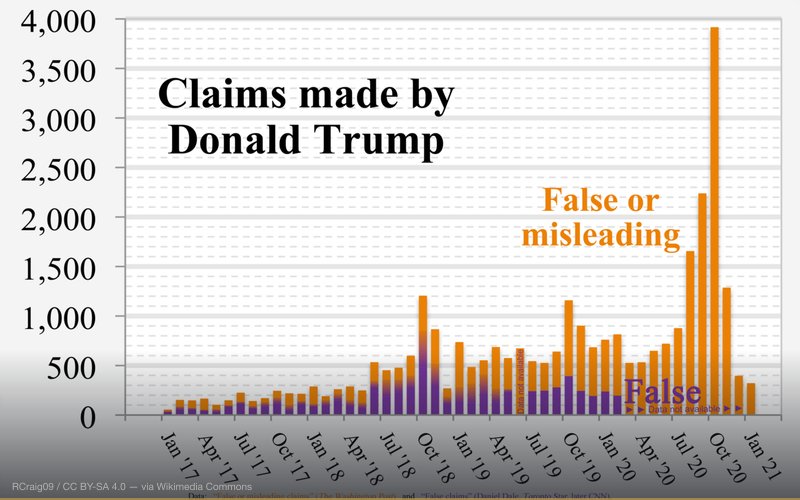
Frequently Asked Questions
Was the 2020 presidential election stolen through widespread fraud?
What happened with the Dominion Voting Systems lawsuits?
How many lawsuits were filed challenging the 2020 election results?
Infographic
Share this visual summary. Right-click to save.